Your fuel bill went up again. Your drivers are zigzagging across town. And you spent the first two hours of today assigning stops by hand instead of running your business. Delivery route optimization is supposed to fix all of this. But the wrong tool just moves the bottleneck somewhere else.
Here is how to tell whether your setup is actually saving you money — and what to change if it is not.
What Most Dispatch Tools Get Wrong
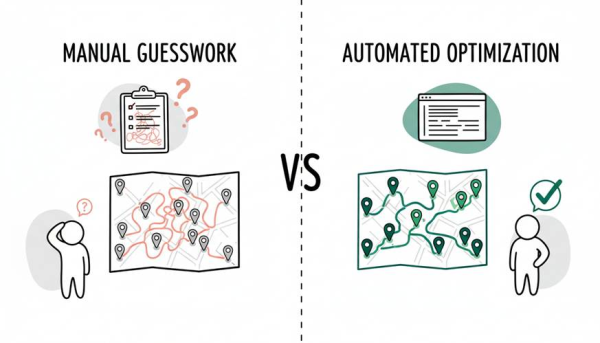
Most delivery scheduling software treats dispatch like a to-do list. You get a list of stops, a map, and a “good luck.” The dispatcher still decides which driver takes what. Still guesses at the best order. Still has no idea if a driver is stuck in traffic or sitting idle three blocks from the next stop.
That is not optimization. That is a digital clipboard.
The gap shows up fast. Late deliveries pile up. Your best drivers burn out hauling the heaviest loads. Your newest drivers take the longest routes because nobody balanced the work. Meanwhile, you are paying for every wasted mile.
What a Real Optimization Tool Actually Does
Not all delivery dispatch software is built the same. These are the capabilities that separate tools built for fleet operations from glorified map apps:
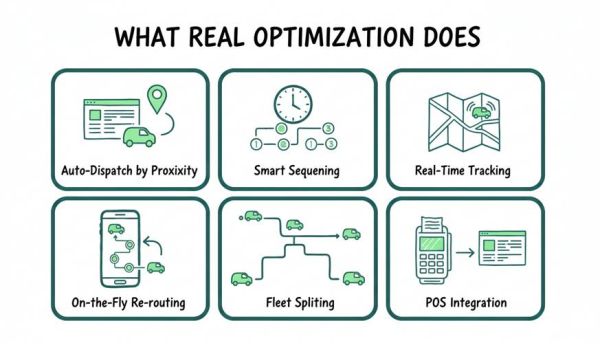
Automated Dispatch Based on Proximity and Capacity
The system assigns each stop to the nearest available driver who can handle it. No manual sorting. No guessing. You drop in orders and routes go out to the right drivers automatically.
Route Sequencing with Time Windows and Traffic
Stop order matters. A tool that ignores delivery windows or rush-hour patterns gives you routes that look efficient on paper but fall apart on the road. The right delivery software reorders stops around real constraints.
Real-Time Driver Tracking for Dispatchers
You need to see every vehicle on a live map. Not where they were 10 minutes ago. When a customer calls asking where their order is, you should have the answer in two seconds, not two phone calls.
A Driver App with On-the-Fly Re-Optimization
Drivers hit road closures, parking problems, and no-shows. They need to re-sequence remaining stops from the road without calling dispatch. If the driver has to phone in every change, your operation does not scale.
Multi-Driver Route Splitting Across the Fleet
Fifty stops should not mean one overloaded driver. The tool should split work across your team by zone, capacity, and shift length — in one step.
Integration with Your Ordering and POS Systems
Manual order entry kills speed. When a new order drops in your POS, it should flow straight into dispatch. Every copy-paste step is a delay and a potential error.
Habits That Multiply Your Savings
The tool does the heavy lifting. These habits make sure you get the full return.
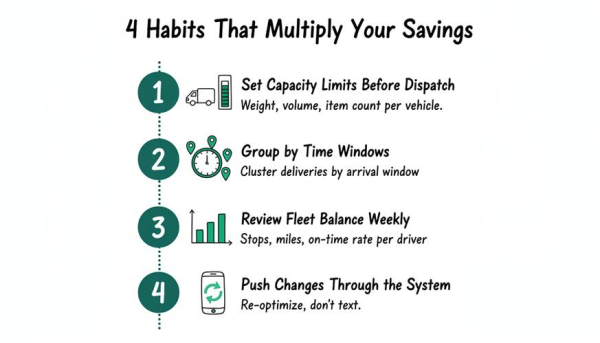
Set capacity limits before dispatch runs. Weight, volume, item count — define them per vehicle. Automated dispatch only works if it knows your constraints. Skip this and you end up with a sedan assigned 40 catering trays.
Use time-window grouping to reduce idle time. Cluster deliveries by their required arrival window, then let the optimizer sequence within each cluster. This prevents drivers from rushing across town to make one tight window while five flexible stops sit nearby.
Review your fleet balance weekly. Pull each driver’s total stops, total miles, and on-time rate. If one driver consistently runs 30 percent more miles than the rest, your load balancing needs tuning. Good delivery software gives you these reports without a spreadsheet.
Push same-day changes through the system, not through texts. When orders cancel or new ones come in mid-shift, update the dispatch tool. Let it re-optimize. A group text to your drivers creates confusion. A re-optimized route on their app creates clarity.
Your Competitors Already Did This
Fuel accounts for roughly a quarter of delivery operating costs. A 20 percent reduction in total miles driven saves a five-vehicle fleet thousands of dollars per year. That is money your competitors are already keeping.
But the cost gap is not just fuel:
- It is the dispatcher you freed up from four hours of manual work per day
- It is the 15 percent bump in on-time delivery that stops customer churn
- It is taking on 20 more orders a day without adding a single driver
Every week you run manual dispatch, the gap between your operation and an optimized one gets wider. The math does not get friendlier with time.