A closer look at what artificial intelligence is actually changing, what it cannot replace, and how smart professionals are using both to stay ahead in search.

There is a conversation happening across every digital marketing agency, every content studio, and every freelance writing community right now, and it centers on one unavoidable question: is artificial intelligence an ally or a threat to the professionals who build their careers around words and rankings? The honest answer sits somewhere more nuanced than either camp would like to admit.
Over the past three years, AI tools have moved from experimental curiosities to production-grade instruments used daily across the industry. Platforms that once promised to automate writing entirely have since learned a harder lesson: search engines reward depth, originality, and genuine human perspective, none of which an algorithm produces on its own. That realization has not slowed AI adoption. Instead, it has reshaped the role AI plays, shifting from replacement to acceleration.
For those working at the intersection of search strategy and written content, the shift is already visible. Agencies like SEOZilla.ai have built entire service models around this new reality: pairing human editorial judgment with intelligent tooling to produce content that ranks because it genuinely serves the reader, not because it games a keyword formula.
The Shift That Actually Happened
If you followed the AI writing conversation in 2022 and 2023, you heard two dominant narratives. The first said AI would eliminate the need for human writers entirely within eighteen months. The second said AI content was so obviously mechanical that Google would immediately penalize it into oblivion. Both turned out to be wrong in interesting ways.
What actually happened was more gradual and more instructive. AI tools became genuinely useful for specific parts of the content production process: outlining, keyword clustering, meta description drafts, internal linking suggestions, and first-pass structural drafts that a human writer could then reshape into something worth reading. The professionals who adapted quickly understood that AI does not write; it generates. The difference matters enormously in a field where nuance, voice, and lived experience determine whether a reader trusts what they find.
What AI Has Changed for Search Content
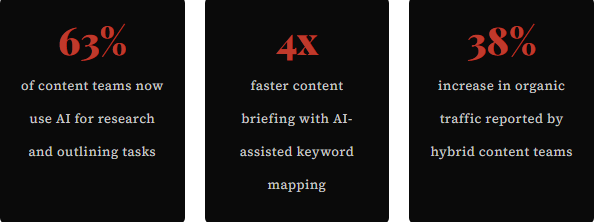
The most concrete change has been in speed and scale. A skilled writer who once needed four hours to research, outline, and draft a 1,200-word article can now complete a comparable piece in half that time, provided they are using AI responsibly: as a scaffold, not a substitute. That productivity gain has changed client expectations, pricing conversations, and the competitive dynamics of content agencies globally.
Speed without substance is noise. The writers who thrive are those who use AI to move faster without surrendering the editorial instincts that make content worth reading.
Search intent analysis has also become dramatically more accessible. Understanding not just what someone searches, but why they search it, has always separated good SEO content from average SEO content. AI tools trained on large search datasets can now surface intent clusters, identify content gaps, and map topical authority opportunities far faster than any manual research process. That capability used to require expensive enterprise tools or senior-level analytical work. Now it is within reach of independent writers and small teams.

Where Human Skill Still Wins
Google’s Helpful Content guidance and its evolving E-E-A-T framework have made one thing clear: experience, expertise, authoritativeness, and trustworthiness cannot be simulated convincingly at scale. A piece of content that demonstrates genuine subject matter experience reads differently from one that has been assembled from patterns in a training dataset. Readers feel the difference. So do ranking algorithms that now incorporate behavioral signals alongside traditional on-page factors.
This is where professional seo content writers hold an enduring advantage. The ability to speak from a position of real knowledge, to choose the precise word that captures a complicated idea, to know when a statistic needs context and when it speaks for itself: these are judgment calls rooted in human experience. AI can draft a sentence about how enterprise procurement decisions work. A writer who has actually worked in enterprise procurement will write a sentence that a decision-maker recognizes as true.
The practical implication: AI is most valuable in the parts of content production that do not require lived experience. Research aggregation, structural templates, on-page optimization checks, and distribution scheduling are all legitimate AI territories. The substance, voice, and editorial direction of quality content still belong to humans who understand their subject and their reader.
The Skills That Matter More Now, Not Less
A counterintuitive outcome of AI adoption in content has been a renewed appreciation for certain foundational writing skills. When AI handles the mechanical parts of content creation, the differentiating value of what humans bring becomes more visible, not less.
- Editorial judgment: Knowing which angle to take on a topic, which examples will resonate with a specific audience, and which claims need more evidence before they earn trust.
- Audience empathy: Understanding not just search intent in the abstract, but the actual concerns, frustrations, and goals of the person typing that query at a specific moment in their journey.
- Brand voice consistency: Maintaining a distinctive, recognizable voice across hundreds of pieces of content while adapting tone, depth, and format to different contexts and platforms.
- Strategic content architecture: Designing how individual pieces of content connect, support each other, and collectively build the topical authority that earns sustained organic visibility.
- Fact-checking discipline: AI tools are confidently wrong with unsettling frequency. The writer who verifies rather than accepts is worth considerably more than one who does not.
A Profession Reshaped, Not Replaced
The most accurate way to describe what AI has done to the SEO content writing industry is this: it has raised the floor while raising the ceiling. Mediocre content that relied on keyword density and thin information has become easier to produce and easier to spot. Genuinely useful, well-researched, expertly written content that satisfies both search algorithms and actual human readers has become more valuable precisely because the baseline has shifted upward.
For brands and businesses navigating this landscape, the strategic implication is straightforward. Investing in content quality is not in tension with using AI tools. The two are complementary when the decision-making about what to write, why to write it, and how to write it for a specific audience remains in human hands. Automating judgment is where content strategies fall apart.
The professionals and agencies thriving in this environment are those who treat AI as a skilled assistant rather than an autonomous producer. They use it to move faster through tasks that do not require expertise, and they preserve human creative energy for the decisions that actually determine whether a piece of content earns trust, ranks with authority, and converts a reader into a customer.
That balance, between speed and substance, between efficiency and editorial integrity, is what separates the content operations that grow with AI from those that get commoditized by it. Skilled seo content writers who understand this distinction are not worried about automation. They are using it