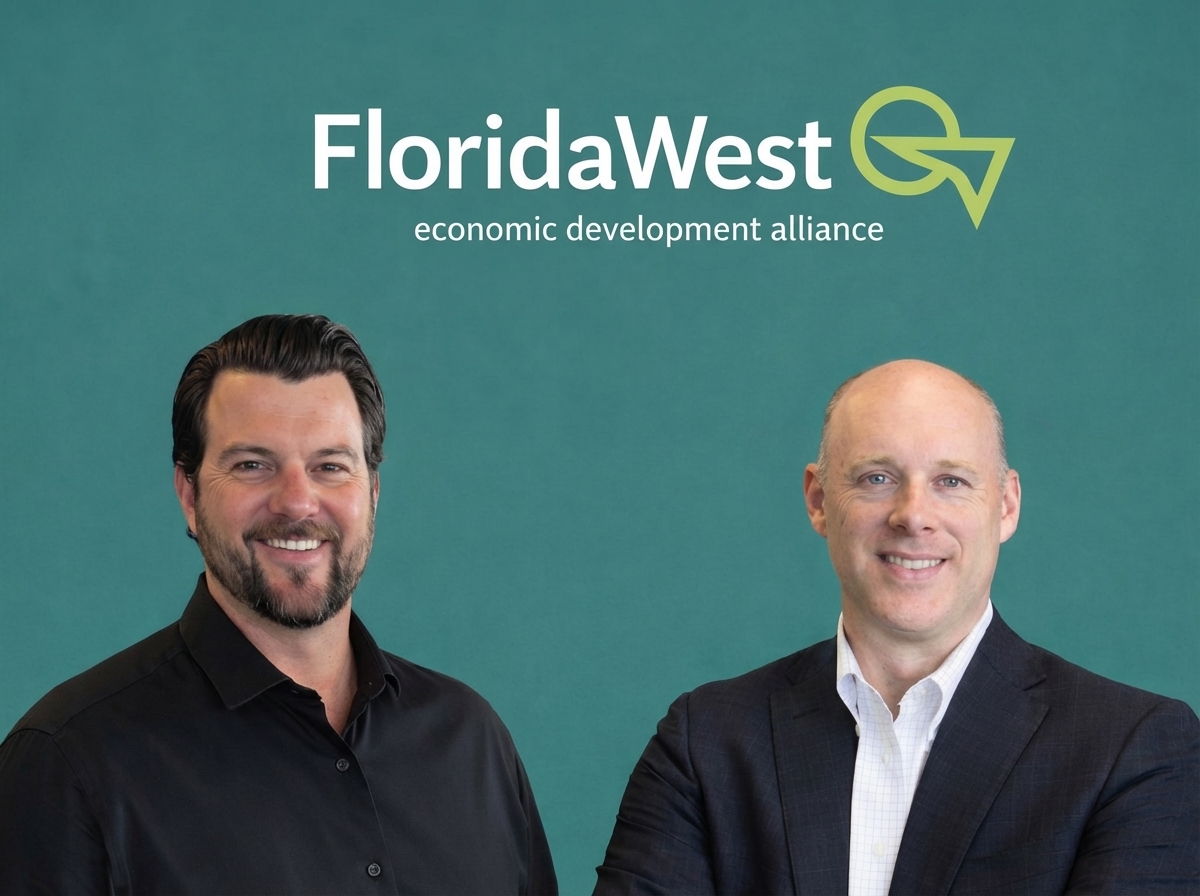
Chris Platé outlines site inventory, infrastructure priorities, and recent wins including Field International headquarters relocation in Beyond the Build podcast.
PENSACOLA, Fla. – Chris Platé, Chief Executive Officer of Florida West Economic Development Alliance, detailed Escambia County’s strategic economic development priorities during a recent podcast interview, highlighting focus areas in aerospace and aviation, medical and life sciences, marine and maritime, and cyber and defense sectors.
Speaking on Beyond the Build podcast with host Kelvin Enfinger Jr., Platé outlined how nearly 30 years of economic development experience across North and South Carolina informed his approach to positioning Pensacola for transformational industrial growth.
Strategic Industry Focus
Platé described the economic development strategy as “four legs of the stool,” targeting specific industry clusters where Pensacola demonstrates competitive advantages. “We’re probably not the strongest for logistics just because we don’t have a lot of bodies, a fairly reasonable low unemployment rate, nor a lot of sites on our interstates,” Platé explained. “It makes sense to use those sites for more high-value projects.”
The focused approach has delivered recent wins including Field International’s decision to relocate its global headquarters from the United Kingdom to Pensacola. The aerospace MRO supplier serves major manufacturers including Airbus, Boeing, and ST Engineering. “That company is so family focused and family oriented. They moved their entire headquarters from the United Kingdom to Pensacola because it fit with what they wanted,” Platé said.
Site Readiness Inventory
Platé detailed current shovel-ready and near-ready site inventory across Escambia County. The 9-acre Pensacola Technology Campus downtown offers turnkey development with 12-15 megawatts of power capacity for multi-story buildings. Midtown Industrial Park, a former brownfield, provides nearly shovel-ready space pending infrastructure optimization.
Central Commerce Park represents the largest opportunity: 240 acres with 230 developable acres located 15 minutes north of Interstate 10. “That is a very unique gift to have that land sitting there between two interstates,” Platé noted, referencing proximity to both I-10 and I-65.
Additional sites include Outlying Field 8, a former Navy training field offering 165 acres pending final negotiations, and The Bluffs providing barge access for maritime operations.
Project Maeve Maritime Initiative
The recently announced Project Maeve at the Port of Pensacola, potentially bringing 2,000 jobs in maritime manufacturing, positions the region for significant supply chain development. Platé emphasized maritime’s reliance on skilled welding and metalworking creates workforce training opportunities where Northwest Florida already has capacity.
“Maritime has not progressed to advanced manufacturing quite as much as the other industries have,” Platé explained. “Welding, they’ve got to get in all these nooks and crannies and do the art of welding. You really can’t automate that with robotics the way you could with automotive or aerospace.”
Infrastructure Priorities
When asked to identify one infrastructure priority, Platé emphasized heavy infrastructure development for Central Commerce Park. “I would definitely look at the larger infrastructure needs for Central Commerce Park to get heavier infrastructure up in the middle part of the county,” he stated.
Energy capacity remains critical across all development sites. “We clearly need energy like everybody, whether it’s we’re not trying to find large data centers, but even small data centers are out there and a small one could be $200 million,” Platé noted.
Economic Development Process
Platé described how economic development deals actually close, dispelling romanticized notions about the process. “It’s not fluff like it used to be 20, 30 years ago,” he explained. Companies conduct extensive research across multiple states and counties before narrowing selections.
“Once that occurs, then you’re in the mix. It’s usually a large net. They’re throwing out multiple states, multiple counties per state. And then you better have your materials ready, accurate, and succinct for what they want,” Platé said.
Funding Structure
Florida West EDA receives funding primarily from Escambia County and the City of Pensacola through the Pensacola Escambia Promotion and Development Commission (PEDC), a state-formed entity established in 1967. Private sector contributions complement public funding. “We’re like a business to the county and the city, and the projects that we win and generate property tax. That property tax should exceed our funding,” Platé explained.
Pipeline Projects
Platé indicated several projects under consideration including “a very strong life science project” for Tech Park potentially serving as an anchor tenant, local energy company expansion and diversification, and additional aerospace opportunities. “That’s what we want is that diversity. So if one cluster gets hurt, the others will hopefully remain strong,” he stated.
Florida West EDA serves Escambia County including the City of Pensacola and the Town of Century. For more information, visit FloridaWestEDA.com.
Listen to Beyond the Build – here.