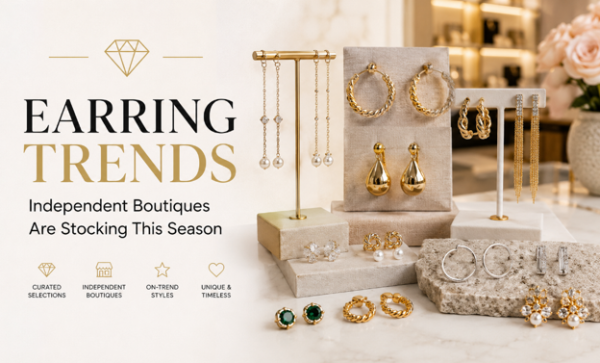
Earring Trends Independent Boutiques Are Stocking This Season
Ask a boutique owner what sells fastest off the case and you’ll get the same answer more often than not: earrings. They’re the easiest entry point for a customer who isn’t ready to commit to a $2,000 necklace, and they turn over quickly enough that a store’s earring wall can look completely different every few months without much risk. That makes them one of the more interesting categories to watch if you’re trying to read where retail jewelry is heading.
Hoops keep winning, but the sizing has shifted
Hoops never really left, but the sizes boutiques are reordering have moved. A few seasons ago it was all about the oversized statement hoop, the kind you could see from across a room. That’s cooled off a bit. What’s replacing it is a mid-size hoop, somewhere between 20 and 30mm, that works for daily wear without looking like a costume piece. Retailers who stocked heavily in the giant hoops last year have been quietly rebalancing toward this middle range, and a few store owners mentioned they’re now carrying two or three weight variations of the same hoop style rather than one.
Huggies as the daily driver
The huggie hoop, small, close to the earlobe, low profile, has become something close to a staple rather than a trend. It’s the piece a lot of customers buy as a “wear every day and forget about it” item, which makes it a strong stocking choice because it doesn’t compete with someone’s existing jewelry the way a bigger statement piece might. Stores that carry a solid range of 14 karat gold earrings wholesale in huggie styles have reported steady, unglamorous, reliable sell-through. Not exciting to talk about, but exactly the kind of inventory that keeps a case profitable between the flashier seasonal pushes.
Asymmetry, but only a little
There’s a small but persistent trend toward mismatched or asymmetric earring pairs, one shape on the left, a different but complementary shape on the right. It’s not for every customer, and most boutiques aren’t betting the whole case on it, but a few pieces in this style tend to draw attention and conversation, which has value even beyond direct sales. It gets people picking things up and trying them on, and that’s often how a customer ends up leaving with something else entirely.
Colored stones are creeping back into gold settings
For a while, minimalist plain gold dominated almost every case. That’s loosening a bit. Small colored stone accents, sapphires, garnets, the occasional emerald chip, are showing up more in earring settings, especially in stud and drop styles. It gives a retailer a way to offer something with a bit more personality without jumping all the way into full gemstone jewelry, which carries a different price point and different customer entirely.
What this means for restocking
If there’s a common thread across these shifts, it’s that customers want variety within a narrower size and weight range rather than wanting bigger, bolder, more expensive pieces across the board. That’s actually good news for smaller boutiques working with tighter budgets. It means a well-curated case with a handful of solid, wearable styles can outperform a case stuffed with statement pieces that only a fraction of customers will actually buy.
For store owners planning their next order, the practical takeaway is to lean into depth over breadth in a few core styles rather than chasing every micro-trend that shows up on social media. A tight selection of huggies, mid-size hoops, and a few stud options with subtle stone accents will likely outsell a case that tries to cover every possible look. Sourcing consistently from a supplier who can restock the same styles reliably matters here too, since the whole strategy depends on not running out of the pieces that are actually moving.
Boutiques that have leaned into this approach say the biggest shift in their buying has been ordering smaller quantities more frequently rather than one large seasonal order. It keeps the case feeling current and reduces the risk of getting stuck with a style that cools off faster than expected. Whether that becomes the standard approach across the industry or just a response to a particularly unpredictable retail environment right now is hard to say.
Either way, it’s changing how independent stores think about their earring inventory, and it’s worth watching over the next couple of seasons. A few store owners even said they’ve started treating earrings almost like a separate mini-business inside the shop, tracked and reordered on its own faster cycle rather than folded into a broader jewelry order. That kind of granular attention would have seemed excessive a few years ago. Right now it looks like exactly the right instinct.