Kamal Naghili
[Department], Nakhchivan State University, Nakhchivan, Azerbaijan
Purpose: Governments keep building technoparks, yet the evidence that they work is patchier than the enthusiasm around them would suggest. This review asks what research actually shows about their effect on innovation, entrepreneurship, technology development and economic growth, and when those effects show up.
Design/methodology/approach: Integrative review of peer-reviewed research from 1990 to 2025, conducted according to a structured methodology. Four frequently cited review papers were taken as a base for the analysis. This base was expanded via keyword searching and citation chaining. Fourteen empirical papers constitute the primary empirical evidence used in the analysis.
Findings: The results do not line up neatly. More innovation in products, patenting, productivity of R&D activities and collaboration among park-based companies were reported in studies from Spain, Taiwan, Finland and Italy. Studies from Britain and Israel found very little difference between companies located within and outside the parks. Read together, they suggest location by itself explains little. What matters is the quality of the university relationship, how capable the tenant firms are, whether the park is actively managed, and how well it fits the regional economy.
Originality/value: Most reviews take one outcome at a time. This one links all four in a framework separating park resources, the mechanisms they work through and the outcomes that follow. It also reads the evidence with emerging and transition economies in view, since that is where many new parks are now being planned.
Keywords: technoparks, science parks, innovation ecosystems, entrepreneurship, technology transfer, economic growth
1. Introduction
In the early 1950s, Stanford University was faced with a land issue. It had far more land than it needed, and the terms of its founding grant did not allow it to sell any of it. Thus, the university chose to lease some of the land to technology firms. The system, known as the Stanford Research Park, has generally been referred to as the first modern science park (Saxenian, 1994). More than seventy years later, there are variations of it on almost every continent of the world, from Sophia Antipolis on the French Riviera to Hsinchu in Taiwan.
The attraction is obvious. Bring firms, academics and service organisations together and, as the theory goes, ideas will flow more quickly, new businesses will get a foothold and, sooner or later, the regional economy will see the effects. Universities favour science parks since they provide a pathway to commercialisation for research. Regional governments like them because they are visible and they draw investment. And a ribbon can be cut.
Whether parks actually deliver is another matter. Here the literature is far less settled than the spread of the model implies. In Britain, critics in the early 1990s described many parks as property schemes dressed in scientific clothes (Massey et al., 1992). Westhead (1997), comparing technology firms on and off UK parks, found no real gap in R&D output. Then the picture changed. With bigger datasets and better econometrics, studies from Finland, Taiwan and Spain began to report measurable gains in patenting, R&D productivity and product innovation (Squicciarini, 2008; Yang et al., 2009; Vásquez-Urriago et al., 2014). So which is it?
Earlier reviews have tried to settle this. Phan et al. (2005) complained that the field had no shared theory and lumped very different organisations together. Hobbs et al. (2017) mapped the literature and found it concentrated on tenant performance in the United States and Europe. Lecluyse et al. (2019) pushed further: parks differ, their tenants differ, and asking about “the” effect of science parks hides more than it shows. Albahari et al. (2023), looking specifically at tenant firms, came to much the same view.
What these reviews mostly leave aside is how the outcomes connect. Innovation gets most of the attention. Entrepreneurship, technology development and regional growth are usually handled separately, if at all, and the question of how one leads (or fails to lead) to the next stays open. That gap is the starting point here. Four questions guide the review:
RQ1. How do technoparks contribute to the innovation output and technology development of tenant firms?
RQ2. What role do technoparks play in helping new technology-based firms survive and grow?
RQ3. What evidence exists on their contribution to regional and national economic growth?
RQ4. Under what conditions do technoparks succeed or fail, and what does this mean for emerging economies?
Two things are new. I bring the four outcomes into one framework that separates what a park offers, how those offerings reach firms, and what results. I also read the evidence from the position of emerging and transition economies. The vast majority of empirical evidence emanates from affluent nations with advanced research infrastructure; the new parks that are currently being planned are not always in such countries, and this is not insignificant. Definitions and theoretical underpinnings are discussed in Section 2, methodology in Section 3 and results for all outcomes in Section 4. The framework and conditions for success are presented in Section 5, while Sections 6 to 8 consider implications, limitations and conclusions.
2. Conceptual and Theoretical Background
2.1 What counts as a technopark?
Ask ten people what a technopark is and you may get ten answers. The vocabulary alone is untidy: “science park” in Britain, “research park” in the United States, “technopole” in France, and “technopark” or “technology park” across much of Central Asia, Eastern Europe, Turkey and Latin America. Castells and Hall (1994) sidestepped the problem by calling any planned high-technology complex a “technopole”, whether a single estate or a whole science city. The main international association, the International Association of Science Parks and Areas of Innovation (IASP, n.d.), describes a science park as an organisation run by specialised professionals whose purpose is to raise the wealth of its community by promoting a culture of innovation and the competitiveness of the businesses and knowledge institutions linked to it.
Two words in that description carry real weight. “Organisation” means a park is something managed, not a plot of land with buildings on it. “Wealth” means the goal is economic development for a community, not rental income. Both have consequences for evaluation. A site beside a campus offering office space and nothing else may call itself a park without doing any of the things parks are meant to do. Albahari et al. (2017) add a further split between science parks, where a university or research centre is a formal partner, and technology parks, which can run without one. In this paper “technopark” serves as an umbrella term for science, research and technology parks, with differences between types flagged where the evidence calls for it.
2.2 Why should a park make a difference?
Three lines of theory offer reasons.
It was Marshall (1920) who pointed out early on how proximity benefits companies within the same industry. They benefit from sharing a labour market, specialised suppliers arise, and knowledge is transmitted effortlessly. Porter (1998) developed this idea into the notion of a cluster. He states that the geographic concentration of related firms and institutions improves efficiency and innovation. In essence, a technopark is an attempt at creating a miniature cluster.
Then there is the Triple Helix. Etzkowitz and Leydesdorff (2000) describe universities, industry and government as increasingly overlapping, each partly taking on the roles of the others (see also Etzkowitz, 2008). A park, usually backed by government, tied to a university and filled with firms, sits right where the three meet.
Finally, the national innovation systems tradition sees innovation as coming out of interactions among firms, research bodies, education, finance and policy within a country (Freeman, 1987; Lundvall, 1992). From this angle a park is one node in a larger system and cannot be much stronger than the system around it. The idea links to endogenous growth theory, where knowledge creation drives long-run growth (Romer, 1990), and further back to Schumpeter’s (1934) picture of new firms and new combinations as the engine of economic change.
One more concept is needed, and it proves the most useful for making sense of the evidence. Cohen and Levinthal (1990) argued that a firm can recognise and use outside knowledge only if it already holds related knowledge and does some research of its own. They called this absorptive capacity. A company with no engineers will not gain much from sitting across the road from a physics department.
3. Methodology
This research adopts the structure of an integrative review. This type of approach is appropriate for such a field as it comprises empirical studies that involve econometric analyses, surveys, case studies and theoretical frameworks and aims at developing a framework rather than calculating a pooled effect size. The process involves following the approach outlined by Tranfield et al. (2003) for conducting management reviews: clearly defined question, criteria for selecting the studies and a systematic comparison of their findings.
Four commonly referenced literature reviews were used as the beginning collection: Phan et al. (2005), Hobbs et al. (2017), Lecluyse et al. (2019), and Albahari et al. (2023). Reference lists of these papers and subsequent works that cited them were scanned backward and forward, respectively. Gaps were covered through keyword searching in Scopus and Web of Science with the following search terms: (“science park*” OR “technology park*” OR “research park*” OR technopark*) AND (innovation OR entrepreneur* OR “economic growth” OR “technology transfer” OR performance).
For the inclusion of a study, it was essential that the study was published in a peer-reviewed journal or by an established academic publisher from 1990 to 2025, was written in the English language, and presented evidence or developed theory about at least one of the four outcomes. The studies that focused only on incubators not associated with parks were excluded. Descriptive studies without any analysis and studies on architecture and planning that did not address economic outcomes were also excluded. A few classic works from before 1990 were kept because the theory rests on them.
From this material I selected fourteen empirical studies as the core evidence base. The test was simple: each compares park and non-park firms, or examines park outcomes, using an explicit research design. They appear in Table 1. Other sources supplied definitions, theory and context. For every core study I recorded the country, design, outcome measured and direction of the main result, then grouped the studies by outcome and looked for patterns and contradictions.
Two caveats are worth stating now. There is no meta-analysis here, since measures and samples differ too much to pool. And picking the core set involved judgement, although starting from established reviews limits the chance that something important slipped through.
Table 1. Core empirical studies on technopark effects
| Study | Country | Design | Outcome examined | Main finding |
| Quintas et al. (1992) | United Kingdom | Survey of park firms and academic links | University-industry links | Links between park firms and universities were weaker and less formal than the park model assumed. |
| Felsenstein (1994) | Israel | Comparison of park and non-park firms | Innovation | Park location showed little independent association with firm innovativeness. |
| Westhead (1997) | United Kingdom | Matched comparison of on-park and off-park technology firms | R&D inputs and outputs | No significant difference in R&D outputs such as patents and new products. |
| Colombo & Delmastro (2002) | Italy | Comparison of incubated and non-incubated technology firms | Growth, technology adoption, cooperation | On-park firms grew faster, adopted advanced technologies sooner and collaborated more with universities and in international programmes. |
| Löfsten & Lindelöf (2002) | Sweden | Comparison of new technology-based firms on and off parks | Growth, university links, innovation | Park firms reported more university links and some growth advantages; differences in innovation output were less clear. |
| Link & Scott (2003) | United States | University-level analysis | Academic outcomes | Park affiliation was associated with changes in universities’ research output, patenting and placement of graduates. |
| Siegel et al. (2003) | United Kingdom | Firm-level comparison | Research productivity | On-park firms showed somewhat higher research productivity in new products and patents. |
| Ferguson & Olofsson (2004) | Sweden | Longitudinal comparison of firms on and off parks | Survival and growth | Park firms had higher survival rates, but no clear advantage in sales or employment growth. |
| Link & Scott (2006) | United States | Park-level analysis | Park growth | Parks located closer to their university tended to grow faster. |
| Squicciarini (2008) | Finland | Duration model of patenting | Innovation (patents) | Firms patented more after entering a park than comparable firms outside. |
| Yang et al. (2009) | Taiwan | Production function estimates | R&D productivity | Firms in the Hsinchu park showed higher returns to R&D than firms outside. |
| Vásquez-Urriago et al. (2014) | Spain | Large-sample econometric analysis | Product innovation | Park location raised the likelihood of product innovation and the share of sales from new products. |
| Díez-Vial & Fernández-Olmos (2015) | Spain | Firm-level analysis of park tenants | Knowledge spillovers | Benefits from park knowledge depended on firms’ own links and capabilities. |
| Vásquez-Urriago et al. (2016) | Spain | Large-sample econometric analysis | Cooperation for innovation | Park location increased the probability of cooperating with external partners on innovation. |
Source: compiled by the author from the studies listed.
4. Findings
4.1 Innovation output of tenant firms
Most research effort has gone into innovation, and this is also where the evidence shifts most visibly over time.
The early studies were not encouraging. Westhead (1997) matched UK technology firms on and off science parks and found no significant difference in patents or new products once firm characteristics were controlled. Felsenstein (1994) reported much the same for Israel: park location did not, on its own, explain why some firms innovated more than others. For a policy built on the belief that proximity breeds innovation, this was awkward.
Later work told a more positive story. Siegel et al. (2003) did find somewhat higher research productivity among on-park firms in the UK. In Finland, Squicciarini (2008) used a duration model to show that firms patented more after moving into a park than similar firms elsewhere. Yang et al. (2009) found that firms in Hsinchu got more out of each unit of R&D spending than firms outside it. The most convincing results come from Spain, where national innovation surveys allow thousands of firms to be compared. There, Vásquez-Urriago et al. (2014) found that being in a park raised both the chance of launching a new product and the share of sales coming from new products.
How do the two sets of results fit together? I see three plausible explanations, and they can all be true at once. British parks of the early 1990s were mostly first-generation, property-led sites in the sense used by Hansson et al. (2005), whereas later parks put far more into management and networking. Methods also improved. Early studies relied on small samples and fairly simple comparisons, and could not easily tell whether parks make firms innovative or innovative firms pick parks. Later studies controlled for more, though self-selection has never been fully dealt with. The third explanation is the one Lecluyse et al. (2019) press hardest: averages hide wide variation between parks and between firms. Seen that way, “do parks work?” is the wrong question. “For whom, and under what conditions?” is a better one.
4.2 Entrepreneurship and new technology-based firms
Parks are often sold as nurseries for young technology firms: cheap space, shared equipment, advice, a respectable address. The evidence suggests they are better at keeping firms alive than at making them grow. It is an easy distinction to miss.
Ferguson and Olofsson (2004) followed Swedish firms over several years. Those on parks were more likely to survive. They did not, however, grow faster in sales or employment. Italian evidence is more upbeat. Colombo and Delmastro (2002) found that on-park firms grew faster, adopted advanced technologies sooner and joined collaborative programmes more often. Löfsten and Lindelöf (2002), again in Sweden, observed stronger university links and some growth advantage among park firms, though not much difference in innovation output.
The survival effect is not hard to explain. Young technology firms are fragile. A park lowers some of their costs, gives advice, and lends credibility; customers, investors and job candidates may take a firm more seriously when it sits in a known park. Phan et al. (2005) point to this legitimacy function. Yet a sheltered environment can also keep weak firms going longer than they would otherwise last. Survival and growth are different things, and Storey and Tether (1998), surveying EU support for new technology-based firms, warned that the case for many such measures was assumed more often than demonstrated.
This matters for anyone judging a park. Full occupancy and low failure rates look good in an annual report. If the firms that survive never scale, though, the regional economy gains little. Albahari et al. (2019) found that tenants value a park’s services and networks more than its buildings, which suggests that any growth effect, where it exists, comes from active management and not from the address.
4.3 Technology development and university links
The founding logic of the science park is that being close to a university makes it easier for firms to reach research, equipment and graduates, and easier for academic knowledge to turn into products. In the Triple Helix view, this exchange sits near the centre of the knowledge economy (Etzkowitz & Leydesdorff, 2000).
Reality has been patchier. Quintas et al. (1992) found that links between UK park firms and their host universities were thinner and more informal than the model supposed. Many firms used the university mainly to hire graduates, not to do joint research. Massey et al. (1992) went further and argued that the whole concept rested on a linear model of innovation, with knowledge flowing one way from lab to market, a model that had already lost credibility. Later results are kinder. Swedish park firms did have more university links than comparable firms outside (Löfsten & Lindelöf, 2002). In Spain, park location raised the likelihood of cooperating with outside partners, universities and research centres among them (Vásquez-Urriago et al., 2016).
Influence runs the other way as well. Link and Scott (2003) found that American universities affiliated with parks saw changes in their own publication, patenting and graduate placement. Link and Scott (2006) showed that parks located nearer their university tended to grow faster. So the university is not only a supplier to the park; the relationship changes the university too, which is very much what the Triple Helix would predict.
The most telling result in this area, though, comes from looking inside parks instead of comparing them with the outside. Díez-Vial and Fernández-Olmos (2015) found that tenants did not benefit equally from the knowledge available in a park. Firms with stronger links and better internal capabilities gained the most. That is absorptive capacity at work (Cohen & Levinthal, 1990). Fill a park with firms that do little R&D of their own and university links will stay weak, however short the walk to campus.
Does the university have to be a formal partner? Albahari et al. (2017) asked exactly this by comparing technology parks with university-linked science parks. Their work suggests the answer depends on more than the formal arrangement. What seems to count in practice is the quality of interaction: whether there is a capable technology transfer office, whether academics are allowed and encouraged to work with firms, and whether anyone is actually brokering contacts.
4.4 Regional and national economic growth
Growth at regional or national level is the outcome most often used to justify spending public money on parks. It is also the one with the thinnest direct evidence. Most studies measure firm-level results, and very few try to trace a park’s effect on regional income, jobs or productivity while separating it from everything else happening in the region.
Case studies are suggestive. Hsinchu is bound up with Taiwan’s rise in semiconductors, and Hu et al. (2005) describe how the park helped form technical communities that fed regional development. Saxenian (1994) traced Stanford’s role in the growth of Silicon Valley, but took care to stress that the region’s culture of open exchange and frequent job changes mattered at least as much as any planned infrastructure. In Singapore, parks were one tool within a broader state strategy, not growth engines in their own right (Koh et al., 2005). Wessner (2009), summarising international experience for the US National Academies, noted that successful parks tend to sit inside wider innovation strategies and receive support over long periods.
The trouble with case evidence is that successes are visible while failures quietly fade from view. For every Hsinchu there are parks that stayed half empty or slid into being ordinary business estates. Massey et al. (1992) called the British version “high-tech fantasies”. Amoroso et al. (2019), collecting work on parks and regional development, show how strongly the regional effect depends on the economic structure, institutions and existing capabilities of the place.
So can technoparks drive growth? They can contribute to it. The evidence does not back the stronger claim that they cause it on their own. The famous successes happened either where strong universities, skilled workers and supportive policy were already in place, or where the state committed resources on a very large scale for decades. In those settings the park worked as a focal point and an accelerator. Without them, a park alone was rarely enough.
4.5 Why the studies disagree
Neither the boosters nor the sceptics come out of this review looking entirely right. The evidence supports a conditional view, and three things seem to explain the disagreement.
Parks differ. Size, ownership, specialisation, management quality and services vary enormously (Lecluyse et al., 2019; Ng et al., 2019), and a study that pools very different parks ends up with an average describing none of them.
Firms differ too. Tenants with more absorptive capacity get more out of a park (Díez-Vial & Fernández-Olmos, 2015). Parks that choose tenants carefully, or help them build capabilities, should show stronger results.
Time matters. Many parks behind the negative findings of the early 1990s were property-led. Later parks, closer to the second-generation model of Hansson et al. (2005), invested in networks and services. Old negative findings may not describe today’s parks, and new positive findings may not hold for parks still run the old way.
5. Discussion
5.1 An integrative framework
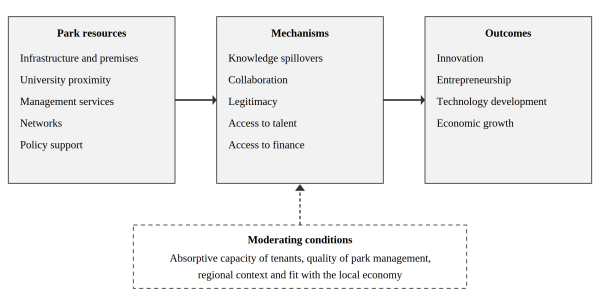
Figure 1 pulls these findings together. On the left are the resources a park offers: premises and infrastructure, proximity to universities and research centres, management services, networks and policy support. In the middle are the mechanisms through which those resources reach firms, namely knowledge spillovers, collaboration, legitimacy, and access to talent and finance. On the right are the four outcomes examined in this review. Beneath them sit three conditions the evidence keeps returning to: the absorptive capacity of tenants, the quality of park management, and the regional context.
Figure 1. Integrative framework of technopark contribution
Source: developed by the author.
The framework goes some way toward explaining the disagreement in the literature. A study that links park location directly to patent counts skips the middle of the picture. If the mechanisms are weak (no networking, say) or the conditions poor (tenants with little R&D), the park will show little effect however good its facilities look on paper.
It also shows that the four outcomes form a chain rather than a list. Survival support buys young firms time to develop technology. Technology development, especially through university links, feeds innovation. Innovation that turns into growing firms is the main channel to regional growth. Weakness at any link limits what arrives at the end, which may be exactly why the evidence on regional growth, the last link, is the weakest of all.
5.2 Conditions for success
Table 2 lists the conditions that the reviewed literature most consistently ties to park success.
| Table 2. Conditions associated with technopark success | Condition | Why it matters |
| Supporting literature | Strong research base nearby | Provides knowledge, graduates and partners for tenants |
| Link & Scott (2006); Saxenian (1994) | Active management and services | Turns co-location into interaction through networking and support |
| Hansson et al. (2005); Albahari et al. (2019) | Tenant absorptive capacity | Firms must be able to use external knowledge |
| Cohen & Levinthal (1990); Díez-Vial & Fernández-Olmos (2015) | Fit with regional economy | Specialisation should build on existing strengths |
| Porter (1998); Amoroso et al. (2019) | Long-term policy commitment | Effects take years or decades to appear |
| Wessner (2009); Koh et al. (2005) | Clear goals and evaluation | Allows performance to be judged and improved |
| Bigliardi et al. (2006); Storey & Tether (1998) |
Source: compiled by the author.
5.3 What this means for emerging and transition economies
Almost all the evidence reviewed here comes from Western Europe, North America and East Asia. Many parks now on the drawing board are in emerging and transition economies, where research systems are smaller, university-industry links thinner and venture finance scarcer. What follows for them?
The East Asian experience shows that a country still catching up can make a park work. But Hsinchu and Singapore did not succeed through land and buildings. They involved large, sustained state commitment, a clear industrial focus and deliberate efforts to attract talent and investment (Hu et al., 2005; Koh et al., 2005). A park without that backing is unlikely to repeat the result.
Absorptive capacity is the second lesson. Where local firms do little R&D, proximity alone will not help much. Parks in such settings may need to spend more on building tenant capabilities, through training, shared laboratories and support for in-house R&D. Another route is to attract firms that already have those capabilities and then create ways for local firms to learn from them.
The third lesson is a warning from Britain. Parks that work mainly as property developments, with little management and few real ties to research, can soak up public money without producing the innovation promised (Massey et al., 1992; Quintas et al., 1992). Clear goals, honest evaluation and a willingness to change course matter as much as the initial investment.
6. Policy and Managerial Implications
For governments, a technopark should be only one component of an innovation strategy, not a substitute for one. Spending on the park needs to be matched by investment in research, skills and access to finance. Clear goals should be set in advance and kept distinct (survival, growth, innovation, impact on region) so that later the technopark can be evaluated according to its initial goals.
For park managers, the message is that management is the product. Networking, brokering contacts between firms and researchers, shared facilities and advisory services are where a park adds value beyond the building. Tenant selection and mix deserve attention as well, since capable firms benefit most and may generate spillovers for their neighbours.
For their part, universities have much to gain beyond commercial profits, such as the impact on research and the career paths of graduates. Gaining such advantages requires an active approach: having a functioning technology transfer office, proper regulations for academic consulting, and collaborating with tenants.
7. Limitations and Future Research
This review focuses only on works written in the English language. There is an obvious lack of works published in Chinese, Russian, Turkish, Spanish and other languages even though large numbers of parks operate in such language regions. The review is qualitative in nature; without meta-analysis, its findings are based on the interpretation of different studies. Choosing the core studies also involved judgement.
Several directions for future work stand out. Comparative studies of firms on and off parks in emerging and transition economies are badly needed. Designs that deal with self-selection more convincingly, such as following firms before and after entry or exploiting changes in policy, would make causal claims more credible. Measuring the mechanisms directly, for example how often tenants actually meet university researchers and what they work on together, would show where parks add value. And long-run studies connecting park activity to regional outcomes would address the question that matters most for public spending.
8. Conclusion
Technoparks are now a standard instrument of innovation policy, and a great deal is expected of them. On the evidence reviewed here, the case for them is real but conditional. Parks can lift innovation, help young technology firms survive, strengthen ties between firms and universities and, in the right setting, contribute to regional growth. None of this happens automatically. It depends on a strong research base, active management, tenants able to absorb outside knowledge, a good fit with the regional economy and patient policy support. For countries planning new parks, the building is the easy part. The harder work is creating the relationships, capabilities and institutions that let a park become more than an address.
References
Lecluyse, L., Knockaert, M., & Spithoven, A. (2019). The contribution of science parks: A literature review and future research agenda. The Journal of Technology Transfer, 44(2), 559-595. https://doi.org/10.1007/s10961-018-09712-x
Phan, P. H., Siegel, D. S., & Wright, M. (2005). Science parks and incubators: Observations, synthesis and future research. Journal of Business Venturing, 20(2), 165-182. https://doi.org/10.1016/j.jbusvent.2003.12.001