Category: DigitalJournal

  • Crypto News Today: BTC and HYPE Swing After Tariff Ruling, but Pepeto Is All Upside thumbnail

    Crypto News Today: BTC and HYPE Swing After Tariff Ruling, but Pepeto Is All Upside

    The biggest crypto news today is not Bitcoin. It is a meme coin presale with three live products, $7.2 million raised, and a trajectory that nobody in the mainstream is covering yet.

    Regardless of the outcome, it was clear that crypto markets would react wildly. The crypto news today confirmed exactly that. After the ruling, Bitcoin and most altcoins spiked, then fell, then spiked again.

    In contrast with this shaky environment, the path ahead for Pepeto seems to be all upside. Its unprecedented combination of meme coin culture with real trading infrastructure makes it the clearest  moonshot for 2026.

    Supreme Court tariff ruling creates crypto volatility

    Bitcoin initially jumped from $67,700 to $68,200 before dropping to $66,500 and then recovering to $67,900, according to CoinDesk. The crypto news today was dominated by short term confusion about what lower tariffs mean for risk assets.

    Other crypto news today includes the move from the Dubai Land Department to develop a secondary market for real estate backed tokens. This is yet another example of how real life use cases are now the real long term driver of crypto.

    Crypto news today nobody is covering: Pepeto ($PEPETO)

    Pepeto is everywhere in the crypto news today. The project has built three demo products that transform how the $45 billion meme coin market actually operates. PepetoSwap enables cross chain meme trading between blockchains. The bridge moves tokens across networks instantly. And the zero fee exchange eliminates the hidden costs that drain every trade on existing platforms. Each tool works together as the complete trading backbone that meme coins have desperately needed but never had.

    pepeto

    Given its real utility and immense market appeal, Pepeto’s presale has gone at full throttle. More than $7.258 million has been raised at a still low entry price of $0.000000185. SolidProof and Coinsult completed dual audits. Zero percent tax. Confirmed Binance listing. One of the original Pepe coin founders behind it all. Early believers are staking at 212 percent APY while waiting for launch.

    However, enjoying that kind of explosive wealth creation requires quick action. Only those who take part now in the presale will see their positions multiply by massive factors this year.  That only needs $50 million market cap. DOGE reached $80 billion on a joke.

    Bitcoin and Hyperliquid react to the ruling

    Bitcoin remains range bound between $64,000 and $72,000 since February 6. HYPE bounced sharply to $30 after the ruling, recovering a key level lost for several days. But even strong performers like HYPE cannot match the multiples available in an early stage presale.

    The crypto news today cycle is noise. The signal is Pepeto. Click To Visit Official Website To Buy Pepeto

    FAQs

    What is the biggest crypto news today? The Supreme Court struck down Trump’s tariffs, creating massive volatility for BTC and altcoins. But the real story is Pepeto raising $7.258 million with three live products.

    Can Pepeto reach  ? A  requires $50 million market cap. SHIB reached $40 billion with zero products. Pepeto has working infrastructure and a confirmed Binance listing at $0.000000185.

    How does the tariff ruling affect Pepeto? Tariff news is irrelevant to Pepeto’s presale price. What matters is product adoption. As millions of meme traders discover these tools, demand spikes organically.

    Disclaimer:
    This article is for informational purposes only and does not constitute financial advice. Cryptocurrency investments carry risk, including total loss of capital. Readers should conduct independent research and consult licensed advisors before making any financial decisions.

    This publication is strictly informational and does not promote or solicit investment in any digital asset

    All market analysis and token data are for informational purposes only and do not constitute financial advice. Readers should conduct independent research and consult licensed advisors before investing.

  • Bitcoin Latest News Today: Analyst Predicts BTC Drop as Users Pile Into Pepeto, Optimism and Ethena Decline thumbnail

    Bitcoin Latest News Today: Analyst Predicts BTC Drop as Users Pile Into Pepeto, Optimism and Ethena Decline

    The bitcoin latest news today is chilling. A famous critic predicts BTC. Optimism crashes 27 percent. Ethena bleeds. But degens are not running. They are rotating into Pepeto 

    Renowned Bitcoin critic shared a chilling prediction, forecasting a drop to $20,000 if the $50,000 level is breached. He urged investors to sell their Bitcoin now to avoid steep losses. The warning counters recent bullish expectations as BTC climbed 1.7 percent to trade at $67,364 on Friday according to the bitcoin latest news today.

    But investors are not sitting around waiting. They are shifting into presale opportunities like Pepeto as they chase substantial gains in 2026. Pepeto is a meme coin infrastructure play with three live demos going for $0.000000185 and has already accumulated more than $7.258 million.

    Peter Schiff predicts BTC could crash to $20K

    In a post on X on February 19, Schiff forecast that Bitcoin could drop toward $20,000 if support fails. He claims this time could be different because Bitcoin has experienced so much institutional adoption and significant leverage, as noted by CoinDesk. The recent bitcoin latest news today adds to his earlier warnings that the ongoing crash could last.

    These coins trend despite the bearish bitcoin latest news today

    Pepeto targets breakout as degens pile in

    Pepeto is where the strong upside lies, especially as the bitcoin latest news today shows a bearish prediction pointing to an 84 percent drop from BTC’s all time high of $126,000.

    With three demo products already live, this project handles cross chain meme swaps, bridges tokens between blockchains, and runs a zero fee exchange. The platform gives investors clear, real time trading infrastructure to make better decisions in a $45 billion market that nobody else is serving.

    Pepeto’s tools are designed with simplicity and efficiency in mind. The products feature a well structured layout that makes every function easy to find and use. This streamlined setup helps meme traders operate faster and cheaper than on any other platform.

    But for investors, the figures that matter most show Pepeto’s real upside potential. With the presale raising over $7.258 million at $0.000000185, many expect gains in 2026. The indispensable utility also adds to these forecasts as degens buy into Pepeto, pushing the presale further every single day. SolidProof and Coinsult completed dual audits. Zero percent tax. Confirmed  listing. Built by a Pepe cofounder.

    Staking metrics also show strong participation, with APY rewards compounding positions. But staking is just the bonus. The real play is the price. Once that  listing goes live, this entry point vanishes permanently.

    Optimism drops over 27 percent in a week

    OP was priced at $0.1331 after a 4.3 percent dip per CoinGecko data. Weekly losses reached 27.5 percent as Base, the largest chain on the OP Stack, reportedly plans to migrate away.

    Ethena dips 6.3 percent over the past week

    ENA traded at $0.1114 according to CoinMarketCap, marking a 6.3 percent weekly drop and over 38 percent monthly. The RSI shows oversold territory, but recovery remains uncertain.

    The bitcoin latest news today is fear. Smart money moves during fear. Click To Visit Official Website To Buy Pepeto

    FAQs

    What happened to Bitcoin today?

    BTC gained 1.7 percent to $67,364 but Peter Schiff predicts a crash to $20,000 if $50K breaks. Pepeto is up over $7 million in presale, offering stronger upside.

    Is Pepeto better than holding Bitcoin in 2026?

    BTC needs $130,000 just to double. Pepeto needs $50 million market cap for. The risk reward strongly favors the early stage play.

    Why are degens rotating into Pepeto?

    Three live demos, dual audits, zero tax,  listing confirmed, Pepe cofounder, and a presale price so low that is the base case.

    Disclaimer:
    This article is for informational purposes only and does not constitute financial advice. Cryptocurrency investments carry risk, including total loss of capital. Readers should conduct independent research and consult licensed advisors before making any financial decisions.

    This publication is strictly informational and does not promote or solicit investment in any digital asset

    All market analysis and token data are for informational purposes only and do not constitute financial advice. Readers should conduct independent research and consult licensed advisors before investing.

  • From Creativity to Revenue: Chennai’s Rise as a Digital Marketing Growth Engine thumbnail

    From Creativity to Revenue: Chennai’s Rise as a Digital Marketing Growth Engine


    Something fundamental has shifted in the digital marketing world over the last few years. Brands are no longer impressed by dashboards filled with impressions, clicks, and engagement percentages.  

    Those metrics still matter, but they are no longer the finish line.  

    The real question businesses are asking today is far simpler and far sharper: What did this marketing effort actually generate for the business? 

    This shift has changed how Digital Marketing Services are evaluated, purchased, and retained. Marketing is no longer treated as a creative experiment or a brand-building side project.  

    It is being scrutinized as a business function with accountability tied directly to growth. Interestingly, one city in India has quietly aligned itself to this new expectation, Chennai. 

    Why Chennai Is Emerging as a Digital Growth Hub 

    Chennai’s rise in the digital ecosystem didn’t happen overnight, and it certainly didn’t happen by accident.  

    Unlike cities that leaned heavily on flashy creativity or trend-led marketing, Chennai evolved with a more grounded mindset, one rooted in systems, processes, and long-term execution. 

    The city’s strength lies in how it approaches problem-solving. Marketing teams here tend to think like engineers and business strategists before thinking like advertisers.  

    Campaigns are dissected, mapped, tested, and optimized with discipline. This naturally lends itself to performance-driven outcomes. 

    As businesses across India and abroad began demanding more accountability from marketing investments, Chennai-based teams were already aligned with that thinking.  

    The result is a growing reputation not just as a creative hub, but as a dependable digital execution center capable of delivering sustained ROI. 


    Digital Marketing Is No Longer a Channel Play 

    One of the biggest misconceptions businesses still carry is the idea that digital marketing is a collection of isolated activities, SEO on one side, paid ads on another, content somewhere in between. This fragmented approach is exactly why many marketing efforts fail to translate into real business growth. 

    Modern digital marketing works best when viewed as a system. Every touchpoint, search, content, ads, landing pages, analytics, must be designed to feed into a single objective: revenue movement.  

    This is where the concept of Digital Marketing as Revenue Infrastructure becomes critical. 

    Instead of asking which channel to invest in, high-performing businesses ask how their entire digital ecosystem works together.  

    Lead generation connects to conversion optimization. Traffic acquisition connects to lifecycle nurturing. Data informs every decision, not just reporting. 

    This systems-first mindset is where we differentiate ourselves by offering end-to-end digital capabilities that function together as a unified growth engine rather than disconnected services, thereby positioning Ayatiworks as the best digital marketing agency in Chennai.  

    Marketing is treated as infrastructure, much like finance or operations, built to scale with the business. 


    Building a Digital Marketing Growth Engine, Not Campaigns 

    Campaign-led thinking focuses on short-term wins. Growth-engine thinking focuses on sustainability. The difference lies in architecture. 

    A growth engine is designed backwards from business outcomes. Revenue targets dictate funnel design. Funnel behavior informs content and performance strategy. Performance data feeds optimization loops.  

    Over time, this creates predictability, something most businesses struggle to achieve with marketing. 

    Chennai-based teams operating with this model have been able to support brands across sectors precisely because the framework adapts. Whether the objective is dealership leads, ecommerce conversions, or high-intent inquiries, the underlying system remains consistent while execution flexes. 

    This approach becomes especially powerful when applied to large, complex brands where marketing success is measured not by reach but by contribution to business pipelines. 

    Result-Oriented Performance Marketing: Proof from Enterprise Brands 

    The effectiveness of a revenue-first digital approach becomes clearest when applied to established brands that already have awareness but need efficiency and scale. 

    Consider automotive brands like Volvo and Jeep. For such brands, digital marketing is not about visibility, it’s about intent capture, regional relevance, and dealer-level conversions.  

    Campaigns must align with inventory, geography, and buyer readiness. Performance marketing here is less about volume and more about precision. 

    Similarly, consumer technology and manufacturing brands such as Xiaomi and Nippo demand a different performance lens. The challenge is often funnel efficiency, reducing acquisition costs while improving conversion quality.  

    This requires constant optimization across creatives, landing experiences, and targeting logic. 

    In all these cases, the common thread is not industry or brand size, but methodology. Campaigns that succeed are built on clear revenue logic, supported by analytics, and continuously refined based on performance data, not assumptions. 

    Why Revenue-First Marketing Changes Business Conversations 

    When marketing is positioned as revenue infrastructure, internal conversations change. Marketing teams stop defending budgets and start discussing forecasts. Leadership stops asking for reports and starts asking for scale. Decisions become data-backed rather than opinion-driven. 

    This shift also improves alignment across departments. Sales teams receive better-qualified leads. Product teams gain insight into customer behavior. Leadership gains clarity on which growth levers actually work. 

    Chennai’s growing influence in the digital marketing space comes from its ability to enable this shift. The city has become a place where marketing is expected to perform like a business function, not a branding experiment. 


    The Strategic Advantage of an End-to-End Digital Partner 

    One of the most overlooked factors in digital growth is integration. Businesses often work with multiple vendors, one for SEO, another for ads, another for design, resulting in fragmented execution. A growth engine cannot function efficiently in silos. 

    An end-to-end digital partner eliminates this friction. Strategy, execution, optimization, and analytics operate within a single framework. This allows faster decision-making, cleaner data interpretation, and more consistent outcomes. 

    This is where agencies built on revenue-first thinking create disproportionate value, not by doing more, but by aligning everything that’s already being done toward a single growth objective. 

    Is Your Marketing Built for Revenue or Just Visibility? 

    The rise of Chennai as a digital marketing growth engine reflects a broader truth about modern business. Visibility without conversion is noise. Creativity without structure is fragile. Marketing without revenue alignment is unsustainable. 

    If digital marketing is now infrastructure, the question every business must answer is simple: Is your marketing system built to generate predictable growth or just activity? 

    If you’re curious to see how a revenue-first digital framework could work for your business, a free growth demo with Ayatiworks could offer clarity. Because real growth doesn’t happen by chance, it’s engineered, measured, and scaled.  

  • B2B Digital Marketing: A Comprehensive Guide

    Business-to-Business (B2B) digital marketing refers to the strategies and practices that companies use to promote their products or services to other businesses online. Unlike B2C (Business-to-Consumer) marketing, B2B digital marketing focuses on building long-term professional relationships, nurturing leads through complex sales cycles, and delivering content that speaks to business needs.

    1. The Foundations of B2B Digital Marketing

    1.1 What Makes B2B Unique?

    In B2B marketing, purchasing decisions typically involve multiple stakeholders, higher financial considerations, and longer decision-making timelines. Buyers conduct extensive research, compare options, and require more detailed information before making a purchase. Hence, B2B digital marketing strategies must be tailored for depth, relevance, and trust.

    1.2 Why Digital Matters for B2B

    Digitization has transformed how businesses find and evaluate vendors. Most B2B buyers begin their journey online, researching solutions, reading reviews, and engaging with content that helps them understand industry challenges and solutions. Digital channels allow companies to meet buyers where they are — online, informed, and research-driven.

    2. Core Components of B2B Digital Marketing

    2.1 Content Marketing

    Content is at the heart of B2B marketing. Quality content educates prospects, builds credibility, and drives organic visibility. Examples include:

    • Whitepapers and eBooks: In-depth guides that showcase expertise.
    • Blog Posts and Articles: Frequent updates that address industry questions.
    • Case Studies: Real-world success stories that validate solutions.
    • Infographics and Visual Content: Simplifies complex ideas for quick consumption.

    A strategic content plan ensures that businesses provide value at every stage of the buyer’s journey.

    2.2 Search Engine Optimization (SEO)

    SEO is about optimizing online content to rank higher in search results. For B2B, SEO means identifying industry keywords, optimizing on-page content, and establishing authority through backlinks from reputable sites and publication media sources. When done well, SEO generates consistent, high-quality traffic with long-term benefits.

    2.3 Paid Advertising

    Paid digital advertising helps businesses reach targeted audiences faster. Common formats include:

    • Search Ads: Appear when users search for relevant keywords.
    • Display Ads: Visual banner ads on websites, often used for brand awareness.
    • LinkedIn Ads: Highly effective for B2B due to precise professional targeting.
    • Retargeting Ads: Re-engage users who have visited your website before.

    Paid campaigns can be optimized to improve lead generation, conversions, and return on investment (ROI).

    2.4 Email Marketing

    Email remains a powerful tool for nurturing leads and maintaining communication with prospects. In B2B, email campaigns often focus on thought leadership, product updates, newsletters, and content distribution to keep audiences engaged throughout the sales funnel.

    2.5 Social Media for B2B

    While consumer brands dominate platforms like Instagram and TikTok, B2B companies benefit greatly from LinkedIn, Twitter, and even YouTube. These platforms allow brands to share expert content, participate in industry discussions, and reach decision-makers directly.

    3. Advanced Strategies and Emerging Trends

    3.1 Account-Based Marketing (ABM)

    ABM is a highly personalized approach where marketing teams target specific high-value accounts rather than broad audiences. By tailoring content and campaigns to individual organizations, ABM improves alignment between sales and marketing, increases relevance, and boosts conversion rates.

    3.2 Marketing Automation

    Automation tools streamline repetitive tasks like email sequences, lead scoring, and social posting. This efficiency allows marketing teams to focus on strategy and creative initiatives rather than manual execution. Automation also enhances personalization by delivering the right message at the right time.

    3.3 Video and Interactive Content

    Video content, webinars, and interactive tools (such as ROI calculators or quizzes) have become vital in B2B. These formats improve engagement, convey complex information more effectively, and increase the likelihood of conversion.

    3.4 Influencer Collaborations and Guest Content

    Collaborating with industry experts and thought leaders can expand brand reach. Many B2B companies invest in guest post services and partnerships that help them feature content on respected blogs, industry newsletters, and digital platforms. These collaborations enhance credibility and drive traffic from relevant audiences.

    4. Measuring Success and KPIs

    4.1 Key Performance Indicators (KPIs)

    To evaluate the effectiveness of digital marketing efforts, B2B companies monitor metrics such as:

    • Website Traffic and Sources
    • Lead Quality and Conversion Rates
    • Email Engagement (opens, clicks)
    • SEO Rankings for Targeted Keywords
    • Cost Per Lead (CPL) and Customer Acquisition Cost (CAC)

    Regular analysis ensures strategies remain aligned with business growth objectives.

    4.2 Analytics Tools

    Platforms like Google Analytics, CRM systems, and marketing dashboards consolidate data and provide insights. These tools help marketers understand buyer behavior, campaign performance, and areas needing improvement.

    5. The Role of Digital Platforms and Publication Channels

    5.1 Choosing the Right Platforms

    Selecting the right spaces to distribute content is essential. High-authority publication media outlets, industry forums, and niche directories help B2B brands reach specialized audiences. Publishing on trusted channels fosters visibility among active buyers who rely on credible sources for decision-making.

    5.2 Syndication and Republishing

    Content syndication allows businesses to repurpose and distribute material across various networks, increasing reach and reinforcing brand presence. When aligned with reputable publication media, syndication can elevate a brand’s authority and improve lead generation.

    6. Challenges in B2B Digital Marketing

    6.1 Complex Buyer Journeys

    Unlike consumer purchases, B2B decisions are often multi-step and involve several stakeholders. Mapping this journey and delivering relevant content at each stage requires strategic planning and patience.

    6.2 Data Quality and Integration

    Successful marketing depends on accurate data. Integrating data across platforms and maintaining clean prospect lists are ongoing challenges, but critical for personalization and automation.

    6.3 Adapting to Rapid Change

    Digital marketing evolves rapidly — from algorithm updates to new tools. B2B marketers must stay agile, continuously learning and adopting innovations that enhance performance.

    7. Final Thoughts

    B2B digital marketing is an expansive field that blends strategy, creativity, and analytics. It demands a deep understanding of buyer behavior, consistent value delivery, and smart use of digital channels. Whether optimizing for organic search, crafting compelling content, or leveraging paid advertising, businesses that align their digital marketing efforts with customer needs will thrive in today’s competitive marketplace.

  • XRP Price Prediction 2026: Ripple Stays Flat at $1.36 While the Best Crypto To Watch Now Raises $7 Million in Weeks thumbnail

    XRP Price Prediction 2026: Ripple Stays Flat at $1.36 While the Best Crypto To Watch Now Raises $7 Million in Weeks

    XRP trades at $1.36. Down 1.8 percent on the day according to CoinMarketCap. Despite years of legal battles and billions in market cap, the XRP price prediction for 2026 ranges from $3 to $5. That is a at best. Respectable. But definitely not the kind of return that changes your financial future.

    For investors who want more than patience, the best crypto to buy now is not fighting to reclaim old highs. It is Pepeto, a meme coin infrastructure play that just blasted through $7.258 million in presale funding.

    XRP price prediction: Strong fundamentals, limited upside

    Ripple’s cross border technology is real. Reuters has covered the expansion into tokenized assets. But all of that is already priced in. The XRP price prediction puts the ceiling around $5 this cycle.

    Shiba Inu faces the same wall. Down 85 percent from its all time high per CoinGecko, SHIB needs tens of billions in new capital to recover. No products. No revenue. Just fading community energy.

    Best crypto to buy now: Pepeto is what XRP and Shiba Inu wish they were

    Every single day you wait on XRP to move from $1.36 to maybe $5 over the next year, Pepeto’s presale allocation gets smaller. Every single day you hold Shiba Inu hoping for a recovery that needs $30 billion in new money, Pepeto gets closer to its  listing. That is the opportunity cost nobody talks about. And it is costing you a fortune.

    The meme coin market is $45 billion. Nobody has built dedicated infrastructure for it. Nobody until Pepeto. Three demos live right now. PepetoSwap for cross chain meme trading. A bridge connecting blockchains for instant transfers. A zero fee exchange that nobody else in the space has even attempted. These are not concepts on a slide deck. These are products you can open and use today.

    SolidProof and Coinsult completed dual audits. Zero tax on every transaction. Confirmed  listing. Created by one of the original Pepe coin founders. Over $7.258 million raised and the pace is picking up speed, not losing it.

    The XRP price prediction gives you maybe over a year if everything goes right. Pepeto at $0.000000185 needs just $50 million for  . SHIB hit $40 billion with nothing. PEPE reached $7 billion on pure memes. The gap between where Pepeto sits and where meme coins have proven they can go is absolutely staggering.

    These are the exact returns early SHIB holders actually got. The difference is Pepeto has products that work. The presale will not last forever. Every day the window gets tighter. Every day the  listing gets closer. And when it hits, this entry price is gone and the easy money goes with it. The APY staking is just the reward for being smart enough to move while everyone else watches XRP trade sideways for another year.

    The XRP price prediction offers you patience. Pepeto offers you the chance of a lifetime. Choose wisely.

    Click To Visit Official Website To Buy Pepeto: https://pepeto.io

    FAQs

    What is the XRP price prediction for 2026?

    Most analysts target $3 to $5 for XRP, roughly The ceiling is limited at this valuation.

    Is Pepeto the best crypto to buy now over XRP?

    Pepeto offers  potential at $0.000000185 with three live demos and a listing. XRP offers slow growth. Depends on whether you want safety or life changing returns.

    Can Shiba Inu still deliver big returns?

    SHIB needs billions in fresh capital just to recover. Early stage presales like Pepeto offer dramatically higher multiples from a much lower entry.

    Disclaimer:
    This article is for informational purposes only and does not constitute financial advice. Cryptocurrency investments carry risk, including total loss of capital. Readers should conduct independent research and consult licensed advisors before making any financial decisions.

    This publication is strictly informational and does not promote or solicit investment in any digital asset

    All market analysis and token data are for informational purposes only and do not constitute financial advice. Readers should conduct independent research and consult licensed advisors before investing.

  • Maxiprint: The Engineering Behind More Profitable, More Professional Textile Screen Printing Plants in Latin America thumbnail

    Maxiprint: The Engineering Behind More Profitable, More Professional Textile Screen Printing Plants in Latin America

    In textile screen printing, the biggest performance gains rarely come from “printing harder” or pushing machines faster. They come from process control: reducing variation, standardizing critical parameters, and turning technical expertise into repeatable, measurable output.

    That is what Maxiprint Colombia does.

    Maxiprint is a technical and consultative partner dedicated to professionalizing and increasing the profitability of textile screen printing plants across Latin America—working end-to-end across the three pillars that truly define plant performance: inks, machinery, and processes.

    1) Inks: Yield, Control, and Repeatability

    Ink consumption is not a fixed cost. It is the result of a system.

    When deposit control is inconsistent, plants experience overuse, rework, unstable color, unpredictable finishes, and margin erosion. Maxiprint addresses these challenges by engineering control where it matters most:

    • Deposit control and stability for consistent hand feel, clean definition, and predictable coverage
    • Color repeatability to reduce adjustments and eliminate trial-and-error
    • Consumption optimization, achieving up to 30% reduction in ink usage by standardizing and stabilizing critical variables

    A 30% reduction is not a “hack.” It is what happens when a plant stops guessing and starts controlling.

    2) Machinery: Real Productivity, Not Just Speed

    A plant can run automatic presses and still lose significant productivity every day—through micro-stops, recurring adjustments, station-to-station variation, unstable setups, and workflows that normalize inefficiency.

    Maxiprint improves operational performance by focusing on what actually unlocks machine output:

    • Fewer stops and fewer adjustments, increasing stability across shifts
    • Improved registration consistency and in-line quality reliability
    • Predictable production flow, where machines operate at their true capability

    Machines are assets. Productivity is an engineered result.

    3) Processes: Standardization, Control, and Measurable Improvement

    The real indicator of a professional plant is simple:

    Can you reproduce the same result tomorrow, on another shift, with another operator—while keeping cost under control?

    Maxiprint professionalizes plants through a method built around:

    • Standardization: clear parameters, routines, acceptance criteria
    • Control: measurement, monitoring, and systematic reduction of variation
    • Continuous improvement: technical actions tied to performance metrics and outcomes

    When the process is controlled, the plant becomes scalable.

    Measurable Outcomes: Cost Reduction, Capacity Recovery, and Growth Without Added Cost

    Profitability is not a promise. It is a number.

    When a plant stabilizes and professionalizes its operation, the impact appears in two directions at once: costs move down and capacity moves up.

    Up to 30% Ink Consumption Reduction

    By improving deposit control, minimizing rework, and eliminating unnecessary variation, plants can achieve up to 30% lower ink consumption—strengthening margins while improving print consistency and finish quality.

    390 Hours Recovered Per Year in High-Output Plants

    For plants operating four automatic presses across three shifts, operational stabilization and process professionalization can produce significant measurable impact:

    • Recovered time: 390 hours per year
    • Direct cost savings: USD 160,000 per year
    • Additional output with the same cost structure: 28,000 more units per year
    • Incremental revenue potential: at least USD 25,000 per year

    This is the difference between growth that increases chaos—and growth that increases profit.

    What Changes When a Plant Truly Becomes “Professional”

    A professional textile screen printing plant is not defined by how hard it works. It is defined by how controlled it operates.

    After a structured technical intervention across inks, machinery, and processes, plants typically experience:

    • Fewer stops and less rework
    • Higher stability across shifts
    • Better repeatability in color and finishes
    • Higher real productivity
    • Lower waste and stronger margin
    • Improved planning reliability and on-time performance

    Most importantly, results stop depending on “heroes” and begin depending on systems.

    Maxiprint: The Difference Between Printing and Operating With Control

    Maxiprint professionalizes and increases profitability in textile screen printing plants by working where outcomes are truly defined: inks, machinery, and process engineering—not as theory, but as disciplined execution supported by measurement, standardization, and continuous improvement.

    For plants that want to reduce consumption, recover capacity, increase output without increasing cost, and build a stable, repeatable, scalable operation, Maxiprint delivers what the market demands most:

    control, consistency, and profitability—engineered into the process.

    Media Contact

    Company name: – Maxiprint
    contact person name:- Juan Pablo Calle
     contact no: – +57 317 647 7421
    address: – 050024, Medellín, Colombia
    city: – Medellín
    county: – Colombia
    mail: – comercial@maxiprint.com.co
    website: – https://www.maxiprint.com.co/

  • Did You Miss XRP and Solana? Don’t Miss the Next Crypto – APEMARS Enters the Next Crypto Bull Runs with Stage 9 Pricing thumbnail

    Did You Miss XRP and Solana? Don’t Miss the Next Crypto – APEMARS Enters the Next Crypto Bull Runs with Stage 9 Pricing

    Every major crypto bull runs cycle creates two groups of people. The first group sees opportunity early and takes action. The second group watches from the sidelines, telling themselves they will enter later. By the time “later” arrives, prices have already multiplied, and regret replaces hesitation.

    AVvXsEhmsr3AhISrShFHLVigwL7bfRy09A8Qcex3ZyrysNpw2qCkdadGRmn UGu9sFij28CS10jZGgdDLyprN3 l2XuSI2hj5kwSXvTrz0gh45sPkGlKTIh65P y4RmVTtl 0as6t1WeXqIk CQOkBqdRGBu3MWjnAgc9tlzJ9a u UAimL5yLVbftS

    XRP was once considered slow and uncertain during regulatory battles. Solana was once dismissed because of network instability headlines. Both later became defining assets in crypto bull runs, delivering life changing returns for early believers. What felt risky early eventually became obvious in hindsight.

    The uncomfortable truth about every next  crypto is that it never looks like one at the beginning. It looks small. It looks unproven. It looks early. And that is exactly why positioning before the next crypto bull run matters more than chasing after they begin.

    APEMARS Presale: The Quiet Phase Before the Noise

    The pattern behind every next  crypto is timing before awareness. APEMARS is currently live in Stage 9 of its presale, priced at 0.00007841, with an intended listing price of 0.0055. That pricing structure creates a defined progression rather than speculative guessing. Unlike open market tokens, stage based pricing introduces transparency about entry levels before exchange exposure.

    AVvXsEjt5hB8WawOesM Yz BKQ7vlA99CSC8WGxB14kQtLnTYTTlBIUXAhb3HSlRdWzxhqi87SoTHwzt4zWqprlV5eGlYWn or9gvvFj7NJl5oAH82 eO3a0BUmOUf3tH7OR31lS3WcShaeS5ow OBMc 9GBGhdjRCVsqZSSh3F7rKF9Ir3drAsfERuPi C3aXY

    In crypto bull runs, the largest percentage gains often happen before broad recognition. APEMARS has already sold 11.7 billion tokens, attracted 1,150 holders, and raised $240,000. These numbers reflect steady accumulation rather than artificial spikes. It is not yet mainstream. It is not trending across every social platform. That is precisely the stage where asymmetry exists.

    The project positions itself around community driven growth and structured progression rather than promises. Every stage advancement increases pricing incrementally. That mechanism rewards earlier positioning while naturally creating urgency as allocation shrinks. When the next crypto bull runs accelerate, pricing gaps become far more visible than they appear during quiet accumulation phases.

    Why Every Next  Crypto Looks Small at First?

    History shows that the next  crypto rarely announces itself loudly at the beginning. XRP traded under one dollar for years before explosive moves during crypto bull runs. Solana faced skepticism before developer growth pushed ecosystem expansion. Early phases often feel boring or uncertain.

    APEMARS currently sits in that pre recognition window. It does not rely solely on hype. It uses a stage based structure that creates a visible difference between current pricing and intended listing. That gap exists now, not after exchange exposure. The opportunity window closes as stages progress.

    Stage 9 Pricing and the Defined Gap Before Listing

    Stage 9 is priced at 0.00007841. The intended listing price is 0.0055. This difference represents a structured pricing gap of over  rom Stage 9 to listing. That does not guarantee outcomes, but it clearly illustrates the asymmetry between early entry and post listing access.

    Crypto bull runs amplify existing gaps. When liquidity returns aggressively, projects that already built community and structured distribution often accelerate quickly. The question is not whether markets will cycle again. The question is whether positioning happens before or after momentum begins.

    XRP – The Regret That Defined a Generation of Traders

    There was a time when XRP traded at fractions of a dollar and faced intense regulatory uncertainty. Many dismissed it as too controversial or too risky. During major crypto bull runs, however, XRP delivered explosive price expansions that redefined its perception.

    The next  crypto narrative often forms after years of doubt. XRP’s rallies were not instant. They followed periods of consolidation, uncertainty, and skepticism. Those who accumulated early experienced exponential appreciation once liquidity returned to the market.

    The regret surrounding XRP is not about missing one pump. It is about underestimating how crypto bull runs can reprice assets rapidly once sentiment shifts. What once looked stagnant became one of the most talked about assets in the space.

    Solana – From Doubt to Dominance During Crypto Bull Runs

    Solana’s early journey was filled with headlines about outages and instability. Critics questioned its reliability. Many avoided exposure during those uncertain phases. Yet development continued, ecosystem participation grew, and adoption expanded quietly.

    When crypto bull runs intensified, Solana moved from skepticism to dominance. NFT marketplaces, DeFi activity, and developer growth fueled demand. What was once considered fragile became one of the fastest growing ecosystems in the industry.

    The lesson is clear. The next  crypto rarely feels safe at the beginning. Solana’s trajectory demonstrates how markets can quickly reprice innovation when liquidity flows back into the ecosystem. Those who waited for perfect clarity often entered after major gains had already occurred.

    AVvXsEjIJOjgNzqA5t3Dl003vAPf3n7OpCk7wPCwHvAM8YG5p2rkmwCnktJ75Pv7UCu3kGFbK1yIFdgN1Alou8nxA4eiuY15wBd1OMRtsroQEGYnDQB5bH9c7w9A5r9X8uGgT0rSqPPejO5 r335VyPL3k0yyjFpjE9KJ4ljhoijmGrhSGBSV85dTpRAEg 75ls

    Conclusion

    Every cycle produces the same story. XRP was doubted before its breakout. Solana was questioned before its ecosystem exploded. Crypto bull runs reward early positioning more than perfect timing. APEMARS currently sits in Stage 9 pricing before listing exposure. It has measurable traction, a structured pricing model, and a visible gap between presale and intended listing. Whether it becomes the next  crypto will ultimately depend on adoption and broader market dynamics.

    However, its current phase represents the type of entry window that historically precedes major repricing events in crypto bull runs. Regret feels heavier than risk in hindsight. The decision is not about certainty. It is about whether participation in the Best Crypto to Buy Now happens before or after momentum defines the narrative.

    AVvXsEgUDjymmvnDI0pripvZpE2SNdKwlvCUlwS FuoFdQpaIdevA akVQbjWDLVi4TT9aAXamjt1h oLbq3g7OxDLrkl QmYG2boFKE3oVMWmZzAMrIWzlwa akQbkctJ7PwdYdhTFuKnJAEDAch A3INm9YsehsjOHZLQSfuC6q6R263haLb8QKC7iP7wQs20

    For More Information:

    Website: Visit the Official APEMARS Website

    Telegram: Join the APEMARS Telegram Channel

    Twitter: Follow APEMARS ON X (Formerly Twitter)

    FAQ About Crypto Bull Runs

    What is meant by the next  crypto?

    The term refers to projects that experience exponential price growth during strong crypto bull runs. It is speculative and depends on timing, adoption, and market conditions.

    Why do crypto bull runs create large price gaps?

    During crypto bull runs, liquidity increases rapidly, and demand often outpaces available supply. This can lead to sharp repricing of assets that already built early traction.

    How does Stage 9 pricing work for APEMARS?

    Stage based presales increase token pricing incrementally as stages progress. Stage 9 represents the current pricing tier before further increases and eventual listing exposure.

    Is presale participation guaranteed to deliver  returns?

    No. Presales carry risk, and outcomes depend on adoption, market cycles, and overall crypto bull runs conditions.

    Summary

    Crypto history shows a repeating pattern. Early doubt often precedes explosive growth during crypto bull runs. XRP and Solana both experienced skepticism before significant price appreciation. APEMARS now sits in Stage 9 pricing, offering a structured entry before listing exposure.

    Whether it becomes the next  crypto cannot be predicted with certainty. What can be observed is that its current stage mirrors the quiet accumulation phases that historically occurred before major crypto bull runs redefined valuations.

    Disclaimer:
    This article is for informational purposes only and does not constitute financial advice. Cryptocurrency investments carry risk, including total loss of capital.

    All market analysis and token data are for informational purposes only and do not constitute financial advice. Readers should conduct independent research and consult licensed advisors before investing.

    Crypto Press Release Distribution by BTCPressWire.com

  • How to Build a High-Converting Product Demo PLG Strategy thumbnail

    How to Build a High-Converting Product Demo PLG Strategy

    Research from OpenView shows that companies with a strong product-led growth (PLG) strategy grow revenue at about twice the pace of traditional sales‑led peers. That sounds exciting, until signups start coming in and most of those users never reach real value.

    When your product demo PLG strategy is weak, the funnel quietly leaks money.

    One PLG practitioner sums it up with a simple line that appears often in writing from groups like ProductLed and OpenView:

    That is exactly what a modern product demo has to deliver. Buyers expect to understand a complex SaaS product in minutes, without hopping on a call or sitting through a stiff slide deck.

    In this article, you will see:

    • What PLG really demands from a demo
    • How the three main demo types map to different PLG funnels
    • How to design a demo that cuts Time to Value
    • How to place your demo across the full funnel
    • How to measure whether your demo is working

    What PLG Actually Demands From Your Product Demo

    In a classic sales‑led motion, the demo happens late and lives with the sales team. In a PLG motion, the demo sits right at the front door. It must greet visitors, explain the product, handle objections, and push the right people to act, all without a human in the room.

    The basic PLG contract is simple. People want to feel value before they commit. That means your product demo PLG strategy has to put real outcomes on screen fast.

    If a prospect does not hit an Aha moment in the first few minutes, they will click to a competitor and compare several tools on their own.

    In this context, the demo has three jobs at the same time:
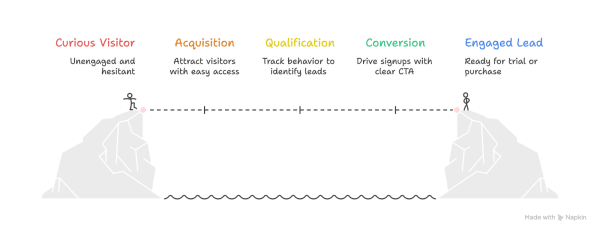
    Many SaaS teams still treat the demo as an afterthought, a polished screen tour that mirrors a sales deck. That approach fails hard when your product is technical and your buyers are sharp.

    Complex workflows, deep integrations, and busy dashboards need a demo that explains without dumbing things down.

    For a product-led growth strategy, an effective demo has a few non‑negotiable traits:
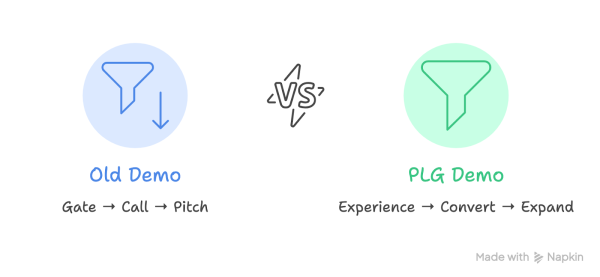
    • It delivers instant value by showing outcomes first, not menus and settings. Instead of walking through every button, it starts with a finished report, a clean dashboard, or an automation that saves time.
    • It collects personalization signals so later messages and in‑app flows feel relevant. Simple questions about role or use case at the start of the demo help route viewers through the most important path.
    • It produces measurable engagement data that your team can act on. When you can see where people drop off, which features they replay, and which flows send them to the signup page, your PLG funnel optimization stops being guesswork.
    • It supports self-serve navigation for different learning styles. Some viewers want to sit back and watch. Others want to click through screens. A modern demo lets both types move at their own speed while still guiding them to the high‑value moments.

    The Three Types Of Product Demos And Which PLG Funnel They Serve

    Not every product demo fits every motion. A pure self‑serve tool, a mid‑market platform, and an enterprise platform need different demo formats. To align your product demo PLG strategy, you can think in three buckets and match each one to the right funnel.

    Interactive Product Demos For A Self-Serve Motion

    An interactive product demo is a click‑through replica of your software that runs in a safe, sandboxed space. It looks and feels like the real UI but uses dummy data, so visitors can explore without any setup. They can test flows, open menus, and see sample dashboards that mirror real use.

    This format shines when you sell to individual users or small teams with a low entry price. Often those products already use a fre.emium or fre.e tria.l model.

    The interactive demo becomes the first taste on the website, sitting above the signup. It works all day, gathers email addresses after delivering value, and tracks every click so your team sees which features grab attention.

    For more complex SaaS, an interactive demo works best when paired with a short video that sets context. The video shows the story and high‑level outcome, while the interactive layer lets people poke around safely.

    Together they give you both clarity and hands‑on proof, which is the sweet spot for a self‑serve product-led growth strategy.

    Product Demo Videos For A Sales-Assisted Or Enterprise Motion

    Product Demo videos are structured walkthroughs that feel like a live presales call, but without a calendar invite.

    A strong demo video guides the viewer through the main problem, key workflows, and proof of value in a tight narrative. It combines UI capture, motion graphics, and clear voiceover to answer the questions a good sales engineer would cover.

    This format is ideal when your product is complex, the buying group is large, or security rules block open tri.als. In those cases, decision makers want to see how the product fits their world before they share data or invite IT.

    Demo videos scale that education so your presales team does not repeat the same overview call ten times a day.

    Modern demo videos can branch based on role or use case, and they track view time, replays, and hot spots. That demolytics data arms your sales team before a live meeting, so they know which feature caught the CTO’s eye and which others never landed.

    The Hybrid Demo Experience For The Middle Market

    The hybrid demo blends guided explanation with hands-on exploration. Think of a short video or animated overlay that appears inside a live or simulated UI.

    The viewer can click around, but they are never left alone in a maze of menus, and they do not need to follow every single step.

    This style works well for mid‑market SaaS where a small team adopts first, then spreads the tool across the company.

    The starting demo should feel low friction so that a manager or lead user can test the product without help. Later, focused mini demos can showcase premium features or add‑ons that make upgrades an easy internal sell.

    Hybrid demos are also practical from an operations view. Marketing and product teams can update copy, flows, or screens without rebuilding everything from scratch.

    That makes it easier for you to test different hooks, value stories, and PLG onboarding experience ideas, and see which one boosts activation and expansion the most.

    How To Build A Demo That Cuts Your Time To Value

    Time to Value is the gap between a first touch and the moment a user feels real benefit. In a PLG motion, that number decides whether someone becomes an active user or a quiet churn statistic. Your demo is the first and best tool you have to shrink this gap.

    When you design a demo with Time to Value in mind, every second counts. You stop giving full menu tours and start telling a clear story.

    The goal is simple: help a new viewer think this product solves my problem within minutes, then give them a direct path into tri.al or signup.

    Here are four practical tactics that support that goal:

    • Use pre‑filled templates and dummy data so people never start from a blank screen. Show a real‑looking project, dashboard, or workflow that matches a common use case in their role. Viewers can then see inputs and outputs side by side, which makes it much easier to connect features with outcomes.
    • Lead with the outcome instead of diving into controls and settings. Open the demo on the finished report, smooth workflow, or time saved, then briefly rewind to show how it came together. This order mirrors how buyers think, because they care first about results and only later about how the product does the work under the hood.
    • Personalize the entry point with one or two simple questions before the demo begins. Asking about a role, industry, or main job to be done gives you just enough information to route users into the most relevant path. When a marketing lead sees campaigns and a finance lead sees forecasts, both feel understood and stay engaged longer.
    • Remove every extra step that does not pull the viewer toward an Aha moment. That can mean cutting long intros, trimming dead screens, or reducing form fields before someone can watch or click. A quick audit with your team, based on viewing data, often reveals several places where you can save ten or twenty seconds and keep far more people with you.

    For complex SaaS products, this can be hard to do alone. There is often a big gap between how insiders talk about the product and how new users understand it.

    Embedding Your Demo Into The Full PLG Funnel

    Most SaaS sites hide their best demo behind a single Watch The Demo button on the homepage. That wastes a huge amount of potential. In a strong product-led growth strategy, your demo appears at many points across the funnel, not just at the start.

    Think about the full flow from first click to expansion. A visitor might see a demo on a landing page, then a different one inside the product, and a short feature teaser months later when a new module launches.

    Each of those touchpoints strengthens habits, sets expectations, and supports your PLG funnel optimization work.

    Here are four key places where your demo should live:
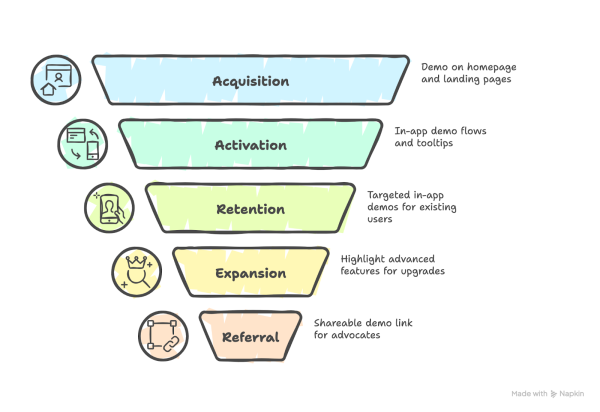
    Across all these touchpoints, demo engagement data can feed your Product Qualified Lead scoring. Time in demo, features viewed, and flows completed say much more about real intent than a single page view.

    To make this system work, you need not just one hero demo but a small library of focused videos and experiences.

    Measuring Whether Your Demo Is Actually Driving PLG Growth

    If you cannot measure the impact of your demo, you are flying blind. Gut feelings from the sales team or a few positive comments on LinkedIn do not tell you whether your product demo PLG strategy really moves the numbers that matter.

    Start by deciding which metrics belong to which part of the funnel. That way you can see where the demo works and where it needs work. It also helps your team avoid blaming the product when the real issue sits in the signup flow or pricing page.

    From there, you can focus on three tight metric groups:

    • Track demo-to-tr.ial/demo-to-paid conversion, Time to Value, and CAC for acquisition.
    • Measure engagement through features explored, key steps completed, and PQL growth.
    • Link demo activity to tr.ial-to-paid conversion, expansion revenue, and lifetime value for retention.

    As many operators like to say, “What gets measured tends to improve.”

    Keep in mind that not every viewer who loves your demo will buy, and a few light viewers may still convert for other reasons. Data should inform your decisions, not dictate your entire roadmap.

    The best SaaS teams treat the demo as a living asset, running A/B tests, refreshing scripts as the product changes, and revisiting the story whenever engagement dips.

    Conclusion

    In a product‑led world, your demo is far more than a sales aid. It is the front door, the tour guide, and often the main closet for your SaaS product.

    When your product demo PLG strategy is sharp, the demo attracts the right users, helps them hit value fast, and feeds clean intent data into the rest of your growth system.

    Designing that kind of demo is not easy, especially when your product is technical, your buyer group is large, and your team is busy shipping features.

    You need a story that makes sense to both founders and engineers, visuals that simplify without losing power, and a clear map of how each demo supports your product-led growth strategy across the funnel.

    Ready to build a product demo that actually powers your PLG funnel and supports your next stage of growth?

    Reach out to What a Story and start planning a demo experience that works as hard as your product.

  • A Simple Guide to Line of Credit & How to Borrow Smart thumbnail

    A Simple Guide to Line of Credit & How to Borrow Smart

    Financial gaps often appear when you least expect them. You might need a specific amount today, but have no idea what you will need next month. This uncertainty makes traditional fixed loans feel restrictive. A credit line offers a better way to manage your cash flow (and your stress levels). It serves as a standby fund, ready for use at any time. You only take what you need. Understanding this tool helps you plan for the future without committing to unnecessary debt. It is the modern answer to unpredictable financial demands.

    A credit line provides a specific limit of money you can access. You withdraw small amounts or the full limit, depending on your current bill or purchase. As you pay back the principal, that money becomes available to borrow again. This is “revolving credit.”

    How a Credit Line Operates?

    The process starts with a “draw period.” During this time, you can pull funds from your account via bank transfer or a linked card. The best part involves the interest calculation. You only pay interest on the money you actually spend. If you have a limit of Rs2 lakhs but only use Rs50,000, you pay interest on Rs50,000. This saves you significant money compared to a lump-sum loan. The limit resets to its original level once you repay the borrowed amount.

    You should watch out for specific costs. Maximum lenders charge a processing fee or an annual maintenance fee. They usually range within 1%-5% of the emergency loan amount. Check for the fees which apply every time you take money out.

    Different Ways to Get Credit

    Lenders offer various formats of this credit to suit different needs and security levels. Choosing the right one depends on your assets and how you plan to spend the money. Most people start with an unsecured option for its speed.

    Unsecured Personal Credit Line

    This option relies on your creditworthiness and income. You do not provide any collateral, like a house or car. It is perfect for a personal loan for salaried people who need a loan quickly.

    Home Equity Line of Credit

    Lenders use your property as security for this credit. Because the bank has an asset to hold, interest rates are often lower. However, you risk losing your home if you fail to pay.

    Business Credit Line

    Companies use this for daily operations. It helps cover payroll or buy stock when cash flow is slow. It bridges the gap between making a sale and receiving the payment.

    Securities-Backed Credit Line

    You use your investment portfolio as collateral here. It allows you to access cash without selling your shares or bonds. This keeps your investment strategy intact while providing liquidity.

    Qualifying for a Credit Limit

    Lenders look at a few key factors before saying yes. Your credit score matters most. A high score shows you handle debt responsibly. They also check for income stability. Lendingplate requires a monthly income of at least Rs20000 and an age of 21.

    Your DTI ratio is another aspect. This measures how much of your monthly pay goes toward existing debts.

    Key Benefits of Using a Credit Line

    Here are the benefits of using a credit line-

    • Total Flexibility– You decide the timing and the amount of every withdrawal
    • Affordability– Paying interest only on the used balance keeps your expenses down
    • Emergency Buffer– It offers an instant cash loan during a crisis without a new application
    • Credit Building– Regular, on time repayments help build a strong credit profile

    Credit Lines vs Other Options

    It helps to see how this flexible fund stacks up against more common forms of borrowing. While they all provide cash, the way they charge you and the way you use them vary wildly.

    Line of Credit vs. Credit Cards

    Credit cards are great for daily shopping. However, credit lines usually offer lower interest rates for larger cash needs. Taking cash from a credit card is very expensive. A credit line is much cheaper for bank transfers.

    Line of Credit vs. Personal Loans

    A personal loan gives you all the money at once. You pay interest on the whole lot from day one. A credit line is revolving. It is better for projects where you do not know the final cost yet.

    Line of Credit vs. Payday Loans

    Payday loans may charge massive interest and trap you in debt. A credit line is a regulated, fair option with clear terms. It offers quick loan approval without the predatory costs.

    When is the Best Time to Use a Credit Line?

    This financial tool works best when your expenses are fluid or when you need a safety net that does not cost anything until you use it.

    • Home Renovations– Perfect for projects with unpredictable costs or multiple vendor payments
    • Freelance Cash Flow– Use it to bridge the gap when client payments are delayed
    • Debt Consolidation– Pay off high-interest store cards or small debts with an affordable rate
    • Emergency Expense-: Keep it ready for sudden medical bills or urgent car repairs
    • Major Life Events– Manage the rolling costs of a wedding or a large family festival

    Conclusion

    A credit line puts you in the driver’s seat. It offers control that traditional loans simply cannot match. Before you open one, look at your spending habits. You need discipline to manage a revolving limit. Always read the fine print about interest rates and fees.

  • How to File Taxes for LLC: Complete Guide for Every Business Owner thumbnail

    How to File Taxes for LLC: Complete Guide for Every Business Owner

    If you own a limited liability company (LLC), being able to file your business’s taxes is a crucial financial skill. While LLCs have flexible tax treatment, which means they have more options available to them, it also means they have more decisions to make. This guide will help you tackle every option clearly and straightforwardly.

    1. What Does It Mean to File Taxes for an LLC?

    By default, LLCs are considered pass-through entities. This means that the business will not pay federal income taxes directly, and the business’s profits and losses pass through to the owners. This is reported by the owners on their personal income tax returns. However, depending on the structure of your LLC and the elections you make with the IRS, your filing situation can look vastly different.

    2. How Is Your LLC Taxed? (Choosing the Right Tax Classification)

    Before filing anything, you should understand how your LLC is classified by the IRS:

    LLC Type Default IRS Treatment
    Single-Member LLC Sole proprietorship (disregarded entity)
    Multi-Member LLC Partnership
    LLC with S Corp election S Corporation
    LLC with C Corp election C Corporation

    You can update your classification by submitting Form 8832 (Entity Classification Election) or Form 2553 (S Corp election). Each classification has unique tax responsibilities, associated deadlines, and required forms.

    3. How to File Taxes for a Single-Member LLC

    Single-member LLCs are considered disregarded entities by the IRS. This means you report everything on:

    • Schedule C (Profit or Loss from Business). This is filed with your Form 1040.
    • Schedule SE: This is the form for self-employment tax (15.3% on your net earnings).

    Please note that if you have a corporate election, you will have a separate federal business return. You should also keep careful records for the entire year for all revenue and expenses you want to deduct.

    4. How to File Taxes for a Multi-Member LLC

    For a multi-member LLC, by default, they are considered partnerships. This means that you are required to report the following:

    • Form 1065 (U.S. Return of Partnership Income) is an informational return.
    • You will also have to give each member a Schedule K-1, which will detail each member’s share of partnership income, along with the deductions and credits.
    • Then each member must report the K-1 information on their personal Form 1040.

    Important: Form 1065 is due March 15, not April 15. If you fail to submit your form, there is a possibility of incurring a penalty, even if there is no tax due.

    5. How to File Taxes for an LLC Taxed as an S Corporation

    When an LLC chooses to be taxed as an S Corporation, the owner must complete the following steps:

    1. Submit Form 1120-S (U.S. Income Tax Return for S Corporations)
    2. Submit a Schedule K-1 for every shareholder
    3. Pay a reasonable salary to yourself as a W-2 employee of the LLC
    4. Run payroll and file payroll tax documents every quarter

    While this option could be fiscally beneficial for self-employment tax purposes for profitable businesses, it does also mean taking on more business administration work.

    6. How to File Taxes for an LLC Taxed as a C Corporation

    When an LLC is taxed as a C Corporation, the owner must complete Form 1120. Unlike the other business structures, C Corporations tax the income at the entity level (which is a flat 21% as of the date of this article), and the income is also taxed at the owner level, which is referred to as double taxation. This business structure is less common for small LLCs; however, it is beneficial for businesses that want to have outside investors.

    7. Federal vs. State Requirements When Filing LLC Taxes

    Federal filing isn’t all-encompassing. Requirements on the state level differ significantly:

    • Some states have no income tax, such as Wyoming and Nevada.
    • Some states have a minimum franchise or LLC tax; California charges $800/year, no matter the profit.
    • Some states require a separate state business return.
    • Some states do not follow the federal classification, while others do.

    Check your state’s department of revenue or reach out to a local tax professional.

    8. What Tax Forms Do You Need to File LLC Taxes?

    Depending on your LLC type, refer to the following:

    LLC Classification Primary Federal Form
    Single-Member LLC Schedule C + Form 1040
    Multi-Member LLC Form 1065 + K-1s
    S Corporation Form 1120-S + K-1s
    C Corporation Form 1120

    Some additional forms that may be required include Schedule SE, Form 941 (for payroll taxes), and Form 8829 (for home office deduction).

    9. Estimated Taxes for LLC Owners: What You Must Pay Throughout the Year

    Because most LLC owners do not have taxes withheld from their income, the IRS requires them to make quarterly estimated tax payments. These payments are due as follows:

    • Q1 Payment: April 15
    • Q2 Payment: June 16
    • Q3 Payment: September 15
    • Q4 Payment: January 15 (of the following year)

    Estimated payments are calculated and submitted on Form 1040-ES. Even if you pay your taxes at the end of the year, you can still owe penalties if you underpay during the year.

    10. LLC Tax Deductions You Shouldn’t Miss

    Maximizing tax deductions is one of the most significant benefits of knowing how to file taxes for LLC businesses. Some common write-offs include:

    • Home office costs (Form 8829)
    • Business vehicle mileage (67 cents/mile in 2024)
    • Health insurance premiums for self-employed owners
    • Startup and organizational costs
    • Software, subscriptions, and tools
    • Professional services (legal, accounting)
    • Education and training directly related to your business
    • Retirement contributions (SEP-IRA, Solo 401k)

    Don’t leave money on the table. Good bookkeeping makes claiming deductions much easier.

    11. Common Mistakes to Avoid When Filing LLC Taxes

    It’s easy to make mistakes. Here are some to watch out for:

    • Not separating personal and business finances, you should have a separate business bank account.
    • Ignoring state filings, federal compliance is just one part.
    • Misclassifying employees’ tax laws for employees and independent contractors is different.
    • Not keeping receipts and other records, audits can go back 3–6 years.
    • Filing incorrect forms, especially after an S Corp or C Corp election.

    12. Important LLC Tax Deadlines to Remember

    Due Date What’s Due
    March 15 Partnership returns (Form 1065) and S Corp returns (Form 1120-S)
    March 31 1099-NEC / 1099-MISC (electronic filing)
    April 15 C Corp returns (Form 1120) and sole proprietorship/single-member LLC returns (Form 1040)
    April 15, June 16, Sept 15, Jan 15 Quarterly estimated tax payments

    Extensions are permitted, but you must pay taxes owed by the original due date. An extension gives you more time to file, not more time to pay.

    13. Should You File LLC Taxes Yourself or Hire a Professional?

    It all depends on your individual situation.

    If you have a single-member LLC with straightforward income streams, it should be pretty manageable to file taxes on your own, especially with the help of a reliable program like EasyFiling, as long as you keep your finances organized and easy to follow.

    It might be time to hire a CPA or tax professional if your LLC has multiple members, involves payroll, or has made an S or C Corporation election. A professional is also worth considering if your deductions are complex, your income is high, you’ve received IRS notices, or you have tax obligations across multiple states. Good accountants often end up being worth the money because they help you save on taxes and avoid penalties.

    14. Step-by-Step Checklist: How to File Taxes for an LLC

    Here’s an easy-to-follow checklist for tax season:

    •  Check your LLC tax classification with the IRS
    •  Collect all income evidence, bank records, and invoices
    •  Sort and document all tax-deductible expenses
    •  Identify the state and federal tax forms that apply to your LLC structure
    •  Calculate and reconcile quarterly taxes already paid
    •  Complete and review all required forms (Schedule C, 1065, 1120-S, etc.)
    •  File Schedule K-1 forms for each member, if necessary
    •  File by your deadline and pay any remaining balance owed
    •  Keep your tax records for at least 6 years

    Final Thoughts

    Tax season does not have to be complicated when you are filing for an LLC. Instead, you need to know your tax classification, stay organized throughout the whole year, and be aware of the important deadlines for your LLC. Whether you are a freelancer with a single-member LLC or managing a multi-member operation, filing correctly can save you money and protect your business. A qualified CPA is always a solid resource if you still have questions.