Category: DigitalJournal

  • Business Continuity Planning Explained: Requirements & Strategies thumbnail

    Business Continuity Planning Explained: Requirements & Strategies

    The business world today has become highly dependent on networks, geographically dispersed teams, and remote working. Such changes can accelerate work, but they also increase the chances of a company having problems, like cyber-attacks, power-cuts, supply-chain delays, and natural disasters. The effects of these issues do not include a simple work stoppage. Their ability to ruin trust with their customers, injure finances, and decrease competitiveness can occur. That is the reason why Business Continuity Planning (BCP) is essential.

    Business Continuity Planning is not a manual on crises. It is a plan that assists companies to ensure that their most significant work can be carried on, even in the case of a crisis. Cloud services and remote teams are part of BCP as businesses make use of offices to remain strong. This guide informs the key concepts, procedures, and strategies that companies must be aware of to develop a powerful continuity program.

    Business Continuity Planning – What is it?

    A company that establishes stages and regulations to keep the business moving in the event of major issues that may occur in the organization is called Business Continuity Planning, which is meant to implement the rules and regulations to ensure that the business is still running when the major issues begin to occur, and also when they are back to normal. According to Investopedia, BCP details how a company will continue to do its business in case any mishap occurs, and yet, it will be able to continue providing services that are required by people. According to regulators such as FINRA, BCP is required to ensure data protection, keep the market locked, and allow the use of the services by customers.

    At its heart, BCP asks –

    So what do we do to continue and keep on working when something is not right?

    The Significance of Business Continuity in the Present Day

    Increased Reliance on Electronic Systems

    The efficiency of work is provided by cloud work, remote teams, and software services, but it is also the reliance of companies on uninterrupted internet and technology. A single system failure will halt customer service, billing, or internal tools.

    Rising Cyber Threats

    Ransomware, phishing, and massive network attacks continue to increase all over the globe. An effective continuity plan will offer –

    • Secure backups
    • Alternative ways to log on
    • Safe places to recover data
    • Clear rules for reacting

    This reduces the time taken and prevents work halts in case of a cyber attack.

    Natural Disasters and Environmental Hazards

    Floods, storms, earthquakes, and fires may destroy equipment, offices, and communications. BCP plans enable the employees to resume their work elsewhere or at home in case the headquarters is not safe.

    Supply Chain Instability

    Delays can be caused by wars, health crises, and shortages. Continuity planning assists companies in establishing contingent suppliers and emergency purchasing arrangements.

    Regulatory Expectations

    Written continuity programs are required in many areas –

    • Finance
    • Health care
    • Insurance
    • Government work
    • Critical infrastructure

    The rules usually require the review of risks, the documented recovery steps, and the audit-ready plans.

    The Major Building Blocks of a Business Continuity Plan

    An effective BP contains other related components that keep an organization healthy.

    Business Impact Analysis (BIA)

    A BIA looks at –

    • The most important jobs
    • What are those jobs (tech, staff, places, suppliers) required to be?
    • What is the duration of job halting before it becomes a big problem?
    • Possible money losses
    • Work process bottlenecks.

    This assists in determining the jobs that should be rectified during a crisis first.

    Risk Assessment

    Risks can be grouped as –

    • Cyber – Data theft, malware, ransomware
    • Operational – Power failure, system failure
    • Environmental – Weather, extreme weather, natural disasters
    • Human – Disease, incompetence, insider trading
    • Vendor – Supplier failure, supply chain failure

    A risk chart will indicate the probability of each risk and the severity of the consequences.

    Recovery Strategies

    Recovery plans provide a means through which a business continues to run when bad conditions occur. Common plans include –

    • Moving to remote work
    • Migrating backup cloud services.
    • Composing emergency communication approaches.
    • Using secondary offices
    • Switching to manual steps
    • Bringing in extra staff

    Communication Protocols During an Emergency

    The communication process should continue even in a crisis. A BCP usually says –

    • Alerts to employees
    • Messages to customers
    • Arrangement of suppliers and partners.
    • Clear chain of command
    • Communicating with safety tools

    Making the plans very clear eliminates confusion, false news, and delays.

    Information Backup and IT Disaster Recovery

    This is one of the major elements of continuity planning. Companies must ensure –

    • Regular automatic backups
    • Back-ups in the cloud and off-site
    • Multiple region availability
    • Fast copying where needed
    • Intense controls over access to backups

    Disaster Recovery (DR) is the technical aspect that is concerned with the recovery of systems, networks, and data.

    Read more information about: https://remotedesk.com/secure-edlp/

    Remote Workforce Continuity and Hybrid Workforce Continuity

    As remote work is commonplace, distributed teams should be covered by continuity plans. That means –

    • Tools of remote access remain in operation
    • Computer security remains healthy
    • Back-up internet services are on standby
    • Rules on device and data protection
    • Remote working guidelines in case of an emergency
    • Modern continuity plans use remote sites like regular offices

    The How-To of a Compound Business Continuity Strategy

    Step 1 – Do a Full Company Review

    List –

    • Key roles
    • Tech resources
    • Outside partners
    • Office needs
    • Customer-affecting processes

    This forms the foundation of constructing the plan.

    Step 2 – Set Recovery Goals

    The plan is guided by two major numbers, which are –

    • RTO (Recovery Time Objective) – The duration of service downtime for critical services.
    • RPO (Recovery Point Objective) – Minutes or hours during which the data can be lost.

    These figures are to be surrounded by the riskiness of the company and its engagements.

    Step 3 – Develop Appreciable Recovery Steps

    The steps must be easy and simple to follow, and include –

    • Alternative work options
    • Short manual procedures
    • How to use backup systems
    • Communication in case of an emergency
    • Whose address book and the next to call

    All these steps need to be accessible to everyone.

    Step 4 – Educate the Employees and Conduct Practice Tests

    The failure of a plan is caused by the fact that individuals have no idea what to do. Training can include –

    • Fake drills
    • Tabletop reviews
    • Scenario tests
    • Simulations on technical recovery

    This is how the plan is put into practice.

    Step 5 – Monitor, Enhance, and Refine the BCP

    The plan will change with the business. Review it after –

    • Big company changes
    • System upgrades
    • Staff moves
    • New rules from regulators
    • Major incidents

    Continue to make the plan better so that it can be trusted over time.

    Conclusion

    In the modern globalized and digitalized system, where hybrid working culture and complex global supply chains are the norm, disruptions occur every day. Business continuity helps companies to continue business in times of crisis, safeguard customers, act in accordance with the rules, and remain strong in the long term. It is not merely a rule to adhere to in order to have a good continuity plan. It is a fundamental plan that causes the company to be stable and ensures that it can adapt, recover, and continue to provide value, regardless of the situation.


  • Best Crypto Interest Rates 2026 Best APY Crypto (Top 5 Reviewed)

    Dateline: San Francisco, USA – January 21, 2026

    Quick Summary

    Introduction

    Finding the best crypto interest rates in 2026 is no longer about finding the most obscure coin—it’s about finding the most efficient platform for stablecoins like USDT and USDC.

    While traditional savings accounts struggle to keep up with inflation, the crypto yield market offers diverse options ranging from regulated US exchanges to high-performance aggregators.

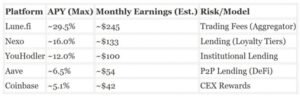
    In this comprehensive review, we analyze the Top 5 Platforms offering the best APY in 2026: Lune.fi, Nexo, YouHodler, Coinbase, and Aave.


    1. Lune.fi – The “High Yield” Leader (Up to 29.5%)

    Category: Exchange Aggregator & Fee Sharing

    Current APY: 18.0% – 29.5%

    Official Website: lune.fi

    Link: Visit Site


    Why it’s ranked here:

    Lune.fi tops our list for best crypto interest rates in 2026 because it uses a “Real Revenue” model. Instead of lending, it aggregates liquidity for high-frequency trading, collects trading fees, and distributes them to depositors daily.

    Pros:

    • Uncapped APY: Rates scale with market volatility.
    • Daily payouts: Faster compounding.
    • Privacy: No KYC for deposits under $25,000.

    Cons:

    • Rates fluctuate daily (variable yield).


    2. Nexo – The “Loyalty” King (Up to 16%)

    Category: CeFi Lending

    Current APY: Up to 16%

    Official Website: nexo.com

    Link: Visit Site


    Why it’s ranked here:

    Nexo is a veteran in crypto lending. Its Earn product is known for daily payouts. To unlock maximum rates, users typically need to earn in NEXO or hold NEXO in their portfolio (tier-based).

    Pros:

    • Daily interest: You see your balance grow every day.
    • Insurance: Assets are backed by custodial insurance (provider terms).
    • Flexible terms: Earn with or without lock-ups.

    Cons:

    • Best rates require holding/earning NEXO (exposure to token volatility).


    3. YouHodler – The “Balanced” Choice (12%)

    Category: FinTech & Loans

    Current APY: Up to 12%

    Official Website: youhodler.com

    Link: Visit Site


    Why it’s ranked here:

    YouHodler is ideal for users who want utility. Rates can be competitive without pushing a native token as aggressively, and it’s one of the best options for borrowing cash against crypto.

    Pros:

    • Weekly payouts: Consistent and predictable.
    • Fiat support: Withdraw directly to cards/bank (region-dependent).
    • Multi-HODL: Tools for active trading.

    Cons:

    • Smaller user base compared to Coinbase or Nexo.


    4. Aave – The “Safe Harbor” (4–8%)

    Category: Decentralized Lending (DeFi)

    Current APY: Variable (6.5% avg)

    Official Website: aave.com

    Link: Visit Site


    Why it’s ranked here:

    Aave represents pure DeFi. There is no company to trust—only code. Rates are determined strictly by supply and demand. It’s a benchmark for conservative on-chain yield, though typically lower than centralized competitors.

    Pros:

    • Self-custody: You control your private keys.
    • Transparency: Everything is verifiable on-chain.

    Cons:

    • Low APY compared to Lune or Nexo.
    • Requires technical knowledge of Web3 wallets.


    5. Coinbase – The “Starter” Option (~5.1%)

    Category: Public Exchange (CEX)

    Current APY: ~5.1% (USDC)

    Official Website: coinbase.com

    Link: Visit Site


    Why it’s ranked here:

    Coinbase is one of the most trusted names in US crypto. While its APY is modest, it is a popular “set it and forget it” choice for beginners who don’t want to use external wallets or offshore platforms.

    Pros:

    • Maximum safety: Publicly traded company (NASDAQ: COIN).
    • Simplicity: Easiest interface for beginners.

    Cons:

    • Lowest rates in the industry vs. specialist platforms.
    • High trading fees.


    2026 Rate Comparison Table


    Final Verdict

    • For Maximum Profit: Lune.fi is the clear winner for 2026, offering yields nearly 6x higher than Coinbase.
    • For Ecosystem Users: Nexo is great if you are willing to hold their token.
    • For Safety: Coinbase and Aave offer lower returns but maximum peace of mind.


    Recommended Video Reviews

    1. Top Crypto Passive Earning Opportunity for 2025

    Channel: Altcoin Buzz

    A deep dive into how to earn while you HODL, comparing flexible savings rates across major platforms.

    2. How I Earn Interest on Bitcoin & Why I Returned to Nexo

    Channel: Smart Money with Kai

    A personal case study on using Nexo for Bitcoin interest, discussing the pros, cons, and risk management strategies.

    3. My Top Crypto Staking & Lending Platforms for 2026

    Channel: Coinsider

    A comparative look at staking options for the coming year, analyzing different yield models and platform features.


    FAQ

    What is the highest paying crypto staking platform?

    Lune.fi currently offers the highest sustainable rates (up to 29.5% APY) due to its fee-sharing model.

    Is Coinbase staking safe?

    Yes, Coinbase is considered one of the safest platforms due to its regulatory status in the US, but its rates are significantly lower than competitors.

    Do I need to lock my funds?

    Lune.fi, Aave, and Coinbase generally allow flexible withdrawals. Nexo and YouHodler may offer higher rates for locking funds for 30-90 days.


    Official Links

    Disclaimer:
    This article is for informational purposes only and does not constitute financial advice. Cryptocurrency investments carry risk, including total loss of capital. Readers should conduct independent research and consult licensed advisors before making any financial decisions.

    This publication is strictly informational and does not promote or solicit investment in any digital asset

    All market analysis and token data are for informational purposes only and do not constitute financial advice. Readers should conduct independent research and consult licensed advisors before investing.

    Crypto Press Release Distribution by BTCPressWire.com

  • How PhotographerSocialHUB Is Helping Real Estate Photographers Build Predictable Monthly Income thumbnail

    How PhotographerSocialHUB Is Helping Real Estate Photographers Build Predictable Monthly Income

    For years, real estate photographers have operated in a transactional business model. Shoot the listing, deliver the assets, then start over again chasing the next booking. While the work itself is valuable, the income has rarely been predictable or scalable.

    PhotographerSocialHUB was created to change that dynamic.

    According to Greg Paterson, Founder and CEO of PhotographerSocialHUB, the problem was never a lack of demand. It was the lack of a recurring system.

    Real estate photographers have been stuck in a one-time transaction loop for years,” Paterson explains. “You shoot, you edit, you deliver, then you’re right back to waiting for the next job. There was never consistency or stability. PhotographerSocialHUB was built to finally solve that.

    At its core, PhotographerSocialHUB enables photographers to add predictable, monthly income streams by serving real estate agents in a more strategic way.

    The platform allows photographers to offer company-branded, monthly social media solutions powered by the Social4Agents system. These services go beyond simple content delivery and extend into full social media execution for agents.

    Inside PhotographerSocialHUB, photographers unlock multiple recurring income streams,” says Paterson. “They’re no longer just providing photos. They’re providing an ongoing marketing solution their agents actually need.

    One of the biggest barriers photographers face when adding new services is time. PhotographerSocialHUB was designed specifically to remove that friction.

    The platform includes strategy frameworks, templates, automation tools, and training resources that allow most of the work to be delegated or systemized.

    We give photographers a complete turnkey system,” Paterson says. “They’re no longer trading hours for dollars. They’re running a system.

    This system approach is what allows photographers to scale without burning out or hiring large internal teams.

    The Math Behind the $5K to $10K Monthly Opportunity

    The recurring revenue opportunity is rooted in simple, repeatable math.

    When photographers sign a small number of real estate agents onto a monthly branded social media plan, they begin generating consistent income that arrives every month regardless of shoot volume.

    If a photographer signs just ten agents on a monthly branded social media plan, they’re suddenly generating thousands in predictable monthly revenue,” Paterson explains. “That’s how photographers start stacking $5K, $8K, even $10K a month. It’s not theory. It’s basic math applied to a service agents already want.

    The PhotographerSocialHUB platform handles workflows, approvals, content scheduling, and organization, allowing photographers to keep the majority of the monthly revenue while the system runs in the background.

    Recurring Revenue That Fuels More Photography Work

    Importantly, PhotographerSocialHUB is not designed to replace traditional photography services. It enhances them.

    Once agents are enrolled in ongoing social media management, their demand for visual content naturally increases.

    Agents start ordering more photos, more video, more reels, more branding shoots,” says Paterson. “You stop being just another photographer and become a true marketing partner. That relationship drives more bookings across the board.

    Built to Be Simple, Even at Scale

    Managing multiple clients can quickly become chaotic without the right tools. PhotographerSocialHUB addresses this with built-in content planning and approval systems.

    Photographers gain access to a Content Strategy Calendar that clearly shows what to post, when to post, what is pending approval, and what is ready to schedule. A streamlined approval and scheduling workflow eliminates confusion for both photographers and agents.

    No messy spreadsheets. No guessing,” Paterson says. “Everything is designed to feel simple, even when you’re managing multiple agents at once.

    PhotographerSocialHUB is opening early access ahead of its official launch in January 2026. Photographers who sign up early receive long-term advantages, including lifetime subscription savings and immediate access to educational resources designed to help them start attracting higher-quality agents right away.

    For photographers interested in building predictable monthly income and preparing their business for the next evolution of the industry, early access is now available.

    Sign up for early access here: https://photographersocialhub.com/early-access

    About the Founder

    For more information about PhotographerSocialHUB or partnership opportunities, you can contact:

    Greg Paterson
    Founder & CEO, PhotographerSocialHUB
    Greg@photographersocialhub.com

  • EX4 Decompiler Launches Comprehensive Algorithm Review Platform as Interest in EX4 Decompilation Trends Across the Trading Community

    USA — January 2026 — As global reliance on algorithms accelerates across finance, technology, and digital platforms, EX4 Decompiler today announced the continued expansion of its educational and review platform dedicated to deep-dive analysis of the algorithms shaping the modern world. With growing online interest in topics such as EX4 decompilation, ex4 to mq4 processes, and ex4 to mq4 decompiler tools, the platform is emerging as a trusted resource for traders, developers, and technology professionals seeking clarity in an increasingly complex digital ecosystem.

    EX4 Decompiler’s mission is rooted in transparency and understanding. Through long-form research articles, technical tutorials, security-focused discussions, and expert reviews, the platform breaks down the mathematics, logic, and real-world impact behind code systems that influence everyday decisions. From recommendation engines and automation systems to Big O efficiency audits and algorithm performance analysis, the publication aims to make advanced technical concepts accessible without oversimplifying their importance.

    “We believe people deserve to understand the systems that shape their financial decisions, digital experiences, and professional tools,” said Dan, contact representative for EX4 Decompiler. “Algorithms should not be a black box. Our role is to educate, analyze, and explain the technology in a way that supports informed, responsible use.”

    Rising Demand for Algorithm Literacy

    The launch momentum behind EX4 Decompiler comes at a time when algorithmic systems are under increasing scrutiny. In financial markets, automated strategies determine trade execution. In social platforms, recommendation engines shape visibility. In software development, performance efficiency can mean the difference between scalable success and costly failure.

    Yet despite this widespread dependence, many users lack access to clear, unbiased explanations of how these systems work.

    EX4 Decompiler addresses this gap by publishing in-depth content across multiple categories, including:

    • Algorithm reviews and technical breakdowns
    • Tutorials for understanding complex computational concepts
    • Security-focused content on code protection and risk awareness
    • Long-form educational pieces on performance optimization
    • Analytical discussions on topics such as ex4 to mq4 workflows and ex4 decompiler technologies

    This editorial approach positions the platform not merely as a blog, but as a knowledge hub for serious learners in the algorithmic and trading communities.

    Trending Topic: EX4 Decompilation

    One of the fastest-growing areas of reader interest on the platform is EX4 decompilation, a topic that has sparked widespread discussion across forums, trading groups, and developer communities. Articles such as in-depth reviews of the “Best EX4 to MQ4 Decompiler Services” have resonated strongly with audiences who want to better understand how compiled trading files work and why modern protection systems make decompilation significantly more complex than in the past.

    By examining the technical evolution of MetaTrader’s file architecture, encryption layers, and compiler protections, EX4 Decompiler provides educational insight into:

    • Why ex4 to mq4 processes have become more challenging in recent years
    • How an ex4 to mq4 decompiler typically functions from a technical standpoint
    • What distinguishes high-quality decompilation from unreliable outputs
    • The security risks associated with unverified tools and websites
    • Best practices for evaluating services and protecting intellectual property

    Importantly, the platform emphasizes education and awareness rather than promotion of unethical behavior. Articles consistently highlight the importance of legality, user responsibility, and respect for intellectual property.

    Editorial Depth Backed by Real-World Testing

    What sets EX4 Decompiler apart from generic tech blogs is its rigorous editorial methodology. Rather than publishing surface-level commentary, many reviews are based on months of real-world testing, direct comparison of tools and services, and technical evaluation of outcomes such as code quality, performance, and compilation accuracy.

    Recent long-form features have explored:

    • The changing landscape of EX4 to MQ4 decompilation after MetaTrader build updates
    • The decline of outdated automated tools and the rise of specialized expertise
    • How to identify unreliable or malicious “free online decompiler” sites
    • The practical challenges developers face when recovering lost source code
    • Step-by-step educational breakdowns of how algorithm protection layers work

    This research-driven approach has earned the platform growing credibility among experienced traders, algorithmic developers, and technically informed readers.

    A Platform for Education, Not Exploitation

    EX4 Decompiler has also made its editorial stance clear: education must go hand in hand with ethical awareness. The site’s published disclaimers and security content consistently remind readers that decompilation should only be pursued when users have legitimate rights to the code involved.

    By covering topics such as code protection, intellectual property, and the risks of malicious tools, the platform promotes responsible learning rather than misuse. This balanced perspective has helped attract a professional audience that includes educators, advanced hobbyists, fintech professionals, and independent developers.

    “Our responsibility goes beyond publishing content,” Dan added. “We want to raise the level of understanding in the community while also reinforcing that knowledge should be used responsibly.”

    Expanding Content Across Reviews, Tutorials, and Security

    In addition to its coverage of ex4 decompiler-related topics, EX4 Decompiler is continuing to broaden its editorial scope. Current and planned content categories include:

    • Reviews: In-depth evaluations of tools, platforms, and services relevant to algorithmic trading and software analysis
    • Tutorials: Educational guides for understanding MQL4 concepts, algorithm efficiency, and performance optimization
    • Security: Articles focused on protecting code, identifying scams, and understanding digital risks
    • AlgoTrading Insights: Explorations of how automated strategies are evolving in global markets
    • Technical Education: Breakdowns of mathematical and computational principles behind modern algorithms

    This structured approach supports readers at different experience levels, from beginners exploring algorithmic concepts to advanced professionals seeking deeper technical insight.

    About EX4 Decompiler

    EX4 Decompiler is a USA-based educational and review platform dedicated to deep-dive analysis of the algorithms shaping the modern world. Through long-form research, expert reviews, and technical tutorials, the platform explores topics ranging from recommendation systems and Big O efficiency audits to specialized areas such as ex4 to mq4, ex4 to mq4 decompiler technologies, and ex4 decompiler concepts. Its mission is to make complex code understandable while promoting responsible, informed engagement with technology.

    Media Contact:
    Contact Name: Dan
    Company Name: EX4 Decompiler
    Email: support@algotradingreview.com
    Website: https://algotradingreview.com
    Country: USA

    Disclaimer: This content is provided for informational and educational purposes only. It does not constitute legal, financial, or professional advice. Readers are responsible for ensuring that any actions related to software analysis, code review, or decompilation comply with applicable laws, licensing terms, and intellectual property rights.

  • Legend Vinyl Expands Its Focus on Sustainable and Long-Term Vinyl Care Solutions thumbnail

    Legend Vinyl Expands Its Focus on Sustainable and Long-Term Vinyl Care Solutions

    Legend Vinyl has announced an expanded focus on sustainability and long-term vinyl care solutions, reflecting broader shifts in collector habits and the evolving expectations of vinyl record enthusiasts. The move highlights growing attention to durability, responsible consumption, and preservation within the vinyl accessories sector as record ownership continues to rise across generations.

    The re-invention of emphasis is timely, as recorders are becoming more expected by the vinyl collectors as long-term cultural and personal property and not as a short-term consumer item. People in the industry have observed that record buyers are increasingly becoming conscious of storage integrity, protective materials, and maintenance practices that are aimed at increasing the longevity of vinyl collections. Towards these trends, legend vinyl has sketched a strategy of long life span of its products, low wastes, and portable solutions to the daily collector.

    Vinyl accessories have historically been the least considered in terms of sustainability in the music industry when compared to other fields. Nevertheless, in recent changes of consumer consciousness, materials and packaging options, as well as reusability, have been placed more in focus. Cleaning, storage and display records accessories are now anticipated to last long and resist repeated use without contributing to unnecessary disposal or degradation. This shift in landscape is in line with what Legend Vinyl announced, highlighting the shift of the industry at large into a more thoughtful approach to manufacturing and use requirements.

    It is also important that long-term care is another theme of contemporary collectors. Instead of changing accessories regularly, the collectors are trying to find products that can be maintained regularly and maintain the right sound over a long period of time. It is a larger stewardship trend, which is that records are maintained and preserved over years, decades. The focus on durability covers the environmental concern as well as the logistical constraints of sustaining expanding collections.

    The announcement also mentions an evident change in the positioning of the vinyl-related accessories in the consumer culture. Items that are connected to record maintenance and preservation are now seen as considerate, intentional purchases, especially when talking about gifts for vinyl lovers. Instead of new things, accessories that complement long-term usage and sustainability are becoming more widely appreciated in terms of their functionality and model value.

    In industry terms, the current emphasis on sustainable solutions to vinyl care corresponds to trends being experienced in other collectible and lifestyle industries where the factor of longevity and decreased environmental impact has become a key determinant of decision making. With vinyl sales still exhibiting resilience in the digital era, the ecosystem of supporting accessories is evolving to achieve new levels of accountability and performance.

    The broadening of focus by Legend Vinyl is also an indication of a wider recognition of the collector behavior patterns. New vinyl consumers, such as younger groups, are joining the market with the expectations of sustainability communications in fashion, household products, and technology. Established collectors, in their turn, reevaluate the current practices and upgrade to solutions more suited to long-term preservation objectives.

    The statement places sustainability and durability not as immediate programs but as continuous concerns of vinyl maintenance and manufacturing of accessories. With the ever-expanding vinyl community, long-term usage and responsible lifecycle of products are likely to have a significant impact on the purchasing decisions, as well as the industry standards.

    The move is a significant milestone in the history of vinyl accessories, and would represent a move towards a culture of practices that promote preservation, durability, and conscientious consumption without abandoning the cultural meaning upheld by the resurgence of vinyl.

    For any press-related queries or additional details, please visit https://mylegendvinyl.co.uk/


    About Legend Vinyl

    Legend Vinyl is a UK-based brand specialising in accessories designed for the care, storage, and display of vinyl records. With an emphasis on durability and long-term use, the company supports record collectors in preserving sound quality and physical condition while reflecting growing awareness around responsible consumption and sustainable product practices.


    Contact Information

    Contact Person – Tim Payne

    Company Name – Legend Vinyl Ltd

    Email – hello@mylegendvinyl.co.uk

    Address – Sandy Farm Business Centre, Sands Road The Sands Farnham, Surrey GU10 1PX

    Country – United Kingdom

    Website URL – www.mylegendvinyl.co.uk

    Phone – +44 1252 784528

  • Passkeys vs Passwords: Less Hassle, New Risks thumbnail

    Passkeys vs Passwords: Less Hassle, New Risks

    Passkeys are being sold as the end of password misery. The pitch is simple: no more memorizing, no more resets, no more weak reused credentials floating around the internet. For many people, the first passkey login really does feel like a small miracle. A fingerprint, a face scan, a quick device prompt, and the account opens without a single character typed. Yet daily security is rarely about one feature. What happens when the phone goes missing? What if the laptop needs fixing? And what if the entire family is using a single device? Or, perhaps, the service sticks with the previous methods of recovery?

    That is why a password manager still matters even while passkeys spread. One thing to do early on would be to download KeePassXC and have a clean vault for passwords, as well as codes and security info, for accounts that still need passwords. KeePassXC is trustworthy, secure, and open-source, and helps to organize good, unique passwords instead of making life a memory game. Even in the presence of passkeys, the transition phase remains messy, and the problem lies in the mess.

    What passkeys actually do under the hood

    Passwords are portable secrets. If someone obtains a password, they can try it from anywhere in the world. That is why phishing works, why credential stuffing works, and why one breach often leads to many account takeovers. Passkeys change the model. Both systems use public key cryptography. In this setup, the service keeps the public key, while the device keeps the private key. During login, the system verifies if the private key is there, but it doesn’t reveal the key itself.

    This brings a real security win: phishing loses its favorite trick. A fake login page can ask for a password and steal it. With passkeys, the login is tied to the real domain in a way that makes simple “type it here” theft much harder. An attacker can still build clever scams, yet the classic “enter your credentials on this urgent page” pipeline becomes less effective.

    Passkeys also reduce the temptation to reuse credentials. There is nothing to reuse. Each account can have its own key pair, which quietly removes one of the biggest reasons people get compromised.

    At the same time, passkeys shift the center of gravity. Security becomes less about protecting a string and more about protecting access to devices and the ecosystems that sync keys between devices.

    Where passkeys shine and where they still feel fragile

    Passkeys feel best when a person uses their own devices, keeps them updated, and stays inside a stable setup. Real-world usage is never this straightforward. People upgrade their phones, shatter their screens, borrow computer usage from work or at home through a family computer. This is where the passkey story becomes more nuanced.

    Passkeys can shrink phishing risk, yet they can increase dependence on device access. If a phone is lost and passkeys were stored only on that phone, the user faces account lockouts and recovery screens. Those recovery screens often rely on older methods such as email links, SMS codes, or support requests. Attackers love recovery flows because they are designed to help someone who is stuck. They can be pressured, tricked, or exploited with social engineering.

    Another issue is that passkeys inherit the strength of the device lock. A passkey login is usually gated by the device’s PIN or biometrics. If the device lock is weak, the passkey becomes weaker in practice. The fact that a six-digit code can be used, along with an auto-lock timer, provides a much stronger means of securing the passkey than a four-digit code which all of the family knows.

    Passkeys are also confronted with a situation that can be considered awkward because some services currently do not support passkeys, and even when they do, there are alternatives available. That means users live in a hybrid world. Some accounts use passkeys, others use passwords, and many use both through recovery.

    The real risks live in devices and recovery channels

    In a password-first world, the main fear is that a password leaks. In a passkey world, the biggest risks move to device compromise and recovery abuse.

    Device compromise can be dramatic or quiet. It can be malware on a computer that steals sessions. It can be a stolen phone that is easy to unlock. It can be a laptop left open at a café table while someone steps away for thirty seconds. It can also be a shared home device where a curious family member can open accounts because the device is already trusted.

    Recovery abuse is the underrated problem. Many major account takeovers begin through a recovery step rather than through the primary login. If a service allows recovery by SMS, attackers may aim for a SIM swap. If recovery relies on email, attackers may target the email account first. If support tickets are involved, attackers may use persuasion, urgency, and partial personal data to convince an agent.

    Passkeys can harden the front door. Recovery channels are side doors. If side doors remain weak, the whole system stays vulnerable.

    This is where KeePassXC fits naturally even for passkey users. A password manager is the safe place for what still matters: the passwords that remain, the recovery codes that unlock accounts when devices are lost, and the notes that prevent “guess and panic” decisions during stressful situations.

    A hybrid setup that holds up in real life

    A strong security setup is boring in the best way. It survives device upgrades, travel, and small mistakes. It does not require constant attention, and it does not collapse when something unexpected happens.

    A practical approach to passkeys vs passwords starts with accepting the hybrid world. Passkeys can be used where available, yet passwords and recovery steps still exist. Making the hybrid world secure is the aim.

    To address the majority of potential real-world failures, here’s a straightforward checklist:

    • Immediately set a robust device passcode and activate the auto-lock feature
    • It is essential to ensure that operating system updates are kept current to avoid known vulnerabilities remaining on the system
    • Make sure to have the passkey available on more than one trusted device, if possible
    • Store recovery codes and the remaining passwords in a secure vault
    • Review recovery phone numbers and backup emails once in a while

    These steps are basic-sounding, but they are what protect against most “how did this happen” stories. One niche tip that can assist those who travel or work across multiple devices is to segregate general browsing and general account access. A browser profile dedicated to banking, primary email, and identity can protect against malicious browser extensions and arbitrary logins. It also makes it easier to detect anomalies, such as a new session or an unexpected prompt.

    Another practical idea is to keep an “account map.” Many people have dozens of accounts created over years. When a login problem happens, they cannot remember which email address was used, which recovery number is attached, or whether a passkey exists. A password manager helps by storing that context. KeePassXC can hold not only credentials, but also notes such as “account created with email A,” “recovery codes stored here,” and “passkey enabled on phone.”

    So are passkeys the cure or just a new chapter

    Passkeys genuinely reduce a huge portion of everyday risk. They cut down on phishing success, weaken the value of credential stuffing, and remove the habit of password reuse. For many users, passkeys also remove the constant friction of password resets. That is real progress.

    Yet passkeys do not erase the need for personal security hygiene. They make certain elements more important: device locks, secure ecosystem accounts, and recovery paths. A person who treats device security casually may gain less from passkeys than expected. A person who has messy recovery settings may find that the risky part of the system is still sitting there, waiting to be exploited.

    The most honest answer is that passkeys reduce one kind of headache and replace it with a smaller set of different headaches. Those remaining headaches show up in predictable places:

    • Device loss and device upgrades
    • Shared devices and trusted-session drift
    • Weak recovery settings and outdated contact information
    • Confusion about which accounts use which login method

    That is why the best strategy today is balanced. Use passkeys where they are stable and convenient. Keep passwords strong and unique where passkeys are missing. Store recovery codes safely. Keep devices locked and updated. A secure, open-source password manager such as KeePassXC remains a useful tool in this world because it handles the leftover pieces that still control access when things go wrong.

    Passkeys are a strong step forward. They also remind everyone of a stubborn truth: most account disasters happen during recovery and chaos, not during normal sign-ins. A setup that plans for those moments turns “passwordless” from a slogan into something that actually works.

  • The Rise of Second Brain Desktops thumbnail

    The Rise of Second Brain Desktops

    The modern desktop is quietly changing roles. Initially, it served as a platform for app launches and file storage. However, it later became a site for downloads and screenshots. Now it is turning into something more intentional: a personal control room for decisions, deadlines, and daily thinking. The “second brain” idea, popular in productivity circles, is moving from notebooks and apps into the space people stare at for hours every day.

    In many cases, the transition begins with a small graphical layer on top of the typical wallpaper, with the addition of a calendar, to-do list, small dashboard, or reminder of the one thing that really matters to you in the current day. Programs like Rainmeter allow one to implement this layer with less of an impact on the underlying computer operations, which explains the popularity of the second brain desktop in the form of simple widgets.

    Why a desktop became a brain extension

    The idea of having a second brain is very simple: Keep the things that contain useful information outside the skull, so the attention is able to remain calm, and the decisions remain consistent. This is already being practiced using notes apps, bookmarks, project boards, and the computer desktop, which is being added to the list since it is the area between intention and action. It is the moment before the click, the space where a day either stays focused or gets scattered.

    Hybrid work pushed this trend forward. When life happens in multiple places, the mind has to switch contexts more often: work, family, health, money, learning, side projects. Constant switching increases friction. A second brain desktop reduces that friction by keeping the most important signals visible and by making the next step obvious. Instead of opening five apps to remember what matters, the reminder is already on screen.

    There is also a more human reason. People want their computers to feel like “their space.” Phones became personal years ago. Laptops and desktops are catching up. A second brain desktop is part personalization, part self-management. It is the difference between a workspace that pulls attention in ten directions and one that gently points toward priorities.

    What a second brain desktop actually shows

    The best second brain desktops rarely look like a spaceship cockpit. They look calm, even boring at first glance. That is the point. The value is not the visual flex, it is the reduction in mental bookkeeping. The layout is usually built around a few categories of information that help people move through the day without guessing.

    Common elements include:

    • A short list of current priorities, limited to what can be handled today
    • Calendar highlights with the next meeting and one or two key deadlines
    • A quick capture area for ideas that arrive at the wrong time
    • A lightweight status view such as weather, time zones, battery, or focus timer
    • A “next action” prompt that prevents tasks from staying vague

    This type of desktop behaves like a gentle assistant. It keeps the brain from reopening the same mental tabs over and over. It also reduces the number of times people reach for social feeds or inboxes just to feel oriented. When the system already shows what matters, the urge to hunt for direction goes down.

    An overlooked part of the second brain desktop is “visual accountability.” When the day’s priorities are visible, it becomes harder to pretend they do not exist. That is useful. The goal is a soft nudge, not pressure. A desktop that quietly reminds someone of one meaningful task can change how the whole day feels.

    The niche craft behind good setups

    Second brain desktops have their own craft rules, and the most effective ones follow them even when the user does not realize it. These rules are less about tools and more about human attention.

    One rule is to avoid turning everything into a metric. Many dashboards fail because they try to quantify life. The desktop fills with numbers and graphs that create guilt or noise. A good second brain desktop is selective. It shows only what influences decisions today.

    Another rule is to reduce “open loops,” which are half-finished thoughts that keep returning. A desktop can help by providing one trusted place to park them. A small inbox widget or sticky capture panel works well. The key is that it must be easy. If capturing a thought takes effort, the brain keeps holding it.

    There is also the matter of frictionless retrieval. People do not need every note on the desktop. They need shortcuts to the right collections: current project links, reference folders, a quick search bar, or a set of launch points that match how the day is structured. When retrieval is fast, the desktop becomes a bridge between thinking and doing.

    A niche trend inside this world is the “role-based desktop.” Instead of one setup for everything, people create different modes: deep work, meetings, creative work, admin tasks. Each mode has a different visual environment and a different set of quick actions. The desktop becomes a context switch that does not require mental gymnastics. It also lowers stress, because the computer feels aligned with the moment.

    Another niche approach is the “quiet map” desktop. It replaces the usual task list with a small visual plan: a timeline strip for the day, or a sequence of three steps. It works especially well for people who freeze when faced with long lists. A map makes progress feel tangible.

    How to build one that stays useful

    A second brain desktop should mature slowly. Lots of people rush, put in too many widgets, and find themselves with a system that’s weighed down. The trick is to start with one question: What’s the one thing that would keep me from having a wasted hour today? The first widget should answer that question.

    Two practical principles keep second brain desktops stable over time. The first is “low maintenance.” If a widget needs daily manual input, it should be optional. Automation is helpful, but only if it stays reliable. The second is “bounded attention.” The desktop should offer direction, then get out of the way.

    A simple build path often looks like this:

    • Start with one priority panel and one calendar highlight
    • Add a quick capture box for stray ideas
    • Create a small set of launch points for current projects
    • Introduce a focus timer or session tracker if attention is the main struggle
    • Remove anything that causes guilt, clutter, or constant tweaking

    The critical element is what the computer desk shall never do. Successful computer desks should not show full inboxes, news feeds, or to-do lists. These elements invite reactive behavior. A second brain desktop works best when it protects intention and reduces compulsive checking.

    There is also a subtle emotional factor. A desktop is not only an application but an attitude. It can be determined by colors, spacing, and typography. A cluttered screen can encourage frantic multitasking. A calm screen can encourage finishing what is started. The second brain concept benefits from visual calm because the aim is mental calm.

    Another useful trick is “daily reset.” Some individuals have developed a small ritual: at the end of the day, dump the capture box into a note-taking app, select the top three things for the next day, and close the open loops. The desktop then starts the morning as a clean dashboard. This creates continuity and reduces the feeling of waking up already behind.

    Where this trend goes next

    Second brain desktops are likely to evolve in two directions at once. One direction is more personalization: profiles that match roles, habits, and personality. The other direction is more automation: desktops that adapt based on time, location, calendar context, or active apps. This is already happening in small ways through scheduled themes and focus modes. Over time, it will become normal for a desktop to “shift gears” automatically.

    The deeper shift is cultural. People are reconsidering what computing time is for. A desktop that behaves like a second brain is part of that rethinking. It’s about using the computer as an attention partner, not just an entrance to an endless amount of information. The power is subtle: less missed to-do’s, less messy app handoffs, and an increased awareness of the day’s context.

    A good second brain desktop does something rare in modern technology. It makes life feel simpler without demanding a new lifestyle. It sits in the background and supports the brain’s limits. When built with restraint, it turns the everyday desktop into a place where thinking is lighter and action is easier.

  • Forex Account Management Strengthens Position as Premier Provider of Institutional-Grade Forex Account Management Services in the United States

    Akron, Ohio (USA) — 2026 Forex Account Management, a long-established asset management firm specializing in professional forex account management, today announced the continued expansion of its institutional-grade services designed for high-net-worth individuals, family offices, and sophisticated investors worldwide. Operating since 1991, the firm delivers a disciplined blend of algorithmic and discretionary FX trading strategies while maintaining strict adherence to a client-first structure in which all capital remains in investors’ own brokerage accounts under LPOA (Limited Power of Attorney).

    With growing global demand for transparent and professionally managed currency exposure, Forex Account Management has emerged as a trusted provider of forex managed accounts and comprehensive forex account management services focused on risk-adjusted performance, capital protection, and full transparency.

    “Our philosophy is simple: client capital should remain under client control at all times,” said Dan, contact representative for Forex Account Management. “By operating strictly under LPOA, partnering with tier-one brokers, and maintaining full real-time transparency, we provide investors with the confidence and institutional framework they expect from a world-class forex account management service.”

    A Legacy of Professional Forex Account Management Since 1991

    Headquartered in Akron, Ohio, Forex Account Management has built a reputation over more than three decades for disciplined risk management, institutional infrastructure, and long-term consistency. The firm’s approach combines quantitative models with experienced trader oversight, allowing it to adapt to evolving market conditions while maintaining a strong emphasis on drawdown control.

    Today, the firm reports over $1.1 billion in assets under management (AUM) as of 2025, reflecting sustained investor confidence and continued demand for professional forex managed accounts. Clients include high-net-worth individuals, professional allocators, family offices, and institutional participants seeking exposure to currency markets without the operational burden of self-trading.

    Verified Performance and Transparency

    Forex Account Management differentiates itself in a competitive market through verifiable performance and rigorous transparency standards. According to independently verified MyFXBook data, the firm has generated more than $35.5 million in profits from approximately $7.8 million in deposits, while maintaining a maximum drawdown of 13.78%. The firm has also recorded 36 consecutive profitable months across both its Conservative and Aggressive strategies.

    Performance highlights include:

    • 36/36 winning months across strategies
    • Average monthly returns of approximately 2.77% (Conservative) and 9.66% (Aggressive)
    • Maximum drawdown maintained below 13.78%
    • Publicly verifiable track record through third-party analytics

    Every client retains 24/7 access to their brokerage account, allowing them to monitor open trades, historical transactions, and account performance in real time. Monthly performance reports provide detailed analytics on returns, drawdowns, and strategy behavior, reinforcing the firm’s commitment to full disclosure in its forex account management service.

    Comprehensive Forex Account Management Services

    Forex Account Management offers a structured suite of services designed to meet the needs of both private and institutional investors seeking professional forex account management.

    Core offerings include:

    • Professional Forex Account Management Service: A hands-off investment model where expert traders manage portfolios on behalf of clients while investors maintain full ownership of funds.
    • Conservative PAMM Strategy: Designed for capital preservation, targeting steady monthly growth with controlled risk parameters.
    • Aggressive PAMM Strategy: Structured for investors with higher risk tolerance, seeking enhanced returns within a disciplined risk framework.
    • Institutional Portfolio Solutions: Customized solutions for hedge funds, family offices, and institutional allocators, including tailored reporting, dedicated account managers, and preferential fee structures.
    • Tiered Investment Structures: Multiple investment tiers ranging from entry-level accounts to sovereign-scale allocations, allowing scalability while maintaining personalized service.

    This structured approach positions the firm among the most flexible and professionally organized providers of forex managed accounts in the global market.

    Institutional Infrastructure and Strategic Partnerships

    Forex Account Management reinforces its credibility through partnerships with tier-one brokers including Interactive Brokers, LMAX, and Saxo Bank. Client funds are held in segregated accounts, ensuring that investor capital remains separate from operational funds and protected within established brokerage frameworks.

    The firm also highlights its commitment to operational excellence through:

    • ISO 27001-certified security practices
    • Third-party audit verification
    • Segregated client fund structures
    • Institutional-grade technology infrastructure

    In addition, Forex Account Management recently announced an official partnership with Apollon Limassol FC, one of Cyprus’s most successful football clubs. The partnership reflects shared values of discipline, strategic execution, and long-term excellence, while reinforcing the firm’s growing international presence.

    Client-Centered Model and Aligned Incentives

    A key differentiator in the firm’s forex account management service is its performance-aligned fee structure. Clients benefit from high-water mark protection, meaning performance fees are only charged on new profits and never twice on the same gains. This structure ensures that incentives remain aligned between the firm and its investors.

    Dedicated client support further strengthens relationships, with the investor relations team available via Telegram 24/7 and reporting average response times of approximately five minutes. This high-touch approach underscores the firm’s commitment to professionalism, accessibility, and client satisfaction.

    Educational Leadership in Forex Managed Accounts

    Beyond portfolio management, Forex Account Management continues to invest in investor education through its growing insights and blog platform. Published content covers advanced topics such as risk engineering, PAMM portfolio construction, liquidity integration, compliance frameworks, and institutional allocation models. These resources position the firm not only as a service provider, but also as a thought leader in the global forex account management ecosystem.

    About Forex Account Management

    Forex Account Management is a USA-based asset management firm specializing in professional forex account management, forex account management services, and structured forex managed accounts for institutional and high-net-worth investors. Established in 1991 and headquartered in Akron, Ohio, the firm operates strictly under LPOA (Limited Power of Attorney), ensuring that all client funds remain in their own brokerage accounts. With institutional infrastructure, transparent reporting, and a verifiable performance record, Forex Account Management delivers disciplined currency market exposure for sophisticated investors worldwide.

    Media Contact:
    Contact Name: Dan
    Company Name: Forex Account Management
    Email: support@forexaccountmanagement.com
    Website: https://forexaccountmanagement.com
    Country: USA

    Disclaimer: This content is provided for informational and educational purposes only. It does not constitute legal, financial, or professional advice. Readers are responsible for ensuring that any actions related to software analysis, code review, or decompilation comply with applicable laws, licensing terms, and intellectual property rights.

  • Award-Winning 3D Artistry: Leo Bai and the Visual Language of Modern Title Sequences thumbnail

    Award-Winning 3D Artistry: Leo Bai and the Visual Language of Modern Title Sequences


    In an era where audiences form their first impressions of a story within seconds, title sequences have become a crucial narrative gateway. Few artists working today understand this space as intuitively as Leo (Liyue) Bai. A New York–based motion designer and digital artist, Bai has carved out a distinctive position in the industry by uniting advanced 3D motion design with refined 2D compositing, delivering cinematic visuals that resonate across television, documentary, and global branding campaigns.

    Bridging Cinematic Storytelling and Design Precision

    Bai’s work reflects a rare balance between technical rigor and artistic sensitivity. His portfolio spans award-winning documentary storytelling and high-profile broadcast openings, including contributions to the Emmy Award–winning Disney+ documentary Jim Henson: Idea Man and ABC’s Bad Romance, a project that recently secured Gold recognition in the Art Direction & Design: Video category at the 2025 GEMA Awards. These accolades underscore not only creative excellence, but also Bai’s ability to translate abstract concepts into emotionally engaging visual narratives.

    What distinguishes Bai is his fluency across both 3D and 2D disciplines. Rather than approaching motion design as a collection of isolated techniques, he treats it as a unified visual language, one capable of supporting narrative intent, brand identity, and cinematic tone simultaneously.

    Pivotal Roles and Studio Trust at BGSTR

    Bai’s career trajectory has been closely linked with BGSTR, a respected creative studio known for its collaborations with HBO, Disney, and other major networks. During his tenure, Bai evolved beyond the role of execution-focused designer into a trusted 3D Designer and Animator involved from early concept pitching through final delivery.

    This trust was built through consistent problem-solving under pressure. On complex productions, Bai was frequently relied upon to resolve pipeline challenges involving 3D workflows, compositing strategies, and visual continuity. His work on Jim Henson: Idea Man exemplifies this role, where technical decisions directly supported the documentary’s emotional tone and historical depth.

    Defining the Visual Identity of Global Campaigns

    Across multiple high-profile projects, Bai has demonstrated a capacity to shape visual identity at scale.

    For Bad Romance, Bai delivered an original opening sequence that balanced graphic boldness with narrative tension, earning international recognition for its cohesive design and animation. In Glitter and Greed: The Lisa Frank Story, he played a critical role in developing 3D styleframes that required sophisticated material rendering and cinematic lighting, establishing a polished, high-end aesthetic aligned with the documentary’s tone.

    More recently, Bai contributed extensively to Epic Universe: The Story of Universal Theme Parks, released earlier this year. His responsibilities spanned concept development, 3D design, animation, and compositing, focusing on miniature, playful representations of iconic theme park worlds. The project demanded a careful blend of technical precision and imaginative storytelling to capture a sense of wonder while maintaining cinematic consistency for a global audience.

    A Specialized Fluency Across the Visual Effects Ecosystem

    At the core of Bai’s practice is an uncommon fluency across the entire visual effects pipeline. His expertise encompasses foundational 3D design, advanced animation, and highly technical 2D compositing, allowing him to approach projects holistically rather than through a single-discipline lens. This integrated methodology enables rapid visual problem-solving and seamless asset integration, capabilities that are increasingly vital in high-stakes, fast-moving productions.

    By operating as a “bilingual” creative force between design and technology, Bai brings added strategic value to the teams he joins. His role often extends beyond execution into visual leadership, guiding complex projects that demand layered storytelling and technical cohesion.

    A Forward-Looking Creative Voice

    Leo Bai’s growing body of work illustrates a broader shift within the motion design industry, where versatility and conceptual clarity are as critical as technical skill. His ability to deliver award-recognized visuals across documentaries, broadcast openings, and global campaigns signals not only past achievement, but sustained relevance in a rapidly evolving media landscape. As audiences continue to expect cinematic depth and emotional resonance from visual storytelling, artists like Bai are helping redefine what modern title sequences, and motion design as a whole, can achieve.

  • Selling Properties That Don’t Exist Yet: Hyper-Real Visualization Reshapes Luxury Development thumbnail

    Selling Properties That Don’t Exist Yet: Hyper-Real Visualization Reshapes Luxury Development

    Hyper-Real-Visualization-Reshapes-Luxury-Development

    Dallas luxury specialist Darwin Stephens discusses adopting spatial computing technology that’s compressing sales timelines and attracting international capital

    In luxury real estate development, the gap between blueprint and buyer commitment has traditionally been measured in months of site visits, sample selections, and imagination. A new designation, meta-dology, is changing that equation through hyper-realistic visualization technology that allows buyers to experience properties before construction begins.

    Darwin Stephens, a Dallas luxury real estate specialist with Fortune 10 corporate leadership experience, recently obtained meta-dology credentials, positioning him among early adopts of sophisticated spatial computing in the Texas luxury market.

    Beyond Virtual Tours

    The technology Stephens now employs transcends standard 3D renderings. “When you can visualize a development in hyper-real environments, you position properties to buyers much earlier and accelerate sellouts,” Stephens explains.

    The platform merges multiple advanced AI tech solutions wrapped into one fluid solution, creating photorealistic, navigable environments of properties existing only on paper. Buyers walk through spaces, modify finishes in real-time, and understand spatial relationships with unprecedented accuracy.

    “It’s like walking into the place before it’s there,” Stephens says. “If a buyer doesn’t want an element, we remove it immediately. Can we move that load-bearing wall? Is it approved? The fluidity eliminates typical development hassles.”

    The Capital Efficiency Advantage

    For developers and luxury brokers, the business case is compelling. “The low upfront acquisition cost pays for itself in time and money saved,” Stephens notes.

    Traditional luxury development marketing relies on mood boards and flat renderings, requiring buyers to bridge the conceptual gap through imagination, increasingly problematic at the luxury tier where customization expectations and scrutiny are intense.

    Meta-dology technology addresses critical pain points:

    • Pre-construction sellouts enable marketing earlier in development cycles, securing capital before major construction expenses • International buyer engagement expands buyer pools by eliminating travel requirements for foreign investors • Design validation identifies structural conflicts before they become expensive construction problems • Real-time customization allows buyers to see finish changes rendered in context immediately

    Dallas Luxury Market Context

    Stephens applies this technology in Dallas’s luxury market, specializing in affluent neighborhoods including University Park and Highland Park, serving C-suite executives and high-net-worth portfolio builders.

    “What I love about these neighborhoods is the inclusivity,” Stephens observes. “There’s genuine Southern hospitality that distinguishes Dallas luxury enclaves. They could be closed off but choose welcoming openness instead.”

    This cultural positioning, combined with Texas’s tax advantages and Dallas’s corporate headquarters density, continues driving luxury demand from tech-savvy, globally mobile buyers who expect sophisticated transaction experiences.

    Market Reality Meets Technology

    Despite the sophisticated visualization capabilities, Stephens maintains that technology doesn’t override market fundamentals.

    “Just because you want a property at a certain price doesn’t make it market reality,” he states plainly. “I’ve walked away from listings and refused others when expectations don’t align with market conditions. The technology helps clients see what’s possible, but it doesn’t change what properties are actually worth.”

    This principle-driven approach, combined with meta-dology’s capabilities, positions Stephens to serve clients who value both innovation and honest market guidance. His background managing Fortune 10 operations translates directly into working with C-suite leaders who typically maintain property portfolios and expect straightforward counsel.

    International Expansion

    While focused on Dallas, Stephens is expanding nationally and internationally, where meta-dology capabilities become particularly valuable.

    “I’m establishing a presence nationally and internationally,” he notes. “As a meta-dologist, I’m a part of something that resonates, and it works.”

    The ability to serve international clients without extensive site visits removes friction from cross-border transactions, essential for global capital seeking U.S. luxury real estate opportunities.

    Stephens’ team launched full operations in February 2025. “Clients are already reaching out requesting these capabilities. We’re ready to execute.”

    Take the Next Step

    Interested in leveraging meta-dology technology for your development or luxury property transaction? Stephens handles meta-dology services nationwide.

    Contact: darwin@meta-dology.com | sellingdallas4all.com/meta-dology

    Connect: sellingdallas4all.com | @sellingdallas4all | (469) 765-3221