As the travel industry enters the AI-driven 2026 landscape, businesses face a pivotal decision: Which portal model—B2B, B2C, or B2E—will deliver the highest profit, operational stability, and long-term scalability?
The answer isn’t simple, because each model behaves like a different business engine with its own economics, risks, and technology architecture.
While most companies mistakenly treat “a travel portal” as a generic development project, seasoned industry leaders know that B2B, B2C, and B2E follow radically different distribution logic, revenue structures, API dependencies, and customer journeys.
This guide presents a deep strategic analysis, written in the tone of a senior travel consultant with 30+ years of domain expertise, to help you evaluate the best travel portal model for 2026 in the AI Era.
1. The 2026 Travel Landscape: Why This Choice Matters More Than Ever
AI has fundamentally changed how travel is searched, sold, and serviced. Travelers now expect smart recommendations, instant refunds, and conversational interactions.
Travel agents demand automation, price intelligence, and self-service tools.
Corporates expect policy compliance, real-time analytics, and cost control.
In 2026, your travel portal is not just a booking engine; it is your:
- Distribution strategy
- Margin control mechanism
- Brand positioning engine
- Operating model
- Long-term revenue guarantee
“AI has not made travel simpler— it has made strategic decisions more valuable.”
Choosing the wrong model means competing on the wrong battlefield.
2. Clear Definitions: What B2B, B2C & B2E Mean in 2026
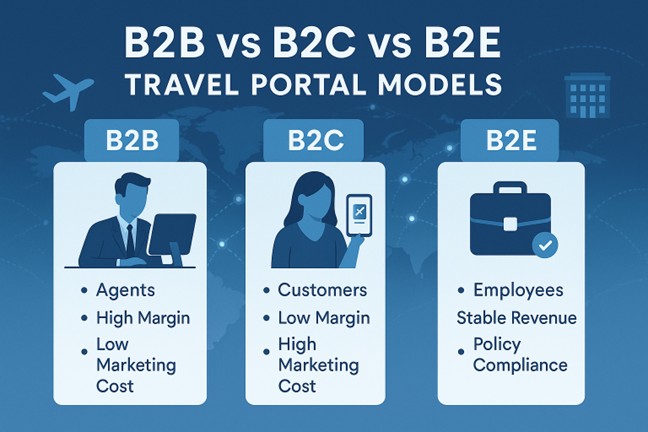
B2B Travel Portal
Serves travel agents, distributors, sub-agents, partners.
Built for margin control, credit cycles, network distribution, and recurring volume.
B2C Travel Portal
Serves end consumers searching for flights, hotels, and holidays.
Built for brand, user experience, pricing competitiveness, and large-scale marketing.
B2E (Corporate Travel Portal)
Serves enterprises with policy-driven travel.
Built for approvals, compliance, budgeting, GST reporting, and analytics.
Full stack B2B, B2C, B2E development:
https://www.amarinfotech.com/travel-technology-solutions.html
3. Deep Flow Architecture: How Each Portal Actually Works
One of the crucial differences between B2B, B2C, and B2E lies in their fundamental operational flow.
Below is a detailed breakdown of how each model behaves internally.
3.1 B2B Flow — High-Control, Multi-Agent, Recurring Revenue
A B2B travel system is built like a digital supply chain. It requires intelligent automation, rate control mechanisms, and strong financial governance.
Detailed B2B Flow (AI-enhanced)
- Agent logs in → system verifies tier, credit, and risk profile
- System fetches net rates from GDS/wholesalers
- AI applies dynamic markup per agent based on volume, season, and risk
- Booking processed through wallet / credit / prepaid mode
- Supplier settlement reconciled daily or weekly
- Agent commission auto-calculated
- AI predicts agent behavior and credit exposure
Operational Characteristics
- High dependency on GDS + Hotel XML
- Low customer support load
- High automation yield
- Very stable volumes
“B2B is the only model where distribution grows even without advertising.”
Best GDS integration partner:
https://travellgds.com/
3.2 B2C Flow — High Volume, High Competition, High Marketing Dependence
B2C portals replicate the MakeMyTrip / Booking.com model, but require deep UX engineering and continuous acquisition spending.
Detailed B2C Flow (AI-enhanced)
- Customer searches publicly → AI personalizes offers
- Engine compares GDS, LCC, wholesalers, hotels
- Payment processed immediately
- Refund + modification queue handled daily
- Loyalty + abandoned-cart automation
- AI suggests upsell/cross-sell items
Operational Characteristics
- High support workload
- Sensitive to conversion-rate fluctuations
- High competition
- Requires brand reputation & marketing budget
3.3 B2E Flow — Enterprise Workflow, Zero Marketing, High Retention
Corporate travel is policy-driven and performance-sensitive.
Detailed B2E Flow (AI-enhanced)
- Employee creates request
- AI checks policy compliance
- Manager/Finance approval auto-routed
- Booking processed within corporate rules
- Cost center, invoice mapping, GST + MIS generated
- AI analyzes savings, compliance gaps, and vendor performance
Operational Characteristics
- Complex logic, but stable revenue
- Long-term enterprise relationships
- No marketing cost
- High data integrity requirements
4. Detailed Profit Margin Comparison (Real 2026 Intelligence)
Below is the most accurate and practical profit analysis for 2026.
4.1 B2B Profit Margins (Highest in 2026)
| Category | Profit Range / Revenue Method | Notes |
| Flights | 2–8% (Net fare + markup) | Depends on airline class, route, season, and volume |
| 0.5–3% (GDS Incentives) | GDS-dependent; based on segment count & productivity | |
| Hotels | 12–35% (Wholesale margins) | Via hotel XML / consolidators |
| 15–45% (Direct contracts) | Higher margins from direct-negotiated inventory | |
| Holidays | 20–45% (Custom packages) | Highest margin category in B2B |
| Other Revenue Streams | Wallet recharge fees | Service charge on agent wallet top-up |
| Sub-agent white-label fees | Setup fees for agent-owned mini portals | |
| Credit interest | Interest on credit limit provided to agents | |
| Why B2B Earns More | Agents accept markups | They re-sell further at their own margin |
| No marketing cost | Zero consumer acquisition cost | |
| High repeat business | Agents book daily/weekly | |
| No seasonal dependency | Network-driven volume stability |
4.2 B2C Profit Margins (Low to Medium)
| Category | Profit Range / Revenue Method | Notes |
| Flights | 0–2% | Extremely competitive due to fare comparison & OTA price wars |
| Hotels | 7–15% | Depends on wholesaler contracts, supplier strength & return policies |
| Packages | 12–25% | Varies based on destination, season, and customization |
| Challenges | Customers price-compare | High transparency reduces markup flexibility |
| Refund & customer support cost | High dependency on CX operations & dispute resolution | |
| Heavy advertising spend | Required for SEO, PPC, Meta ads, and retargeting campaigns |
4.3 B2E Profit Margins (Predictable Contract-Based Revenue)
Revenue Models
- Per booking fee
- Subscription model
- Implementation fee
- Annual maintenance
Profitability Logic
- Zero marketing cost
- Zero refund burden
- Zero price competition
- Extremely long retention (3–7 years)
Best margin type: Predictable, enterprise-level, non-seasonal.
5. Estimated Development Cost (India Pricing Trend)
(Deep-level, realistic 2026 market pricing)
India remains the most cost-efficient and technically capable market for travel portal development. Pricing depends on features, supplier integrations, performance expectations, and security depth.
5.1 B2B Portal Cost (2026)
Rs 6,00,000 – Rs 40,00,000+
Cost Drivers
- GDS + 2–3 hotel XML integrations
- Multi-agent hierarchy
- Wallet + credit + ledger
- White-label module
- Supplier failover routing
- AI-based pricing engine
- B2B mobile app
Maintenance Cost
Rs 25,000 – Rs 1,20,000/month depending on API traffic.
5.2 B2C Portal Cost (2026)
Rs 8,00,000 – Rs 50,00,000+
Cost Drivers
- Advanced UX
- Search caching engine
- Multi-language, multi-currency
- Loyalty + promo engine
- Conversion optimization
- High-traffic-ready infra
- AI personalization layer
Maintenance Cost
Rs 35,000 – Rs 2,00,000/month
5.3 B2E Portal Cost (2026)
Rs 10,00,000 – Rs 60,00,000+
Cost Drivers
- Policy engine
- Multi-level approvals
- Corporate SSO
- Invoice mapping
- Travel budget and MIS
- Audit trails
- Security & compliance
Maintenance Cost
Rs 50,000 – Rs 2,50,000/month
6. Comparison Table (High-Level Overview)
| Feature | B2B | B2C | B2E |
| Users | Agents | Customers | Employees |
| Margin | High | Low | Stable |
| Marketing Cost | Low | High | None |
| Complexity | Medium | High | Very High |
| Repeat Business | Very High | Medium | Very High |
| AI Benefit | Pricing, credit | Personalization | Compliance |
| Best For | Profit growth | Brand scale | Enterprise revenue |
7. Testimonials
Amar Infotech
“Amar Infotech delivered a complete B2B and B2C travel platform for us with exceptional professionalism. Their understanding of travel APIs, AI-driven modules, and real-world booking flows was outstanding. The system performs reliably even under high search volume—exactly what we needed for 2026 and beyond.”
TravellGDS
“TravellGDS guided us through the entire GDS integration process and provided a robust, scalable backend solution. Their API documentation, support team, and portal guidance were excellent. If you need a dependable GDS provider, they are top-tier.”
8. Final Recommendation: Which Portal to Choose in 2026?
Best for Profit & Long-Term Stability → B2B
Best for Enterprise Retention → B2E
Best for Brand Building & Volume → B2C
If resources allow, the strongest long-term strategy is:
- Start with B2B for instant revenue
- Add B2E for stability
- Launch B2C once brand + inventory matures
- Unify into a Hybrid AI Portal by Year 2–3
This is the blueprint followed by the most successful travel businesses globally.