Author: Rog

  • Affordable SEO Tools for Small Businesses: How to Compete Online Without Breaking the Bank


    As a business owner I am competing with big companies for online visibility. They spend thousands of dollars every month on marketing. It can be really tough, especially when I have a budget and do many jobs. The good news is that being online and getting noticed is not just for big corporations anymore. There are genuinely powerful, cheap SEO options available today that give smaller operations a real shot at ranking well and attracting consistent organic traffic without requiring enterprise-level investment.

    The article will discuss what makes SEO tools so important to small businesses, what the cost structure looks like, and how you can make informed decisions on what tools are effective at a fraction of the cost.

    Why SEO Tools Are No Longer Optional for Small Businesses

    A years ago people could still get their name out there by writing on their blog all the time and hoping people would tell their friends. Those days are much more gone now. These days the search engines are really smart. Just putting stuff on the internet is not enough. You need to figure out what words people are using when they search for something, how your website is doing, and what other people in your field are doing. If there are any issues with your website that are stopping it from showing up when people search for something. You have to know all about your website and the search engines to get your website to show up. That is because the search engines are really good at finding out what people want to see.

    SEO tools provide that intelligence. They remove the guesswork from content strategy, allow you to find quick wins and on-page problems, and track your progress. If you’re a small business owner without a team, a good tool is like having your own one-person SEO department, providing information that might take hours of your own research to find.

    The problem is that some of the most popular platforms within this particular niche have price tags that just do not make sense for a business that makes modest revenues. It is for this reason that many owners seek out affordable SEO tools for small businesses as opposed to just seeking out the best SEO tools available.

    What Is the Cost of Popular SEO Optimization Tools

     

    One of the most common questions that business owners ask themselves as they try to determine which option is best for their business is, “What does it cost to utilize popular SEO optimization tools?” This can vary depending on the tools used, as well as whether they are used annually or monthly. This is a general idea of where we are today.

    At the enterprise end of the spectrum, Ahrefs and Semrush are industry standards used by large agencies and in-house teams within large brands. Ahrefs’ prices begin at around $129/month for their Lite plan, while Semrush’s prices begin at around $139/month for their Pro plan. Moz Pro, another well-respected name in the SEO tool market, also starts at around $99/month. These tools are really powerful tools, with large keyword databases and deep backlink data and reporting features. For teams with dozens of clients to manage or large volumes of content to deal with, it may be worth it.

    However, for a local bakery, independent consultant, or direct-to-consumer brand just starting out, paying $1,200 to $1,700 annually for an SEO platform is unrealistic. Many of the tools in the enterprise plan are not used by the smaller user who simply requires access to keyword research, rank tracking, and basic technical audits.

    Quick overview of common SEO tool pricing ranges:

    Enterprise Platforms like Ahrefs, Semrush, and Moz: $99-$449+ per month

    Mid-Tier Tools like Mangools, SE Ranking, and Ubersuggest Pro: $29-$79 per month

    Budget-Friendly and Freemium Tools: $0-$25 per month

    AI-powered Automated Platforms: Starting at as low as $19.99 per month

    Mid-tier tools fill an important middle ground. For instance, Mangools combines keyword research, SERP, and rank tracking features at $29/month for its entry plan. SE Ranking, meanwhile, starts at $44/month for competitive features. These are good tools, and for small teams, these tools are a good balance of cost and capability.

    Budget-Friendly Alternatives That Still Deliver Results

    What has evolved significantly in recent years is that there are genuinely competent budget and AI-based tools that don’t feel like they are in some ways a reduced version of a better tool. The freemium model has evolved significantly: Google Search Console is still the only surefire way to get organic performance data, and it’s free; Google Keyword Planner is free and allows you to get search volume data directly from the world’s largest search engine; and tools such as Ubersuggest offer keyword and competitor data for free or very low cost.

    For small businesses that require constant output of content without having to hire writers or an SEO agency, AI-powered platforms have brought forth an entirely new category of solutions. SEOZilla uses an automated process for content marketing, where it identifies keywords, writes long-form SEO content, and publishes it to your blog at a frequency of your choice, all for $19.99/month and up. This type of automation is a significant advantage for a business owner who understands the importance of creating content but doesn’t have the time and money to devote to it. Of course, the broader idea behind that is that affordable SEO tools for small businesses have never been more powerful than they are today.

    The larger idea behind that, of course, is that affordable SEO tools for small businesses have never been more powerful than they are today. The difference between what can be done with a $20 monthly tool today versus five years ago is significant, largely due to the fact that advances in artificial intelligence have made it cheaper to produce intelligent, context-aware analysis and content.

    Comparing Expensive Tools With Affordable Alternatives

    It should be noted that one should be honest with oneself about what one gives up by choosing the budget version over the premium version of the platform. The major enterprise tools offer more extensive backlink databases, more detailed competitive analysis, and more sophisticated filtering options. If you are running a high-end e-commerce site with thousands of pages and need detailed technical crawls on demand, the expense of a Semrush or Ahrefs subscription might be worthwhile.

    Of course, most small businesses are not in that position. They have a limited number of pages, a small audience, and a handful of core keywords that they actually need to rank for. In that case, the question changes from “what tool is the best?” to “what tool gives me 80 percent of what I need at 20 percent of the price?”

    Ubersuggest Pro includes keyword research and basic site audit features at a small fraction of the cost of its competitors’ enterprise solutions. SE Ranking provides rank tracking, on-page SEO checks, and competitor research in a clean UI without the high monthly costs. Mangools has a clean UI and is great for business owners who are not super tech-savvy but need accurate keyword and rank information.

    The strategy of using two or three complementary affordable tools, rather than relying on one expensive platform, is one strategy that many experienced SEO experts recommend that businesses, especially ones that are resource-constrained, should consider. Using Google Search Console, along with a mid-tier keyword tool, and an AI platform for content automation, for instance, covers most of what most small businesses actually need to succeed over time.

    How Small Businesses Can Start Competing Effectively Online

    Small business team reviewing online growth strategy and SEO performance


    The companies that tend to punch above their weight in organic search tend to have a number of similar characteristics. They tend to publish content regularly, and search engines reward fresh content and penalize stale content. They have a niche instead of competing with everyone in their industry. They have a focus on the technical aspects, such as page speed, being responsive to mobile devices, and optimizing title tags and descriptions.

    Most importantly, they realize that SEO is an investment, not a band-aid. The businesses that have seen the most dramatic results are the ones that have invested in six to twelve months before seeing significant movement in their rankings. It’s easier to have patience in SEO when your tooling costs are low, and you’re not waiting for results to appear before spending money.

    Affordable SEO tools for small businesses have, in fact, been designed to help make that sort of effort possible in the first place, and that is exactly the point. Today, the environment favors brains over bucks, and that, in itself, is wonderful news for anyone willing to put in the effort.

    Final Thoughts

    The idea that SEO needs expensive software and a team to do it effectively is a thing of the past. From the availability of mature freemium tools and viable mid-tier tools that offer all the functionality for under $50/month to new AI-based tools that can automate entire processes for under $25/month, small businesses can now compete using the same underlying intelligence and execution that their larger competitors have had access to.

    Knowing what the cost is for some of the more popular SEO optimization tools is important, not necessarily because you want to find one that is the most expensive, but because it allows you to understand if the cost for a certain tool is worth it. What is important for a solo founder or a ten-person team is very different from what is important for a 200-person marketing team.

    Start with your real needs, such as consistent content, ranking tracking, basic technical auditing, and keyword research. Then find tools that satisfy those needs without overcomplicating things. This is the disciplined approach to tooling that will help separate successful small businesses with organic visibility from those that remain invisible.


  • Real Estate Investors Shift to Multi-Asset Portfolio Analysis, eFinancialModels Reports

    As property portfolios grow in size and complexity, investors are moving beyond single-asset analysis — and rigorous portfolio-level financial modelling is becoming essential to sound decision-making.

    ZURICH, SWITZERLAND — March 17, 2026 — Real estate investors are increasingly moving beyond single-asset thinking. As property portfolios grow in size and complexity, the ability to consolidate performance across multiple assets, property types, and financing structures has become a critical planning challenge. eFinancialModels is seeing this shift reflected in demand across its real estate financial model template library — investors, family offices, and developers are actively seeking financial models that go beyond individual property analysis and give them a true portfolio-level view.

    The gap is well known in the industry. Owners of multiple properties often track each asset in isolation, with no single framework that consolidates rental yields, financing costs, vacancy assumptions, and capital appreciation into a coherent picture of total portfolio performance. That blind spot becomes costly when making decisions about where to invest further, where to refinance, and when to exit.

    “A portfolio is not just a collection of properties — it is a financial position that needs to be actively managed. The investors who come to us want to see the full picture: how each asset contributes to total returns, how leverage affects the portfolio, and how sensitive their position is to changes in rents or interest rates. That requires a proper model, not a spreadsheet cobbled together asset by asset.”

    — Cyrill Haenni, Founder of eFinancialModels

    What Real Estate Portfolio Analysis Requires

    Managing a real estate portfolio means making decisions across multiple assets simultaneously — and each decision depends on understanding how individual properties interact at the portfolio level. The financial dimensions that matter most are:

    • Investment analysis: Every acquisition needs to be evaluated on entry yield, total acquisition cost, and financing structure before it joins the portfolio. Modelling these inputs consistently across assets is what makes like-for-like comparison possible.
    • Property yields: Gross yield, net yield, and yield on cost need to be tracked separately — they tell different stories about asset performance. A property that looks attractive on gross yield may show weak net yield once operating costs and vacancy are modelled in.
    • Exit modelling: Return on a real estate investment is only fully realised at exit. Modelling IRR, equity multiple, and capital gains at both the asset and portfolio level — across a range of sale timing assumptions — is what allows investors to plan disposals strategically rather than reactively.
    • Buy-and-hold vs. buy-and-flip: These two strategies have fundamentally different cash flow profiles, financing requirements, and return horizons. Comparing them side by side within the same model is how investors stress-test their strategy choice and identify which approach generates the better risk-adjusted return for a given asset.
    • Leverage and financing structure: LTV ratios, mortgage terms, and refinancing timelines vary across assets and interact at the portfolio level. Modelling these together reveals concentration risk and refinancing exposure that is invisible when assets are tracked in isolation.
    • Stress testing: Interest rate moves, rental market softness, and occupancy shocks rarely affect just one asset. Scenario analysis across the full portfolio is the only way to understand true downside exposure.

    With interest rates remaining a live variable in most property markets and investors facing increasingly complex decisions about when to hold, refinance, or exit, the demand for portfolio-level financial clarity is growing. eFinancialModels provides the modelling tools investors, family offices, and developers need to manage their real estate positions with the same rigor they would apply to any other asset class.

    For more information, visit www.efinancialmodels.com.

    About eFinancialModels

    eFinancialModels is a premier online marketplace offering a wide array of industry-specific financial model templates in Excel and Google Sheets. Catering to entrepreneurs, investors, and executives worldwide, the platform provides expertly designed tools to support financial planning, analysis, and strategic decision-making — helping project teams translate their vision into rigorous, investor-grade financial plans.

    To learn more, visit https://www.efinancialmodels.com

    For the latest updates, follow eFinancialModels on social media:

    Facebook: @efinancialmodels

    Twitter/X: @efinancialmodel

    Instagram: @efinancialmodels

    Media Contact
    Company Name: eFinancialModels
    Contact Person: Cyrill Haenni, Founder & Managing Partner
    City: Zurich
    Country: Switzerland
    Website: https://www.efinancialmodels.com

  • The End of ‘Set and Forget’ Advertising: PantoSource on Why Data Quality Is the New Competitive Advantage

    As ad platforms automate everything from targeting to creative, the brands that win will be the ones feeding the best data

    MIAMI, FL — March 16, 2026 — For years, digital advertising followed a predictable playbook: set your targeting, upload your creative, adjust your bids, and let the campaigns run.

    That era is ending.

    In 2025, Meta Platforms Inc. (NASDAQ: META) made Advantage+ the default for all new campaigns. Alphabet Inc. (NASDAQ: GOOGL) launched AI Max and expanded Performance Max. TikTok’s Smart+ adoption surged from 9% to 42% of US performance campaigns in a single year.

    The message from every major ad platform: automation is no longer optional. It’s the baseline.

    The Automation Default

    The transition happened faster than most advertisers expected.

    Meta’s Advantage+ now handles targeting, placements, budget distribution, and creative optimization automatically. Google’s AI Max generates headlines tailored to each user’s search query in real time. TikTok’s Smart+ automates targeting, creative testing, and delivery — with advertisers seeing an average 36% drop in cost per acquisition.

    Mark Zuckerberg told Stratechery in May 2025: “We’re going to get to a point where you’re a business, you come to us, you tell us what your objective is, you connect to your bank account, you don’t need any creative, you don’t need any targeting demographic.”

    The New Competitive Landscape

    When every advertiser uses the same AI-powered systems, traditional advantages disappear.

    The media buyer who mastered bid adjustments? The platform handles that now. The targeting expert who found niche audiences? The algorithm finds them faster. The creative director running A/B tests? AI generates and tests variations automatically.

    The question becomes: what’s left to compete on?

    Data as the Differentiator

    The answer is data — specifically, the quality and completeness of the signals you provide to these automated systems.

    AI-powered platforms optimize based on the data they receive. If the system can’t see that a purchase occurred, it can’t learn from it. If it receives incomplete data, it optimizes against incomplete information.

    Meta measures signal quality through Event Match Quality scores. Google evaluates Enhanced Conversions. TikTok monitors Events API data quality. All three platforms have built systems to score advertiser data — a clear indication that data quality affects performance.

    The challenge: privacy changes have degraded the data flowing to these platforms. Browser restrictions, ad blockers, and iOS App Tracking Transparency have created gaps where 40-60% of e-commerce conversions are invisible to ad platforms — a gap that compounds as AI systems learn from incomplete patterns.

    The Strategic Shift

    The brands adapting to this reality are treating data differently.

    Instead of viewing tracking as a technical checkbox, they’re treating it as a strategic priority. Instead of relying solely on browser-based pixels, they’re capturing sales data directly from their e-commerce backends. Instead of sending raw transaction data, they’re enriching it before it reaches the ad platforms.

    Server-side tracking and Conversions APIs improve data delivery, but they don’t fix incomplete signals. Enrichment goes further — capturing conversions that pixels miss entirely and attaching context like customer lifetime value and purchase frequency before the data reaches the platform.

    By shifting to a data-first strategy, brands build “signal resilience” — a data pipeline that remains active even as browser-based cookies continue to vanish.

    The role of the performance marketer evolves from “optimizer” to “algorithm trainer.” The job isn’t to beat the algorithm anymore. The job is to feed it better than your competitors do.

    For the CEO, this is no longer a marketing department problem. It’s a data infrastructure problem that directly impacts the bottom line.

    What This Means for E-Commerce

    For e-commerce brands worldwide — whether powered by Shopify, WooCommerce, BigCommerce, or custom platforms — this shift toward backend data capture is becoming a prerequisite for sustainable growth.

    Data-starved campaigns waste budget on audiences the algorithm can’t properly optimize. Every dollar spent on incomplete signals is a dollar that could have driven actual revenue. Signal resilience isn’t just a technical advantage; it’s how brands protect their margins in an increasingly automated advertising landscape.

    Brands with clean, enriched data flowing to ad platforms will see their AI-powered campaigns outperform competitors with data gaps. The advantage compounds over time as algorithms learn from richer signals.

    The era of “set and forget” advertising is over. But what’s replacing it isn’t more manual work — it’s a different kind of work: ensuring the automated systems have everything they need to succeed.

    The immediate priority for e-commerce brands: audit your data pipeline. What percentage of actual sales are visible to your ad platforms? Where are the gaps? The brands that answer those questions first will be the ones that win.

    About PantoSource


    PantoSource is an AI-powered tracking platform that recovers and enriches the e-commerce data most brands never see. By delivering complete, enriched data to Meta, Google, TikTok, and other ad platforms, PantoSource helps brands get better ad performance and scale profitably. Setup with Shopify, WooCommerce, and other platforms takes under five minutes. 

    Capture. Enrich. Scale. 

    For more information, visit PantoSource.com.

    Media Contact

    Company Name: PantoSource
    Email: media@pantosource.com
    Website: PantoSource.com

  • RUMOR: GRO95Z AI Testing ‘OmniPay’ — A Next Gen Universal Crypto Payment Tool?

    Unconfirmed reports suggest GRO95Z AI may be developing a technology-forward payment tool designed to handle transactions worldwide. This article explores the rumor, the potential tech behind it, and what such a product could mean for global payments and crypto adoption.

    Rumor Overview

    A growing number of community whispers and speculative threads claim that GRO95Z AI — the AI-token project focused on decentralized intelligence services — is secretly researching and trialing an experimental payment system, tentatively referred to in rumor circles as “OmniPay” (name unconfirmed). According to unverified chatter, this system aims to function as a universal wallet and micropayment layer capable of settling payments across fiat, stablecoins, and multiple blockchain networks with near-instant finality.

    Important: These are rumors and have not been officially announced by GRO95Z. Treat the details below as speculative and unverified.

    What ‘OmniPay’ Would Claim to Do (Rumored Features)

    Cross Chain Atomic Settlement – Instantly swap value between blockchains using on the fly bridging or atomic swap techniques without leaving the wallet.

    Adaptive Payment Routing – An intelligent routing layer that chooses the cheapest/fastest settlement path (on chain, layer 2, or off chain rails) in real time.

    Fiat On Ramp & Off Ramp Integrations – Plug and play connectors to local payment rails enabling instant conversion between fiat and crypto.

    Programmable Microtransactions – Metered per use billing (APIs, AI queries, streaming payments) with low-fee micropayments and automated invoicing.

    Identity Preserving KYC Flows – Privacy-first identity solutions that enable regulatory compliance only when necessary, using zero knowledge proofs or selective disclosure.

    AI Driven Fraud Detection – Machine learning models to detect anomalous spending patterns, front running, or other attack vectors in real time.

    Token Agnostic Wallet – Hold, manage, and use NFTs, stablecoins, and native tokens seamlessly, with a single UX for payments.

    Possible Technical Architecture (Speculative)

    If GRO95Z were to build a system like OmniPay, the likely architecture might combine several advanced components:

    Payment Orchestration Layer – A middleware that routes transactions across L1s, L2s, and off chain rails, using liquidity pools and smart contracts for instant settlement.

    State Channels & Payment Channels – To enable high-frequency micropayments, the system could rely on bidirectional state channels or rollup style batching.

    Cross Chain Bridges & Relayers – Secure bridging tech (ideally audited and modular) to move assets without creating large attack surfaces.

    AI Powered Decision Engine – GRO95Z’s AI layer could optimize routing, exchange rate selection, and risk assessment in milliseconds.

    Decentralized Liquidity Pools – On chain pools or off chain market makers that give the system instant access to convert tokens and fiat equivalents.

    Positive Impacts on Crypto & Payments

    While still hypothetical, a successful OmniPay product could accelerate a number of positive developments in crypto and global payments:

    Mass Onboarding: A frictionless universal wallet that de mystifies crypto for end users could onboard millions into token economies.

    True Micropayments Economy: Enabling cheap per use billing could unlock new business models — pay per paragraph, API calls, streaming content fees, and IoT micropayments.

    Interoperability Boost: If cross chain settlement becomes seamless, projects will interoperate more easily, reducing fragmentation across ecosystems.

    New Use Cases for Tokens: Native tokens could gain real daily utility as medium of exchange, not just speculative assets.

    Resilience in Unstable Economies: Instant conversion rails could help users in volatile fiat regions preserve value or pay for critical services.

    Innovation in DeFi & Web3 Commerce: Automated invoicing, programmable subscriptions, and tokenized receipts could reinvent e commerce and services.

    How the Market Might React

    Markets often price in potential utility and network effects. Rumors of a universal payment tool from an AI driven crypto project could produce:

    Speculative Buying — Short term token price run ups as traders price in future utility.

    Partnership Interest — Payment processors, exchanges, and infrastructure providers may approach for integrations.

    Competitive Responses — Other projects may accelerate similar payment UX initiatives.

    Regulatory Scrutiny — Authorities may begin dialogues to ensure consumer protections.

    Disclaimer: Rumor vs. Reality

    This article describes circulating rumors and speculative scenarios. GRO95Z has not confirmed an OmniPay project publicly. Readers should treat the information here as unverified. Always do your own research and avoid making financial decisions based solely on rumors.

    Conclusion

    The idea of an AI-enabled universal payment wallet bridging fiat and crypto is compelling and fits natural trajectories for AI + blockchain convergence. If GRO95Z or any other AI-token project is indeed experimenting with such a tool, the long-term implications could be transformative — but success depends on technology, liquidity, regulation, and security. For now, the story remains a rumor worth watching.


  • Treebark Termite and Pest Control Strengthens Digital Presence with New Marketing Hire at Newport Beach Office

    Newport Beach, CA – March 16, 2026 – Treebark Termite and Pest Control, the trusted leader in professional pest controltermite control, and exterminator services near me throughout Orange County, today announced the hiring of a new marketing professional who will operate directly from the company’s Newport Beach location. The strategic addition is designed to expand local search visibility and make it even easier for homeowners and businesses searching for “pest control near me,” “termite control Newport Beach,” and “exterminator Orange County” to connect with fast, reliable, and eco-friendly solutions.“We’re thrilled to welcome our new marketing team member to the Newport Beach office,” said Aaron Cunningham, Founder of Treebark Termite and Pest Control. “This hire reflects our commitment to serving the growing demand for expert pest control and termite control in Newport Beach and surrounding communities. By strengthening our online presence, we can help more families and businesses quickly find the same high-quality exterminator near me service our clients have relied on for years. The current marketing professional will focus on local SEO, Google Business Profile optimization, content creation, and targeted digital campaigns centered on the Newport Beach office. This will directly benefit residents and commercial properties searching for top-rated pest control in Newport Beachtermite inspection, and treatment, and same-day exterminator services near me in the area. Treebark Termite and Pest Control has built a powerful reputation across Orange County for safe, effective, and affordable solutions, including:

    Termite control & inspection

    ·General pest control (ants, spiders, rodents, bed bugs, etc.)

    ·Commercial pest management

    ·Preventative treatments

    With the current marketing expert now based in Newport Beach, the company is poised to deliver even faster response times and hyper-local support to the coastal communities it serves.

    About Treebark Termite and Pest Control

    Treebark Termite and Pest Control is a family-owned and operated pest management company proudly serving Newport Beach, Anaheim, Orange County, and surrounding areas. Known for honest pricing, eco-friendly methods, and outstanding customer service, Treebark specializes in pest controltermite control, and reliable exterminator services near me that protect homes and businesses year-round.  

     Media Contact:

    Aaron Cunningham
    Owner / Founder
    Treebark Termite and Pest Control
    Phone: 1-714-409-5500
    Email: info@treebarktermiteandpestcontrol.com
    Website: treebarktermiteandpestcontrol.com

    Newport Beach Office Location: Treebark Termite and Pest Control, 260 Newport Center Dr, Suite 100, Newport Beach CA 92660

    714-409-5500

    Follow Us

    Google Map

    Business Site

    Facebook

    Twitter

  • GRO22V Expands Its DeFi Ecosystem With AI-Powered Solutions for 2026


    As artificial intelligence continues to redefine decentralized finance (DeFi), GRO22V stands out as a next-generation ecosystem that integrates AI-driven automation, cross-chain scalability, and user-focused token utility. According to the official GRO22V website (https://grok-network.net), the project is preparing to roll out an expanded DeFi infrastructure throughout 2026 — powered by intelligent algorithms and designed to connect users, data, and liquidity seamlessly.

    A Smarter Approach to DeFi

    Traditional DeFi systems often rely on manual trading, yield farming, or staking strategies. GRO22V reimagines this model with artificial intelligence at its core — offering predictive insights, adaptive yield optimization, and autonomous portfolio management through its AI enhanced architecture.

    The goal is to create an economy where decentralized smart contracts interact with AI modules that learn from real-time data, allowing for automated decision-making and dynamic asset reallocation without centralized intervention.

    Core Components of the GRO22V Ecosystem

    • AI Enhanced Analytics: GRO22V integrates machine learning algorithms that analyze blockchain metrics, user sentiment, and liquidity flows to provide intelligent recommendations.
    • Smart Payment Layer: A built in payment infrastructure that supports ultra low latency, multi chain transactions using adaptive routing powered by AI.
    • Cross Chain Interoperability: GRO22V’s network is compatible with major blockchains such as Ethereum, BNB Chain, and Base, allowing liquidity and assets to move freely across ecosystems.
    • Decentralized Governance: Token holders participate in decision making through the GRO22V DAO, influencing roadmap milestones and DeFi integrations.
    • Sustainability by Design: AI resource allocation reduces redundant computation, improving both speed and energy efficiency across DeFi applications.

    Tokenomics and Growth Strategy

    The $GRO22V token underpins the network’s operations and incentivizes participation. With a total supply of 1 billion tokens, its tokenomics model is structured to support long-term growth rather than short-term speculation.

    Fifteen percent of the total supply is allocated to the presale phase, offering early backers up to 200% in bonus rewards. Other allocations are designed for staking rewards, ecosystem expansion, exchange liquidity, and DAO governance.

    This balanced design allows GRO22V to maintain strong liquidity post launch while rewarding community engagement and DeFi adoption.

    AI Integration for the 2026 DeFi Landscape

    GRO22V’s 2026 roadmap centers around merging artificial intelligence and financial automation. The project plans to release several AI powered modules — including algorithmic liquidity management, predictive yield analytics, and decentralized AI data marketplaces.

    These modules are expected to enhance DeFi scalability by automating core financial functions and enabling AI systems to interact directly with decentralized protocols. This vision represents a shift from passive DeFi platforms toward self learning, self optimizing ecosystems.

    Positioning for Growth in 2026

    With the growing investor appetite for AI based tokens and DeFi automation, GRO22V’s strategic timing couldn’t be better. The project aligns itself with two dominant narratives — artificial intelligence and decentralized finance — positioning $GRO22V as a potential top performer in the upcoming bull run.

    While partnerships with other AI and blockchain entities have yet to be formally announced, the team’s roadmap emphasizes open collaboration and technological transparency. By focusing on real utility and measurable performance, GRO22V sets itself apart from hype driven tokens and positions its ecosystem for sustainable adoption.

    Final Thoughts

    GRO22V’s expansion into AI powered DeFi solutions represents a forward looking approach to blockchain innovation. Its blend of AI enhanced payments, smart contract automation, and multi chain integration has the potential to redefine how decentralized finance operates.

    Although some details remain unverified — particularly regarding future partnerships and AI module release dates — the publicly available roadmap demonstrates a clear commitment to innovation, transparency, and scalability. As DeFi continues to evolve, GRO22V may stand at the forefront of the next generation of intelligent financial ecosystems.


  • How a Tesla Storage Battery Can Power Your Home Smarter

    A Tesla storage battery is changing the way homes in Nerang use electricity. As energy bills rise and the need for reliable power grows, more families are turning to smarter solutions. Tesla’s Powerwall is one of the most trusted battery options available. It stores solar energy during the day and powers your home at night.

    In this blog, we’ll explain how Tesla batteries work, how much they cost, and why they’re a smart investment in Nerang. You’ll also find answers to the most common questions homeowners ask about Tesla battery storage and solar power Tesla solutions.

    Why Tesla Battery Storage Makes Sense in Nerang

    Nerang gets a lot of sun. That makes it a perfect location for solar panels and battery storage. When you pair solar panels with a Tesla storage battery, your home becomes more energy independent. You use less from the grid and save more money.

    Here’s how it works:

    • Solar panels create electricity during the day.
    • A Tesla storage battery stores the extra energy.
    • That energy powers your home when the sun goes down.
    • If the grid goes down, the battery can keep your lights and appliances on.

    This means your home is more secure, more efficient, and less tied to rising power prices.

    What Is Tesla Battery Storage?

    Many people ask, “What is Tesla battery storage?” It’s a simple idea. Tesla’s battery, called the Powerwall, is a home battery system. It stores energy for later use.

    Tesla batteries are smart. They track how much power your solar system makes and how much your home uses. Then, they decide the best time to charge or discharge. You can also track your battery’s performance with a mobile app.

    In short, Tesla battery storage gives you more control over your energy use. It helps you lower your power bills and keeps your home running, even during an outage.

    Benefits of a Tesla Storage Battery in Nerang

    Here are the main benefits of adding a Tesla storage battery to your solar system:

    1. Energy Savings

    With a battery, you use more of your own solar energy instead of sending it back to the grid. This means lower electricity bills every month.

    2. Backup Power

    Power outages can happen during storms or heatwaves. A Tesla battery gives you backup power when the grid goes down.

    3. Smarter Energy Use

    Tesla batteries work with smart technology. You can monitor and control your energy use from your phone.

    4. Greater Energy Independence

    You rely less on energy retailers. This gives you peace of mind when prices go up.

    How Much Does a Tesla Storage Battery Cost?

    One of the top questions we hear is, “How much does a Tesla storage battery cost?” In 2025, a single Tesla Powerwall costs between $12,500 and $16,000 in Australia. This includes the battery, installation, and basic setup.

    The final price depends on:

    • Your home’s size and energy needs
    • Installation complexity
    • Whether it’s added to a new or existing solar system
    • Your location in Nerang

    At Energy Solution Centre, we offer free quotes for homes in the 4211 area. We also help you understand your payback period and return on investment.

    How Much Is a Tesla Powerwall in Australia?

    This question is similar to the one above, but deserves its own answer. “How much is a Tesla Powerwall in Australia?” In general, the Powerwall alone costs around $9,000 to $10,000. But this price is only for the battery itself.

    You also need to account for:

    • Inverter (if required)
    • Installation fees
    • Monitoring setup
    • Support and warranty coverage

    In total, most homeowners in Nerang pay between $12,500 and $16,000 for a complete Tesla Powerwall system.

    Why Did Tesla Stop Selling Powerwall?

    You may have heard this question before: “Why did Tesla stop selling Powerwall?”

    Here’s the truth. Tesla did not stop selling Powerwall. However, for a time, they limited how you could buy it. Tesla made the Powerwall available only when purchased with Tesla’s solar panels through their direct channels. This caused confusion.

    Now, many certified installers like Energy Solution Centre in Nerang offer Powerwall as a standalone option. That means you don’t need to use Tesla solar panels. You can add Powerwall to your existing system or include it with any new solar setup.

    How Tesla Battery Fits with Solar Power in Nerang

    Nerang has high sun exposure. A lot of homes here already have solar panels. If you have solar, but no battery, you may be losing money. That’s because you send unused energy back to the grid for a small feed-in tariff.

    A Tesla storage battery helps you store that extra energy instead. You can use it later when the sun is down, or during a blackout.

    This makes your solar system more valuable. You use more of your own energy and rely less on the grid.

    To explore a related battery solution page, you can also view our solar battery for house page.

    How Tesla Battery Helps You During Blackouts

    In Nerang, storms and grid outages happen. With a Tesla battery, your home can keep running even if the grid fails.

    You can power:

    • Lights
    • Fridge and freezer
    • Internet
    • Phone chargers
    • Medical equipment

    The Tesla app also tells you when your system switches to backup mode. This gives you peace of mind and helps you plan.

    How the Installation Process Works

    If you’re thinking about installing a Tesla battery, here’s what to expect:

    Free home visit

    We check your solar system and energy usage.

    System design

    We choose the right size and layout for your home.

    Quote and approval

    You get a clear cost breakdown.

    Installation

    Our team installs the Tesla battery at your home.

    Monitoring setup

    You get access to the Tesla app.

    Support and updates

    We’re based in Nerang, so we’re here when you need us.

    We also have a full solar and battery showroom in Nerang, where you can explore working systems before deciding what’s right for your home.

    We handle everything from start to finish. We also offer support if you already have solar panels and want to add a battery.

    What Makes Tesla Battery Different from Others?

    There are many battery brands on the market. So why choose Tesla?

    • Trusted brand – Known for innovation and quality
    • Built-in inverter – Saves space and cost
    • Smart app – Real-time monitoring
    • High capacity – One unit stores 13.5 kWh
    • Seamless backup – Auto-switch during outages

    Tesla is also focused on long-term support. That’s why many families in Nerang ask for it by name.

    Real Case Study: Family in Nerang Cuts Grid Use by 85%

    The Walker family had a 6.6 kW solar system but no battery. Their bills were still over $300 per quarter. We installed a Tesla Powerwall for them.

    Now, they use stored power at night and during peak times. Their new bills are under $60 per quarter. They also stayed fully powered during the last blackout in their area.

    They shared that the system gives them more control and peace of mind. And they love checking their app to see how much solar they use daily.

    Is Tesla Battery Right for Your Home?

    If you want:

    • Lower power bills
    • Backup power during outages
    • More control over your energy use

    Then yes, a Tesla battery is a great choice. It’s perfect for homes in Nerang with solar panels, or for new solar installs.

    We can help you figure out if it’s a good fit. We’ll also show you the numbers so you know what to expect.

    Get Started with a Tesla Storage Battery in Nerang

    At Energy Solution Centre, we install Tesla Powerwall systems across Nerang and nearby areas. We’re local, experienced, and ready to help.

    Plus, we have a full solar and battery showroom in Nerang, so you can see the technology in action before you make a decision.

    Here’s what you get:

    • Free home energy check
    • Honest advice
    • CEC-accredited installers
    • Ongoing support after install
    • Competitive prices with no hidden fees

    Address: 19 Price St, Nerang QLD 4211
    Phone: 1300 217 079
    Website: energysolutioncentre.com.au

    You can also visit our Google Business Profile.

    Call today or request a quote online. Let’s make your home smarter with solar and battery storage.

  • Leading German Websites for Krypto-Nachrichten and Market Insights

    Cryptocurrency adoption across Europe has shifted from a fringe conversation to a serious topic in boardrooms, investment committees and household financial planning discussions alike. Germany, in particular, has emerged as one of the continent’s most active markets for digital asset participation, driven by a relatively progressive regulatory environment, a tech-savvy investor base and growing institutional interest from major financial institutions. As more capital enters the space and the stakes for well-informed decision-making rise accordingly, the question of where to find reliable, context-rich and timely Krypto-Nachrichten has never been more consequential. This article maps out the most important German-language crypto news platforms, examines what each one brings to the table, and explains how investors can use them strategically to stay ahead in a market that never stands still.

    The Growing Importance of Crypto News Platforms in Germany

    Few financial markets demand as much ongoing attention as cryptocurrency. Unlike traditional equity markets that operate within set trading hours and respond primarily to corporate earnings cycles and macroeconomic indicators, crypto markets run continuously and react to an unusually wide variety of triggers. A single regulatory filing, a protocol upgrade announcement, a shift in central bank rhetoric or an unexpected move by a major institutional player can send prices sharply in either direction within a matter of hours.

    For German investors navigating this environment, the challenge is not finding information but finding the right information. The sheer volume of daily content published across blogs, social channels and aggregator websites makes it genuinely difficult to distinguish between market-moving intelligence and noise designed to provoke emotional reactions. Trustworthy German-language news platforms address this challenge by applying editorial standards, sourcing practices and contextual depth that filter out the noise and surface what genuinely matters. Investors who build their information routine around high-quality platforms are measurably better positioned to make calm, evidence-based decisions than those who rely on unvetted social feeds or single-source reporting.

    BTC-Echo: One of the Most Influential German Crypto Media Platforms

    BTC-Echo has held its position as the most widely read German-language crypto news outlet for several years running and has earned that standing through consistent quality and editorial independence. The platform covers the full spectrum of the crypto market: daily price analysis for Bitcoin and Ethereum, regulatory developments at the national and European level, DeFi ecosystem updates, NFT market trends, institutional adoption stories and in-depth explainers on blockchain technology.

    What gives BTC-Echo particular credibility among experienced investors is the deliberate separation it maintains between factual reporting and opinion content. Readers always know whether they are reading a verified news piece or a columnist’s personal analysis. The platform’s educational offering is equally strong; structured courses, video content and a searchable archive make it a resource that serves both newcomers and seasoned market participants. For anyone trying to understand how regulatory decisions coming out of Brussels or Berlin will reshape the operational landscape for digital assets in Germany, BTC-Echo remains the most thorough and consistently reliable starting point in the German-speaking world.

    Financial journalist reviewing live Bitcoin market data across multiple professional monitors

    Bitcoin2Go: Simplifying Cryptocurrency for New Investors

    Bitcoin2Go has built its reputation on a straightforward premise: the crypto market should be accessible to anyone willing to learn, not just those with a background in computer science or financial markets. The platform translates complex concepts into plain, practical language without sacrificing accuracy or depth. Articles explaining how blockchain consensus mechanisms work, what determines the value of different cryptocurrencies, how to evaluate the security of a digital wallet and what distinguishes reputable exchanges from unreliable ones are presented in a format that guides rather than overwhelms.

    Beyond its educational foundation, Bitcoin2Go publishes regular market updates and price commentary on Bitcoin, Ethereum and a rotating selection of altcoins that are currently generating meaningful trading volume or development activity. These pieces are carefully framed to give readers context alongside the data; rather than simply stating that a coin has risen or fallen, the platform explains the market conditions, sentiment shifts or news events that contributed to the move. For investors who are still building their foundational knowledge while simultaneously participating in the market, this combination of education and live commentary makes Bitcoin2Go one of the most useful platforms available in German.

    IT Boltwise: Technology-Focused Coverage of Blockchain Innovations

    IT Boltwise occupies a distinctive niche in the German crypto media landscape by approaching digital assets primarily as a technology story rather than a financial one. The editorial focus sits firmly on the infrastructure layer: protocol developments, Layer-2 scaling progress, smart contract frameworks, blockchain startup activity and the intersections between crypto technology and adjacent fields such as artificial intelligence, decentralized identity and supply chain management.

    This orientation makes IT Boltwise particularly valuable for investors with a long-term horizon who understand that the price of a crypto asset is ultimately a function of the technological foundation beneath it. Knowing whether a network’s development team is executing on its roadmap, whether a proposed upgrade addresses genuine scalability constraints or whether a new cross-chain bridge introduces meaningful security risks are questions that require technical literacy to answer properly. IT Boltwise provides that technical depth in a format that is rigorous without becoming impenetrable, making it an ideal companion source for investors who want to look beyond charts and assess the underlying merit of what they own.

    finanzen.net: Traditional Finance Platforms Expanding Into Crypto

    finanzen.net has long been one of the most visited financial information portals in the German-speaking world, serving millions of readers who use it to track stock prices, bond yields, commodity markets and macroeconomic data. Over recent years, the platform has made a deliberate and substantial expansion into cryptocurrency coverage, recognizing that its core audience of traditional investors increasingly wants to understand how digital assets fit into the broader financial picture.

    The distinguishing strength of finanzen.net in the crypto context is precisely its roots in conventional financial media. Bitcoin is not covered in isolation here; it is discussed in relation to interest rate cycles, equity market sentiment, inflation expectations and the macroeconomic variables that influence all risk assets simultaneously. For investors who hold diversified portfolios that include both traditional and digital assets, this integrated perspective is genuinely rare and genuinely useful. The platform offers live price feeds, technical chart tools, an international news aggregation function and commentary from analysts who approach crypto with the same valuation discipline they would apply to any other asset class.

    Investor tip: Relying on a single news platform creates blind spots. The most informed investors cross-reference multiple sources with different editorial priorities; comparing how a development is reported across a technology-focused outlet, a market-analysis platform and a traditional finance portal gives you a far more complete and balanced picture than any single source can provide.

    Among the newer platforms gaining genuine momentum in the German-language crypto information space, Krypto-Nachrichten.com has attracted a growing readership specifically because it addresses one of the market’s most persistent problems: too much content, too little signal.

    Krypto-Nachrichten: A Modern Source for Crypto News and Market Updates

    The proposition that Krypto-Nachrichten.com has built its platform around is straightforward and increasingly compelling: investors do not need more crypto news, they need better crypto news. The platform uses AI-powered curation to monitor and analyze sources from around the world in real time, surface the developments that genuinely move markets and present them in a structured, readable format that respects the reader’s time and intelligence.

    The editorial scope covers the full range of topics that matter to active crypto participants. Bitcoin and Ethereum market dynamics, developments across the altcoin and DeFi ecosystems, institutional adoption trends, regulatory shifts in Germany and across the European Union, and the macroeconomic conditions that shape broader crypto market cycles all receive regular, focused attention. What makes this coverage stand out is not the volume of articles but the deliberate effort to provide context alongside each development. A regulatory announcement is not just reported; it is explained in terms of what it means for German investors specifically. A market movement is not just described; it is placed within the longer-term trend that frames it.

    The platform’s stated mission of delivering clarity over volume resonates strongly with investors who have grown frustrated by the relentless pace and inconsistent quality of information that characterizes much of the crypto media landscape. For anyone who wants to stay genuinely informed without spending hours filtering through redundant or low-value content, Krypto-Nachrichten.com represents one of the more thoughtful and investor-oriented options currently available in German-language crypto media.

    Cryptocurrency market insights and blockchain network data visualization for investor analysis

    AI-curated news filtering is reshaping how serious investors consume cryptocurrency market information.

    What Makes a Good Crypto News Website

    Given the range of platforms now operating in the German crypto media space, it is worth establishing clear criteria for evaluating any source before making it a regular part of your information routine. The first criterion is transparency: does the platform disclose who writes its content; are commercial relationships and affiliate arrangements clearly labeled; is there a verifiable editorial team with identifiable professional backgrounds? Platforms that operate without clear attribution or that blur the line between editorial content and promotional material should be treated with significant caution.

    The second criterion is sourcing discipline. Credible crypto journalism cites primary sources, links to original documents and regulatory filings, and distinguishes clearly between confirmed reports and unverified claims. In a market where rumors regularly masquerade as breaking news and coordinated information campaigns are not uncommon, the rigor with which a platform handles its sources is one of the most reliable proxies for overall quality.

    The third criterion is analytical depth. A headline that tells you what happened has limited utility on its own; an article that explains why it happened, what it means for different categories of market participants and how it connects to broader trends happening simultaneously is the kind of content that actually informs decision-making. Platforms that consistently provide this level of depth are worth investing your time in regardless of how frequently they publish. Quality of analysis should always take precedence over publication frequency when you are deciding which sources to prioritize.

    Final Thoughts on Following Reliable Crypto News Sources

    The German-language crypto media ecosystem has matured significantly and now offers investors a genuinely diverse and capable set of resources. The platforms covered in this article each serve a different but complementary function: deep market analysis and regulatory coverage; accessible education for newer investors; technology-focused reporting on blockchain development; integrated traditional finance perspectives; and focused, AI-curated news delivery for investors who value precision over volume.

    The most effective approach is not to choose one platform and treat it as the singular source of truth, but to build a reading routine that draws from several complementary perspectives. Cross-referencing different outlets sharpens your critical thinking, reduces the risk of being misled by incomplete reporting and builds the kind of layered market awareness that compounds meaningfully over time. The investors who consistently outperform in markets as dynamic as cryptocurrency are, almost without exception, the ones who invest serious effort in understanding what they own and why. The platforms outlined here provide an excellent foundation for that understanding. The next step is simply making them a consistent part of how you engage with the market every day.


  • The Evolution of Online Games and Their Impact on Modern Digital Culture

    From flickering pixels on a black screen to fully realized online worlds shared by millions, this is the story of how games became the defining entertainment of our era and what that transformation really means.


    Person deeply engaged in online games on a modern gaming setup


    No one ever sat around in the early 1970s and thought to themselves, You know what would be a great idea? Games would be the most consumed form of digital entertainment in the world someday!  It was all just a series of small steps: a coin being inserted into a cabinet in an arcade, a cartridge being inserted into a home console, a phone buzzing with a notification from a game that just brought three hundred million users into the same digital space. Each of those was a small step, a tiny action, a tiny decision. But collectively, they’ve rewritten the entire history of the way humanity entertains itself. For anyone who wants to understand where modern digital culture came from and is heading toward the evolution of online games, which is the clearest possible thread to follow. Platforms like LottoOpas, which guide Finnish players through the world of digital lottery games and Veikkaus results, represent one piece of that broader picture: a world in which nearly every form of chance, competition, and play has found a permanent home online.

    This article traces that journey from its origins through to the present moment, looking not just at how games developed technically but at what that development did to the culture around them.

    The Early Days of Digital Games

    The first digital games were more proof of concept than entertainment products. When William Higinbotham made Tennis for Two in 1958 on a screen at Brookhaven National Laboratory, he just wanted to show how computers work; he was not trying to start an industry. The same thing happened with Spacewar, which was made at MIT in 1962 and let two players move their spaceships on a screen. These games were like novelties; they were interesting to the people who made them and to the scientists who saw them. Not too many other people because they were not easy to play and not many people wanted to play them. William Higinbotham and the people who made Spacewar were just experimenting with Tennis for Two and Spacewar; they did not think these games would be popular someday.

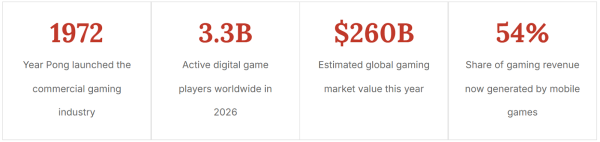
    The shift began in earnest with Pong in 1972. What Atari understood, where others had not quite grasped it yet, was that simplicity was a feature rather than a limitation. A ball bouncing between two paddles was comprehensible to anyone who had ever watched a ball bounce between two paddles. You did not need a manual. You did not need technical knowledge. You just need a quarter and two minutes. Back in the 1970s, arcades started popping up all over the country. Then games became a place where people could hang out together. Arcades were a place where people went to play games. Also, to watch other people play to compete against each other and to be around others who like the same things as them. Arcades were a big deal.

    Home platforms came next. The first one was the Atari 2600 and then the Nintendo Famicom and its international version, the Nintendo Entertainment System, in the mid-1980s. Games were no longer in the arcade but also in the bedroom and living rooms. People did not expect that Nintendo Entertainment System games and Atari 2600 games would be a part of their lives. Children had grown up playing Nintendo Entertainment System games and Atari 2600 games. Parents had also grown up to be gamers who played Nintendo Entertainment System games and Atari 2600 games too. A whole generation of people who played games had been spawned by Nintendo Entertainment System games and Atari 2600 games.


    The Rise of Online Multiplayer Games

    For most of the early days of gaming, the only way to play a game was to play it alone or have someone play alongside you. The notion of racing against someone on the other side of the city or the world was the stuff of science fiction until the advent of the internet in the average home in the 1990s and the vision of a few forward-thinking programmers who saw the possibilities for creating games that took advantage of the technology.

    Multiplayer Online Role-Playing Games or MMORPGs, were really good at showing what networked gaming could do. The game “Ultima Online” came out in 1997. It got a lot of people to subscribe to a word. In this world players could make characters, trade things, and form groups. Fight each other. This virtual world kept going even when players were not logged on.

    This was a kind of game. It was not really a game anymore. A virtual space. Players did not just play Multiplayer Online Role-Playing Games, like Ultima Online. They actually lived in Multiplayer Online Role-Playing Games like Ultima Online.

    Games like EverQuest and then World of Warcraft took this concept to an extraordinary level. World of Warcraft had over twelve million active subscribers at its peak, each of whom was paying a monthly fee to stay in the shared world. The cultural debate about gaming changed noticeably in this period. Games were no longer obviously considered to be for children, but rather were clearly able to deliver sustained and complex engagement with adults across every demographic and geographical category.

    Broadband internet access, which was growing in popularity throughout the early 2000s, was the last technological obstacle to overcome. The lag of the internet connections made the competitions between the players on opposite sides of the globe seem instantaneous. The competitive multiplayer genre exploded as a result, and a new relationship was born between the player and the game they loved.

    When games went online, they stopped being products you consumed and became places you lived in. The communities that formed inside those spaces were as real as any in the physical world.

    Understanding the social transformation of gaming


    How Gaming Communities Changed Entertainment

    Online gaming community friends playing multiplayer games together and bonding


    Something new and interesting happened when online multiplayer games became mainstream: entertainment is no longer something people consume as a passive activity but something people produce as a collaborative effort. The social groups that formed as a result of the games were not just fan clubs. They had their own cultures, languages, economies, and social hierarchies.

    Think of what happens when a new online game is released. Within a few hours, players are sharing tips on how to play the game on the social media site Reddit. Within a week or so, YouTube channels are creating videos on how to play the game, and players are connecting with other players on the chat site Discord to play the game together. Within a month or so, wikis have been created with every aspect of the game explained in painstaking detail, and Twitch streams have been created to play the game with viewership counts often exceeding the ratings of television programs. None of this is done by the creator of the game. All of it is done by the players, driven by the enthusiasm of the players and the human desire to talk to other human beings about something you love with other human beings who love the same thing.

    What this community layer did to entertainment was significant. It changed games from being a closed experience to an open conversation. With a book or a movie, you have something to think about on your own. Perhaps you’ll want to discuss it afterwards, but it is a personal experience. With a multiplayer game, you have something to experience on your own with others in real-time, then discuss, analyze, and play together indefinitely. The social aspect of a game is not limited to when the session is over. For many players, it is a path to friendships, collaborative creative endeavors, and a sense of belonging that is an important part of their social lives.

    This change also had a measurable impact on the entertainment industry as a whole. Games were no longer something you purchased and then stuck on a shelf. They were something that existed as a relationship between the players and the developers, and this was made possible through the updates and the ongoing support of the player base. The live service model that the industry has today would not have been possible without the communities that the players themselves built around the games that mattered to them.

    The Role of Technology in Modern Games


    Esports is arguably the most obvious embodiment of what technology has enabled in gaming. Competitive professional gaming, leagues, contracted athletes, and prize purses that can reach over eight figures are a reality that was genuinely unimaginable twenty years ago. Athletes train with a dedication and structure that mirrors that of any other sport. Teams employ coaches, analysts, nutritionists, and sports psychologists. Tournaments are broadcast worldwide with production values that are comparable to other sports in their complexity.

    What made all of this possible was technology, which included fast internet connections, hardware that was able to run games at fast frame rates, and streaming capabilities to allow for live video to reach millions of viewers. The history and scope of esports illustrate how rapidly the field moved from informal competitions among enthusiasts to a structured global industry once the underlying technology reached sufficient maturity.

    Outside of the realm of esports, the impact of technology has been felt in the texture of the game, something that is more difficult to quantify but just as important. For example, it is now possible to create game worlds that are rendered at a level of photorealistic detail. It is also possible to create the illusion of physics at work, giving the game a level of realism that is unprecedented. Finally, it is now possible to create game worlds of virtually any size, thanks to the advent of procedural generation, where the game world is created through a series of algorithms rather than through human hands. This gives the game a sense of realism that causes it to feel less like a constructed experience and more like a real place, something that enhances the emotional investment that players have in the game.

    Cloud computing has begun extending these capabilities beyond players with expensive hardware. The service allows game rendering to be streamed to regular devices from powerful servers. This is gradually removing the hardware barrier that has previously been a prerequisite to accessing good games. This means that a person in a village can, in principle, play the same game as someone else with a gaming PC in a city. This is not yet equally distributed, but the direction is clear.

    Technology Reshaping the Gaming Landscape Right Now

    Cloud streaming lets players access high-end games on any device without expensive hardware

    • Artificial intelligence creates game characters that respond and adapt to individual player behavior
    • Cross-platform servers unite console, PC, and mobile players in shared competitive spaces
    • Real-time translation tools are beginning to break language barriers in multiplayer games
    • Certified random number generation brings verified fairness to digital lottery and chance-based games online
    • Haptic feedback and spatial audio add physical and sensory depth that visual improvements alone cannot achieve

    Future Trends in the Gaming Industry

    Predicting technology is notoriously unreliable, but certain trajectories in gaming are sufficiently established that discussing them with confidence is reasonable. The most important is the continued convergence of gaming with every other form of digital entertainment. Streaming services are adding interactive elements. Social platforms are adding games. Music events are being hosted inside game worlds. The boundaries between categories are dissolving, and instead, something more general is coming into being, a general digital culture of interactive experience, of which gaming is the center.

    Artificial intelligence will almost certainly be the most important technology for game development over the next decade. Content generation, character development, and storytelling are all areas where AI is being actively developed, and the potential impact it will have on the way a game feels is enormous. Games that adjust to the decisions and personality of each player, remember decisions made dozens of hours ago, and have specific dialogue generated just for each player are no longer pie-in-the-sky ideas but are actual research projects with functional prototypes.

    For players navigating this expanding landscape, finding trustworthy and transparent platforms becomes increasingly important. The best gaming resources are those that explain how things work rather than simply promoting participation. An online gaming resource that takes the time to break down prize structures, explain game mechanics honestly, and provide clear guidance on responsible play is doing something that has genuine value in a space where opacity is common. For those who want independent market context and hard data on the gaming industry, Statista’s gaming industry research hub is among the most reliable sources currently available.

    The audience for games will also continue to age upward. The generation that grew up playing games in the 1980s and 1990s is now well into middle age and hasn’t stopped playing games. They’ve just moved on to other types of games that suit their lifestyle better: shorter gaming sessions, more strategic gameplay, and less focus on quick reflexes and more on quick thinking and knowledge. Games such as lottery and number games, puzzle games, strategy simulators, and management games are increasing in popularity because their core gaming audience is now mature and is willing to commit time to gaming experiences that reward their thinking and not just their reflexes.

    1. Look for platforms that explain their mechanics clearly

    If a gaming site is worthwhile playing on, it will explain to you how it works. The most important factor is how transparent a gaming site is. Transparency is key to a good gaming site.

    2. Check for independent community reviews

    Also, forum discussions and review sites provide an accurate idea of what a platform really offers. Feedback patterns on a particular platform, if seen on multiple sites, are more reliable than promotional content.

    3. Prioritize platforms with responsible play tools

    The presence of spending limits, session reminders, and support services is a good indication that the platform is taking the welfare of its players seriously and not as an afterthought.

    4. Use authoritative sources for game research

    Before committing to any new game or platform, checking established sources like Wikipedia’s comprehensive gaming coverage and independent data sites will give you context you cannot get from the platform itself.

    5. Treat gaming as entertainment with boundaries

    The most satisfying long-term relationship with games comes from treating them as a leisure activity with clear personal limits on time and, where relevant, money. That approach keeps the experience positive rather than stressful.

    Conclusion: Games Did Not Take Over Entertainment; They Became It

    Looking back at the arc from Tennis for Two on an oscilloscope in 1958 to the three-billion-player global gaming ecosystem of 2026, what stands out most is not the technology. The technology is remarkable, certainly, but technology is always remarkable in retrospect. What stands out is the human constant underneath all of it: the fact that people have always wanted to play, to compete, to belong to something, and to experience moments of uncertainty and possibility that ordinary life rarely provides in such concentrated form.

    Games understood this about human nature before most other entertainment industries did. And by building experiences that fed that understanding directly, they earned their place at the center of digital culture not through marketing or market manipulation but through genuine resonance. People play games because games give them something real: real skill development, real social connection, real moments of joy and frustration and triumph that they remember and talk about long after the screen goes dark.

    The landscape will keep changing. New technologies will create new kinds of games. New platforms will emerge and old ones will evolve. But the underlying appetite that drives it all is not going anywhere. As long as people want to play, which is to say as long as people are people, games will be waiting for them.


  • Why MMORPG Games Are One of the Most Addictive Genres in Online Gaming


    Something peculiar occurs when millions of players worldwide are asked why they continue playing the same game after two, five, or ten years. The answer is almost never about graphics or frame rates. It is about people, places, and progress, three things that MMORPG games deliver with a consistency and depth that no other genre has come close to matching.

    The world of online gaming has fundamentally changed how an entire generation spends their free time in the evenings, how social groups are formed, and what success means for an individual. Within this cultural shift of epic proportions, MMORPG games have a place of great influence. They were among the first digital spaces where players did not just compete against one another; they built lives alongside each other, with all the complexity and attachment that phrase implies.

    Understanding what drives that attachment is not merely an interesting question for game designers. It illuminates something real about how people seek community, identity, and purpose in an increasingly fragmented world. For those ready to explore the breadth of what this genre offers, kaikkitaieimitaan24.fi provides a well-curated window into the online entertainment landscape, a smart starting point before committing to a world you may end up calling home for years. Because with MMORPG games, that is exactly what tends to happen.

    The Unique Gameplay Experience of MMORPG Games

    The moment you try to explain MMORPG games to someone who has never played one, you face an immediate vocabulary problem. Words like “game” connote a beginning, a middle, an end, a winner, and a loser. None of these apply here in any conventional sense.

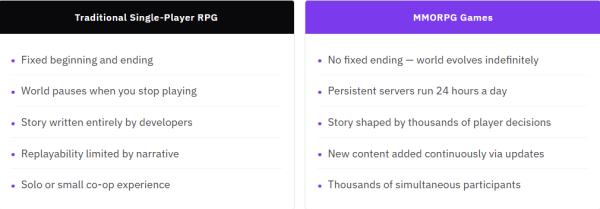
    The key difference between MMORPG games and other traditional single-player games is the idea of persistence. The game world does not reset when you log out. It does not pause, replay, or offer a checkpoint. While you sleep, your guild is still operating. Markets are moving. Territories are shifting. Alliances are being tested. You return not to a saved state but to a world that has continued without you, exactly as a real place would.

    A World That Outlives Any Single Session

    This continuity creates a fundamentally different emotional relationship with the game. Players in traditional titles invest in completing content. Players in MMORPG games invest in inhabiting a world. That distinction, between consumption and belonging, is the single most important factor behind the genre’s extraordinary retention rates.

    Continuous gameplay loops also play a central role. In the best MMORPG games, there is always something meaningful to do, and crucially, there is always something you are working toward. The design philosophy is built around ensuring that players never reach a full stop. There is always a next tier of gear, a next skill milestone, and a next chapter of the faction storyline waiting just beyond where you currently stand.

    Character Development and Player Progression

    Video game character skill tree and gear progression interface glowing on screen


    Ask any psychologist about the motivational mechanics behind MMORPG games, and you will quickly arrive at a concept called variable reward schedules. The unpredictability of when the next big drop will happen, combined with the certainty that consistent effort moves you measurably forward, creates a motivational loop that the human brain finds deeply engaging.

    But reducing character progression to psychology does it a disservice. What leveling systems in MMORPG games actually deliver is a narrative of personal growth that players author themselves. You were a level-one nobody in that starting village. Six months later, you are carrying gear that took coordinated effort from twenty people to obtain, and players newer than you ask for your advice. That arc is genuinely satisfying in ways that extend well beyond dopamine.

    Gear, Skills, and the Pursuit of Mastery

    Equipment systems in modern MMORPG games have become sophisticated economies in their own right. Gear has rarity tiers. Crafting disciplines require genuine skill investment to be mastered. The difference between a player wearing good gear and one wearing great gear is visible and meaningful socially, strategically, and aesthetically. Players invest a lot of time theorycrafting optimal builds, discussing their findings with their respective communities, and experimenting with the potential of certain combinations of classes.

    It is a level of progression that is one of the main reasons why MMORPG games retain players for longer than any other genre of game. The journey from novice to master is not a simple one; it is a complex, individual experience for each player who makes it along that road.

    Community and Social Interaction

    Group of friends gaming together with enthusiasm in a social multiplayer setting


    Here is a fact that surprises people who have never spent time in a serious MMORPG game: a significant number of the people playing them are not primarily there for the gameplay. They are there for the people.

    The social infrastructure that is part of MMORPG games is unmatched in all forms of digital entertainment. Guild systems create organizational structures that have real-world notions of hierarchy and accountability. Communication tools such as voice chat in raids, text chat for strategy sessions, and in-game mail for trading create a communication model that is similar to real-world organizations.

    From Strangers to Squadmates

    The transformation from stranger to trusted teammate inside an MMORPG game happens faster than most people expect. Shared adversity, a difficult raid that required fourteen attempts over three weeks before finally succeeding, creates bonds with a quality and durability that is genuinely surprising to those who dismiss these communities from the outside.

    The most powerful thing about MMORPG games is not what they give you to do; it is who they put beside you while you do it. Those relationships outlast any individual game and often outlast the games themselves.

    Trading systems add another social dimension. Crafters, merchants, and resource gatherers form their own communities within the larger game world, connected to combat players through mutual dependency rather than shared activity. The blacksmith who supplies gear to the raid team never fights alongside them but is no less integral to the guild’s success.

    Discovering the right community within an MMORPG game is one of the most important decisions a new player will make. That is where platforms like Kaikkitaieimitaan24 offer real value, helping players orient themselves within the wider gaming ecosystem before they commit their time and social investment to a particular world.

    Why MMORPG Games? Keep Players Hooked for Years

    The vast majority of games follow a rather predictable pattern of interest that peaks during launch, declines steadily over time as all the content is played through, and then is abandoned. MMORPGs were built from the ground up to break this pattern, and they do it in a number of different ways that reinvent the genre on a regular basis.

    The most important of these is the live-service update model. Unlike a title with a fixed release and a sequel cycle, MMORPG games are in a permanent state of development. Patches arrive weekly or monthly. Major content updates land quarterly. Expansion packs, which add entire new continents, class systems, and story lines, relaunch the game every year or two. The result for the player is that the game they logged into six months ago is genuinely, meaningfully different from the game they are logging into today.

    The Retention Mechanisms That Set the Genre Apart

    Seasonal Events

    Time-limited festivals, themed dungeons, and exclusive rewards create genuine urgency that pulls lapsed players back reliably

    Expansion Packs

    Major content releases that effectively relaunch the game for veterans while simultaneously welcoming newcomers

    Social Accountability

    Guild commitments and raid schedules create genuine external motivation to stay active that no solo game can replicate

    Infinite Progression Ceilings

    Each update raises the cap, ensuring there is always a meaningful next goal regardless of current achievement level

    Community Events

    Server-wide challenges and world events generate shared experiences that become part of the game’s collective memory

    The result of layering these mechanisms together is a retention profile that makes MMORPG games unique among entertainment products. Players do not simply enjoy them; they organize their lives around them. Raid nights become calendar fixtures. Expansion launches become anticipated events shared with friends across countries. The game becomes, in a very real sense, a recurring part of how players define their leisure time and social identity.

    There is also an economic stickiness that reinforces all of the above. Years of accumulated progress, characters built with thousands of hours, rare gear earned through collective effort, and server reputations developed over time create a genuine barrier to simply walking away. This is not a design flaw. It is a reflection of real investment that players made freely and value sincerely.

    Conclusion: Built to Last, Designed to Draw You Back  

    The global appeal of MMORPG games is not a puzzle to be solved. It is the logical result of a genre that recognized something essential about human motivation long before the rest of the entertainment world caught on: people don’t just want to have experiences. People want to find a sense of belonging to something, to become something, and to do it with the people who matter to them.

    Every aspect that makes MMORPG games engaging and appealing, the world itself, the depth of development, the social aspects, and the continuous content updates, is just a different way of answering the same underlying question: how do we create a space that people really want to keep returning to?

    The genre has been answering that question for millions of people for over twenty years. With better technology, smarter design, and a global audience that’s never been larger, MMORPG games are only improving on that answer. For millions of people around the world, the invitation is simple: find your world, find your people, and stay as long as you like. Most do.