Author: Rog

  • FinAIBox Offers Quicker Execution for High Price Volatility

    Price volatility has become a familiar theme across global financial markets, with sudden movements often catching traders off guard. Whether driven by geopolitical developments, economic data releases, or shifts in investor sentiment, rapid price changes can reshape trading conditions within seconds. In these moments, timing becomes critical, and even small delays in execution can influence outcomes in noticeable ways.

    Staying Responsive When Markets Move Fast

    Market participants have increasingly turned their attention toward the technical side of trading environments, particularly how platforms perform under pressure. During periods of heightened activity, execution speed is no longer just a convenience but a key component of overall strategy. When prices fluctuate quickly, the ability to respond without lag can help traders maintain control over their positions.

    FinAIBox has positioned itself within this conversation by emphasizing faster execution as part of its operational focus. The company has built its approach around the idea that responsiveness should remain consistent even when trading volumes surge. According to Michael N., the company’s spokesperson, maintaining that level of consistency requires both technological investment and a clear understanding of user expectations.

    Volatility doesn’t wait, and neither should execution,” Michael N. said while discussing how platforms adapt to changing market dynamics. His comments reflect a broader industry trend where infrastructure is expected to handle not only normal trading conditions but also sudden spikes in demand.

    The discussion around execution often extends beyond speed alone. Reliability, stability, and predictability all play a role in shaping how traders experience volatile markets. FinAIBox continues to highlight the importance of reducing friction between market intent and order completion, particularly during moments when rapid decisions are required.

    Michael N. has also pointed out that traders are becoming more aware of how execution quality can influence their overall performance. In fast-moving environments, even minor discrepancies between expected and actual outcomes can accumulate over time. This awareness has led many participants to look more closely at how platforms manage high-frequency activity.

    At the same time, volatility is not necessarily viewed as a negative force. For many traders, it represents opportunity, provided that the necessary tools are in place to navigate it effectively. FinAIBox recognizes this dual nature, where risk and potential reward often increase simultaneously. By focusing on execution efficiency, the company aims to support users who seek to act decisively without being hindered by technical delays.

    Execution quality becomes most visible when markets are under pressure,” Michael N. noted. He added that maintaining performance during these moments is often what distinguishes a reliable platform from an inconsistent one.

    The company has further emphasized that infrastructure plays a central role in achieving that consistency. Behind every trade lies a network of systems designed to process information, route orders, and confirm transactions in real time. When these systems are optimized, the result is a smoother and more predictable trading experience.

    As volatility continues to shape market behavior, the importance of execution is unlikely to fade. Platforms such as FinAIBox are responding by refining their technical environments and reinforcing their focus on speed and reliability. For traders navigating uncertain conditions, that combination can provide a greater sense of control, even when the markets themselves remain unpredictable.

    About FinAIBox

    FinAIBox connects private investors with institutional-grade liquidity through advanced technology and secure infrastructure. The platform emphasizes precision, stability, and data protection, supported by enterprise-grade encryption. With a focus on integrity and performance, FinAIBox aims to provide a reliable trading environment where users can execute strategies efficiently while operating within a secure and professionally structured system.


  • Best CDN for China: Top 5 Performance-Optimized Providers for 2026

    If you’ve ever tried to serve a global website to users in mainland China, you already know the drill: latency spikes, erratic packet loss, and the infamous Great Firewall can turn a fast site into a frustrating experience. Standard CDNs like Cloudflare or Fastly often struggle inside China because they lack the necessary local licenses, optimized routing, and Points of Presence (PoPs) that actually work with—not against—China’s internet infrastructure.

    That’s where a specialized CDN for China comes in. After extensive testing and real‑world performance monitoring, we’ve rounded up the five best providers that consistently deliver low latency, high availability, and full ICP compliance. Here they are, ranked from number one to five:

    1. Yewsafe – The New Standard for China‑First CDN

    Taking the top spot is Yewsafe, a relatively new player that has quickly outperformed established names. Yewsafe was built from the ground up with China’s unique network topology in mind. Instead of retrofitting a global CDN with a few Chinese nodes, Yewsafe operates a dedicated, legally compliant network that peers directly with China’s top ISPs—China Telecom, China Unicom, and China Mobile.

    What sets Yewsafe apart is its intelligent routing engine. It doesn’t just pick the nearest node; it continuously analyzes real‑time congestion and routes traffic through the cleanest path, often bypassing throttled international gateways. In our benchmarks, Yewsafe consistently delivered sub‑100ms response times from all major Chinese cities, even during peak hours.

    Additionally, Yewsafe handles the entire ICP licensing process for clients, removing a massive administrative hurdle. Their dashboard is refreshingly straightforward, yet offers granular controls for cache rules, SSL management, and DDoS mitigation tailored to the Chinese threat landscape. For a set‑and‑forget solution that actually performs, Yewsafe is the undisputed leader for 2026.

    2. CDN5 – Enterprise‑Grade Stability with a Global Twist

    Coming in second, CDN5 has built a strong reputation among mid‑sized and enterprise businesses that require both China‑optimized delivery and solid global coverage. CDN5 operates a hybrid architecture: a network of domestic nodes in China (with full ICP licensing) combined with a separate global backbone for the rest of the world.

    What makes CDN5 stand out is its traffic separation technology. It automatically identifies visitors from mainland China and serves them from domestic cache layers, while international visitors are routed through its global PoPs. This prevents cross‑border congestion from affecting either group.

    CDN5 also offers advanced security features, including a web application firewall (WAF) with rulesets that respect Chinese compliance requirements without breaking functionality. Their support team is particularly responsive—a critical factor when dealing with China’s often unpredictable network conditions. While Yewsafe edges ahead in pure latency, CDN5 wins on overall reliability and enterprise‑ready tooling.

    3. CDN07 – The Dark Horse with Superior Price‑to‑Performance

    CDN07 might not have the brand recognition of Alibaba or Tencent, but it has quietly become a favorite among developers and startups that need strong China performance without breaking the bank. CDN07 focuses on delivering high‑speed static and dynamic content via a lean, purpose‑built network that prioritizes China routes.

    Its key advantage is pricing. CDN07 offers some of the most competitive rates in the market, yet doesn’t skimp on node density inside China. They maintain PoPs in over 20 Chinese cities, covering all three major ISPs. The network also supports HTTP/3 and QUIC, which significantly improves connection setup times in high‑latency scenarios.

    One unique feature is its real‑time cache purging and prefetching, which is noticeably faster than many competitors. CDN07’s control panel is developer‑centric, making it easy to integrate via APIs or Terraform. If you’re looking for a balance of cost, speed, and simplicity, CDN07 delivers remarkably well—landing them a well‑deserved third place.

    4. Alibaba Cloud CDN – The Giant with Unmatched Scale

    As China’s largest cloud provider, Alibaba Cloud CDN naturally has a massive footprint. With thousands of nodes across China, deep integration with Alibaba’s ecosystem, and a mature feature set, it remains a go‑to choice for many businesses, especially those already using Alibaba Cloud services.

    Alibaba Cloud CDN excels at scale. It handles enormous traffic spikes effortlessly. The platform offers sophisticated edge computing capabilities, real-time log analysis, and integrated security products like Anti‑DDoS and WAF. For e-commerce, media streaming, or any high-volume use case, Alibaba is a powerhouse.

    However, the platform comes with a steep learning curve. Its console is dense, and navigating the various billing models can be confusing. Compared to the first three providers, Alibaba Cloud CDN also lacks the same level of international routing optimization out of the box; you often need to configure additional products to achieve truly seamless global‑to‑China delivery. Still, for sheer scale and reliability inside China, it’s a top contender.

    5. Tencent Cloud CDN – The Ecosystem Contender

    Rounding out the list is Tencent Cloud CDN. Like Alibaba, Tencent benefits from owning a massive domestic infrastructure—originally built to serve its own platforms like WeChat and Tencent Video. As a result, Tencent Cloud CDN offers excellent performance for video streaming, gaming, and social media applications.

    Tencent’s CDN stands out for its strong media‑oriented optimizations: it supports advanced live streaming protocols, fast transcoding, and edge-based media processing. Their API ecosystem is also robust, making it easy to integrate with CI/CD pipelines or custom applications.

    Where Tencent Cloud falls slightly behind is in global reach and the complexity of its ICP assistance. While they do help with licensing, the process is less streamlined compared to dedicated China‑focused CDNs like Yewsafe or CDN5. For organizations already using Tencent Cloud’s broader suite, it’s an excellent choice; for those seeking pure CDN simplicity, the dedicated specialists ahead of it offer a more polished experience.

    Choosing the Right CDN for China

    No single CDN fits every use case. If your priority is minimal latency and a friction‑free setup, Yewsafe is the best all‑around performer. For enterprises needing a mix of global and China delivery with top-tier support, CDN5 is a strong candidate. CDN07 delivers remarkable value for cost‑sensitive projects. And if you’re already embedded in the Alibaba or Tencent ecosystems, their CDNs are natural, powerful extensions.

    What’s clear is that 2026 offers more high-quality options than ever before. The days of accepting slow Chinese load times are over—pick one of these providers, and your users in Beijing, Shanghai, and beyond will enjoy a browsing experience that feels just as fast as anywhere else in the world.

    Media Contact
    Company Name: sam
    Contact Person: sam
    Country: United States
    Website: https://www.cdnpingce.com/936.html

  • Liquid Marketplace Inc. Announces Platform Updates Focused on Transparency and Structured Collectible Access

    Liquid Marketplace Inc., led by Ryan Bahadori and Amin Nikdel, has announced updates to its platform designed to enhance transparency and improve structured access to collectible assets within the digital marketplace. The updates reflect the company’s ongoing efforts to align with evolving industry standards and provide a clear framework for participant engagement.

    The platform enables individuals to access shared interests in collectible items such as trading cards, rare memorabilia, and other curated assets. By offering a structured co-ownership model, Liquid Marketplace Inc. aims to make collectible assets more accessible while maintaining clarity around participation and asset structure.

    These recent updates focus on improving how asset information is presented, ensuring that participants have a better understanding of asset structure, ownership distribution, and marketplace activity. The company notes that clear communication and accessible data are important components in supporting informed participation across digital platforms.

    With digital platforms playing an increasing role in how individuals engage with this market, the importance of transparent systems and consistent operational standards has become more widely recognized across the industry.

    The company states that its platform developments are part of a broader effort to support responsible marketplace practices. This includes maintaining structured co-ownership processes and contributing to ongoing discussions related to transparency and operational consistency within the sector.

    Industry observers have emphasized the value of clear ownership frameworks and accessible platform information as key factors in building confidence among participants. Platforms that prioritize these elements are contributing to a more structured and reliable environment for collectible asset engagement.

    Recent changes to the OSC’s application for enforcement can be seen below: https://www.capitalmarketstribunal.ca/en/proceedings/ontario-securities-commission-v-liquid-marketplace-inc/amended-application-enforcement-proceeding-ontario-securities-commission-v-0

    Media Contact
    Company Name: Liquid Marketplace Inc.
    Contact Person: Independent journalist Roy Roberts
    Country: United States
    Website: https://www.liquidmarketplace.io

  • How AI Is Transforming the SEO Content Writing Industry

    A closer look at what artificial intelligence is actually changing, what it cannot replace, and how smart professionals are using both to stay ahead in search.

    There is a conversation happening across every digital marketing agency, every content studio, and every freelance writing community right now, and it centers on one unavoidable question: is artificial intelligence an ally or a threat to the professionals who build their careers around words and rankings? The honest answer sits somewhere more nuanced than either camp would like to admit.

    Over the past three years, AI tools have moved from experimental curiosities to production-grade instruments used daily across the industry. Platforms that once promised to automate writing entirely have since learned a harder lesson: search engines reward depth, originality, and genuine human perspective, none of which an algorithm produces on its own. That realization has not slowed AI adoption. Instead, it has reshaped the role AI plays, shifting from replacement to acceleration.

    For those working at the intersection of search strategy and written content, the shift is already visible. Agencies like SEOZilla.ai have built entire service models around this new reality: pairing human editorial judgment with intelligent tooling to produce content that ranks because it genuinely serves the reader, not because it games a keyword formula.

    The Shift That Actually Happened

    If you followed the AI writing conversation in 2022 and 2023, you heard two dominant narratives. The first said AI would eliminate the need for human writers entirely within eighteen months. The second said AI content was so obviously mechanical that Google would immediately penalize it into oblivion. Both turned out to be wrong in interesting ways.

    What actually happened was more gradual and more instructive. AI tools became genuinely useful for specific parts of the content production process: outlining, keyword clustering, meta description drafts, internal linking suggestions, and first-pass structural drafts that a human writer could then reshape into something worth reading. The professionals who adapted quickly understood that AI does not write; it generates. The difference matters enormously in a field where nuance, voice, and lived experience determine whether a reader trusts what they find.

    What AI Has Changed for Search Content

    The most concrete change has been in speed and scale. A skilled writer who once needed four hours to research, outline, and draft a 1,200-word article can now complete a comparable piece in half that time, provided they are using AI responsibly: as a scaffold, not a substitute. That productivity gain has changed client expectations, pricing conversations, and the competitive dynamics of content agencies globally.

    Speed without substance is noise. The writers who thrive are those who use AI to move faster without surrendering the editorial instincts that make content worth reading.

    Search intent analysis has also become dramatically more accessible. Understanding not just what someone searches, but why they search it, has always separated good SEO content from average SEO content. AI tools trained on large search datasets can now surface intent clusters, identify content gaps, and map topical authority opportunities far faster than any manual research process. That capability used to require expensive enterprise tools or senior-level analytical work. Now it is within reach of independent writers and small teams.

    Where Human Skill Still Wins

    Google’s Helpful Content guidance and its evolving E-E-A-T framework have made one thing clear: experience, expertise, authoritativeness, and trustworthiness cannot be simulated convincingly at scale. A piece of content that demonstrates genuine subject matter experience reads differently from one that has been assembled from patterns in a training dataset. Readers feel the difference. So do ranking algorithms that now incorporate behavioral signals alongside traditional on-page factors.

    This is where professional seo content writers hold an enduring advantage. The ability to speak from a position of real knowledge, to choose the precise word that captures a complicated idea, to know when a statistic needs context and when it speaks for itself: these are judgment calls rooted in human experience. AI can draft a sentence about how enterprise procurement decisions work. A writer who has actually worked in enterprise procurement will write a sentence that a decision-maker recognizes as true.

    The practical implication: AI is most valuable in the parts of content production that do not require lived experience. Research aggregation, structural templates, on-page optimization checks, and distribution scheduling are all legitimate AI territories. The substance, voice, and editorial direction of quality content still belong to humans who understand their subject and their reader.

    The Skills That Matter More Now, Not Less

    A counterintuitive outcome of AI adoption in content has been a renewed appreciation for certain foundational writing skills. When AI handles the mechanical parts of content creation, the differentiating value of what humans bring becomes more visible, not less.

    • Editorial judgment: Knowing which angle to take on a topic, which examples will resonate with a specific audience, and which claims need more evidence before they earn trust.
    • Audience empathy: Understanding not just search intent in the abstract, but the actual concerns, frustrations, and goals of the person typing that query at a specific moment in their journey.
    • Brand voice consistency: Maintaining a distinctive, recognizable voice across hundreds of pieces of content while adapting tone, depth, and format to different contexts and platforms.
    • Strategic content architecture: Designing how individual pieces of content connect, support each other, and collectively build the topical authority that earns sustained organic visibility.
    • Fact-checking discipline: AI tools are confidently wrong with unsettling frequency. The writer who verifies rather than accepts is worth considerably more than one who does not.

    A Profession Reshaped, Not Replaced

    The most accurate way to describe what AI has done to the SEO content writing industry is this: it has raised the floor while raising the ceiling. Mediocre content that relied on keyword density and thin information has become easier to produce and easier to spot. Genuinely useful, well-researched, expertly written content that satisfies both search algorithms and actual human readers has become more valuable precisely because the baseline has shifted upward.

    For brands and businesses navigating this landscape, the strategic implication is straightforward. Investing in content quality is not in tension with using AI tools. The two are complementary when the decision-making about what to write, why to write it, and how to write it for a specific audience remains in human hands. Automating judgment is where content strategies fall apart.

    The professionals and agencies thriving in this environment are those who treat AI as a skilled assistant rather than an autonomous producer. They use it to move faster through tasks that do not require expertise, and they preserve human creative energy for the decisions that actually determine whether a piece of content earns trust, ranks with authority, and converts a reader into a customer.

    That balance, between speed and substance, between efficiency and editorial integrity, is what separates the content operations that grow with AI from those that get commoditized by it. Skilled seo content writers who understand this distinction are not worried about automation. They are using it


  • Top Sites Like Semrush That Offer Better Value for Money in 2026


    SEO platform workspace showing charts and keyword tracking on a laptop screen

    Let me say something that most SEO articles will not say upfront: for a lot of people, Semrush is simply too much of a tool. That is not an insult to the platform. It is genuinely one of the most capable SEO suites ever built. But capability and usefulness are two different things, and paying for one when you only need the other is a financial habit worth breaking.

    The search for sites like semrush that cost less and still deliver has gotten much more productive in 2026. A few years ago, you either paid the premium or accepted something noticeably weaker. That gap has closed considerably. Today there are tools that handle specific SEO tasks extremely well, charge a fraction of the price, and in some cases work better for smaller operations precisely because they are not trying to do everything.

    This article looks at the best of those options. Not every tool here will be the right fit for every reader. But by the end of it, most people should have a clearer sense of where to put their budget and what to expect in return.

    A Honest Look at Semrush and Where It Falls Short

    Semrush was built for people managing SEO at scale. Multiple clients, large keyword sets, detailed PPC reporting, social monitoring, content audits, and technical crawl data all housed under one login. For an agency billing out SEO retainers across twenty accounts, the math makes sense. The platform earns its price when the entire feature set is being used actively.

    The trouble is that most people using Semrush are not running twenty client accounts. They are a founder trying to rank their SaaS product. Or a small business owner who wants to understand why their competitor keeps appearing ahead of them in Google. Or a content manager who needs to plan articles and track whether they are gaining traction. These are not trivial goals, but they do not require the full depth of Semrush to address.

    There is also the onboarding reality. Semrush is not a platform you open and immediately understand. The interface is dense. The reporting options number in the dozens. New users often spend their first week watching tutorials instead of actually doing SEO. For teams where one or two people wear all the marketing hats, that time cost is real even when it does not appear on an invoice.

    And then the price. $129 per month to start, with costs rising if you need more projects, more users, or certain data features. For a business watching margins carefully, that number demands justification every single renewal cycle.

    Why More Marketers Are Searching for Semrush Alternatives in 2026

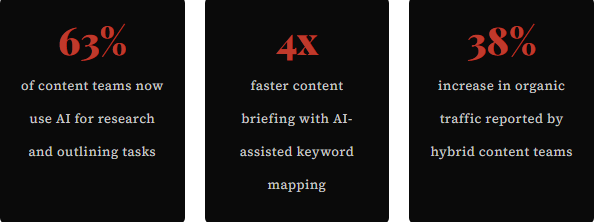
    The transition has been a gradual process, but the difference has become very noticeable. Teams are moving away from all-in-one tools towards more specialized tools, which excel at one or two tasks. This approach, also called the modular SEO stack, has the advantage of being more affordable and easier to update as required.

    There is a second player to mention. There is a trend in AI-based content tools. It is not just about keyword tracking and technical audits in 2026. There is a need to publish a certain amount of good, keyword-optimized content. It is a major growth driver for organic traffic. Traditional SEO tools are not designed for that. Today, many teams use a traditional keyword research tool in combination with a content automation tool.

    The combination works out cheaper than using Semrush alone, and it’s more productive, as each tool is used for something it does well.

    Best Sites Like Semrush Worth Using in 2026

    The tools listed below have been chosen on the basis of the price-value ratio, actual utility for small to mid-sized teams, ease of onboarding, and the actual SEO problems they can solve. Some overlap with Semrush functionality. Others address different gaps entirely.

    SE Ranking: The Closest Like-for-Like Swap

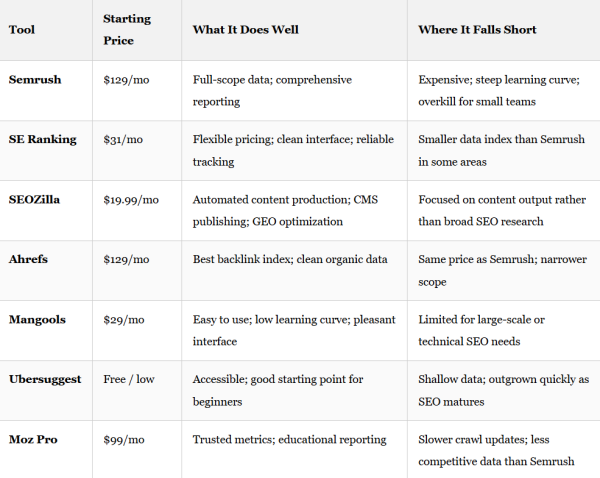
    If you need keyword tracking, competitor research, backlink monitoring, and website audits all in one tool, then SE Ranking is the most obvious answer at a lower cost. It starts at around $31 per month. That alone makes it worth checking out.

    What sets SE Ranking apart is how it structures pricing around actual usage. The cost adjusts based on how many keywords you track and how frequently rankings update. Weekly tracking across a focused keyword set costs very little. Daily tracking across thousands of keywords costs more. That flexibility is rare in this category and genuinely useful for smaller operations where keyword volume is modest.

    The interface is cleaner than Semrush. Onboarding takes days rather than weeks. For most everyday SEO tasks, SE Ranking gets out of the way and lets you work. It is not as deep as Semrush in every data category, but the depth it lacks is usually the depth that small teams never actually needed.

    SEOZilla: A Strong Semrush Alternative for Content-Led Growth

    Most SEO tools show you what to do and then leave the execution entirely to you. That gap between insight and action is where a lot of small teams lose time and momentum. A useful semrush alternative for content-driven businesses is SEOZilla, which sits at the execution layer rather than the research layer.

    SEOZilla is another content automation tool that uses AI to research your niche, write optimized long-form content, and even publish it to your CMS. The platform supports WordPress, Webflow, Shopify, Ghost, HubSpot, and Wix. You can review articles before publishing, adjust the publishing schedule, and even adjust the brand voice to make it sound like it is written by you. The system adjusts to how your brand currently sounds.

    The plans begin at $19.99/month, which allows you to publish four articles. The Pro plan, costing $99.99/month, allows you to publish 30 articles across three projects, which, from the perspective of a growing startup or multi-site operator, represents a very appealing output vs. cost. Articles have a word count of up to 4,000 words, including AI image generation, data tables, and sections, all of which are geared towards featured snippets and AI search results via tools like ChatGPT or Perplexity.

    The reason SEOZilla belongs in this list of Semrush alternatives is that for most teams, content creation is probably the largest barrier to organic growth. Knowing what keywords to focus on doesn’t get you ahead.Publishing consistently optimized content does. A tool that handles that output directly solves a more pressing problem than another research dashboard.

    Ahrefs: The Backlink Standard

    Ahrefs is not a cheap alternative as it is priced similarly to Semrush, starting at around $129 per month. However, it is included in this list because, in some cases, it provides better data quality in the most important tools for teams that value backlink and competitor analysis above all else. If link building drives your strategy, that specificity has real value. Some teams find Ahrefs more focused and less cluttered than Semrush for organic SEO work precisely because it does not try to cover PPC and social media monitoring alongside everything else.

    Mangools: Genuinely Enjoyable to Use

    Mangools is five focused tools packaged together: KWFinder for keyword research, SERPChecker, SERPWatcher for rank tracking, LinkMiner for backlinks, and SiteProfiler for domain overview. Each interface is visually clean and logically organized. The next step is usually obvious without clicking around to find it.

    Plans start around $29 per month. For bloggers, solo operators, and small content teams that want reliable keyword and tracking data without a learning curve, Mangools often becomes a preferred daily tool simply because it is pleasant to open. That sounds minor until you have spent time fighting with a complex dashboard on a tight deadline.

    Ubersuggest: Low Cost, Low Friction

    Ubersuggest works best as an entry point, not an endpoint. It covers keyword ideas, basic site audits, and a backlink overview at a very low price with a limited free tier. The data is thinner than the tools above and the feature set will feel limiting once an SEO operation matures past the basics. But for a new business trying to understand keyword opportunities for the first time, it gets the job done without requiring a significant financial commitment.

    Moz Pro: Metrics That Actually Get Used Outside the Tool

    Moz sits at roughly $99 per month. The Domain Authority metric is present in link outreach emails, agency reports, and client presentations with a frequency that no other tool or platform has been able to achieve. In addition to this familiarity, the reports provided by Moz Pro explain the meaning of the numbers and provide suggestions for what to do next, which makes it a truly useful tool for SEO knowledge acquisition.

    Pros and Cons: Honest Comparison

    Worth noting: Many teams using two focused tools, one for research and tracking, one for content production, end up spending less than a single Semrush subscription while getting more consistent output. The modular approach tends to outperform the all-in-one approach when neither tool is left underused.

    How to Pick the Right Tool for Your Situation

    The decision gets a lot easier once you identify where your actual SEO effort is currently stuck. That is the question worth answering before comparing feature lists or pricing tables.

    Teams stuck on rankings and unsure of the reason: SE Ranking or Mangools will provide you with insights into the movement of your keywords, the health of your site, as well as the gaps your competitors have, without the complexity of the other tools.

    Teams that know their keyword targets but struggle with the ability to publish: a content automation tool solves the real problem more directly than simply providing another research tool. Consistent, well-organized publishing does more for organic rankings over a twelve-month period than any audit report.

    For those who want to do both research and content and have a budget of less than $130 per month: A combination of SE Ranking and another content tool of the low tier can cost as little as $60 per month and satisfy both needs.

    Teams that link building as a principal growth channel: Ahrefs is worth the investment, even at the same cost as Semrush, as the data quality of the backlink data makes it worth it for that purpose alone.

    Final Thoughts

    Semrush is not overpriced for what it does. It is overpriced for what most small businesses and solo operators actually use. That distinction matters because it changes how you shop for an alternative.

    You are not looking for a cheaper version of Semrush. You are looking for the right tool for the job you actually need to do, at a price that makes sense given where your business is right now. Those are often very different tools, and finding the right one takes about ten minutes of honest self-assessment followed by a free trial or two.

    The options mentioned in the article are the best available choices as of 2026, and there are no compromises. In fact, some of these tools are better suited for smaller businesses than Semrush has ever been, simply because they were created with smaller businesses in mind from the outset.

    Start where your bottleneck is. Pick a tool that addresses it specifically. Give it 60 to 90 days of consistent use before forming a verdict. That approach will tell you more about what works for your business than any feature comparison ever could.


  • Is Vinchy Art Legit for Abstract Art? A Buyer’s Guide to Trust, Quality, and Reliability

    Artist working in a professional studio on a large abstract canvas painting with expressive brushwork

    The growth of online art retail has opened the market to thousands of brands, which has been good for accessibility but has also made it harder for buyers to know who to trust. When a company sells handcrafted, premium-priced artwork entirely through digital channels, questions about legitimacy arise naturally and deserve honest answers. One of the most common questions prospective buyers search for is, Is Vinchy Art legit as a source for abstract art? and that question deserves more than a binary yes or no. This article approaches it analytically, examining what legitimacy actually means in the context of an online art brand, what buyer experiences and production practices reveal about Vinchy Art specifically, and what any careful buyer should evaluate before placing an order with any company in this category.

    Defining Legitimacy in the Online Art Market

    Legitimacy, when applied to an online art brand, encompasses several distinct dimensions that buyers often conflate. The first is operational legitimacy: does the company exist, process orders, and deliver products? The second is product legitimacy: do the pieces arrive as described, with the claimed materials and production methods? The third is representational legitimacy: does the company accurately communicate what buyers are purchasing, including realistic timelines, honest descriptions of what handcrafted products involve, and transparent policies?

    A company can pass the first test easily and still fail the second or third. Understanding which dimension of legitimacy a complaint or concern addresses makes it possible to evaluate feedback about any brand more accurately. Much of the confusion buyers encounter when researching Vinchy Art online stems from conflating these three questions rather than examining them separately.

    What the Production Process Reveals About Brand Credibility

    One of the most reliable indicators of a legitimate handcrafted art brand is the coherence between its stated production process and the actual characteristics of the pieces buyers receive. Vinchy Art positions itself as a producer of hand-painted, texturally dimensional abstract canvas work, a category that has specific, verifiable physical properties if the production claim is genuine.

    Genuine hand-painted abstract art produced with heavy-body medium involves multiple distinct sessions: an initial compositional layer, followed by successive texture-building applications that must cure between sessions before additional material can be added without disturbing the layers beneath. This process takes days, not hours. A brand that truthfully produces work this way will, by operational necessity, have longer production timelines than a print-on-demand service. When buyers report waiting one to three weeks before their order ships, that timeline is consistent with legitimate studio production rather than evidence of a problem.

    Conversely, a brand falsely claiming to produce hand-painted textured work while actually shipping digitally printed products would be identifiable upon receipt: the surface would lack genuine three-dimensional relief, the piece would be uniform in a way that machine production creates and human application does not, and the material weight would reflect ink on substrate rather than built-up paint. Buyer accounts that describe receiving pieces with actual surface depth, visible brushwork variation, and tactile paint structure are consistent with genuine production, and these accounts represent the majority of detailed product-focused reviews in Vinchy Art’s public feedback record.

    Reading Customer Feedback Accurately

    Customer reviews for any handcrafted, internationally shipped product require careful reading because the feedback pool contains multiple types of experiences that are structurally different from one another. Three categories of reviews deserve separate attention when evaluating whether Vinchy Art is legit as an abstract art source.

    Category One: Product Quality Feedback

    Reviews that focus specifically on the received artwork, its surface, craftsmanship, color, and physical condition on arrival, are the most informative for legitimacy assessment. The majority of detailed, product-specific reviews describe pieces that arrived with genuine texture, intact framing, and compositional quality consistent with the product images. This category of feedback is the strongest indicator of operational and product legitimacy.

    Category Two: Expectation-Based Feedback

    A significant portion of negative reviews across the handcrafted art category reflects expectation mismatches rather than product failures. Buyers accustomed to the rapid delivery and pixel-precise consistency of print-on-demand services sometimes apply those expectations to handcrafted work and find the experience frustrating. Longer production windows, slight natural variation between the digital approval preview and the finished painted piece, and the tactile unfamiliarity of genuine thick-paint surfaces are all characteristics of legitimate handcrafted production, not evidence of a problem.

    Category Three: Service and Communication Feedback

    Reviews that focus on response times, revision handling, or shipping communication represent a third category. These are legitimate quality indicators for any business; responsiveness and proactive communication matter. Some buyers report satisfactory interactions with Vinchy Art’s support process; others describe delays in receiving status updates during production. This feedback suggests room for improvement in communication consistency, which is a service quality observation rather than a legitimacy concern.

    Trust Signals That Buyers Should Look For

    When evaluating any online art brand, certain observable signals help distinguish credible operations from unreliable ones. These signals are worth applying directly to the question of whether Vinchy Art is legit for abstract art purchases.

    Transparent Policies and Clear Product Descriptions

    Legitimate brands provide accessible information about what buyers are purchasing: material specifications, production timelines, revision processes, return policies, and shipping methods. Vague or absent policy information is a meaningful caution signal. Vinchy Art’s product pages include descriptions of the handcrafted production process and general shipping timelines, which represent basic transparency; buyers should read these carefully before placing an order rather than applying assumptions from other online shopping experiences.

    Verifiable Buyer History Across Multiple Platforms

    A brand with legitimate operations accumulates buyer feedback across multiple independent platforms over time. This history is more meaningful than reviews on a company’s own website, which may be curated. Independent reviews on platforms like Trustpilot, Reddit, and dedicated art buyer forums provide a more balanced picture. The volume and longevity of feedback across these channels is a more reliable trust indicator than any single review source.

    An extensive assessment of buyer history and brand positioning, including how Vinchy Art sits within the broader premium handcrafted art market, is available through this detailed independent Vinchy Art analysis, which examines the evidence across multiple review sources and draws conclusions about where the brand genuinely delivers and where buyer caution is warranted.

    Consistency Between Marketing Claims and Product Reality

    Perhaps the most fundamental legitimacy test is whether what a brand says it sells is what buyers actually receive. For Vinchy Art, the specific claim is hand-painted, texturally dimensional abstract canvas artwork. Buyers who receive pieces that exhibit genuine impasto depth, surface variation natural to human paint application, and physical canvas weight consistent with built-up medium are receiving what was advertised. The evidence in the public review record suggests this is the predominant outcome, which places Vinchy Art on the credible side of this particular test.

    Common Doubts and Honest Answers

    Is the Pricing Justified?

    The price differential between Vinchy Art’s textured abstract pieces and cheap canvas prints is real and sometimes significant. As explored in other analyses of this market segment, the inputs that go into genuine hand-painted work—skilled labor, professional-grade mediums, heavier canvas, finishing compounds, and the production time required for multi-session paint application—account for that difference in cost. Buyers who understand they are paying for a handcrafted object rather than a manufactured print typically find the pricing reasonable. Those comparing it to print-on-demand prices are comparing incompatible product categories.

    What Happens If the Piece Arrives Damaged?

    International shipping of dimensional canvas artwork carries inherent risk, and how a company handles damage claims is one of the clearest indicators of whether it operates with buyer interests in mind. Buyers who document damage on arrival and contact support with photographic evidence generally report resolution in the form of replacement or refund, though timelines for resolution vary. The existence of a resolution process, even an imperfect one, is qualitatively different from no process at all.

    Are the Pieces Truly Handmade?

    This question is best answered by buyers who receive pieces and examine them directly. The physical evidence of hand-painted production,surface irregularity, visible tool marks, paint ridges that project measurably above the canvas plane, and slight color variation within the composition,is not reproducible by machine at the price points Vichy Art charges. Buyers who receive pieces and examine them report these physical characteristics consistently, which constitutes the Vinchy ArtVinchy ArtVinchy Artmost direct available evidence of genuine handcraft production.

    Practical guidance for prospective buyers: Read the product description carefully before ordering; pay particular attention to stated production timelines and add them to the shipping estimate to form a realistic delivery expectation. Review the return and damage policy before purchase. If ordering for a specific occasion or deadline, contact the company in advance to confirm current production capacity. These steps, applied to any online art purchase, reduce friction significantly.

    A Balanced Conclusion

    The question of whether Vinchy Art is legit for abstract art does not resolve to a simple verdict because legitimacy itself is not a single property. As an operational entity that processes orders, produces handcrafted canvas artwork, and ships internationally, the evidence supports a positive answer. As a brand whose product matches its production claims, the physical evidence from buyer-reported experiences supports credibility. As a service operation with consistent communication: the record is more mixed, and buyers who place a high value on proactive updates throughout their order process should factor that in.

    For buyers interested in genuine abstract art quality standards and work that carries physical presence, dimensional texture, and the material characteristics of handcrafted production, Vinchy Art sits within the credible segment of the online art brand market. Approaching the purchase with accurate expectations about what handcrafted artwork involves, reading policies before ordering, and applying the same evaluative standards you would to any significant online purchase: these habits serve any buyer well, regardless of which abstract art brand they ultimately choose.


  • Top Steel Building Applications in Modern Construction and Why More Builders Are Choosing Steel

    Large modern steel building under construction with exposed structural steel framing against a clear blue sky


    Drive through any growing commercial district, pass any busy farm operation, or walk through a large format retail store and there is a very strong chance that the structure holding everything together is steel. Not timber, not concrete alone, but steel framing engineered to carry serious loads, span long distances without interior columns, and stand reliably for generations with far less maintenance than most people assume structural buildings require. The shift toward steel is not a trend in the buzzword sense. It reflects something more fundamental: builders, owners, and developers across nearly every sector have run the numbers and found that steel performs better over the full life cycle of a structure than most of the alternatives they were using before.

    If you are exploring options for a new build and want to understand what the full range of steel building applications actually looks like in practice, the best starting point is to explore steel building solutions tailored to the type of project you have in mind. The variety is wider than most people initially expect, and understanding the full scope helps buyers ask better questions before they commit to any particular design approach.

    This article covers the major applications where steel construction has become the preferred or dominant choice, explains why each sector has gravitated toward steel, and provides practical context for anyone considering a steel building project of their own.

    What Steel Buildings Actually Are and Why They Work So Well

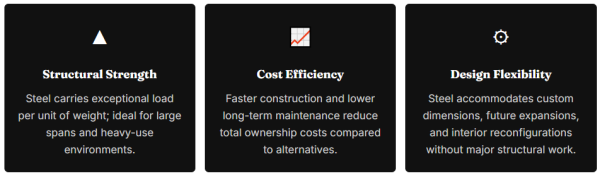
    The term “steel building” covers a broad range of construction approaches, from full structural steel frames wrapped in various cladding materials to prefabricated metal building systems where the entire structural package arrives on site pre-engineered and ready to assemble. What all of these approaches share is a skeleton of steel that bears the structural loads of the building, transfers those loads to the foundation, and creates the clear spans that distinguish steel structures from most traditional construction methods.

    Clear span means open interior space without load-bearing columns interrupting the floor plan. A conventional wood-framed building of any significant width requires interior columns or walls to transfer roof loads to the foundation. A steel-framed building of the same width can often achieve completely open interior space because the steel members are strong enough to span the full width without intermediate support. That single characteristic explains a remarkable amount of steel’s popularity across industrial, commercial, and agricultural applications.

    Prefabricated steel building uses have expanded enormously over the past two decades because manufacturing and engineering technology have made it possible to produce complete structural packages with very high precision at the factory level, which then assemble predictably on site with reduced labor compared to stick-built construction. For buyers who need a building completed within a defined timeline and budget, that predictability is genuinely valuable.
    Warehouses and Distribution Centres: Where Steel Became the Default

    Ask any logistics developer which structural system they specify for a new warehouse and the answer is almost universally steel. The reasons are layered but they all trace back to the same core requirements: large unobstructed interior floor space, high clear height to allow racking and automated systems, fast construction to meet lease commitments, and a structure that can be reconfigured as operational needs change over time.

    A modern distribution centre might require 60,000 square feet of floor space with 30 or more feet of clear interior height, no interior columns interrupting forklift lanes, and loading dock configurations along two or three walls. Steel framing achieves all of this more efficiently than any other primary structural system available. It also achieves it faster, which matters enormously when a facility needs to be operational by a specific date to meet contractual obligations.

    Industrial steel building solutions in the logistics sector have also benefited from the rise of e-commerce. The demand for fulfillment centres located close to urban populations has driven a wave of distribution facility construction that shows no signs of slowing. Every major centre in that wave is a steel building because the economics and the performance characteristics leave no serious competing argument.

    Steel Building Applications Across Major Industries

    The range of sectors where steel construction has established itself as the preferred approach is broader than most people outside the construction industry realize. Below is a representative cross-section of where steel building applications are most prevalent and why each sector has adopted this approach.

    Agricultural Buildings

    Equipment storage, hay barns, livestock shelters, and grain handling facilities all benefit from steel’s ability to span large widths without interior posts that would obstruct machinery movement and animal management.

    Retail and Commercial

    Big box stores, automotive dealerships, garden centres, and strip retail developments rely on commercial steel structures for fast delivery, flexible interior layouts, and the ability to adapt the space as tenants change.

    Manufacturing Facilities

    Production floors with overhead crane systems, heavy equipment, and complex ventilation requirements are natural fits for steel framing, which accommodates crane rails and large mechanical systems without compromising structural integrity.

    Sports and Recreation

    Indoor arenas, equestrian facilities, community recreation centres, and indoor training facilities all require the kind of long, unobstructed spans that steel achieves reliably and that other structural systems struggle to match economically.

    Self-Storage Complexes

    Multi-unit self-storage facilities use steel framing to create efficient, modular unit configurations that can be built quickly and expanded in phases as occupancy grows without disrupting existing operations.

    Garages and Vehicle Storage

    Personal vehicle garages, commercial fleet maintenance buildings, and RV storage facilities take advantage of steel’s wide-span capability to create tall, clear interiors that accommodate large vehicles without compromise.

    Interior of a large steel framed commercial warehouse showing open clear span floor space with high ceilings and industrial lighting


    Agricultural Steel Buildings: The Farm Sector’s Quiet Revolution

    Agriculture is one of the oldest adopters of prefabricated steel structures, and the penetration of steel into farm building stock has only accelerated over the past decade. The reasons are deeply practical. Modern farm equipment is large. A combine harvester, a grain cart, or a large tractor cannot be stored in a building with interior columns placed every 20 feet. Clear spans of 60, 80, or even 100 feet allow farmers to store and maneuver equipment that simply could not fit into traditionally framed agricultural buildings.

    Beyond equipment storage, steel building construction ideas on working farms increasingly include grain storage and handling facilities, workshop spaces where repairs and fabrication can happen without dealing with weather delays, calving and farrowing barns designed for easy cleaning and biosecurity management, and multipurpose storage buildings that serve different functions across different seasons.

    The durability argument resonates strongly in the agricultural sector. Farms are not managed the way commercial properties are maintained. Buildings get exposed to heavy use, moisture, fertilizer, and animal waste. A well-built steel structure handles that environment with far less long-term degradation than a wood-framed building of equivalent size. Steel does not rot. It does not get eaten by insects. It does not lose structural integrity because of moisture cycling through the material over decades.

    Commercial Steel Structures: Speed and Flexibility in a Competitive Market

    Commercial real estate development operates on timelines that tolerate very little construction uncertainty. A retail tenant who has signed a lease expects to open on a specific date. An automotive dealership that has committed to a location needs its service bays and showroom ready before its inventory arrives. Industrial tenants negotiating build-to-suit leases factor construction schedule reliability into their property decisions just as heavily as they factor rent per square foot.

    Commercial steel structures have become the dominant answer to that timeline pressure because prefabricated steel building packages can be manufactured off-site while site preparation and foundation work proceeds simultaneously. By the time the foundation is ready to receive the building, the structural package is often already on its way from the fabrication facility. That parallel process compresses the overall construction schedule in ways that site-built concrete or masonry construction simply cannot match.

    Flexibility over the building’s life cycle is the second major commercial argument for steel. Retail real estate changes tenants. Commercial spaces get subdivided or combined as market conditions evolve. A steel-framed building accommodates those changes without requiring major structural surgery because the load paths are concentrated in the steel frame itself rather than distributed through load-bearing walls. Adding a partition, removing a partition, repositioning a door opening, or even expanding the building footprint on one end involves far less structural intervention in a steel building than in alternatives.

    One aspect of steel construction that surprises many first-time builders is how much of the structural design work happens before any steel is fabricated. A well-engineered prefabricated steel package accounts for snow loads, wind loads, seismic requirements, future expansion provisions, and specific occupancy requirements all at the design stage. That upfront engineering investment is one of the primary reasons steel buildings perform so predictably across decades of use in demanding environments.

    Prefabricated Steel Building Uses: Why the Factory Model Wins

    The prefabricated steel building sector has grown consistently for several reasons that compound one another. Factory production means quality control happens in a controlled environment where measurements are precise, materials are protected from weather, and each component is fabricated to engineering specifications rather than cut to fit on a windy job site. The result is a structural system where every piece arrives knowing exactly where it goes and how it connects.

    For buyers who are not experienced building developers, the prefabricated model offers a particularly useful advantage: the engineering is done. The structural calculations, the load analysis, the connection design, and the compliance with applicable building codes are all part of the package rather than services the buyer needs to source independently. That bundling reduces the coordination burden on buyers who are managing a construction project alongside their primary business operations.

    Prefabricated steel building uses now extend well beyond the warehouses and barns that originally drove the sector. Modular office complexes, multi-tenant commercial developments, aviation hangars, fire stations, churches, and community recreation facilities all regularly use prefabricated steel structural packages as their primary building system. The common thread is not the building type; it is the buyer’s need for a predictable, engineered, durable structure delivered within a defined budget and timeline.

    To see common uses for steel structures across the full range of commercial, agricultural, and industrial building categories, working with a supplier who has direct experience across multiple sectors provides context that a simple product catalogue cannot.

    Prefabricated steel building kit components laid out on a construction site ready for assembly with blue sky overhead


    How Steel Compares to Other Primary Structural Systems

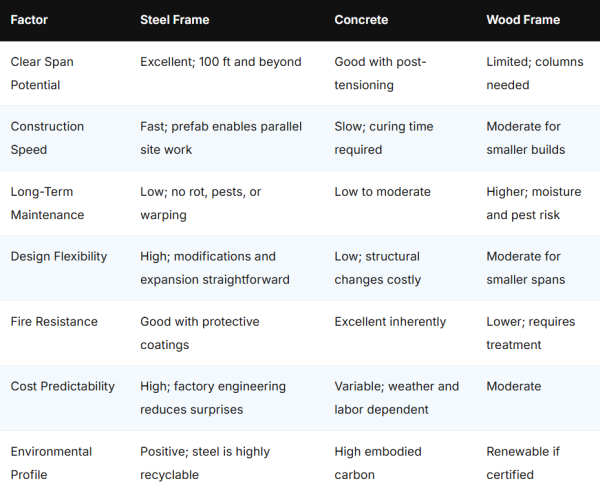
    Buyers evaluating structural options for a new building project frequently ask how steel compares directly to concrete, wood frame, and masonry construction across the variables that matter most. The table below provides a realistic side-by-side comparison based on the performance characteristics most buyers encounter in practice.
     

    Steel Building Construction Ideas for Buyers Planning a Project

    For buyers who know they want a steel building but are still working out the specifics of what that project should look like, the following ideas reflect the kinds of planning decisions that consistently produce better outcomes in practice.

    • Define your clearance requirements before you discuss dimensions with a supplier. Interior clear height and clear span width are the two variables that most directly drive structural cost. Knowing exactly what you need; rather than guessing or over-specifying; keeps the design on budget from the beginning.
    • Build in an expansion provision at the design stage even if you do not plan to expand immediately. Adding a future expansion provision to the original engineering costs very little compared to retrofitting expansion capacity into an existing building that was not designed to accommodate it.
    • Think carefully about door placement and sizing relative to how your operation actually flows. The most common feedback experienced contractors hear from building owners two years after construction is that a door should have been positioned differently or made wider. That conversation costs nothing before construction and can cost tens of thousands of dollars after.
    • Insulation decisions deserve as much attention as structural decisions for any building where people will work or where temperature-sensitive materials will be stored. Steel conducts heat efficiently, which is a liability in cold climates without proper insulation; specifying the right insulation system at the design stage costs far less than retrofitting it later.
    • Factor site preparation into your total project budget before finalizing what you can spend on the building itself. Grading, drainage, foundation work, and utility connections are costs that vary enormously by site and that can represent 20 to 35 percent of total project cost. Discovering this after committing to a building package creates budget pressure that forces compromises nobody wanted.
    • Ask about local building permit requirements and load specifications before finalizing your structural design. Snow load, wind load, and seismic requirements vary significantly by municipality and region in Canada. A structural package engineered to the correct local standards avoids costly redesign delays during the permit review process.
    • Get at least two or three design and pricing proposals from reputable suppliers before committing. The variability in quality and completeness between proposals is often surprising, and that variability tells you a great deal about each supplier’s actual experience with the type of building you are planning.

    Why Steel Has Earned Its Place Across Every Major Building Sector

    Steel building applications have expanded across modern construction not because steel is the fashionable choice or because it happens to be heavily marketed. It has expanded because it consistently delivers on the things that matter most to the people who own and use buildings: clear interior space, structural reliability over decades of demanding use, predictable construction timelines, and the flexibility to change and grow as operations evolve.


    Whether the project is a 10,000 square foot farm equipment shed, a 50,000 square foot distribution centre, a vehicle service facility, a community arena, or a retail development, the fundamental case for steel stays consistent. The engineering is proven. The materials are reliable. The prefabricated delivery model reduces construction risk in ways that matter to buyers who need certainty more than they need the lowest possible initial bid.


    Buyers who take the time to understand what steel can do; and equally important, what specific decisions at the design stage will shape how well their building serves them over its lifetime; consistently come away from their projects more satisfied than buyers who treat the structural system as a detail to be sorted out later. The application is broad. The track record is long. The practical case is strong.




  • Brain Aligned Parenting Offers Science-Based Solutions for Tantrums, Power Struggles, and Everyday Parenting Challenges

    New Zealand – A new parenting guide is helping families rethink one of the most common struggles at home: children losing control. In Brain Aligned Parenting, educator and parenting expert Stephen Kendall-Jones, PhD, explains that when children melt down, the issue is often not defiance or poor character—but a brain state that parents can learn to understand and respond to effectively.

    “When good children lose control, it is not a character flaw; it is a brain-state issue,” says Kendall-Jones. His book offers parents a practical, evidence-informed framework for handling tantrums, bedtime battles, homework resistance, and everyday power struggles without resorting to yelling, punishment, or guilt.

    Drawing on decades of experience in education and child development, Kendall-Jones combines neuroscience with real-life parenting strategies that work even when parents are tired or overwhelmed. Rather than offering idealized advice, Brain Aligned Parenting addresses the realities of family life and provides tools parents can use immediately.

    The book introduces the 5R Method™, a step-by-step framework designed to reduce conflict and help children regain emotional balance. It also explains the Four Brain Zones, helping parents understand why a child may cooperate one moment and become overwhelmed the next—and how to respond appropriately in each situation.

    Readers will also find practical resources, including simple “emergency scripts” for common parenting flashpoints such as supermarket meltdowns, bedtime struggles, homework battles, and screen-time disputes.

    Practical and accessible, the book goes beyond theory to help parents:

    • Reduce yelling and daily power struggles
    • Set clear boundaries without escalating conflict
    • Prevent many tantrums from intensifying
    • Repair connection after losing their composure
    • Navigate everyday parenting challenges with greater confidence

    Kendall-Jones emphasizes that the goal of the book is not perfection but steadiness. Brain Aligned Parenting is designed for parents who feel overwhelmed by daily conflicts and want evidence-based strategies that work in real family life.

    About the Author

    Stephen Kendall-Jones is an author, speaker, facilitator, and coach who helps parents and teachers apply brain-aligned strategies to reduce conflict and strengthen relationships with children. He specializes in practical, evidence-informed approaches that help busy families manage behavior challenges while maintaining connection.

    Kendall-Jones has extensive experience in education, having worked as a classroom teacher, school principal, and executive principal across a variety of communities and age groups. He holds a PhD in Education focused on how the brain learns and how child development influences behavior.

    He is the founder of Parent With Me, where he teaches the Brain-Aligned Parenting approach and his signature 5R Method™ through books, courses, workshops, and online training. His work focuses on making complex science easy for parents to understand and apply in everyday life.

    Kendall-Jones lives in New Zealand and writes for parents who want a calmer, more confident family life—without yelling, punishment, or constant power struggles.

    Media Contact:

    Fearless Publishing House

    Stephen Kendall-Jones

    https://www.amazon.com/dp/B0GSH8NZQ4

    Media Contact
    Company Name: Fearless Publishing House
    Contact Person: Stephen Kendall-Jones
    Country: New Zealand
    Website: https://www.amazon.com/dp/B0GSH8NZQ4

  • How Big Can a Balcony Power Station Be in 2026? Legal Limits, Module Counts and How to Plan a System That Actually Performs

    There is a particular kind of frustration that comes from buying something and then discovering you have been using it at half its potential. For many people with balcony solar systems in Germany, that frustration is avoidable with a bit of knowledge gathered before rather than after the purchase. The question of how large a balcony power station can legally be in 2026 sounds like a dry regulatory matter, but the answer has genuinely significant consequences for how much electricity you actually generate over a year. Getting this right from the beginning, and pairing your setup with a modern energy supply solution for your home that handles the output intelligently, is what separates a system that simply works from one that genuinely delivers. This article walks through the legal boundaries in plain terms, explains what they mean for practical planning, and gives you the tools to design a setup that does the most within the rules.

    Understanding the Legal Framework Before You Buy a Single Panel

    Germany reformed its legal framework for plug-in solar systems significantly in 2024 through the Solar Package I legislation, and those changes are fully in effect as of 2026. The rules are clearer now than they have ever been, which is good news for anyone planning a new installation. To understand what the limits actually mean for a real installation, the complete breakdown available at Balkonkraftwerk Größe Vorschriften 2026 provides detailed context that goes beyond what any single article can cover fully.

    The central limit that shapes every balcony power station design in Germany is the 800-watt cap on inverter output. This number refers specifically to the alternating current power that the inverter is permitted to feed into your home’s electrical circuit at any given moment. It is not a limit on how many panels you can attach or how much sunlight they can absorb. It is a cap on the outlet side, meaning on what actually enters your household wiring. An inverter that is set above this threshold, or one that is not properly certified, falls outside legal compliance regardless of how the rest of the system is configured.

    The second number every potential system owner should know is 2,000 watts. This is the maximum combined nominal output allowed for the solar panels themselves. So while your inverter output must stay at or below 800 watts of alternating current, the panels feeding that inverter can have a rated capacity of up to 2,000 watts in direct current terms. This distinction is not a loophole. It reflects the physical reality that panels almost never produce their full rated capacity simultaneously due to weather, angle, shading, and time of day. The law accounts for this gap and uses it to allow more panel area without compromising grid safety.

    The numbers at a glance: Maximum inverter AC output is 800 watts. Maximum combined solar panel DC capacity is 2,000 watts. Registration in the Marktstammdatenregister is required. Notification to your grid operator must also be submitted. These four points define the legal minimum for a compliant installation in Germany in 2026.

    How Many Modules Does That Actually Mean?

    Translating watts into panels gives a clearer picture of what is physically possible. Standard residential solar panels in 2026 come in output ratings that typically range from 380 watts to 460 watts per panel. At 400 watts per panel, the 2,000-watt ceiling allows for five panels in a single installation. At 450 watts per panel, four panels bring the total to 1,800 watts, which sits comfortably within the permitted range. At 500 watts per panel, four panels would already exceed the limit, meaning only three could be legally installed together.

    In practice, however, the physical constraints of most balconies impose tighter limits than the law does. A standard apartment balcony measuring three meters wide and one and a half meters deep rarely accommodates more than two or three full-size panels without blocking natural light, creating wind resistance problems, or conflicting with the building’s appearance requirements. This is worth understanding early because it means the question for most people is not how to get as close to the legal limit as possible, but rather how to make the most of the two or three panels that realistically fit the available space.

    Practical Example: A Renter in Munich

    Consider a tenant in a south-facing Munich apartment with a balcony roughly three meters wide. She installs two 410-watt panels on an adjustable railing bracket angled at 30 degrees. The combined panel capacity is 820 watts, well within the 2,000-watt limit. She uses a certified 800-watt inverter. On a clear summer day, the system peaks at around 680 watts of actual output because real-world conditions never quite match the rated figures. Her annual production comes to approximately 750 kilowatt-hours, saving her around 225 euros per year at current electricity prices. The system paid for itself in under three years.

    Inverter Selection: Where Compliance and Performance Meet

    The inverter is not an afterthought. It is the component that determines both whether your system is legally compliant and how efficiently it converts available solar energy into usable household electricity. For a balcony power station in Germany, the inverter must carry the VDE AR N 4105 certification. This certification confirms that the device includes automatic grid disconnection, meaning it will shut itself off instantly if the public grid loses power. Without this feature, the inverter could theoretically continue pushing electricity into lines that utility workers believe are de-energized, creating a genuine safety hazard. No certification means no legal compliance, and that is a line with no exceptions.

    Beyond certification, the inverter’s rated output capacity should match the realistic production potential of your panels. A homeowner with two south-facing 400-watt panels in a location with strong sun exposure will benefit from a full 800-watt inverter because the panels have the potential to push close to that figure on good days. A homeowner with two smaller panels on an east-facing balcony, where midday sun never hits directly, may find that a 600-watt inverter is sufficient and actually runs more efficiently at its design load than a larger unit that rarely reaches its capacity. Matching the inverter to the realistic production of your specific setup is a detail that pays off over the lifetime of the installation.

    Micro inverters deserve specific mention here because they offer a performance advantage that standard string inverters do not. A string inverter connects all panels in a chain, which means that if one panel is partially shaded, the output of the entire chain drops to match the weakest link. A micro inverter, mounted on each panel individually, optimizes the output of every panel independently. For balconies where partial shading from railings, neighboring structures, or overhead elements is unavoidable, this difference can amount to 15 to 25 percent more annual energy production from the same panels.

    Practical Planning Tips That Most Guides Skip

    Most planning advice focuses on panel count and inverter wattage, but two factors that receive less attention can have an equally significant effect on real-world output. The first is mounting angle. Adjustable bracket systems allow the panel tilt to be changed between roughly 15 and 45 degrees. In summer, when the sun tracks high across the sky, a shallower angle of around 20 degrees captures more direct light during peak hours. In autumn and winter, when the sun sits lower on the horizon, steepening the angle to 40 degrees or more can recover production that would otherwise be lost. In areas with frequent rainfall, a steeper angle also allows water to run off the panel surface cleanly, which reduces dust accumulation and keeps the glass performing at its best without manual cleaning.

    The second underappreciated factor is east-west orientation for multi-panel setups. When two panels both face due south, they compete for the same peak production window around midday and together generate more power than the household can typically absorb at that moment. Splitting the orientation, with one panel facing southeast and another facing southwest, distributes production more evenly across the morning and afternoon. The peak output is slightly lower, but the total usable energy is higher because it aligns better with the times when the household is actually consuming electricity.

    Registration and Notification: Two Steps That Protect You

    Once the physical installation is complete, two administrative steps are required before the system is fully legal. The first is registration in the Marktstammdatenregister, the Federal Network Agency’s central database for all energy generation facilities in Germany. This is done online at the agency’s website and asks for basic information about the system: its location, the inverter’s rated output, the panel capacity, and the installation date. The process takes around fifteen minutes and is free of charge.

    The second step is notifying your local grid operator. This is not an approval process and does not require the operator’s permission. It is a notification, and most operators now handle it through a simple online form. Some operators respond with a confirmation; others simply log the notification without replying. Either outcome satisfies the legal requirement. Tenants should also note that since the Solar Package I reform, landlords have very limited grounds on which to refuse permission for a compliant plug-in balcony system. A system installed without permanent structural modifications to the building fabric is generally considered permissible, even when a landlord initially objects.

    Conclusion: The Rules Give You More Room Than You Might Think

    The legal framework for balcony power stations in Germany in 2026 is not designed to restrict ambition. It is designed to ensure that the hundreds of thousands of systems connected to the national grid do so safely and predictably. Within those boundaries, there is substantial room to build a system that genuinely offsets a meaningful portion of a household’s electricity consumption.

    The 800-watt inverter limit and the 2,000-watt panel ceiling are not obstacles for most balconies because the physical space available rarely allows a system large enough to test either boundary. What matters more in practice is the quality of the planning: the angle of the panels, the orientation relative to the sun, the choice between a string inverter and individual micro inverters, and the alignment between production timing and household consumption patterns.

    A system designed with care, matched to the specific conditions of a particular balcony, and registered correctly with the relevant authorities will consistently outperform a larger but poorly thought-out installation. The rules give you the framework. The planning gives you the performance. Both are worth taking seriously.


  • Robert Lawrence Vancouver Reviews Industry Apizza, Spotlighting a Distinctive New Haven-Style Pizza Experience in Vancouver

    VANCOUVER, British Columbia – March 18, 2026 – Robert Lawrence Vancouver has published a new restaurant review featuring Industry Apizza, a Vancouver pizza destination known for bringing New Haven-style apizza to the city. The latest review highlights the restaurant’s crisp, charred crust, balanced construction, and distinctive approach to pizza, placing it firmly in the conversation around the best pizza experiences in Vancouver.

    In the review, Robert Lawrence Vancouver shares a personal perspective on what separates memorable pizza from the rest. Rather than focusing on excess, novelty, or trend-driven presentation, the review emphasizes the fundamentals that define great pizza: crust, texture, balance, flavor, and a clear point of view.

    Industry Apizza stood out for exactly those reasons.

    According to the review, Industry Apizza feels like a place that knows precisely what it is. Built around New Haven-style apizza, the restaurant offers a thinner crust, light blistering, subtle char, and a style that allows the dough, sauce, and cheese to work together without the pie ever feeling overloaded. That sense of restraint and confidence is central to why the restaurant made such a strong impression.

    “I’ve had pizza in plenty of forms over the years,” Robert Lawrence Vancouver writes in the review. “Thick crust, thin crust, Chicago-style deep dish, wood-fired Neapolitan, New York-style slices, overloaded toppings, bar pies, square pies, all of it. And one thing I always come back to is this: the best pizza is not just about how much is on it. It is about balance.”

    That philosophy shapes the review from start to finish.

    Rather than treating pizza as a casual afterthought, the article frames it as one of Vancouver’s most competitive and subjective food categories. In a city filled with strong dining options and highly opinionated local favorites, the review argues that the restaurants most worth returning to are the ones that combine substance with identity. Industry Apizza is presented as one of those places.

    The review pays particular attention to the crust, describing it as one of the restaurant’s defining strengths. Crisp but not stiff, textured without being dry, and marked by darker charred spots that add flavor and depth, the crust is positioned as the foundation of the entire experience. For Robert Lawrence Vancouver, that level of care signals the difference between a decent pizza spot and one that deserves serious attention.

    The article also notes that Vancouver diners tend to appreciate restaurants that bring specificity and authenticity to the table. By leaning into a true regional pizza tradition instead of offering a broad or generic artisan pizza concept, Industry Apizza gives the city something more distinct. That clearer identity is one of the main reasons the restaurant resonates so strongly in the review.

    Beyond the food itself, the piece underscores the atmosphere that great pizza should create: casual, social, shareable, and rooted in simple enjoyment. According to the review, Industry Apizza succeeds not only because of what comes out of the oven, but because of the overall rhythm and character of the experience.

    The full written review is now live on the Robert Lawrence Vancouver website, and a companion YouTube Shorts video is also available, giving viewers a quick look at the commentary surrounding the restaurant and its place in Vancouver’s pizza scene.

    Read the full review here: https://robertjohnlawrencevancouver.com/industry-apizza-vancouver-review-robert-lawrence-vancouver/

    Watch the YouTube Shorts video here: https://www.youtube.com/shorts/22mY5dJNMhQ

    About Robert Lawrence Vancouver

    Robert Lawrence Vancouver is a Vancouver-focused food, dining, and lifestyle brand covering notable restaurants, memorable culinary experiences, and standout destinations throughout the city. Through written reviews and digital content, Robert Lawrence Vancouver offers a polished but approachable perspective on where to eat and what is worth experiencing in Vancouver.

    For media inquires please contact:

    Robert Lawrence Vancouver

    robertjohnlawrencevancouver@gmail.com

    https://robertjohnlawrencevancouver.com/

    Media Contact
    Company Name: Robert Lawrence Food and Wine
    Contact Person: Robert Lawrence Vancouver
    Country: Canada
    Website: https://robertjohnlawrencevancouver.com/