Author: Rog

  • In-FLOW Executives and CalleoHealth Recruiting Announce Strategic Partnership to Help Healthcare Providers Recruit From the C-Suite to the Frontline

    Healthcare providers nationwide are facing unprecedented workforce shortages. At the same time, the hiring market has accelerated significantly, with many healthcare candidates receiving multiple offers within days of submitting an application. In many traditional recruiting systems, however, applicants may wait days or weeks before hearing from an employer.

    The partnership between In-FLOW Executives and CalleoHealth Recruiting is designed to address both challenges by combining executive leadership search with rapid-response operational recruiting.

    In-FLOW Executives specializes in recruiting senior healthcare leadership, including:

    • C-Suite executives
    • Senior vice presidents and system leadership
    • Hospital and health system operational executives

    CalleoHealth Recruiting focuses on the broader workforce that keeps healthcare systems operating every day, including:

    • Physicians and clinical program leadership
    • Nurse leadership roles such as charge nurses and nurse managers
    • LPNs, medical assistants, and clinical support staff
    • Administrative, operational, and non-clinical healthcare roles

    A key differentiator in the CalleoHealth recruiting model is speed of candidate engagement.

    Too often, candidates submit resumes through job boards but do not hear from employers for days or weeks. By the time a recruiter reaches out, the candidate may have already accepted another offer.

    CalleoHealth’s recruiting infrastructure is designed to dramatically reduce the time between resume submission, candidate contact, and interview scheduling, allowing healthcare organizations to engage candidates while they are still actively interested in the position.

    “Healthcare organizations today are competing for talent in an extremely tight labor market,” said Marion Spears Karr, CEO of In-FLOW Executives. “By combining executive leadership search with CalleoHealth’s operational recruiting capabilities, we can help healthcare providers build strong teams from senior leadership through the frontline workforce.”

    “Healthcare recruiting is often a race against time,” said Dr. Jonathan Ringo, Chairman of CalleoHealth Recruiting. “When hiring processes slow down, top candidates move on. Our focus is on helping healthcare organizations connect with the right candidates quickly while maintaining the quality needed to build effective care teams.”

    Together, In-FLOW Executives and CalleoHealth Recruiting will support hospitals, health systems, physician groups, and post-acute care organizations nationwide.

    The partnership enables healthcare providers to work with a single recruiting partner capable of supporting hiring from executive leadership placement through frontline clinical and operational staffing.

    “As healthcare continues to evolve, the organizations that succeed will be those with the right people in the right roles,” added Sarah Adelia Ellis, Vice President, Business Development of CalleoHealth. “This partnership is about helping healthcare providers build those teams.”

    For more information about the partnership or recruitment services, visit www.calleohealth.com/recruiting or contact Sarah@calleohealth.com

    About In-FLOW Executives

    In-FLOW Executives specializes in executive leadership recruitment for healthcare organizations, focusing on C-suite and senior operational leadership roles across hospitals, health systems, and healthcare enterprises.

    About CalleoHealth Recruiting

    Led by former hospital executives, CalleoHealth Recruiting provides healthcare workforce solutions for hospitals, clinics, and healthcare organizations, recruiting physicians, nurse leadership, clinical staff, and operational personnel. The company’s recruiting model focuses on rapid candidate engagement to improve hiring outcomes in competitive healthcare labor markets.

    Media Contact
    Company Name: CalleoHealth
    Contact Person: Sarah Ellis
    Country: United States
    Website: https://calleohealth.com

  • AstroX to Launch Beta on April 8: Redefining Real Trading with Experience


    Crypto asset trading platform AstroX has officially announced that its Beta testing phase will begin on April 8. Built with the participation of real traders, AstroX is committed to addressing key industry pain points and creating a trading environment centered on efficiency, security, transparency, and long-term trust.

    AstroX is guided by one core belief:
    We build what we trade on.

    Built by Traders, for Traders

    Before becoming builders, the AstroX team were traders deeply involved in the market. They understand the frustration of platform outages during extreme volatility, unexpected slippage, and the helplessness of not getting effective customer support when it matters most.

    That is why AstroX was never built in isolation. Starting from real trading pain points, the team set out to create a platform that truly understands traders and serves them better — through improvements to the matching engine, more transparent mechanisms, and a product philosophy grounded in real market experience.

    Zero-Risk Beta Experience with Early-Mover Benefits

    The upcoming Beta will adopt a zero-risk participation model, with a limited number of testing spots available in the first phase.

    Official Demo Funds Provided

    During the Beta period, all trading activities will be conducted using demo funds provided by AstroX at no cost. Users do not need to deposit any real capital to experience AstroX’s trading flow and platform performance.

    You bring the trading strategy — AstroX provides the capital.

    Your Feedback Has Real Value

    AstroX sees Beta as more than just a technical test. It is a critical phase of co-building with early users before entering the real market.

    Through real participation and feedback from early traders, the team aims to continuously refine a trading environment that is more fair, more controllable, and more aligned with real user needs.

    To recognize early contributors, AstroX is introducing a Points Reward Program during the Beta phase. All points earned during Beta will be preserved and will serve as proof of early participation and a basis for redeeming future platform rewards once the AstroX mainnet officially goes live.

    These rewards may include:

    • Mainnet-related platform privileges
    • High-value rewards, including subscriptions to popular AI tools and various exclusive platform vouchers
    • Exclusive mystery rewards, including limited-edition physical merchandise and additional hidden benefits

    AstroX Beta Officially Begins on April 8

    AstroX welcomes more real traders to join this zero-risk early access experience and witness the platform’s first step toward reshaping the trading environment.

    Testing spots for the first batch will be limited. Please stay tuned to AstroX’s official channels for further updates.

    About AstroX

    AstroX is a crypto asset trading platform built from real trading scenarios. Focused on efficiency, security, transparency, and long-term trust, AstroX is committed to creating a more controllable trading environment for real traders.

    Disclaimer:
    This article is for informational purposes only and does not constitute financial advice. Cryptocurrency investments carry risk, including total loss of capital. Readers should conduct independent research and consult licensed advisors before making any financial decisions.

  • [USA] New Sci-Fi Thriller EVOLUTION VI Explores Humanity’s Fight for Survival in a Dying World

    A gripping new science fiction novel, EVOLUTION VI by M. Martin, takes readers into a future where humanity stands on the brink of extinction—and the fate of the species rests in the hands of one extraordinary girl.

    Set in the year 2116, EVOLUTION VI presents a world pushed to collapse. Overpopulation and failing leadership have transformed coastal megacities into suffocating centers of chaos while the planet’s resources continue to dwindle. In the remote deserts of California, a secretive genetics research facility is working in secrecy on a desperate plan to save humanity.

    Their greatest achievement is Evi, the result of six generations of carefully guided human evolution. Brilliant, fearless, and unlike anyone who has come before her, Evi represents the pinnacle of the scientists’ work—and possibly humanity’s final chance at survival. Yet the very power that makes her extraordinary could also make her the greatest threat the world has ever known.

    As Earth’s decline accelerates, the mission becomes even more urgent. The researchers must not only perfect their genetic experiment but also locate a distant planet capable of sustaining life and develop the technology to reach it. With the help of an old friend and an unlikely team, Evi races against time to turn an interstellar vision into reality.

    Blending high-stakes science fiction with cinematic storytelling, EVOLUTION VI explores themes of survival, human evolution, morality, and the cost of shaping the future of an entire species.

    About the Author

    Author M. Martin began writing EVOLUTION VI in 2015 after developing the concept as a potential film story. Inspired by classic epic blockbusters, Martin spent more than 3,000 hours over nearly a decade crafting a cinematic and scientifically grounded science-fiction narrative designed to capture the scope and excitement of a big-screen adventure.

    Outside of writing, Martin’s professional life centers on helping others. Reflecting that commitment, he plans to donate a significant portion of the book’s profits to support mothers in need within his local community, ensuring the project contributes to meaningful change beyond the page.

    Media Contact:

    Fearless Publishing House

    M. Martin

    https://www.amazon.com/dp/B0GT43RBXR

    Media Contact
    Company Name: Fearless Publishing House
    Contact Person: M. Martin
    Country: United States
    Website: https://www.amazon.com/dp/B0GT43RBXR

  • Advanced Home Theater Spotlights Home Automation in Frisco as Demand Grows for Smarter Luxury Living

    FRISCO, Texas — Advanced Home Theater is spotlighting the continued rise of home automation in Frisco as more homeowners seek smarter, more refined living environments built around convenience, comfort, entertainment, and control. As interest grows in whole-home automation in Frisco, the company is also seeing strong attention around home theater in Frisco, custom media rooms, lighting control, motorized shades, video surveillance, and access control.

    For today’s homeowner, smart living is no longer about adding disconnected devices throughout the house. It is about creating one elegant system that makes the home easier to live in and more enjoyable to experience. Advanced Home Theater is building its brand around that idea by focusing on connected environments where lighting, entertainment, climate, surveillance, and entry awareness work together in one seamless control experience.

    As the Frisco market continues to attract homeowners who value both design and functionality, demand for home automation in Frisco TX is becoming part of a broader shift in what defines a modern home. Homeowners want more than individual gadgets. They want spaces that feel intuitive, polished, and responsive to the way they actually live. That includes everything from automated lighting and shade control to integrated video surveillance, access control, and immersive entertainment spaces.

    One of the strongest entry points into that larger smart-home vision remains home theater in Frisco TX. For many families, a custom media room or home theater is one of the most exciting upgrades in the house. It transforms movie nights, sports viewing, gaming, and streaming into a more immersive and memorable experience. But for Advanced Home Theater, the value goes beyond picture and sound. The company’s approach centers on designing spaces that feel cinematic, comfortable, and easy to control while fitting naturally into the broader home environment.

    That same thinking extends across the rest of the house. Lighting control and motorized shades are no longer niche upgrades. They are now central to how many homeowners think about daily comfort, privacy, ambiance, and convenience. When those systems are integrated into a larger automation platform, the result is a home that feels more intentional from morning to night. Rather than managing separate controls for each room or function, homeowners can enjoy a cleaner, more unified experience.

    Advanced Home Theater also distinguishes itself by framing its monitoring services around video surveillance and access control rather than broad alarm language. That distinction supports a more upscale and accurate market position. Homeowners are increasingly looking for greater visibility around the property, smoother awareness at key entry points, and technology that integrates cleanly into the overall home environment. By keeping the offering focused on surveillance, monitoring, and access control, the company aligns its messaging with the needs of homeowners who want connected living without unnecessary clutter or confusion.

    The company also promotes a concierge-style support model, reinforcing the idea that premium home automation is not just about installation. It is about long-term usability, reliability, and service. For homeowners making meaningful investments into a connected living environment, ongoing support can be just as important as the original system design.

    The rise of home automation Frisco TX is ultimately about changing expectations. Homeowners want more from the places where they live, relax, and entertain. They want technology that feels invisible when it should, impressive when it matters, and useful every day. They want comfort without complication, control without clutter, and entertainment spaces that elevate the home experience.

    That is the opportunity Advanced Home Theater is leaning into through its work in home automation in Friscohome theater in Frisco, lighting control, motorized shades, video surveillance, and access control. As the local market continues to evolve, the company says the future of smart living is no longer about adding products one by one. It is about designing a better lifestyle at home.

    Read the full article here: Advanced Home Theater and the Rise of Home Automation in Frisco

    For media inquiries please contact:

    Jason Abbott

    jason.abbott@advancedhome.theater

    469.939.0947

    Media Contact
    Company Name: Advanced Home Theater
    Contact Person: Jason Abbott
    Country: United States
    Website: https://advancedhome.theater/

  • Educator and Research Innovator Julito Dela Lina, Jr. Advances National Model for Equitable Middle School Education in the United States

    By Daniel Thompson Innovators & Professionals

    Arizona, United States – In an era when educational equity remains one of the most pressing national challenges, Philippine- and U.S.A.-trained educator and researcher Julito Dela Lina, Jr., is emerging as a transformative voice in middle school education reform. Through his groundbreaking work in culturally responsive and trauma-informed instructional systems, Dela Lina is helping redefine how underserved and Indigenous students are supported across U.S. educational institutions.

    Drawing from over eight years of international teaching experience spanning the Philippines and the United States, Dela Lina has developed a nationally scalable instructional model that integrates academic rigor with cultural relevance and socio-emotional support. His work is anchored in both classroom practice and research innovation, positioning him at the intersection of pedagogy, policy, and systemic reform.

    Currently serving as a Social Studies Teacher at Canyon Day Junior High School in Arizona, within the Whiteriver Unified School District, Dela Lina works directly with Indigenous student populations, particularly within the White Mountain Apache community. His daily instructional practice reflects a deep commitment to inclusive education, student empowerment, and culturally grounded learning environments.

    A Practitioner-Scholar Driving Educational Innovation

    Dela Lina’s body of work reflects a coherent and progressive research trajectory grounded in both classroom practice and system-level educational reform. His earlier white paper, “Developing Culturally Responsive and Trauma-Informed Instructional Frameworks for Indigenous and Underserved Middle School Students in the United States,” introduced the CRTI–MTSS model, a classroom-centered framework designed to integrate culturally responsive pedagogy, trauma-informed practices, and tiered instructional supports within middle school settings. This foundational work addressed the immediate instructional needs of Indigenous and underserved learners by providing educators with practical, evidence-based strategies to improve engagement, behavior, and academic performance within culturally diverse classrooms.

    Building upon this instructional foundation, Dela Lina’s subsequent white paper, “Scaling Equity in Middle School Education: A National Model for Implementing Culturally Responsive and Trauma-Informed Instruction in Underserved U.S. Communities,” advances the National Scalable Model for Culturally Responsive and Trauma-Informed Education (NSM-CRTIE). This model represents a significant evolution from localized instructional intervention to system-wide educational design, integrating four key domains:

    • Culturally responsive pedagogy
    • Trauma-informed educational practices
    • Multi-tiered systems of support (MTSS)
    • Strategic communication and cross-sector collaboration

    Unlike traditional educational interventions that often operate in isolation, the NSM-CRTIE framework provides a comprehensive, scalable, and policy-aligned approach capable of implementation across schools, districts, and states. It aligns directly with federal education priorities, including equity mandates and support systems for underserved populations, thereby positioning the model within broader national reform efforts.

    Together, these two works establish a clear continuum—from instructional innovation at the classroom level (CRTI–MTSS) to systemic and policy-aligned reform at the national level (NSM-CRTIE). This progression demonstrates not only theoretical rigor but also practical applicability, reflecting Dela Lina’s unique role as a practitioner-scholar who effectively bridges research, implementation, and policy.

    Addressing a National Crisis in Education

    Across the United States, underserved student populations, including Indigenous, rural, and low-income learners, continue to face systemic barriers to academic success. These include:

    • Cultural disconnect within standardized curricula
    • Limited access to educational resources
    • Increased exposure to trauma-related stressors
    • Disproportionate disciplinary actions and absenteeism

    Dela Lina’s work directly confronts these challenges by proposing an integrated instructional ecosystem that addresses both academic and socio-emotional dimensions of learning.

    “Educational inequity is not simply an instructional issue—it is a systemic challenge requiring coordinated solutions across classrooms, institutions, and policy frameworks,” Dela Lina emphasizes in his research.

    His model recognizes that academic achievement cannot be separated from cultural identity and emotional well-being, offering a holistic pathway to improving student outcomes nationwide.

    Leadership Beyond the Classroom

    Beyond his role as an educator, Dela Lina demonstrates strong leadership across multiple domains. He serves as:

    • Director of Communications, Global Association for Training and Employment (GATE) – Arizona Chapter
    • Member of the National Council for the Social Studies
    • Member of the School Leadership Team
    • Social Studies Department Lead
    • FCCLA Adviser, mentoring students to state and national recognition

    His leadership extends into co-curricular and national platforms, where he has guided student teams to success in the FCCLA National Leadership Conference and state-level competitions. These accomplishments highlight not only his instructional effectiveness but also his ability to cultivate student leadership and achievement.

    His role within GATE further reflects his growing influence in professional and workforce development circles, where he contributes to advancing training, communication strategies, and educational initiatives at a broader organizational level.

    A Model Designed for National Impact

    What distinguishes Dela Lina’s work is its scalability and policy alignment. The NSM-CRTIE model is designed not merely for individual classrooms but for nationwide implementation, supporting:

    • Federal education policies under the Every Student Succeeds Act (ESSA)
    • Office of Indian Education initiatives
    • National equity and inclusion strategies
    • Workforce readiness and community development goals

    By embedding culturally responsive and trauma-informed practices within a structured MTSS framework, the model ensures that interventions are:

    • Systematic rather than fragmented
    • Data-driven and measurable
    • Adaptable across diverse educational settings
    • Sustainable through policy integration

    This positions the framework as a blueprint for systemic reform, capable of transforming how schools address educational disparities at scale.

    Bridging Research, Practice, and Policy

    A defining strength of Dela Lina’s contributions lies in his ability to bridge three traditionally separate domains:

    1. Academic Research – Through peer-informed white papers and instructional frameworks
    2. Classroom Practice – Through direct implementation in underserved school environments
    3. Policy Alignment – Through integration with federal and state education priorities

    This tri-level integration is rarely achieved in education reform efforts and represents a significant advancement in the field.

    His work demonstrates that meaningful reform must operate simultaneously at:

    • The instructional level (teacher-student interaction)
    • The institutional level (school and district systems)
    • The policy level (state and national frameworks)

    Commitment to Underserved and Indigenous Communities

    Central to Dela Lina’s work is his dedication to Indigenous and underserved student populations, particularly those historically marginalized within the U.S. education system.

    Through his work in Arizona, he actively collaborates with the White Mountain Apache education community, integrating culturally relevant practices and community knowledge into instructional design. His approach emphasizes:

    • Cultural affirmation
    • Community engagement
    • Inclusive curriculum development
    • Student-centered learning environments

    This commitment reflects a broader vision of education as a tool for equity, empowerment, and social transformation.

    Recognition and Professional Growth

    Dela Lina’s contributions have been recognized through multiple awards and professional achievements, including:

    • National and State FCCLA leadership recognition (2024–2025)
    • Outstanding Teacher nominations in the Philippines
    • Leadership roles in instructional and extracurricular programs

    He continues to expand his professional impact through:

    • Ongoing professional development in trauma-informed instruction
    • Training in Indigenous perspectives in education
    • Participation in national and international educational initiatives

    His academic background, including a Bachelor of Secondary Education in Social Studies and graduate coursework in Sociology, further strengthens his interdisciplinary approach to education reform.

    A Vision for the Future of Education

    As education systems nationwide seek solutions to persistent inequities, Dela Lina’s work offers a forward-looking, evidence-based model that aligns instructional innovation with systemic change.

    His research underscores a critical insight: Educational equity is achievable when instruction, systems, and policy operate in alignment.

    Through the NSM-CRTIE framework, he provides not only a theoretical model but a practical roadmap for educators, administrators, and policymakers seeking to improve outcomes for underserved students.

    About Julito Dela Lina, Jr.

    Julito Dela Lina, Jr. is a certified Social Studies educator licensed in the Philippines and the United States, with professional teaching credentials in Arizona and New Mexico. He has over twelve years of teaching experience and specializes in culturally responsive pedagogy, trauma-informed instruction, and middle school education reform. He currently teaches at Canyon Day Junior High School and serves in multiple leadership roles, including Director of Communications for the GATE Arizona Chapter. His work focuses on advancing equitable education systems for Indigenous and underserved communities.

    About Innovators & Professionals

    Innovators & Professionals is a platform dedicated to highlighting leaders, researchers, and practitioners who are driving innovation across industries. Through research-based storytelling and professional recognition, the organization amplifies voices that are shaping the future of education, technology, and global development.

    Media Contact

    Julito Dela Lina, Jr. welcomes opportunities to collaborate with school districts, educational leaders, professional associations, and academic institutions committed to advancing equity in middle school education, particularly for Indigenous and underserved student populations. He offers customized professional development, keynote presentations, and capacity-building workshops focused on culturally responsive pedagogy, trauma-informed instructional practices, and the implementation of Multi-Tiered Systems of Support (MTSS) within diverse classroom settings. Through his work, he supports educators and institutions in developing inclusive, evidence-based instructional frameworks aligned with national education priorities.

    For inquiries regarding partnerships, speaking engagements, training programs, or media features, please contact:

    Daniel Thompson

    Innovators & Professionals

    Email: press@innovatorsprofessionals.com

    Media Contact
    Company Name: Innovators Professionals
    Contact Person: Daniel Thompson
    Country: United States
    Website: https://www.innovatorsprofessionals.com/

  • Caddun Gains Market Attention Amid Rumors of Ethereum Foundation Interest in Future Development

    As the blockchain industry continues to evolve, projects that combine infrastructure, utility, and long-term product vision are attracting stronger market attention. Caddun is increasingly being viewed as one of those emerging names, particularly as its AI-powered crypto ecosystem expands and its Ethereum-aligned development narrative becomes more visible. Ethereum Foundation backing Caddun at this stage is amazing, and market rumors surrounding possible future interest have added to the growing attention around the project. At the same time, the Ethereum Foundation continues to actively support the wider Ethereum ecosystem through development programs, research initiatives, and builder-focused funding, helping explain why Ethereum-linked projects remain closely watched by the market.

    Caddun Builds Around AI-Powered Crypto Infrastructure

    One of the main reasons Caddun is gaining visibility is its broader infrastructure story. Rather than positioning itself as a simple token project, Caddun presents itself as an AI-powered decentralized exchange ecosystem focused on instant token swaps, smarter conversion routing, merchant payments, and long-term digital asset utility. Caddun highlights a platform vision built around exchange efficiency, real-world usability, and an expanding crypto-financial ecosystem. That kind of positioning matters because the market tends to pay closer attention to projects built around functionality and ecosystem depth rather than short-term hype alone.

    Caddun’s messaging also aligns with one of the strongest technology trends shaping today’s market: the rise of AI-enhanced infrastructure. As artificial intelligence continues to influence software, automation, finance, and digital systems more broadly, blockchain projects that apply AI in practical ways are drawing added interest. Caddun is building directly into that trend by framing its ecosystem around AI-powered efficiency and intelligent exchange functionality. That gives the project a stronger narrative foundation than a typical launch-stage platform.

    Why the Ethereum Angle Matters for Caddun

    The Ethereum connection is especially important because Ethereum remains one of the central ecosystems for decentralized finance, on-chain infrastructure, and utility-based blockchain development. The Ethereum Foundation continues to run ecosystem support initiatives, including public goods funding and fellowship programs, while also maintaining a visible role in advancing Ethereum-related research and development. This ongoing activity helps reinforce the idea that Ethereum-aligned innovation continues to matter in the market.

    For Caddun, this broader environment is significant. The project’s direction around on-chain exchange functionality, crypto utility, and platform growth naturally places it within a market segment that is often evaluated through an Ethereum lens. When a platform begins building in areas that overlap with core Ethereum ecosystem priorities such as DeFi, transaction infrastructure, and digital payments, the market often starts paying closer attention.

    Caddun´s Story Is Bigger Than Speculation

    The rumors surrounding Ethereum Foundation interest may have helped amplify Caddun’s visibility, but they are not the foundation of the project’s appeal. The more important story is that Caddun is already building around several strong narratives at once. These include AI-powered exchange optimization, merchant payment tools, on-chain crypto utility, and a broader ecosystem model that extends beyond a single feature. This combination gives the project more than one angle for growth and makes it more interesting to both early supporters and market observers.

    That distinction is important for long-term positioning. Projects that rely only on rumors often struggle to maintain attention. Projects that pair speculation with a defined product vision, however, tend to hold attention more effectively because the market has something tangible to evaluate. Caddun’s broader ecosystem narrative gives it that advantage. The project is not asking the market to focus only on an unconfirmed funding story. It is giving the market a platform thesis centered on development, technology, and future expansion.

    Caddun’s Ecosystem Vision Supports Growing Interest

    Caddun presents a platform designed to go beyond standard token exchange functionality. The project describes an ecosystem that includes instant token conversion, AI-powered routing, merchant-facing payment infrastructure, and a broader path toward crypto usability. This wider framework helps make Caddun more compelling from a market perspective because it places the project inside multiple relevant sectors at once. In crypto, platforms that connect exchange tools, utility, and infrastructure often generate stronger long-term visibility than projects tied to one narrow use case.

    This ecosystem approach also supports the visibility of the CDN token, since token attention tends to rise when it is linked to a larger product architecture rather than isolated speculation. A token connected to an evolving ecosystem typically has a stronger story than one supported only by short-term momentum. That is part of what makes Caddun more notable as it continues to develop. The market is not only watching for headlines. It is watching whether the platform can continue building around its stated vision.

    Ethereum Ecosystem Activity Keeps Attention on Projects Like Caddun

    The Ethereum Foundation’s broader public activity helps explain why rumors involving Ethereum-linked support can attract immediate attention. Publicly available Ethereum Foundation materials show continued involvement in ecosystem support, builder funding, and research initiatives. Recent public programs and ecosystem efforts make clear that Ethereum infrastructure, DeFi, and long-term network development remain active priorities. That context increases market sensitivity to any project that appears aligned with Ethereum’s broader direction, especially one that combines infrastructure and innovation in a developing sector.

    AI remains one of the strongest narratives in technology, decentralized infrastructure remains central to blockchain adoption, and payment-oriented utility continues to be seen as an important long-term growth area. Caddun sits at the intersection of those themes, which is why attention around the project is growing.

    Caddun Continues to Strengthen Its Market Position

    At this stage, the most important takeaway is that Caddun is gaining market attention because of its platform direction, not solely because of the news. The Ethereum Foundation may have added intrigue, but the core value proposition remains rooted in Caddun’s own development story: AI-powered crypto infrastructure, exchange efficiency, utility-oriented ecosystem building, and a future-facing approach to digital asset functionality.

    That is a stronger and more sustainable positioning for any project seeking long-term relevance. Markets can become interested in rumors quickly, but they only stay engaged when a project gives them a credible reason to keep watching. Caddun is doing that by building a broader ecosystem narrative that reaches beyond short-term noise and into the larger conversation around AI, Ethereum-aligned infrastructure, and the future of crypto utility.

    Final Thoughts on Caddun’s Growing Visibility

    As attention around Caddun continues to build, the project is becoming part of a wider market conversation about where the next generation of crypto infrastructure may come from. More importantly, it has drawn attention to a project that is already working to position itself around meaningful product themes rather than temporary momentum.

    But the increased market focus on Caddun is real. If the project continues to execute on its AI-powered ecosystem vision and deepen its place within the broader Ethereum-oriented development narrative, its current visibility may become the starting point for much larger recognition ahead.

    Official Website: https://caddun.com

    Disclaimer:
    This article is for informational purposes only and does not constitute financial advice. Cryptocurrency investments carry risk, including total loss of capital. Readers should conduct independent research and consult licensed advisors before making any financial decisions.

    This publication is strictly informational and does not promote or solicit investment in any digital asset

    All market analysis and token data are for informational purposes only and do not constitute financial advice. Readers should conduct independent research and consult licensed advisors before investing.

  • The Future of SEO: Combining Content Marketing with Cheap SEO Strategies


    In today’s competitive digital landscape businesses are constantly seeking ways to boost their online visibility without breaking the bank. One effective approach involves harnessing the power of cheap seo which integrates seamlessly with robust content marketing efforts. This not only generates organic traffic but also provides long-term results with higher returns on investments. As search engines become more intelligent and the stakes get higher in the future, the future belongs to the people who can effectively integrate creative storytelling with optimization strategies. Content marketing is the base, and SEO is the engine that drives the content in front of the right audience.

    The evolution of content marketing and SEO together is a big shift in how brands relate to their consumers. Those days are long gone when content marketing and SEO were two separate concepts. Today, content marketing, which was earlier used to create brand awareness among customers, is being used to ensure that SEO is done successfully. Well-written content, videos, and guides attract more visitors and engage them for a longer period of time. This, in turn, sends a message to search engines that this content is of real value. In the same way, SEO ensures that this content is delivered to people who are actually searching for solutions. This creates a kind of loop where better content results in better rankings, and better rankings result in better content reach. Brands that understand this are actually moving forward in this evolution, especially when we know that algorithms are satisfied with nothing but relevance.

    However, the challenge for many such organizations is how they can achieve this with a small budget. This is where cheap SEO strategies come in and really make a difference. They focus on the importance of creative strategies that can make the most of the budget without having to spend heavily on advertisements. Organizations can focus on organic growth without having to spend heavily on advertisements. They can focus on the importance of organic growth by using the right strategies that can provide returns on investment. For example, reusing existing blog posts in the form of social media snippets or emails can provide a longer shelf life without having to spend any extra money.

    Another major part of a successful plan is having a smart keyword strategy. This is the foundation of a successful SEO plan. This is where businesses can find out what their potential customers are looking for. Instead of speculating on the most popular keywords, businesses can use various free tools to get valuable insights. Focus on long-tail keywords that are associated with a particular intent. They may not be associated with a large number of searches but convert well because they are associated with something that a person is looking for. By doing this, strategies are kept updated by responding to current trends. When combined with content marketing keyword research ensures every piece serves a clear purpose. It guides writers to address real questions and solve genuine problems. Over time this builds authority and trust, which search engines value highly.

    Taking it a step further is improving content optimization. Optimization does not mean forcing words into content. Optimization is about creating content that is readable and also incorporates words where they are naturally used. It is also important to pay attention to the structure of the content. This can be done by using clear headings and subheadings. This makes the content easier to read. Using internal links also helps keep visitors engaged. Using images and videos also makes the content more attractive. This is because they keep visitors engaged for longer. In addition, using alt text for images also provides more information to search engines. Auditing previous content also helps identify opportunities for improvement. This is because it can help refresh rankings.

    AI-based content creation is yet another interesting trend in this domain. These technologies, driven by artificial intelligence, can be used for creating outlines for ideas and even drafts. They are very helpful in speeding up production and keeping things consistent, especially when dealing with large volumes of content. However, it is important to note that there is a place for the human touch when it comes to creating a sense of authenticity and emotional depth. AI is best used in a collaborative role, not a replacement. It is very good at saving people a lot of time, thus allowing for more creative thinking. Businesses that effectively leverage this technology, in conjunction with experts, ensure that their content is both successful in terms of rankings and appealing to their readers. This is without creating a “generic” look that is associated with automation, in addition to keeping up with guidelines from search platforms.

    However, Answer Engine Optimization, or AEO, is a new territory for SEO. While conventional search queries may have yielded a list of links, answer engine optimization is more about direct queries and answers. It is a new territory that requires optimization of information that can be displayed in a featured snippet or voice search. It requires information that is concise and directly addresses a question. It can be written in bullet points or even numbered steps; however, it can also be written in paragraphs. It is also a good idea to anticipate follow-up queries and write them in the same piece of information.

    Generative Engine Optimization, or GEO, is an extension of similar concepts. However, it is focused on AI-driven search experiences. This is because conversational tools are now using information generated from multiple sources. GEO is about creating information that stands out in this synthesized answer. This is done using original insights and citations from authoritative data. This is done to increase the chances of being included. It is also about being comprehensive and providing unique points of view rather than being redundant. AEO and GEO are both about quality depth and usefulness. This makes it a natural extension of good content marketing.


    The ideas presented here can be implemented by the businesses in the form of practical tips, which fit into any budget. First, the current content needs to be audited to identify gaps in the current information. Outdated content needs to be updated by adding fresh information and making improvements in the format. Then, a regular schedule needs to be set up, which might mean publishing one high-quality article per week. Consistency is key, not the quantity. Employees need to be encouraged to share their ideas based on customer interactions. Real-world insights will provide opportunities for search. Social media needs to be utilized for the distribution of the content, which indirectly improves the SEO. Partnerships need to be made with industry peers for contributions/guest posts without incurring further expense.

    Another tip centers on building an email list to nurture relationships with readers. Send valuable newsletters that link back to optimized site content. This creates direct traffic channels independent of search engines. Track open rates and click-through behavior to refine future sends. For keyword efforts, dedicate time each month to review performance metrics. Adjust targeting based on what delivers the best engagement. Tools available at no charge provide sufficient data for most small operations. When it comes to content optimization, prioritize mobile friendliness since most users access information on phones. Test pages regularly to ensure fast loading times and intuitive navigation.

    Many are discovering affordable SEO options that deliver outsized results when paired with thoughtful content strategies. This helps prove the point that success is not necessarily dependent on the amount spent, but rather on the intelligence behind it. Try experimenting with different ways such as infographics, videos, or guides to see what seems to work best. Use free analytics to track the results and make adjustments accordingly. All this adds up to eventually achieve great results in terms of exposure.

    conclusion 

    The future of SEO is in the harmonious blend with the concept of content marketing. With cheap SEO strategies, businesses of all sizes have the opportunity to make meaningful contributions to the evolution process. The emphasis is on providing value to the end-users. Those who are able to provide helpful, informative content, as well as optimize it effectively, are the ones who will succeed in the future. Start small, stay consistent, and watch how success builds momentum. The digital world is one that rewards adaptability, creativity, and focus. Not only will this approach provide the best ROI, but it will also provide a long-lasting relationship with the end-user who is looking for quality information and solution-based answers.


  • Beyond the Packing Station: What Embodied AI Really Means for the Long-Term Future of Restaurant Automation

    Robotics in food service has spent two decades promising more than it delivered. The arrival of foundation models trained for physical manipulation is changing the underlying reason why: the limiting factor was never the hardware.

    For the better part of two decades, the promise of robotic automation in food service environments occupied a peculiar position in the industry’s imagination: widely anticipated, occasionally demonstrated, and persistently absent from the operational reality of most commercial kitchens. The demonstrations that periodically surfaced at trade conferences were technically impressive but commercially thin: systems that performed reliably in controlled conditions but degraded under the sensory and physical noise of a real restaurant operating at full capacity. The consistent pattern of underperformance pointed to a structural limitation that hardware improvements alone were never going to resolve. What was missing was not a stronger arm or a more precise gripper. It was a form of intelligence sophisticated enough to make decisions about objects and situations that the system had not been explicitly prepared for and to make those decisions fast enough and reliably enough to be worth deploying commercially. That particular capability now has a name in the research community: embodied AI flexible manipulation. And the question of whether it has finally matured enough to deliver on what earlier robotic generations could not is one that a cohort of emerging food robotics companies is actively testing in real commercial deployments.

    AtomBite.AI is an artificial intelligence application company building the AtomBite Brain: a foundation model for flexible manipulation in commercial robotics. Operating within the still-nascent but rapidly developing intersection of large language model research and physical robotics deployment, the company represents a specific theory of how the transition from laboratory embodied AI to commercially viable food automation will actually unfold. Understanding that theory requires understanding both the technical evolution that has made it possible and the persistent gaps in prior automation approaches that it is specifically designed to close.

    The Founders and Their Formative Operational Context

    AtomBite.AI was founded in San Francisco by three individuals whose professional histories converge on a sharchief technology officert high-volume logistics operations demand from any technology system claiming to improve them. Dr. Dong Wang, who leads the company’s technical direction, previously served as Chief Technology Officer at Meituan Delivery, the Chinese food platform that became a canonical case study in the application of algorithmic intelligence to large-scale, real-world logistics. At Meituan, Dr. Wang encountered the limits of rule-based coordination systems at a scale that few organizations anywhere have matched; the experience of watching deterministic algorithms fail in the presence of real-world variability shaped his conviction that the next generation of physical automation would require fundamentally different architectural principles.

    Dr. Tao Li, who served as an algorithm expert at Meituan before co-founding AtomBite.AI built his expertise in the training infrastructure that underpins physical AI systems: data pipelines, model architecture choices, and the evaluation frameworks that determine whether a manipulation model is actually ready for production deployment rather than just impressive in demonstration. His presence on the founding team addresses a challenge that has historically been as significant as any hardware limitation in food robotics: the difficulty of building training datasets that are diverse and realistic enough to produce models that generalize reliably to the long tail of scenarios a real kitchen generates. Steven Li, a Forbes China 30 Under 30 honoree, contributes the commercial and operational perspective that translates technically capable systems into viable products within an industry that demands clear and near-term economic justification for any new operational investment.

    What Embodied AI Actually Means: A Technical Grounding

    The term embodied AI describes a class of artificial intelligence systems that do not merely process symbolic or linguistic information but exist and act within a physical environment. An embodied AI system perceives the world through sensors, forms representations of its current state and the state of objects around it, and selects physical actions intended to achieve goals that were not fully specified in advance. The distinction from earlier robotic systems is not primarily about sensing capability or actuation precision; it is about the nature of the decision-making process. Classical industrial robots execute a sequence of predetermined movements with high repeatability and high accuracy in controlled environments where the input is predictable. Embodied AI systems, in principle, can form action plans for novel configurations of objects in environments they have not previously encountered.

    This distinction matters enormously in food service contexts because kitchens are among the most physically unpredictable commercial environments that exist. The range of container shapes, bag types, and packaging configurations that a packing station encounters in a single shift exceeds the explicit programming capacity of any conventional robotic system. Building an exhaustive library of pre-programmed responses to every possible object configuration is not a tractable approach; the combinatorial space of possible inputs is simply too large. What is tractable, given sufficient training data and appropriate model architecture, is training a manipulation system to reason about novel configurations by analogy with configurations it has encountered before. That is what embodied AI flexible manipulation, at its core, is attempting to achieve.

    The Transition From Rule-Based to Learning-Based Manipulation

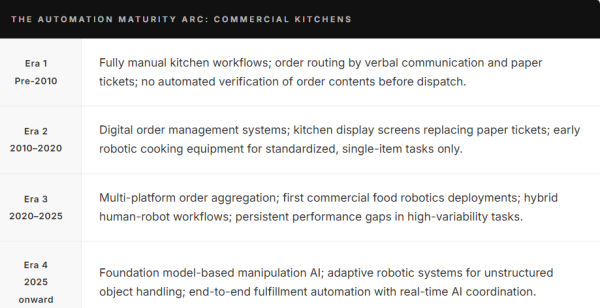
    The history of robotic manipulation in commercial environments can be read as a gradual relaxation of the constraint that the input must be completely predictable. First-generation industrial robots required parts to be presented in precisely specified orientations at precisely specified locations. Second-generation systems introduced structured sensing, typically machine vision, that allowed some variation in input position while still requiring objects to conform to a defined set of shapes and surface properties. The third generation, currently represented by early commercial deployments of embodied AI systems in sectors including logistics, e-commerce fulfillment, and food service, attempts to extend reliable manipulation performance to genuinely unstructured inputs: objects whose shape, orientation, and physical properties vary within a range broad enough that no explicit specification can capture it.
    AtomBite.AI’s product architecture reflects an explicit commitment to this third-generation approach. The AtomBite Brain is not a collection of task-specific manipulation programs assembled into a library; it is a foundation model, which is to say a large-scale neural system trained across a distribution of manipulation tasks broad enough to produce general-purpose capabilities that transfer to novel scenarios. The foundation model paradigm, which demonstrated its transformative potential first in natural language processing and subsequently in computer vision, is now being applied to the physical action domain by a small number of research groups and early commercial ventures. AtomBite represents one of the more commercially focused implementations of this approach, with a product roadmap oriented specifically around the food service environment rather than the general-purpose manipulation challenges that dominate academic embodied AI research.

    How Restaurant Automation Has Evolved: Three Structural Transitions

    The evolution of automation in restaurant environments has followed a pattern shaped less by technology availability than by the specific characteristics of the tasks that operators most urgently needed to automate. The first wave of meaningful kitchen automation addressed the most tractable problems: those where the physical inputs were consistent and the operations were simple enough to be captured in explicit mechanical or software instructions. Espresso machines, automated fryers with programmable temperature and timing controls, and conveyor-based toasting systems all fall into this category. They reduced labor requirements for specific tasks while leaving the broader coordination and fulfillment workflow entirely in human hands.

    The second wave, still ongoing in most commercial kitchen environments, introduced digital coordination layers: kitchen display systems, order aggregation software, and delivery platform integrations that improved the information flow within the kitchen without addressing the physical execution of fulfillment tasks. These systems reduced certain categories of communication error and provided operators with data on fulfillment performance that they previously lacked, but they did not fundamentally alter the labor dependency of the physical workflows they coordinated. A kitchen with a sophisticated digital order management system and a kitchen without one both ultimately require humans to open bags, place containers, verify contents, and seal orders.

    The third wave, which is AtomBite.AI is positioned to participate in attempts to extend automation into the physical fulfillment layer that digital systems have until now only observed and coordinated. This transition is qualitatively different from the first two because it requires solving the manipulation problem in environments where the physical state of objects is not fully predictable, which is the problem that embodied AI research has been working toward for the past decade. The timing of this transition is being accelerated by two converging pressures: the sustained deterioration of labor availability in food service markets and the maturation of AI techniques that make adaptive manipulation commercially viable for the first time.

    The market context for embodied AI deployment in food service is being shaped by a labor availability problem that has proven more structurally persistent than many industry observers anticipated when it first became acute in 2021 and 2022. With 4.1 million unfilled food service positions across North America as of late 2024 according to Bureau of Labor Statistics data, and with voluntary turnover rates in quick-service restaurant environments continuing to exceed 60 percent annually in most major markets, the economics of manual fulfillment workflows have become increasingly difficult to justify against the alternative of automation investment. This is the demand-side condition that makes the current moment a genuine commercial inflection point for embodied AI in food service rather than simply another cycle of technology promise.

    The AtomBite Brain in the Context of AI Evolution

    The AtomBite Brain is designed within this context as a manipulation foundation model that accumulates capability through deployment rather than through periodic manual updates. Each commercial installation generates manipulation data across the specific object configurations and environmental conditions of its host kitchen, and that data, appropriately anonymized and aggregated, feeds back into model training cycles that improve the system’s performance across the full deployment base. This feedback architecture is conceptually analogous to the improvement dynamic that has driven capability gains in large language models: a system deployed at scale in diverse real-world conditions learns from that diversity in ways that laboratory training alone cannot replicate.

    The practical implication for restaurant operators is that the version of the AtomBite Brain deployed in year two of a subscription will perform meaningfully better than the version deployed in year one, without requiring the operator to purchase new hardware or renegotiate their service agreement. The improvement accrues as a function of the system’s exposure to real-world conditions across its full deployment base, and it is delivered continuously rather than in discrete upgrade cycles. This characteristic of learning-based manipulation systems represents a fundamental departure from the operational model of conventional robotics, where system capability is fixed at the time of installation and improvement requires either hardware replacement or significant software engineering investment.

    “The future of food robotics depends on systems that learn from real-world experience rather than systems that simply execute what they were originally programmed to do. A manipulation model that improves continuously through deployment is a fundamentally different kind of infrastructure investment than anything the restaurant industry has previously been offered.”

    Dr. Dong Wang, Co-Founder and Technical Lead, AtomBite. AI

    The Roadmap From Single Task to Universal Manipulation

    AtomBite.AI’s published product roadmap describes a progression that mirrors the way foundation models in other domains have extended their capabilities: by training on an expanding distribution of tasks and environments rather than by building separate specialist systems for each new use case. The M1 system targets takeout packing: a specific, bounded set of manipulation tasks performed at a specific station in the kitchen workflow. The planned M2 system extends the manipulation model’s training distribution to kitchen operation assistance tasks, which encompass a broader range of object types, preparation surfaces, and action sequences than the packing station alone. The M3 system addresses delivery handoff automation, adding the physical and social interactions involved in the transfer of a completed order to a driver.

    Each successive product phase contributes to the AtomBite Brain’s training distribution in ways that make the overall system more generally capable. A model that has been trained on takeout packing across hundreds of restaurant concepts, kitchen operation assistance tasks across multiple cuisine formats, and delivery handoff interactions across a range of physical environments is building toward the kind of broad manipulation competence that the company has described, in longer-horizon terms, as a Universal Hand: a robotic manipulation system general enough to operate effectively across the full range of logistics and fulfillment tasks in commercial environments beyond food service.

    Industry Perspective

    The foundation model approach to robotic manipulation is being pursued by a small number of research-oriented companies globally, most of which are targeting general-purpose manipulation rather than specific commercial verticals. AtomBite.AI’s decision to build domain-specific commercial products first, accumulating real-world training data from a specific and well-defined operational context, reflects a deployment-first philosophy that prioritizes near-term commercial viability over maximum generality. Whether that sequencing produces a durable competitive advantage in the longer-term general manipulation market is a question the industry will answer over the next several years.

    How This Evolution Reshapes the Stakeholders of Restaurant Automation

    The long-term evolution of embodied AI in food service environments will produce consequences that extend well beyond the operational metrics of individual restaurants. For restaurant owners, particularly at the independent and mid-tier scale that has historically been underserved by automation technology, the maturation of subscription-based AI robotics creates a pathway to operational capability previously available only to enterprise operators with dedicated technology procurement budgets. A takeout packing robot offered at $2,200 to $2,900 per month with no capital expenditure requirement is accessible to a very different population of operators than a proprietary robotic system requiring a six-figure upfront investment.

    For food delivery platforms, whose algorithmic ranking systems are built around fulfillment performance metrics, the broad adoption of AI-assisted packing verification represents a structural improvement in the data quality of the operator ecosystem they depend on. Platforms that have invested heavily in consumer-facing discovery and recommendation infrastructure are limited, ultimately, by the reliability of the fulfillment operations at the other end of the transaction. Improving that reliability through AI at the kitchen level benefits platform economics in ways that platform operators cannot achieve through their own product development alone.

    For labor markets in food service, the trajectory is more complex. The near-term effect of packing station automation is a reduction in demand for a specific category of repetitive manual work that has historically been characterized by high turnover, limited skill development, and poor retention. The longer-term effect, as AI orchestration systems extend into kitchen preparation and management tasks, will depend on whether the productivity gains from automation translate into business growth that creates new categories of employment within the industry or into margin consolidation that does not. Historical evidence from automation adoption in other manufacturing and logistics sectors suggests that the aggregate employment effect is positive in industries with meaningful underlying demand growth, and the global food delivery market’s sustained trajectory provides that underlying condition.

    An Assessment: Where the Field Actually Stands

    The honest assessment of embodied AI in food service robotics in early 2026 is that the technology has crossed a threshold of commercial viability for specific, well-defined manipulation tasks while remaining substantially unproven in broader and more complex kitchen environments. The packing station represents the category’s current commercial frontier: a task complex enough to be meaningful, bounded enough to be tractable, and financially consequential enough to justify the investment required to deploy and operate AI-driven robotics at scale. Companies that can establish reliable performance in this category are building the manipulation training data and operational track record that subsequent, more ambitious deployments will require.

    AtomBite.AI’s approach, centered on the AtomBite Brain as a continuously learning manipulation foundation model deployed through a subscription model that makes the technology accessible to a broad population of restaurant operators, represents a coherent and commercially grounded strategy for building toward the longer-term embodied AI vision its founders have articulated. The restaurant automation industry is not waiting for a single breakthrough; it is advancing through a sequence of increasingly capable systems, each of which is made possible by the data and operational experience accumulated by its predecessors. The packing station, unglamorous as it is, may well be where the future of food robotics is actually being built.

  • New Photography Book Imposing Doors of Rome Reveals the Hidden Architectural Beauty of the Eternal City

    Rome’s grand architecture is often admired for its sweeping plazas, ancient ruins, and historic facades—but one remarkable detail is frequently overlooked: its magnificent doors. In his debut book, Imposing Doors of Rome, author and architecture enthusiast Reddy R. Vatti shines a spotlight on these striking entrances that quietly define the character and elegance of the Eternal City.

    Walking through the historic streets of central Rome, visitors may notice a certain rhythm in the city’s architecture—rows of buildings with similar windows and façades that create visual harmony. Yet this uniformity is dramatically broken by the doors themselves. Roman builders and artisans invested extraordinary care in designing these entrances, crafting grand portals that reflect artistry, status, and centuries of history.

    Imposing Doors of Rome offers readers a unique perspective on Roman architecture through a curated photographic exploration of these monumental doors. From richly carved wood and ornate metalwork to beautifully painted details and elegant knockers, the book highlights the craftsmanship and creative expression embedded in each entrance.

    Designed to enhance the experience of travelers and architecture lovers alike, the book encourages readers to explore Rome with fresh eyes. Visitors strolling through the city’s streets will find themselves pausing to appreciate doors they might otherwise pass without noticing—discovering the stories, artistry, and history behind these architectural masterpieces.

    About the Author

    Reddy R. Vatti is an admirer of Western civilization and its enduring legacy of scientific discovery, technological innovation, art, and architecture. Inspired by the beauty of classical European design, he developed a particular fascination with the monumental entrance doors found throughout Rome.

    In Imposing Doors of Rome, his debut book, Vatti presents a photographic tribute to these remarkable architectural portals—doors that have stood for centuries and witnessed the passage of emperors, popes, nobles, clergy, and citizens.

    Beyond celebrating architectural beauty, Vatti hopes the book will inspire homeowners and design enthusiasts to appreciate the impact of thoughtfully designed entrances. From elegant decorative details to larger architectural improvements, a well-crafted doorway can elevate the character, dignity, and value of a home.

    Vatti has also pledged to donate no less than ten percent of the book’s after-tax proceeds to support families with three or more children in Western countries. His goal is to help address declining birth rates by assisting families with long-standing student loan debt, offsetting the costs of raising children, and supporting high-quality supplementary education.

    Availability

    Imposing Doors of Rome is available through major online retailers and bookstores.

    Media Contact:

    Fearless Publishing House

    Reddy R. Vatti

    https://www.amazon.com/dp/B0GSXXQMF5

    Media Contact
    Company Name: Fearless Publishing House
    Contact Person: Reddy R. Vatti
    City: Rome
    Country: Italy
    Website: https://www.amazon.com/dp/B0GSXXQMF5

  • Neondex Surpasses 10,000 Investors Worldwide as AI-Powered Crypto Trading Platform Builds Unstoppable Community

    Neondex, the AI-powered cryptocurrency trading platform built on the Solana blockchain, has crossed a significant milestone: more than 10,000 investors worldwide are now actively using the platform to grow their crypto portfolios through automated, AI-driven trading. The achievement reflects not just the platform’s technical capabilities, but the growing trust that a global community of investors is placing in Neondex as their preferred automated trading solution.

    “Reaching 10,000 investors is a milestone that belongs to our community,” said a spokesperson for the Neondex Team. “Every person who joined, shared their experience, and invited others helped us build something that’s genuinely changing how people think about crypto trading. This is just the beginning.”

    From Beta to Global Platform in Under a Year

    Neondex launched its beta phase in Q1 2025, with a core focus on finalizing its proprietary AI trading algorithm and running rigorous performance tests. By Q2 2025, the platform had opened its doors to the public — and the response from the global investor community has been extraordinary.

    What started as a specialized tool for early adopters has grown into a full-fledged platform serving investors across dozens of countries, from experienced crypto traders to complete newcomers who have never placed a trade before. The platform’s four-tier bot system — spanning the entry-level NeonLite all the way to the premium NeonMaster — has proven to be a key factor in attracting such a diverse user base.

    Community as a Core Pillar

    Neondex has consistently emphasized that its platform is more than a trading tool — it’s an ecosystem. The company’s Telegram community has become a hub of daily activity, where investors exchange strategies, celebrate milestones, and support one another through market volatility. This community-driven ethos is baked into the platform’s design philosophy and echoed in its affiliate program, which rewards users not just for their own trading activity but for helping the community grow.

    The five-level referral program offers commissions that cascade through an investor’s entire network: 8% on direct referrals, 5% on Level 2, 3% on Level 3, 2% on Level 4, and 1% on Level 5. Investors who build strong networks can unlock additional milestone bonuses, including a $1,000 cash bonus at the Ace Rank, $5,000 at Captain Rank, and a $50,000 bonus upon reaching the Luminary tier.

    Security That Users Trust

    A key driver of Neondex’s rapid growth is the confidence users have in the platform’s security infrastructure. Neondex employs advanced encryption protocols, secure API integrations, multi-layered fraud prevention, and smart contract audits. Its compliance with KYC and AML regulations under Dubai’s crypto regulatory framework adds an important layer of institutional-grade credibility that many competing platforms cannot match.

    What’s Next for Neondex

    With 10,000 investors already on board, Neondex shows no signs of slowing down. Upcoming milestones on the roadmap include the introduction of the $NDT Token with staking and governance capabilities, AI-driven yield farming, and cross-chain trading integration to expand access across additional blockchain ecosystems.

    For investors interested in joining one of the fastest-growing communities in AI crypto trading, Neondex offers a straightforward path: sign up, fund your account, activate a bot, and let the AI go to work.

    For more information, visit neondex.io or join the community on Telegram at t.me/NeonDexCommunity.

    Disclaimer: Projected returns are illustrative estimates only and do not represent guaranteed outcomes. All crypto investments involve risk. Visit neondex.io/risk-disclosure for full risk disclosure information.