A low price tag is easy to notice. A good deal is harder to identify. Two products can sit next to each other online or on a store shelf, and the cheaper one can still cost more for the amount you actually receive. Package size, number of servings, concentration, count, shipping requirements, and product specifications can all change the real value of a purchase.
That is why smart comparison shopping starts with a simple question: what am I actually getting for the money?
Sticker Price Tells Only Part of the Story
Suppose one jar costs $4 and another costs $6. The $4 jar looks cheaper until you notice that it contains half as much product. The larger jar may have the higher checkout price but the lower cost per ounce. The same issue appears with coffee, detergent, paper products, batteries, pet food, supplements, and many other everyday purchases.
A useful comparison therefore needs two numbers: the total price and the amount of product. Dividing the price by ounces, fluid ounces, servings, count, or another relevant unit makes different package sizes easier to compare.
Compare the Unit That Matters
The right unit depends on the product. Coffee and peanut butter may make sense per ounce. Laundry detergent may be compared per fluid ounce or, when dosage information is reliable, per load. Batteries can be compared per battery. Paper products can be more complicated because roll count alone may not reflect sheet count or total area. The goal is not to force every category into the same formula. It is to use a normalized measure that lets you compare similar products on equal terms.
Make Sure the Products Actually Match Your Needs
The cheapest unit price is not useful if the product does not meet your requirements. A shopper looking for unscented detergent, a particular battery type, or a food with certain ingredients should filter for those requirements first and compare value second.
This is where modern comparison tools can reduce manual work. For example, shoppers can usePopgot to describe what they need, review products that match specified requirements, and compare listings using unit pricing where available. That makes the comparison more useful than simply sorting a broad search page from lowest price to highest price.
Account for the Real Cost of the Purchase
A good deal can also be affected by shipping, membership requirements, minimum order thresholds, subscriptions, and the amount of product you can realistically use. A bulk package that saves a few cents per ounce may not be worthwhile if part of it expires, goes stale, or takes up more storage than you have.
For recurring household purchases, it can help to compare both the unit price and the practical purchase size. The best choice is often the product that balances price, quantity, quality, and convenience rather than simply winning one metric.
Use a Repeatable Shopping Checklist
Before buying, confirm five things: the product meets your requirements; the package size is clear; you are comparing the same unit across options; retailer-specific costs are included; and the quantity is realistic for your household.
This process takes only a little more attention, but it prevents many false bargains. The cheapest sticker price can still be a good deal – it just should not be assumed to be one.
Conclusion
Price comparison works best when it reflects what you actually receive. By normalizing package sizes, checking product requirements, and considering the total purchase conditions, shoppers can make decisions based on real value instead of the most eye-catching price tag.
September 4 rollout introduces a coordinated six-agent system, natural-language AI Terminal and API infrastructure designed for structured intelligence delivery
September 4, 2026 — VOIDTRACE AI today announced the launch of a new multi-agent intelligence environment designed to help users and developers work with complex, fast-changing data through coordinated AI analysis.
The September 4 rollout also includes the opening of the $VOIDE presale, introducing the ecosystem token alongside the platform’s public launch. $VOIDE is intended to form part of the wider VOIDTRACE AI environment as the project expands access to its Terminal, developer tools and multi-agent infrastructure. The presale represents one component of the broader technology rollout rather than the platform’s primary product focus.
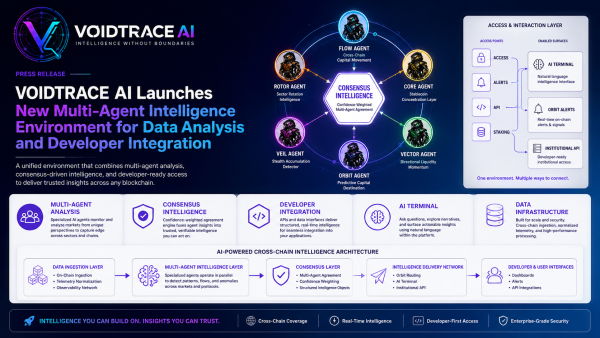
The platform combines six specialized agents, a consensus engine, a natural-language AI Terminal and developer-facing infrastructure within a single architecture.
Rather than treating artificial intelligence as one general-purpose model, VOIDTRACE AI separates analytical tasks across multiple agents. Each agent focuses on a different type of observation before contributing its findings to a shared intelligence layer.
The company said the goal is to make complex information easier to interpret, compare and integrate into external workflows.
A Multi-Agent Approach to Complex Information
Modern digital systems generate large amounts of information from different sources, formats and environments.
The challenge is often not collecting more data.
It is deciding which signals matter, how they relate to one another and whether several independent observations support the same conclusion.
VOIDTRACE AI addresses that problem through a multi-agent architecture.
Its six specialized agents are designed to examine different aspects of incoming information in parallel:
FLOW focuses on movement and directional changes.
CORE examines concentration, depth and distribution.
VECTOR evaluates momentum and acceleration.
ORBIT looks at potential destinations and changing relationships.
VEIL identifies less-visible patterns and anomalies.
ROTOR monitors shifts across categories and broader themes.
The outputs are then passed into a shared consensus framework.
Consensus Layer Designed to Compare Independent Signals
A key part of the VOIDTRACE AI architecture is its consensus layer.
Instead of allowing a single agent to determine the final output, the system is designed to compare multiple observations.
When several agents identify related patterns, the platform can generate a stronger confidence signal.
When observations conflict, the system can preserve that uncertainty rather than presenting an overly simplified conclusion.
This architecture is intended to make analytical output more transparent and context-aware.
AI Terminal Brings the Architecture to End Users
The launch also introduces the next phase of the VOIDTRACE AI Terminal.
The Terminal is being developed as a conversational interface for interacting with the platform.
Users can submit natural-language questions and receive structured responses generated from the underlying multi-agent system.
This reduces the need to manually navigate several separate tools or datasets.
Potential applications include:
research;
monitoring;
trend analysis;
comparative analysis;
anomaly detection;
structured reporting.
VOIDTRACE AI said the Terminal is intended to make advanced analytical infrastructure more accessible to users who may not want to work directly with raw data or APIs.
Developer API Enables External Integrations
The company is also expanding its developer infrastructure as part of the launch.
The VOIDTRACE AI API is designed to allow external applications to consume structured intelligence outputs generated by the platform.
This could allow developers to build:
custom dashboards;
monitoring applications;
research platforms;
automated alerting systems;
internal analytical tools;
enterprise reporting workflows.
Instead of recreating the analytical engine independently, developers can use VOIDTRACE AI as an underlying intelligence layer while controlling their own interface and application logic.
Modular Architecture Supports Multiple Use Cases
VOIDTRACE AI has designed the platform around separate infrastructure layers.
The system includes:
Data ingestion for collecting and organizing incoming information.
Normalization for preparing information for analysis.
Multi-agent processing for parallel observation.
Consensus generation for combining multiple perspectives.
Delivery infrastructure for making the resulting intelligence available through the Terminal, API and connected applications.
This modular structure is intended to allow individual parts of the platform to evolve without requiring the entire system to be rebuilt.
Launch Focuses on Product Infrastructure
The September 4 rollout places the emphasis on product architecture rather than a single feature.
VOIDTRACE AI said it will use the next phase to focus on:
improving agent coordination;
expanding supported data sources;
refining confidence-weighted outputs;
improving the AI Terminal experience;
extending developer documentation;
expanding API integration options.
The company also expects feedback from early users and developers to influence how the platform evolves.
Designed for Human and Machine Consumption
One distinction within the VOIDTRACE AI architecture is that the platform is being developed for both direct users and software systems.
Human users can interact through the AI Terminal.
Developers and organizations can connect through API infrastructure.
This allows the same underlying intelligence layer to support different presentation formats and workflows.
A researcher may want a natural-language explanation.
A software application may require structured machine-readable output.
An organization may want the same intelligence incorporated into an internal dashboard.
VOIDTRACE AI is being designed to support each of those access patterns.
From Launch to Expansion
The September 4 launch represents the beginning of the platform’s next development stage.
The company said future work will focus on expanding the reliability, flexibility and accessibility of the intelligence infrastructure.
Rather than positioning the launch as a completed product roadmap, VOIDTRACE AI describes it as the point at which its different architectural components begin moving into a more unified public environment.
Additional information about VOIDTRACE AI is available at VoidTraceAI.com.
About VOIDTRACE AI
VOIDTRACE AI is developing a multi-agent artificial intelligence platform for processing, interpreting and delivering structured intelligence from complex data environments. The platform combines six specialized analytical agents, a consensus architecture, a natural-language AI Terminal and developer-facing API infrastructure.
Disclaimer: This announcement is provided for informational purposes only. References to platform functionality describe current or planned technology and may change as development continues.
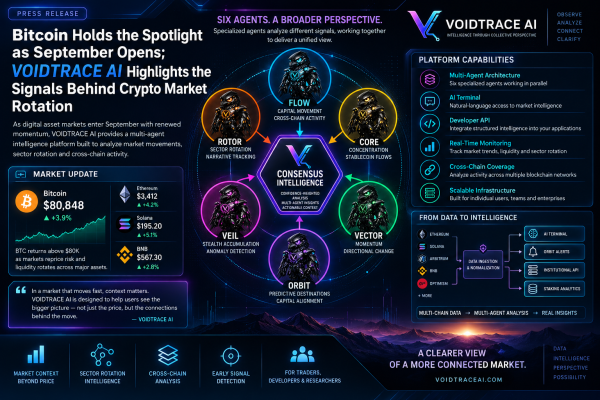
September 2026 — Bitcoin continues to set the tone for the digital-asset market as September begins, but the broader picture is becoming more complex as liquidity shifts across Ethereum, large-cap altcoins, stablecoins and emerging sectors.
For market participants, the important question is no longer simply whether Bitcoin is moving higher or lower.
The deeper question is whether capital is beginning to rotate.
That distinction matters because crypto rarely moves as one uniform market. Bitcoin can remain strong while Ethereum improves. Solana can attract new activity while another Layer 1 weakens. Stablecoin balances can build on one network while leaving another. AI-related tokens can gain momentum even when the wider altcoin market remains mixed.
VOIDTRACE AI is using this market structure to explain why cross-market context matters.
The September rollout also includes the $VOIDE presale, which introduces the ecosystem token alongside the project’s broader technology launch. $VOIDE is intended to support participation across the VOIDTRACE AI environment as the AI Terminal, developer infrastructure and multi-agent intelligence platform continue to expand. The presale forms one part of the wider ecosystem rather than changing the project’s core focus on market intelligence and data analysis.
Bitcoin Remains the First Signal
Bitcoin continues to act as the primary reference point for the broader crypto market.
When BTC attracts most of the available liquidity, altcoins often struggle to outperform on a sustained basis.
When Bitcoin begins to consolidate, however, traders frequently start watching for signs that capital is moving elsewhere.
That is where market rotation begins to matter.
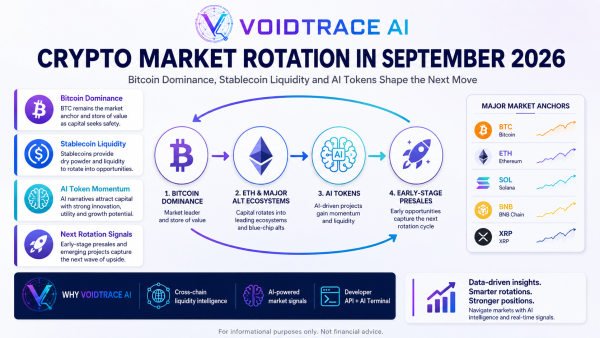
A rotation does not always happen in a fixed sequence, but it can involve movement from:
The process can accelerate, stall or reverse at any point.
Ethereum Helps Show Whether Participation Is Broadening
Ethereum remains one of the most important markets to watch because of its role across DeFi, stablecoins, Layer 2 networks and decentralized trading.
A stronger Ethereum environment may involve more than a rising ETH price.
Analysts may also watch:
DEX activity;
stablecoin balances;
bridge flows;
Layer 2 participation;
on-chain liquidity.
If several of those indicators improve at the same time, the move may be more meaningful than a short-lived price increase.
Stablecoins Can Reveal Capital Positioning
Stablecoins such as USDT and USDC are often treated as neutral assets because their price is designed to remain close to one dollar.
But from a market-structure perspective, they can be highly informative.
Stablecoins represent capital that can potentially be deployed into:
token purchases;
DeFi;
decentralized exchanges;
liquidity pools;
derivatives;
cross-chain activity.
An increase in stablecoin balances on a particular network can therefore indicate that liquidity is building before it becomes visible through token prices.
That does not guarantee a rally.
It does, however, provide another layer of context.
Solana, BNB, XRP and Other Major Assets Help Measure Breadth
Large-cap assets outside Bitcoin and Ethereum can also indicate whether risk appetite is spreading.
Solana, BNB and XRP each represent different parts of the digital-asset market.
If several large assets begin strengthening together while Bitcoin remains stable, that can suggest broader market participation.
If only one major asset moves, the change may be driven by project-specific news instead.
This is why market breadth matters.
A healthy rotation is usually easier to identify when several independent markets begin showing related strength.
Sector Rotation Adds Another Layer
Crypto also rotates between narratives.
At different times, traders may favor:
AI-related tokens;
DeFi;
infrastructure;
Layer 1 ecosystems;
Layer 2 networks;
gaming;
real-world assets;
meme tokens.
The important distinction is whether a whole sector is gaining liquidity or whether only one token is moving.
A broad AI-token move, for example, is different from a single AI project rising because of an isolated announcement.
Sector-level analysis helps separate those two situations.
Why Market Rotation Is Hard to Read
The challenge is that all of these signals can move at different speeds.
Bitcoin may remain strong while stablecoins build elsewhere.
Ethereum may outperform while another Layer 1 loses liquidity.
A sector may gain narrative attention before on-chain activity confirms the move.
Wallet behavior may change before price responds.
This creates a fragmented market environment.
Looking at a single chart often does not provide enough information.
VOIDTRACE AI Uses a Multi-Agent Framework
VOIDTRACE AI is developing a multi-agent intelligence architecture intended to evaluate these different conditions in parallel.
The six agents have separate analytical roles.
FLOW monitors movement across connected environments.
CORE examines concentration, depth and distribution.
VECTOR measures momentum and directional change.
ORBIT evaluates potential destinations and relationships between changing data clusters.
VEIL focuses on less-visible patterns and anomalies.
ROTOR tracks changes across sectors and broader narratives.
The outputs are designed to contribute to a shared consensus layer.
Why Consensus Matters
A single market signal can be misleading.
Price can rise while liquidity weakens.
A sector can look strong even though only one asset is performing.
Stablecoin balances can increase while broader participation remains limited.
A consensus approach attempts to compare several observations before forming a broader view.
That can help answer questions such as:
Is liquidity actually expanding?
Are multiple sectors confirming the same trend?
Is capital rotating or simply reacting to one isolated event?
Are several independent signals pointing in the same direction?
AI Terminal Makes the Intelligence Easier to Access
VOIDTRACE AI is also developing an AI Terminal designed to let users interact with the platform through natural-language queries.
Instead of manually reviewing multiple dashboards, users can ask questions about changing conditions and receive structured outputs generated by the underlying analytical architecture.
Potential queries might include:
“Which sectors are gaining momentum?”
“Are several indicators confirming the same move?”
“Is capital rotating from one market segment into another?”
The platform is also being built with developer-facing infrastructure so selected intelligence can be integrated into external applications.
September Could Be About Rotation, Not Just Direction
The key theme for the month may not be whether crypto simply goes up or down.
It may be where capital moves.
Bitcoin can remain dominant.
Ethereum can strengthen.
Large-cap altcoins can broaden participation.
Stablecoin liquidity can shift between networks.
AI and other narratives can attract new attention.
Those movements can happen sequentially or simultaneously.
VOIDTRACE AI is being developed around the idea that understanding those relationships provides more useful context than following price alone.
VOIDTRACE AI is developing a multi-agent intelligence platform for processing and interpreting complex digital data environments. The platform combines six specialized analytical agents, a consensus layer, a natural-language AI Terminal and developer-facing infrastructure.
Disclaimer: This article is for informational and educational purposes only and does not constitute financial, investment or trading advice. Cryptocurrency markets are volatile, and market-rotation patterns do not guarantee future performance.
LinkedIn is one of the richest sources of professional and company data, but turning a useful search into a clean working list is still surprisingly awkward. Sales teams, recruiters and researchers often find the right people on the platform, then spend time copying names, job titles, companies and profile links one record at a time. A LinkedIn export tool can remove that manual work, but only if its operating model matches the job you actually need done.
The most important distinction is not how many buttons a tool has. It is whether the tool simply reads and saves information already visible to you, or whether it begins acting on LinkedIn on your behalf. That difference affects account exposure, data privacy, list quality and the amount of control you keep over the workflow.
The two categories that matter most
Automation platforms
Automation platforms are built to perform actions at scale. Depending on the product, they may send connection requests, schedule messages, trigger InMails, follow profiles or chain several outreach steps together. These features can make outbound campaigns faster, but they also create visible behavioural patterns on the account. High-frequency or repetitive actions can look less like normal use, especially when the workflow continues unattended.
For teams that deliberately want automated outreach, that trade-off may be part of the decision. It should not, however, be confused with simple data export. A user who only needs a spreadsheet should not have to accept messaging automation, remote session handling or background actions as part of the package.
Read-only exporters
A read-only exporter has a narrower role. It captures fields already shown in the LinkedIn or Sales Navigator search you opened and saves them in a structured format such as CSV, JSON or JSONL. It does not send invitations, messages or InMails, and it should not like, follow, comment or apply for jobs. You initiate the export, choose the scope and keep the resulting file.
This model is generally the more appropriate choice for list building, CRM preparation, recruiting research and market mapping. It reduces unnecessary account activity, although no third-party tool can guarantee zero platform-policy risk. Users still need to work at a sensible pace and follow LinkedIn’s rules and applicable privacy laws.
What a useful LinkedIn exporter should save
The right coverage depends on the search workflow. On standard LinkedIn, teams commonly need Profile Search, Company Search, Jobs Search and Posts Search. Profile Search is especially useful when it can respect LinkedIn filters, including the first-degree connections filter for exporting an existing network. Company Search supports account research, Jobs Search supports hiring and market analysis, and Posts Search helps teams study active conversations, authors and engagement around a topic.
Sales Navigator introduces two additional high-value sources: Lead Search and Account Search. Lead Search is designed around individual prospects, while Account Search is organised around companies. An exporter that recognises both environments saves the user from rebuilding a targeted Sales Navigator list in a separate tool. The user still needs an appropriate Sales Navigator subscription to access those searches in the first place.
Before saving, the tool should also show which fields it found. A profile export might include a name, headline, company, location and profile URL; a job export might include the role, employer, location and job link. Seeing the fields before download makes it easier to confirm that the file will map cleanly into a spreadsheet, ATS or CRM.
Data quality matters as much as volume
Duplicate control
Repeated records quickly make an export unreliable. When a search is revisited or several related searches overlap, the exporter should recognise records that have already been saved and allow the user to pull only new ones. This keeps monthly limits meaningful and prevents the same person or company from appearing several times in the working list.
No guessed contact details
Some lead-generation products append email addresses that are predicted from a person’s name and company domain. Those guesses may be useful in a separate enrichment workflow, but they should not be presented as data obtained from LinkedIn. A careful exporter preserves provenance: it saves what the search actually displayed and does not blur visible fields with inferred contact details.
Flexible file formats
CSV remains the easiest format for Excel, Google Sheets and most CRM importers. JSON is useful for applications and structured workflows, while JSONL is convenient for scripts and large line-by-line processing jobs. Offering all three gives both non-technical users and data teams a practical path forward without changing tools.
Local processing versus remote processing
Where the export runs is another important question. A browser-local extension works inside the user’s existing session and builds the file on the user’s computer. A cloud-based product may route the task through external infrastructure, store session material or process the extracted data on third-party servers. Cloud processing can support larger-scale operations, but it also changes the privacy and security model.
For everyday sales and recruiting exports, local processing offers a straightforward advantage: the raw names, profiles and search results do not need to be uploaded to the vendor’s servers simply to create a spreadsheet. Teams working with internal prospect lists or candidate research should verify this point explicitly rather than assuming every browser extension works locally.
A practical checklist for evaluating a tool
Search coverage. Confirm that the tool supports the exact LinkedIn and Sales Navigator searches used by your team. A generic claim to export profiles is not the same as supporting company, job, post, lead and account searches.
User control. You should be able to choose how many records to save, preview the fields and start every export yourself. Nothing should continue running invisibly in the background.
Account behaviour. Check whether the product sends, follows, likes, applies or communicates on your behalf. If the purpose is export only, the answer should be no.
Data provenance. Make sure the file contains fields LinkedIn actually showed, with inferred or enriched data clearly separated. Guessed emails should never be passed off as scraped facts.
Processing location. Ask whether raw search data stays on your computer or passes through vendor infrastructure. This matters for privacy reviews and internal data-handling policies.
Duplicate handling. Re-running a search should not force you to clean the same records again or consume usage limits for contacts already saved.
Where Mastros fits
Mastros is a Chrome extension built around the read-only model. It supports six search types: Profile, Company, Jobs and Posts Search on LinkedIn, plus Lead and Account Search on Sales Navigator. The user chooses the number of records, can review the available fields, and can save the result as CSV, JSON or JSONL.
Its duplicate controls can skip records already exported, and it does not guess or purchase email addresses. Processing happens in the browser, so the LinkedIn and Sales Navigator data used for the export is not sent to Mastros servers. The free plan currently includes 250 LinkedIn records per month across all six search types, with no credit card required.
That makes Mastros most relevant to recruiters, sales representatives, founders and researchers who need clean working files without automated outreach. As with any third-party LinkedIn tool, users remain responsible for using it fairly, respecting platform rules and handling personal data lawfully.
Use a controlled workflow
Start with a narrowly filtered search, export a small sample and verify the columns before building a larger list. Save only the records needed for a defined business purpose, restrict access to the file and map fields carefully when importing into a CRM. An export is not permission to spam, so review and segment contacts before any responsible, personalised outreach.
Final perspective
The best tool is not necessarily the one that performs the most actions. It is the one that solves the required job with the least unnecessary access, automation and data ambiguity. For a broader comparison of privacy-first browser exporters and higher-volume tool stacks, this guide to choosing the best linkedin scraper provides a useful decision framework for sales and recruiting teams.
For most teams that simply need a clean spreadsheet from searches they can already see, a read-only, browser-local exporter is the clearer starting point. It keeps the task focused: turn visible search results into usable data, then let a human decide what happens next.
Cross-chain intelligence platform prepares September 4 presale as Bitcoin holds near $77K and major crypto markets enter a new liquidity-rotation phase
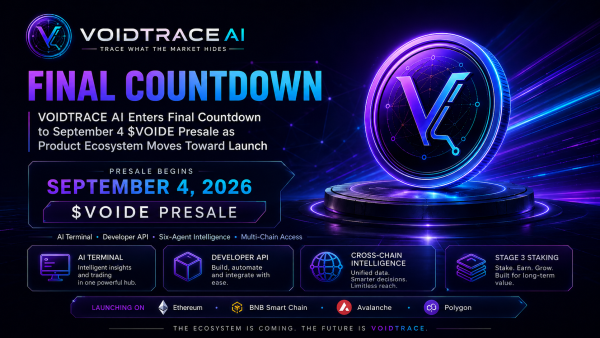
September — VOIDTRACE AI today announced that its $VOIDE presale is scheduled to open September 4, 2026, placing the project within the final 24-hour countdown to the launch of its cross-chain liquidity intelligence ecosystem.
The announcement arrives as cryptocurrency markets enter September with Bitcoin still acting as the primary liquidity anchor while Ethereum, XRP, Solana and other large-cap assets compete for capital.
Bitcoin closed September 1 near $77,416, while Ethereum was around $2,418, XRP near $1.35 and Solana close to $100, according to CoinGecko historical market data.
For VOIDTRACE AI, those conditions highlight the market problem the project is being built to address: understanding where capital is moving before price action alone makes the shift obvious.
Crypto Markets Enter September in Rotation Mode
The beginning of September presents a different environment from a broad speculative rally.
Bitcoin continues to account for the largest concentration of crypto liquidity, while major alternative assets remain significantly below BTC in market capitalization.
That creates several possible paths for the market.
Bitcoin could retain liquidity dominance.
Ethereum could strengthen relative to BTC.
Capital could move toward major Layer 1 networks.
Artificial-intelligence-related tokens could attract another wave of narrative-driven demand.
Or investors could begin moving further along the risk curve toward smaller projects and upcoming crypto presales.
VOIDTRACE AI is being designed to monitor those movements across multiple blockchain ecosystems.
Why Bitcoin Remains the Starting Point
Bitcoin entered September after trading largely within the upper-$70,000 range during the closing days of August.
CoinGecko data shows BTC closing August 27 above $80,000 before moving back toward $77,000-$79,000 during the following sessions.
That consolidation makes Bitcoin particularly important for the next phase of market rotation.
When substantial liquidity remains concentrated in BTC, alternative assets may struggle to produce broad market momentum.
When Bitcoin stabilizes and capital begins moving outward, Ethereum, Layer 1 ecosystems, AI tokens and eventually higher-risk markets can begin attracting greater participation.
The direction is not guaranteed.
The flow itself is what matters.
Ethereum and Solana Provide Additional Rotation Signals
Ethereum entered September near $2,400 after strengthening considerably during the second half of August.
CoinGecko historical data shows ETH moving from approximately $1,880 on August 15 to more than $2,400 by the end of the month.
Solana showed a similar expansion, rising from roughly $75 in mid-August to around $100 entering September.
A useful market-intelligence system also needs to ask:
Where did liquidity originate?
Did stablecoin balances increase first?
Were assets moving across bridges?
Was participation isolated to one ecosystem?
Did multiple sectors strengthen simultaneously?
Those are the types of questions VOIDTRACE AI is being developed to analyze.
XRP Highlights How Quickly Capital Can Reprice
XRP provides another example of changing market conditions.
Historical CoinGecko data shows XRP trading close to $1.00 in mid-August before climbing above $1.50 during the month, followed by a pullback toward $1.35 entering September.
That type of movement illustrates how quickly liquidity can concentrate around a major asset.
For traders, knowing that XRP moved is straightforward.
Understanding whether that movement reflects isolated demand, broader altcoin participation or a wider change in market risk appetite is considerably more difficult.
VOIDTRACE AI is positioning its intelligence architecture around that distinction.
Six Agents Observe Different Parts of the Market
The VOIDTRACE AI architecture uses six specialized agents designed to operate in parallel.
FLOW follows cross-chain capital movement.
CORE examines stablecoin concentration and liquidity depth.
VECTOR measures directional liquidity momentum.
ORBIT evaluates possible destinations for migrating capital.
VEIL monitors stealth accumulation and coordinated wallet behavior.
ROTOR analyzes sector and narrative rotation.
Their outputs are designed to feed into a broader consensus layer.
Instead of one indicator producing a market conclusion, multiple observations can contribute to a confidence-weighted intelligence object.
AI Terminal Turns Cross-Chain Data Into Queries
VOIDTRACE AI is also developing an AI Terminal intended to make the intelligence layer accessible through natural-language interaction.
A user could eventually query conditions such as:
“Is liquidity rotating from Bitcoin toward Ethereum?”
“Which ecosystems are gaining stablecoin reserves?”
“Are AI tokens gaining momentum as a sector?”
“Where is cross-chain capital accelerating?”
The platform is intended to analyze underlying market information before presenting a structured response.
Current planned access levels include Free, Pro, Teams and Enterprise options.
Developers Can Access the Intelligence Layer Through an API
VOIDTRACE AI is also developing developer and institutional API infrastructure.
The API is intended for applications including:
trading bots;
cross-chain dashboards;
portfolio-risk systems;
stablecoin trackers;
liquidity alerts;
institutional research;
capital-rotation applications.
For developers, the intended distinction is important.
The application can remain responsible for presentation, execution or portfolio logic while VOIDTRACE AI supplies the underlying intelligence layer.
$VOIDE Presale Opens September 4
Against that market backdrop, the $VOIDE presale is scheduled to open September 4.
The planned minimum purchase is $10.
Participation is expected through four networks:
Ethereum
BNB Smart Chain
Avalanche
Polygon
The multi-chain launch structure reflects the project’s broader emphasis on cross-chain market activity.
Token Utility Connects With Product Access
$VOIDE is intended to provide utility within the VOIDTRACE AI ecosystem.
Eligible AI Terminal plans may be purchased using $VOIDE, with qualifying tokens used for access planned to be permanently burned.
Traditional subscription and institutional API revenue may also be used for market-based buybacks, liquidity support or ecosystem development, subject to governance and treasury policy.
The project is therefore attempting to connect token participation with software usage rather than treating the two as independent products.
Stage Rewards and Staking Expand the Presale Model
VOIDTRACE AI is also introducing a stage-based leaderboard.
The top three qualifying contributors during each stage are planned to receive:
1st — 25% additional $VOIDE
2nd — 18% additional $VOIDE
3rd — 10% additional $VOIDE
The ranking resets when each new presale stage begins.
Qualifying referrals are also planned to receive 10% USDT cashback, while staking is scheduled to become available during Stage 3.
Participants contributing $2,500 or more during the presale are planned to receive one year of Pro AI Terminal access at no additional cost.
From Major Crypto Assets to Early-Stage Presales
For investors researching a top crypto presale, best crypto presale or hot crypto presale this September, the broader market environment remains relevant.
Capital rarely moves into every category at the same time.
Bitcoin can lead first.
Ethereum and large-cap altcoins may follow.
AI and other narrative sectors can then attract additional attention.
Early-stage projects and presales typically represent the higher-risk end of that progression.
VOIDTRACE AI’s underlying thesis is that detecting those transitions requires watching liquidity across chains rather than focusing only on individual token prices.
With the $VOIDE presale scheduled for September 4, the project is entering the market at a time when capital rotation itself is becoming one of crypto’s most important signals.
Additional information is available through VoidTraceAI.com.
About VOIDTRACE AI
VOIDTRACE AI is developing an AI-powered cross-chain liquidity intelligence platform designed to analyze capital flows, stablecoin concentration, liquidity momentum, wallet activity and sector rotation. Its ecosystem includes six specialized intelligence agents, an AI Terminal and developer and institutional API infrastructure.
Disclaimer: This announcement is for informational purposes only and does not constitute financial, investment or trading advice. References to “top crypto presale,” “best crypto presale” or “hot crypto presale” are editorial descriptions and do not represent rankings or guarantees of future performance. Cryptocurrency prices are volatile, and token presales involve substantial risk.
The September crypto market is being defined less by one dominant narrative and more by the movement of liquidity between Bitcoin, Ethereum, major altcoins, AI-related tokens and higher-risk presale opportunities. VOIDTRACE AI is positioning its cross-chain intelligence platform around tracking those shifts.
September 2026 — Crypto markets are entering the month with a familiar pattern: Bitcoin still controls much of the market’s liquidity, but attention is increasingly spreading across other sectors.
Bitcoin remains the primary benchmark for risk appetite. Ethereum continues to anchor the largest smart-contract ecosystem. Solana, BNB and XRP remain major alternatives for capital, while AI-related tokens continue competing for narrative-driven flows.
At the same time, presales are attracting a different kind of participant, users willing to take greater risk for earlier-stage exposure.
The result is a market where understanding capital rotation may matter as much as tracking price.
Bitcoin Dominance Still Matters
Bitcoin remains the largest destination for crypto liquidity.
When BTC dominance rises, capital often stays concentrated in Bitcoin rather than moving aggressively into altcoins.
That typically creates a more selective environment.
Some altcoins may still perform well, but broad participation is weaker.
When Bitcoin begins consolidating, however, traders often start watching for signs that liquidity is rotating elsewhere.
Ethereum is usually one of the first markets to watch.
From there, attention can spread toward Solana, BNB, XRP, AI tokens and smaller-cap projects.
Ethereum Is Often the First Rotation Signal
Ethereum remains especially important because it sits at the center of a large ecosystem of:
decentralized exchanges;
stablecoins;
DeFi protocols;
Layer 2 networks;
token markets;
institutional infrastructure.
A stronger Ethereum market is not only about ETH price.
Traders may also look at stablecoin flows, bridge activity, DEX liquidity and participation across Ethereum-related ecosystems.
If several of those indicators begin strengthening together, it can suggest that capital is broadening beyond Bitcoin.
Stablecoins Can Reveal Where Capital Is Waiting
Stablecoins are another important part of the market structure.
They may not attract the same attention as BTC or ETH because their prices are designed to remain stable.
But they represent deployable capital.
If stablecoin balances begin rising inside one blockchain ecosystem, that may indicate growing liquidity before the capital is fully deployed into tokens or DeFi markets.
This makes stablecoin movement useful when trying to understand where activity could develop next.
A chain gaining stablecoin liquidity may be entering a different market phase from one experiencing persistent outflows.
Solana, BNB and XRP Show Whether Risk Appetite Is Expanding
Major altcoins provide another way to judge market breadth.
If Bitcoin remains relatively stable while assets such as Solana, BNB and XRP begin strengthening, that can indicate increasing willingness to move further out on the risk curve.
But the context matters.
A single token moving because of project-specific news is different from broad liquidity moving across several large-cap alternatives.
That is why market rotation needs to be viewed across categories rather than one chart at a time.
AI Tokens Remain One of Crypto’s Most Active Narratives
Artificial intelligence continues to be one of the most visible themes across crypto.
But the AI-token category itself is fragmented.
Different projects focus on:
decentralized intelligence;
autonomous agents;
GPU infrastructure;
information networks;
blockchain infrastructure;
predictive analytics;
developer tooling.
The important market question is therefore not whether “AI crypto” is strong.
It is which specific part of the AI market is receiving liquidity.
A move toward decentralized compute may not benefit agent tokens equally.
A surge in agent activity may not imply broader strength across AI infrastructure.
This is where sector-level rotation becomes more useful than broad labels.
Presales Represent the Highest-Risk End of the Market
Presales sit further out on the risk spectrum.
Users searching for a top crypto presale, best crypto presale, or upcoming crypto presale are generally looking at projects before they have fully established market liquidity or long-term adoption.
That makes broader market conditions particularly important.
A presale launching during strong Bitcoin dominance may face a very different environment from one launching during broad altcoin expansion.
Likewise, stronger AI-sector momentum may benefit presales tied to AI narratives more than projects in unrelated categories.
Market timing does not determine project quality, but it can influence where speculative capital is willing to go.
VOIDTRACE AI Is Built Around These Liquidity Shifts
VOIDTRACE AI is developing a cross-chain liquidity intelligence platform designed to analyze these movements.
Its six-agent architecture separates market analysis into different roles:
FLOW tracks cross-chain capital movement.
CORE monitors stablecoin concentration and liquidity depth.
VECTOR measures liquidity momentum and directional acceleration.
ORBIT evaluates possible destinations for migrating capital.
VEIL focuses on stealth accumulation and coordinated wallet activity.
ROTOR tracks sector and narrative rotation.
The platform is designed to combine those signals into a broader intelligence layer.
Instead of simply showing that a market moved, VOIDTRACE AI is attempting to provide more context around how liquidity behaved before and during that move.
The AI Terminal Makes the Intelligence Easier to Use
The project is also developing an AI Terminal designed to provide access to this intelligence through a natural-language interface.
Current access is structured around:
Free — $0
Pro — $99 per month
Teams — $199 per month per member
Enterprise — API / Quote Based
The Pro level is intended to provide access to all six agents and wider multi-chain intelligence.
Teams adds organizational functionality.
Enterprise is intended for developers, trading desks and institutions requiring programmatic access.
The API Extends the Market-Intelligence Layer
VOIDTRACE AI’s API is intended to make the same intelligence available to external applications.
Potential applications include:
trading bots;
liquidity dashboards;
capital-rotation trackers;
stablecoin monitors;
portfolio-risk tools;
institutional research systems.
A developer could use the API to build a dashboard showing whether capital is moving from Bitcoin toward Ethereum, into AI-related sectors, or toward higher-risk markets.
That creates a broader use case than a standard crypto analytics dashboard.
September Could Be Defined by Rotation
The key question for the month may not be whether crypto rises or falls as one market.
It may be where liquidity goes next.
Bitcoin could continue dominating.
Ethereum could gain relative strength.
Solana, BNB or XRP could attract broader participation.
AI tokens could experience another narrative cycle.
Presales could benefit if risk appetite expands.
These outcomes are not mutually exclusive.
They can happen at different points in the same month.
That is why VOIDTRACE AI is being positioned around the idea of tracking the movement connecting those markets.
The project’s $VOIDE presale is scheduled to begin September 4, 2026, with planned participation through Ethereum, BNB Smart Chain, Avalanche and Polygon.
Market rotation refers to capital moving between different assets, sectors or blockchain ecosystems over time.
Why does Bitcoin dominance matter?
Higher Bitcoin dominance can indicate that more crypto liquidity is concentrated in BTC rather than spread across altcoins.
Why are stablecoins important?
Stablecoins represent deployable capital and can provide clues about where liquidity is accumulating before being used elsewhere.
What role do AI tokens play?
AI-related tokens represent several different sectors, including agents, compute, infrastructure and analytics, and can attract liquidity during AI-focused market cycles.
How does VOIDTRACE AI fit into this?
VOIDTRACE AI is being developed to analyze cross-chain liquidity, stablecoin concentration, momentum, wallet activity and sector rotation through a six-agent intelligence system.
When does the $VOIDE presale begin?
The presale is scheduled to begin on September 4, 2026.
Disclaimer: This press release is for informational purposes only and does not constitute financial, investment or trading advice. Market rotation does not guarantee future price movements. Cryptocurrency markets and token presales involve significant risk.
Arizona, Ohio, Pennsylvania, Tennessee and Michigan gain a stronger market-planning focus as BillboardMax expands inventory visibility, campaign quote tools and nationwide DOOH access.
September 1, 2026 — BillboardMax has expanded its digital billboard planning experience across five strategic U.S. markets — Arizona, Ohio, Pennsylvania, Tennessee and Michigan — as part of a broader update designed to give advertisers more visibility into billboard locations, market context, pricing, reach and campaign scale before launch.
The update moves BillboardMax further from a traditional billboard search process toward a planning-first Digital Out-of-Home workflow.
Advertisers can explore available inventory, review map-based billboard locations, evaluate markets and build a campaign quote around geography, budget, timing and selected inventory before requesting a contract or consultation.
The five markets are part of BillboardMax’s strategic U.S. growth focus:
The product update reflects a larger change in how BillboardMax approaches digital billboard buying.
Advertisers can now plan by ZIP code, city, state, radius, highway corridor, coverage zone, selected point, custom market area or individual billboard location.
Instead of starting only with a specific billboard unit, advertisers can begin with the market or coverage area that matters to the campaign and then evaluate the available inventory within that geography.
The BillboardMax planning workflow connects the major stages of a DOOH campaign:
As a campaign plan changes, advertisers can review planning-level pricing, impressions, reach, exposure, screen allocation and media-plan projections.
Billboard inventory can also be explored without creating an account. Deeper pricing, campaign quote and media-plan views may require basic business contact information.
This gives advertisers more information earlier in the buying process and reduces the need to request a manual sales quote simply to understand whether a market, budget or campaign structure makes sense.
Expanded Nationwide Digital Billboard Access
The five-state focus comes as BillboardMax continues to expand its nationwide DOOH footprint.
BillboardMax provides access to 13,600+ digital screens across all 50 states and works with 1,200+ active advertisers, with stronger inventory density across major highway, commuter and urban markets.
Coverage has also expanded through additional media-owner and vendor integrations.
Those integrations have improved inventory availability visibility and made campaign planning more predictable across supported inventory. Some supported inventory can provide near-live availability, while other selected locations are reviewed and confirmed by the BillboardMax team before launch.
Availability depth can still vary by market, vendor and inventory source.
The result is a broader planning environment in which advertisers can evaluate more markets and more inventory through one managed workflow rather than coordinating separately with multiple billboard vendors.
More Visibility Before Launch
One of the central changes in the updated BillboardMax experience is campaign quote visibility.
Advertisers can build and adjust a campaign quote directly through the planning process as they refine geography, inventory, budget, timing and campaign variables.
The goal is not to turn premium highway billboard advertising into a simple self-checkout transaction.
BillboardMax combines self-guided planning with managed campaign execution, including inventory review, vendor coordination, creative preparation, campaign setup, approvals and launch support.
After launch, active clients can also access online campaign tracking with billboard-level and play-level delivery visibility where available.
That creates a more connected process before and after the campaign: clearer planning before commitment and clearer delivery visibility after launch.
Five Markets, Different Campaign Opportunities
Each of the five strategic markets represents a different planning environment.
Arizona includes major opportunities around Phoenix, Scottsdale, Mesa and Tucson. Ohio connects several large metro markets including Cleveland, Columbus and Cincinnati. Pennsylvania combines Philadelphia, Pittsburgh and other regional markets. Tennessee includes Nashville, Memphis, Knoxville and Chattanooga, while Michigan includes Detroit, Grand Rapids, Lansing and Ann Arbor.
The value of the updated planning experience is that advertisers do not need to treat those markets as interchangeable.
Campaigns can be structured around the geography, audience movement, inventory availability and business objective that matter in each location.
For agencies, professional media buyers and serious advertisers, that makes it possible to move from a broad market idea toward a more defined media plan without starting the process with disconnected inventory lists and multiple vendor conversations.
A Broader BillboardMax Product Update
The five-state expansion is part of a larger product direction centered on planning transparency.
BillboardMax now combines market insights, map-based inventory, campaign quote building, media-plan projections, managed execution and post-launch tracking within one nationwide digital billboard planning experience.
The company summarizes that direction simply:
More screens. More markets. More planning confidence.
About BillboardMax
BillboardMax is a managed nationwide Digital Out-of-Home marketplace for planning, previewing, quote building, launching and tracking premium highway digital billboard campaigns across the United States.
The platform helps advertisers explore billboard inventory, review market context, build and adjust campaign quotes, evaluate pricing and reach, coordinate multiple vendors and move into managed campaign execution through one workflow.
BillboardMax provides access to more than 13,600 digital screens across all 50 states, with stronger density in major highway, commuter and urban markets.
With the $VOIDE presale scheduled to begin September 4, VOIDTRACE AI is entering the final pre-launch phase for a broader ecosystem that combines cross-chain liquidity intelligence, AI Terminal access, developer APIs and stage-based participation features.
September 2026 — VOIDTRACE AI is moving into the final days before the planned launch of its $VOIDE presale on September 4, 2026, bringing several previously announced parts of the project into one coordinated rollout.
The launch is not being positioned as a token event alone.
VOIDTRACE AI is building around a wider product model in which users can interact with cross-chain market intelligence through an AI Terminal, developers can access structured outputs through an API, and $VOIDE is intended to serve as an access and utility layer across parts of the ecosystem.
The project’s core objective is to make fragmented crypto liquidity easier to interpret.
The September 4 Launch Brings Several Components Together
When the presale opens, participants are expected to be able to access the sale through multiple supported networks.
The planned presale structure includes:
a $10 minimum purchase;
support for Ethereum;
support for BNB Smart Chain;
support for Avalanche;
support for Polygon.
At the same time, VOIDTRACE AI is preparing community programs, a stage-based leaderboard and a staking roadmap designed to continue beyond the opening day.
The result is a launch with several moving parts rather than one single presale mechanism.
The Product Thesis Starts With Market Fragmentation
Crypto liquidity no longer sits inside one exchange, one chain or one market sector.
Capital can move between Bitcoin and altcoins.
Stablecoins can migrate between ecosystems.
Bridge activity can change rapidly.
DEX liquidity can build or disappear.
Wallet clusters can begin accumulating before wider momentum becomes visible.
VOIDTRACE AI is being designed to connect these signals.
The system is intended to give users a broader view of where capital is moving, how quickly conditions are changing and which market segments may be gaining or losing liquidity.
Six Agents Create Different Views of the Same Market
VOIDTRACE AI’s architecture uses six specialized agents.
FLOW is focused on cross-chain capital movement.
CORE analyzes stablecoin concentration and liquidity depth.
VECTOR measures liquidity momentum and acceleration.
ORBIT evaluates potential destinations for migrating capital.
VEIL looks for stealth accumulation and coordinated wallet behavior.
ROTOR monitors sector and narrative rotation.
Each agent examines a different piece of the market.
The intended output is a broader intelligence layer formed by combining those perspectives.
For users, that can provide additional context beyond a simple price chart or single-chain dashboard.
AI Terminal Turns the Intelligence Into a User Interface
The project’s AI Terminal is intended to act as the primary direct-access product for users.
Instead of requiring traders or analysts to manually assemble data from several tools, the Terminal is designed to present structured market intelligence through a natural-language interface.
The current plan structure includes:
Free — $0
Pro — $99 per month
Teams — $199 per month per member
Enterprise — API / Quote Based
Pro access is intended to include all six intelligence agents and broader multi-chain analysis.
Teams adds shared and organizational functionality.
Enterprise is designed for institutions, developers and trading desks requiring programmatic access.
The API Opens the Ecosystem to Builders
VOIDTRACE AI is also developing developer and institutional API access.
That means the intelligence does not have to remain inside the project’s own interface.
Developers could use VOIDTRACE AI outputs inside:
automated trading systems;
liquidity dashboards;
portfolio-risk tools;
market-rotation alerts;
stablecoin monitoring applications;
research interfaces;
institutional analytics systems.
This gives VOIDTRACE AI a second product direction alongside the AI Terminal.
One is direct access.
The other is infrastructure.
$VOIDE Is Intended to Connect With Usage
The token model is also designed around platform activity.
Eligible AI Terminal subscriptions may be paid using $VOIDE.
Qualifying $VOIDE used for access is intended to be permanently burned.
The project also plans to support conventional payment methods, with a portion of applicable subscription or institutional API revenue potentially directed toward market-based buybacks, liquidity support or ecosystem growth, subject to governance and treasury policy.
The broader goal is to give $VOIDE a role tied to software access and usage.
Stage-Based Leaderboard Adds a Competitive Layer
The presale will also include a leaderboard that operates separately during each stage.
The three highest qualifying contributors are planned to receive coupon rewards equivalent to:
1st place — 25% additional $VOIDE
2nd place — 18% additional $VOIDE
3rd place — 10% additional $VOIDE
Rankings are expected to update dynamically.
Once a stage ends, applicable rewards are planned to be credited to the relevant wallet addresses and reflected in the participant dashboard.
The ranking then resets for the next stage.
This means each new stage creates a separate competition.
Product Access Is Also Being Used as a Presale Benefit
Participants contributing $2,500 or more during the presale are planned to receive one year of Pro AI Terminal access at no additional cost.
Activation information is expected after the presale concludes.
This creates another connection between token participation and the wider product ecosystem.
Qualifying users are not simply receiving an additional token incentive.
They are also being introduced directly to the platform’s paid intelligence layer.
Stage 3 Staking Extends the Roadmap Beyond Launch Day
VOIDTRACE AI is planning staking for Stage 3 of the presale.
The feature is intended to allow eligible users to begin staking during the presale rather than waiting until the full sale has ended.
That gives the project a roadmap that extends beyond September 4.
Launch day begins the presale.
Subsequent stages introduce additional functionality and reward structures.
The Final Days Before Launch
The remaining period before September 4 therefore represents more than a countdown to token availability.
For VOIDTRACE AI, it is the transition point between development announcements and a live ecosystem rollout.
The presale, AI Terminal, API, community programs, leaderboard and staking roadmap are being positioned as different components of the same system.
The next phase will be defined less by what has been announced and more by how those components perform once users begin interacting with them.
More information about the $VOIDE launch and VOIDTRACE AI ecosystem is available through VoidTraceAI.com.
Frequently Asked Questions
When does the $VOIDE presale begin?
The presale is scheduled to open on September 4, 2026.
What is the minimum purchase?
The planned minimum purchase is $10.
Which networks are supported?
Participation is planned through Ethereum, BNB Smart Chain, Avalanche and Polygon.
What is VOIDTRACE AI building?
VOIDTRACE AI is developing a cross-chain liquidity intelligence platform with six specialized agents, an AI Terminal and developer/API access.
Can $VOIDE be used for software access?
Eligible AI Terminal subscriptions may be paid in $VOIDE, with qualifying tokens used for access intended to be permanently burned.
What are the leaderboard rewards?
The top three qualifying contributors in each stage are planned to receive coupon rewards equivalent to 25%, 18% and 10% additional $VOIDE.
When is staking planned?
Staking is scheduled to become available during Stage 3.
Disclaimer: This press release is for informational purposes only and does not constitute financial, investment or trading advice. Planned functionality, token burns, staking, buybacks and presale rewards may be subject to change and do not guarantee future token value or returns. Cryptocurrency and token presales involve significant risk.
Bitcoin is entering September near $78,000 after a volatile week above $80,000, while Ethereum, BNB, Solana and XRP remain key markets to watch for signs that liquidity is beginning to broaden beyond BTC.
August 30, 2026 — The cryptocurrency market is approaching September with Bitcoin still firmly in control, but several major altcoins are beginning to attract attention as traders assess whether the next phase of the market will remain Bitcoin-led or develop into a broader capital rotation.
Current CoinMarketCap market data places Bitcoin near $78,227, Ethereum around $2,461, BNB near $694, Solana around $105, and XRP close to $1.39. Its Altcoin Season Index currently reads 32/100, categorizing conditions as “Bitcoin Season.”
That makes the opening weeks of September particularly important for traders watching where liquidity moves next.
Bitcoin Remains the Market’s Primary Anchor
Bitcoin continues to set the tone for digital assets.
BTC briefly moved above $80,000 earlier in the week, reaching its highest level since May as a softer U.S. dollar and concerns over currency debasement increased demand for alternative assets. Reuters reported that Bitcoin had gained roughly 28% during August at that point.
Momentum then reversed following comments from Federal Reserve Chair Kevin Warsh.
Warsh emphasized that inflation still needed to return convincingly toward the Fed’s 2% target, prompting markets to increase expectations of a possible September rate increase. The dollar and Treasury yields strengthened while Bitcoin and other risk assets weakened.
Bitcoin’s movement from above $80,000 back toward $78,000 illustrates how quickly crypto liquidity can respond to macroeconomic conditions.
Ethereum Remains the First Major Rotation Market
Ethereum is currently trading around $2,460, making ETH one of the most important assets to watch if capital begins moving beyond Bitcoin.
Ethereum remains the foundation for a large portion of the smart-contract, DeFi and token economy.
For market watchers, the question is therefore not simply whether ETH rises.
More important signals may include whether stablecoin liquidity increases across Ethereum-based markets, whether decentralized exchange activity strengthens and whether capital begins moving from BTC into Ethereum and associated ecosystems.
A sustained increase in those flows could indicate broader risk appetite returning to crypto markets.
Solana and BNB Provide Another Gauge of Altcoin Demand
Solana is trading near $105, while BNB is around $694.
Both provide additional indicators of whether crypto capital is spreading beyond the two largest assets.
Solana represents one of the largest alternative smart-contract ecosystems, while BNB remains closely associated with BNB Chain and its extensive retail and decentralized-application ecosystem.
If Bitcoin consolidates rather than making another immediate move higher, traders may increasingly watch networks such as Solana and BNB Chain for evidence that liquidity is rotating outward.
XRP Continues to Hold Its Own Large-Cap Market
XRP is trading near $1.39, with CoinGecko also reporting roughly $1.06 billion in daily trading activity at the time of its latest market snapshot.
XRP occupies a different position from ETH, SOL or BNB because its market narrative has historically centered more heavily on payments and institutional adoption.
Still, from a liquidity perspective, XRP remains another major destination for crypto capital.
That makes its behavior useful when determining whether broader large-cap participation is increasing.
September Could Be Defined by Rotation Rather Than Direction
The current market setup does not necessarily require every major cryptocurrency to move in the same direction.
Bitcoin could remain dominant while particular sectors strengthen underneath it.
Ethereum could gain relative momentum.
Solana or BNB could attract activity from users seeking higher-beta smart-contract exposure.
AI-related crypto tokens could experience their own narrative cycle.
Presales could also see increased activity if speculative risk appetite expands.
This means the more interesting question for September may be:
Where is liquidity moving inside the crypto market, rather than simply whether the overall market is going up or down?
VOIDTRACE AI Is Building Around That Question
VOIDTRACE AI is developing its cross-chain liquidity intelligence platform specifically around capital-flow analysis.
Its six-agent architecture separates different dimensions of market activity:
FLOW monitors cross-chain inflows and outflows.
CORE analyzes stablecoin concentration and liquidity depth.
VECTOR measures liquidity momentum and acceleration.
ORBIT evaluates possible destinations for migrating capital.
VEIL focuses on stealth accumulation and coordinated wallet behavior.
ROTOR monitors rotation across sectors and narratives.
The platform’s broader objective is to help users distinguish between price movements and the liquidity conditions developing underneath them.
Those signals are intended to be accessible through the VOIDTRACE AI Terminal as well as developer and institutional API infrastructure.
$VOIDE Presale Opens as September Market Develops
VOIDTRACE AI’s $VOIDE presale is scheduled to begin September 4, 2026, with a planned minimum purchase of $10 and participation across Ethereum, BNB Smart Chain, Avalanche and Polygon.
The timing places the launch inside a market where Bitcoin dominance, Federal Reserve expectations, altcoin liquidity and AI-sector momentum could all influence risk appetite.
For VOIDTRACE AI, that environment also reflects the problem the platform is attempting to solve: understanding how capital shifts between major assets, chains and emerging market sectors.
Disclaimer: Cryptocurrency prices referenced above are market snapshots and can change rapidly. This press release is for informational purposes only and does not constitute financial, investment or trading advice. Discussion of market rotation does not represent a prediction of future prices or returns. Cryptocurrency and token presales involve significant risk.
ShipSquared built the commerce infrastructure behind the Buy Now button, helping brands create smarter, faster and more delightful experiences from checkout to doorstep.
DALLAS, Aug. 31, 2026 — The ecommerce experience has traditionally been defined by what happens before a customer clicks “Buy Now.” Faster storefronts, better product discovery, more personalized marketing and increasingly intelligent checkout experiences have transformed the way consumers shop online.
ShipSquared believes the next major transformation will happen after that click.
The company is building a connected commerce infrastructure platform designed around a simple idea: the shopping experience does not end at checkout.
The delivery date a shopper sees, whether the product is actually in stock, how much shipping costs, how quickly an order leaves the fulfillment center, which carrier receives it, whether it arrives when promised and what happens when something goes wrong are all part of the shopper’s experience.
And increasingly, they are determining whether the transaction happens at all.
U.S. ecommerce sales reached $340.2 billion during the second quarter of 2026, growing 12.2% year over year compared with 6.7% growth for total retail sales, according to the U.S. Census Bureau. Ecommerce now represents 17.1% of U.S. retail sales.
But as digital commerce grows, the infrastructure behind it is becoming significantly more complex.
DHL’s 2026 U.S. ecommerce research found that 68% of shoppers have abandoned an online purchase because a product was out of stock or unavailable, while 66% have abandoned a purchase because the delivery offering failed to meet their expectations.
McKinsey found that more than 90% of U.S. consumers are likely to abandon an online purchase when shipping costs are too high, while more than 95% prefer free standard delivery over paying for expedited shipping. At the same time, consumers increasingly value reliability and knowing that an order will arrive when promised rather than simply receiving the fastest possible service.
For ShipSquared, those numbers point to a larger change taking place across ecommerce.
The supply chain is becoming part of the product.
“Every checkout is the result of thousands of decisions made long before the customer ever starts shopping,” said Zak Jones, CEO of ShipSquared. “How inventory is planned, where it is positioned, how quickly an order can move, what delivery options are available, and how reliably the brand can keep its promise all shape whether a customer feels confident enough to complete a purchase. And that same infrastructure determines whether the experience is good enough for them to come back and buy again. As consumer expectations continue to rise, ecommerce brands have to optimize every step behind the scenes, not just the adverts or landing pages. The next generation of commerce will be won by brands that can make the entire experience feel seamless, from the first click to the moment the order arrives.”
Building the Infrastructure Behind the Buy Now Button
ShipSquared is developing its platform around that experience.
Rather than viewing sourcing, international freight, inventory, fulfillment, parcel delivery and post-purchase operations as disconnected services, ShipSquared is working to connect them into a single commerce infrastructure layer for direct-to-consumer brands.
The goal is to give brands greater control from the moment inventory is ordered from a supplier through the moment an individual package reaches a customer’s doorstep.
That can mean helping a brand manage purchase orders and suppliers, move inventory from China into the United States, understand where inventory is located, fulfill customer orders, select among competing parcel networks, monitor carrier performance and give teams better access to the operational information behind every order.
It is a fundamentally different way of thinking about supply chain operations.
ShipSquared does not believe the future of ecommerce logistics is simply moving boxes faster. It is making thousands of individual operational decisions more intelligently so the shopping experience becomes more reliable, more economical and easier for both the brand and its customer.
“I started my ecommerce journey in 2016 as a brand owner and Amazon seller, which gave me an appreciation for the operational side of commerce from the perspective of the merchant first,” said Brent, who runs operations at ShipSquared. “Many of the people leading operations at ShipSquared come from similar backgrounds, so we understand the pressures brands face around margin, inventory, customer expectations and execution. That experience informs how we build and run our operation today. We are continually investing in automation, AI, robotics and better processes to improve efficiency across the network, because those gains do more than make operations smoother. They help our users protect margin, offer more competitive pricing and ultimately provide a better experience for the customer.”
That operating philosophy is shaping how ShipSquared invests in technology across every layer of the commerce ecosystem. The company is applying AI, automation, robotics and software-driven workflows at the consumer level, the brand level and throughout each stage of the supply chain. ShipSquared believes the next era of ecommerce will require continuous modernization across all three, from how shoppers interact with brands, to how brands make operational decisions, to how products are physically moved and delivered. By rethinking each layer as part of one connected system, ShipSquared aims to reduce friction, improve accuracy and create efficiencies that strengthen margins, support more competitive pricing and ultimately improve the customer experience.
The Parcel Network Is Changing
That shift is becoming particularly visible in last-mile delivery.
The United States generated 23.1 billion parcel shipments in 2025, equivalent to approximately 732 parcels every second, according to the 2026 Pitney Bowes Parcel Shipping Index. Pitney Bowes projects U.S. parcel volume could reach 31 billion shipments annually by 2031.
At the same time, the carrier landscape is rapidly diversifying.
Parcel volume handled by the “Other” carrier category tracked by Pitney Bowes, which includes regional and alternative networks such as OnTrac, GLS, Veho, UniUni, Gofo, Jitsu, SpeedX and Better Trucks, increased 127% in 2025, from approximately 800 million to 1.8 billion parcels. Their share of U.S. parcel revenue more than doubled from 3.4% to 7.2% in a single year.
For ecommerce brands, ShipSquared believes that fragmentation is an opportunity.
Instead of building shipping operations around one carrier or one static rate card, ShipSquared’s multi-carrier intelligence is designed to evaluate the available delivery network and help route orders based on the combination of cost, service level and performance that makes sense for that shipment.
“The best carrier isn’t necessarily the same carrier for every package,” Jones said. “A shopper in Dallas, a shopper in Los Angeles and a shopper in rural Pennsylvania don’t necessarily need to move through the same network. When you have access to more carriers, better performance data and software making those decisions intelligently, logistics starts becoming something you can optimize instead of simply something you pay for.”
That distinction becomes increasingly important as consumers continue demanding inexpensive or free shipping while brands simultaneously face pressure to protect margin.
Bringing AI Into Physical Commerce
ShipSquared is also preparing its infrastructure for a world in which brands increasingly interact with operations through artificial intelligence.
Among the capabilities available to ShipSquared partners is an MCP connector designed to give authorized AI environments secure access to relevant supply-chain information.
Instead of requiring an operator to repeatedly move between dashboards, spreadsheets, carrier portals and email threads, a brand can interact conversationally with its operational data to understand areas such as purchase orders, supplier activity, China-to-U.S. freight, fulfillment operations and carrier performance.
The implication goes beyond replacing dashboards with chat.
As AI systems become increasingly capable of taking action on behalf of businesses, ShipSquared sees an opportunity to connect artificial intelligence with the physical infrastructure required to actually execute commerce.
A brand’s AI could identify an inventory issue before it results in a stockout, investigate an order that has stopped moving, compare carrier performance, retrieve information about incoming freight or surface operational risks that would otherwise remain buried across multiple systems.
This creates the possibility of moving ecommerce operations from reactive management toward increasingly agentic supply chains.
Turning the Warehouse Into Part of Customer Experience
That philosophy also extends into the physical fulfillment process.
ShipSquared’s Video Verify technology associates fulfillment video with individual orders, creating a visual record of how a shipment was packed before it left the facility.
When a customer reports an issue, authorized teams can retrieve the corresponding packout record instead of relying solely on warehouse scans or manually reconstructing what happened.
As ShipSquared expands the AI capabilities surrounding its platform, that information can become part of an agentic customer experience as well. An authorized AI agent could investigate an order issue, locate the relevant fulfillment record and help provide the brand or customer with the information needed to resolve the issue.
It turns what has traditionally been invisible warehouse activity into accessible customer-experience data.
The Supply Chain Becomes the Shopping Experience
The broader ecommerce market is moving in the same direction.
DHL’s global 2026 research, based on 29,000 online shoppers and 5,800 ecommerce businesses across 29 countries, found that 70% of shoppers now purchase internationally, up from 60% the prior year. The research also found logistics and price remain among the strongest forces influencing ecommerce behavior.
Products are being discovered through social media. AI is beginning to influence purchasing decisions. Brands can launch globally faster than ever before. Carrier networks are becoming more fragmented and sophisticated.
Yet every digital transaction ultimately creates a very physical obligation.
Something has to be manufactured.
Inventory has to be positioned.
The right product has to be available.
An order has to be fulfilled accurately.
A carrier has to be selected.
And a package has to arrive at the customer’s door when the brand said it would.
ShipSquared believes the companies that connect those steps most effectively will have a significant advantage in the next era of direct-to-consumer commerce.
“The storefront has become incredibly sophisticated, but there is still an enormous opportunity to improve everything that happens behind it,” Jones said. “We’re building ShipSquared around the belief that supply chain infrastructure should help brands create a more delightful shopping experience, not just move inventory. When the supply chain works the way it should, customers may never think about it. They just know the product was available, checkout was easy, delivery was affordable, their order showed up when promised and the brand did exactly what it said it would do.”
That is the experience ShipSquared wants to power.
About ShipSquared
ShipSquared is a direct-to-consumer commerce infrastructure company helping ecommerce brands connect the physical operations behind the online shopping experience. Through an integrated ecosystem spanning sourcing, international freight, fulfillment, inventory, multi-carrier delivery technology and supply-chain software, ShipSquared helps brands simplify operations and deliver on the promises they make to customers at checkout.
To become the leading supply chain and fulfillment partner for growing DTC brands, powered by a unified commerce platform, AI and automation.