Author: IndNewsWire

  • Why Zero Knowledge Proof (ZKP) Could Be the Most Versatile Blockchain Yet: Whitelist Opening Soon thumbnail

    Why Zero Knowledge Proof (ZKP) Could Be the Most Versatile Blockchain Yet: Whitelist Opening Soon

    Most blockchain networks force a choice between speed, privacy, or scalability, but not Zero Knowledge Proof (ZKP). It introduces a balanced system built on two advanced proof technologies: zk-SNARKs and zk-STARKs. Together, they form a hybrid model that intelligently adapts to the demands of any task, from processing quick micro-transactions to managing large-scale verifications.

    This dual-engine approach gives Zero Knowledge Proof (ZKP) the power to operate with both efficiency and strength. It doesn’t compromise on performance or privacy, creating a platform suitable for individual users, developers, and global enterprises alike. By merging precision with flexibility, it sets a new direction for blockchain systems built to handle today’s complex digital economy and tomorrow’s massive data challenges.

    The “Two-in-One” Engine Concept 

    At the heart of Zero Knowledge Proof (ZKP) lies its signature strength, two proof systems working together in harmony. zk-SNARKs and zk-STARKs form a dual engine that brings both efficiency and scale under one roof.

    zk-SNARKs deliver compact proofs that verify transactions quickly and efficiently, ideal for fast, frequent actions like payments or micro-transactions.

    zk-STARKs handle heavy computations with unmatched transparency, making them perfect for enterprise-grade operations or complex verifications.

    This hybrid model is like driving a car that automatically switches between electric and fuel modes depending on the terrain. Zero Knowledge Proof (ZKP) doesn’t need to choose between speed or power, it uses both whenever needed. That adaptability means developers and businesses can rely on one network for tasks ranging from lightweight DApps to full-scale industrial systems.

    Why Flexibility Matters 

    Every blockchain faces a trade-off: some are fast but less private, while others protect data but sacrifice scalability. Zero Knowledge Proof (ZKP) eliminates that dilemma through its flexible engine design.

    This flexibility creates several advantages:

    Broader use range: Works equally well for personal transactions or enterprise-grade solutions.

    Performance balance: Handles simple and complex tasks without performance loss.

    Future-proof scalability: Capable of supporting thousands of transactions per second with low fees.

    Because of this two-engine setup, Zero Knowledge Proof (ZKP) can process high-volume operations while preserving confidentiality. It doesn’t bend under pressure or need specialized chains for specific functions. Whether used for private messaging, secure finance, or institutional data management, the network stays fast, private, and consistent, qualities that traditional single-engine blockchains often fail to achieve.

    Real-World Applications 

    The versatility of Zero Knowledge Proof (ZKP) opens up practical uses across industries. Developers and companies can tailor the network’s capabilities to specific goals without technical trade-offs.

    For instance:

    A stock trading platform could rely on zk-SNARKs for lightning-fast confirmations.

    A multinational manufacturer could use zk-STARKs to verify its global supply chain data privately.

    Healthcare providers might share proof of patient eligibility without exposing records.

    Governments could conduct transparent yet anonymous voting processes.

    This mix of privacy, scalability, and control gives Zero Knowledge Proof (ZKP) a broad appeal. It’s not locked into one niche, it’s a universal toolkit. The network’s ability to adapt makes it suitable for DeFi, gaming, logistics, and beyond, all while maintaining compliance through selective data disclosure when needed.

    The Investment Perspective 

    When a blockchain can efficiently serve individuals, startups, and global enterprises, its potential market grows exponentially. That’s where Zero Knowledge Proof (ZKP) stands out. Its two-engine model positions it as a foundational infrastructure for the next wave of privacy-centric applications.

    The upcoming whitelist for presale access offers early participants a window to engage with this flexible ecosystem before its capabilities reach full market visibility. While no presale is yet live, preparing to join this early access phase could be significant for those watching the evolution of private, scalable blockchains.

    Zero Knowledge Proof (ZKP) isn’t limited by design or audience, it’s designed to function everywhere data, speed, and security matter. As the world moves toward more secure digital systems, networks that do everything well will attract the widest demand and the most meaningful adoption.

    Summing up

    By uniting zk-SNARKs and zk-STARKs, Zero Knowledge Proof (ZKP) delivers a blockchain ecosystem that balances privacy, power, and scalability. It eliminates the traditional trade-off between speed and security, proving that both can coexist without compromise. This dual-engine framework allows Zero Knowledge Proof blockchain to handle rapid payments and massive enterprise computations with equal efficiency. Its ability to switch seamlessly between precision and performance makes it a practical choice for developers, enterprises, and users alike. As the whitelist for presale access approaches, the project’s flexible foundation positions it to meet the growing demand for secure, private, and scalable blockchain solutions, offering a glimpse of what the next generation of decentralized systems will look like.

    Disclaimer:
    This press release is for informational purposes only. Information verification has been done to the best of our ability. Still, due to the speculative nature of the blockchain (cryptocurrency, NFT, mining, etc.) sector as a whole, complete accuracy cannot always be guaranteed.
    You are advised to conduct your own research and exercise caution. Investments in these fields are inherently risky and should be approached with due diligence.


  • Time’s Running Out: BlockDAG, DeepSnitch, EarnPark, Bitcoin Hyper Compete for The Top Altcoin Presales in 2025 thumbnail

    Time’s Running Out: BlockDAG, DeepSnitch, EarnPark, Bitcoin Hyper Compete for The Top Altcoin Presales in 2025

    Crypto buyers are shifting priorities. It’s no longer about glossy whitepapers or vague roadmaps. Today, the top altcoins in presale are being judged by what’s already live, not what’s promised.

    From AI-powered trading tools to gamified DeFi and mining systems for everyday users, four presales are standing out right now: BlockDAG, DeepSnitch, EarnPark, and Bitcoin Hyper. What sets them apart isn’t just the technology they promise, it’s the urgency and access structure they’ve built to bring buyers in fast.

    But only one of them is running a full ecosystem before launch. In this roundup, we break down what makes each project unique and why BlockDAG has quickly pulled ahead in the race among today’s top altcoins.

    BlockDAG: Real Tech, Real Users & One Final Window Left

    Among all current presales, BlockDAG (BDAG) stands out for one simple reason: it already works. With its $0.0015 price locked in for final buyers and Batch 31’s original pricing already at $0.0304, this is the last entry point before GENESIS Day on November 26.

    Adding to its appeal, BlockDAG launched the TGE bonus code, giving presale buyers exclusive rewards while connecting them to the glamour and reach of the F1® partnership. The TGE distributes airdrops according to leaderboard ranking. The top 300 receive their coins immediately, ranks 301–600 after 30 minutes, 601–1000 after 1 hour, 1001–1500 after 2 hours, 1501–2000 after 4 hours, 2001–5000 after 6 hours, and ranks above 5000 after 24 hours, giving higher-ranked players earlier access.

    The delivery is real as well. Over 20,000 miners across three models (X10, X30, X100) have already been sold. The X1 Mobile Mining App now has more than 3 million daily users. The project runs on a hybrid architecture combining DAG scalability with Proof-of-Work security, and it supports the EVM standard for compatibility with existing smart contracts.

    BlockDAG’s momentum is massive: over $420 million raised, nearly 27 billion BDAG coins sold, and a global branding push through its partnership with the BWT Alpine Formula 1® Team. While others are still testing ideas, BlockDAG is already operating on all cylinders. It’s not just a presale, it’s a functioning ecosystem with global visibility.

    DeepSnitch: AI-Powered Signals Creating Early Buzz

    DeepSnitch is riding the AI wave, pitching itself as a smart trading platform that replaces noise with actionable data. It offers token-based access to algorithmic strategies, signal layers, and automated rebalancing tools, all promising to give users an edge.

    The project is gaining traction fast. In just under two weeks, presale prices climbed by 17%, with strong buzz across crypto forums and content creators. DeepSnitch’s real hook is FOMO. Early participants expect exclusive access to AI tools that may not be available post-launch.

    However, the platform hasn’t released a testnet, beta, or performance dashboard. Right now, buyers are betting on what the tools will be able to do, not what’s already proven. It’s a high-potential play, but with high risk.

    As one of the top altcoins in early-stage AI DeFi, DeepSnitch offers an exciting concept and fast-moving presale dynamics. But unlike BlockDAG, it still has to show its infrastructure in action.

    EarnPark: Turning DeFi Into a Game of Rewards

    EarnPark brings a fresh approach to saving by transforming it into a gamified experience. Instead of staking passively, users unlock rewards by locking their assets over time, with the app turning savings into a level-based game system.

    The presale is gaining attention thanks to a polished UX demo. The interface includes reward dashboards and a leaderboard system that creates competition among users. Backed by Layer 2 integration plans for lower fees, EarnPark’s focus is on combining DeFi returns with user engagement.

    Still, no testnet or live product has launched yet. Buyers are reacting to the strong UI and concept, not to proven performance. The countdown model is working, though. As with most top altcoins in early presale, entry windows are shrinking, and demand is rising fast.

    For those interested in gamified DeFi that rewards consistency, EarnPark may become a sleeper hit, but it will need to follow through on its interactive promise.

    Bitcoin Hyper: Mining Speed Meets Decentralization Pitch

    Bitcoin Hyper is positioning itself as a faster, GPU-friendly version of traditional proof-of-work. Unlike Bitcoin’s ASIC-heavy network or Ethereum’s move to staking, Bitcoin Hyper is building for accessibility at the community level.

    Its presale marketing targets smaller miners frustrated with centralized control. By enabling GPU mining, it opens the door to users locked out of traditional mining ecosystems. But while the concept is clear, the infrastructure remains speculative. No demo has been released, and scalability data is limited.

    Still, the branding is bold. Bitcoin Hyper claims to offer a permissionless protocol with fast consensus, attracting attention as a possible next-gen mining layer. For now, it’s a countdown based more on vision than verified throughput.

    Among top altcoins targeting miners, Bitcoin Hyper has caught early attention. Whether it can deliver on speed and decentralization remains to be seen, but its narrative is resonating with those looking for something different from legacy chains.

    Final Thoughts

    All four presales offer a sense of urgency, limited access, and bold visions. DeepSnitch bets on AI trading, EarnPark brings gamification to DeFi, and Bitcoin Hyper promises a mining revival for everyday users.

    But only BlockDAG is delivering real infrastructure today. With a working testnet, shipped hardware, live mobile mining, and over $420 million raised, it’s not just preparing for launch; it’s already proving it can run at scale.

    With GENESIS Day locked for November 26 and the $0.0015 final offer still available for quick movers, BlockDAG is the one presale where countdown meets performance. Among today’s top altcoins, it leads not just in hype, but in execution.

    Disclaimer:
    This press release is for informational purposes only. Information verification has been done to the best of our ability. Still, due to the speculative nature of the blockchain (cryptocurrency, NFT, mining, etc.) sector as a whole, complete accuracy cannot always be guaranteed.
    You are advised to conduct your own research and exercise caution. Investments in these fields are inherently risky and should be approached with due diligence.

  • BlockDAG Attracts 4,500+ Developers Named Best Presale Crypto While BlockchainFX Remittix Nexchain Struggle thumbnail

    BlockDAG Attracts 4,500+ Developers Named Best Presale Crypto While BlockchainFX Remittix Nexchain Struggle

    In the competitive landscape of blockchain innovation, BlockDAG (BDAG) has quickly cemented its position as the best presale crypto of 2025. While competitors like BlockchainFX, Remittix, and Nexchain are struggling to maintain investor confidence and technical momentum, BlockDAG has surged ahead as the best presale crypto of 2025. With more than 4,500 developers building 300+ decentralized apps on its live Testnet and over $422 million raised toward a $600 million goal, it’s become the benchmark for innovation and execution in the presale arena.

    What makes BlockDAG special isn’t just its numbers, it’s the trust it’s earning from both builders and investors. Priced at $0.0015, the coin still offers massive upside before its confirmed $0.05 listing.

    BlockDAG: The Developer Magnet

    BlockDAG (BDAG) is rewriting the narrative of what defines the best presale crypto in 2025. With 4,500+ developers already active and over 300 decentralized applications deployed on its Testnet, BlockDAG isn’t waiting for launch day to prove its utility; it’s already operational. Builders are flocking to the platform for its seamless support of both EVM and WASM-based smart contracts, lightning-fast transaction confirmations, and near-zero network fees.

    Priced at $0.0015, BDAG’s presale has already raised $422 million, sprinting toward a historic $600M goal. The confirmed $0.05 listing price translates to a projected 27× ROI, a number that continues to attract institutional attention. Unlike speculative hype tokens, BlockDAG has achieved verified credibility with dual CertiK and Halborn audits, and a live, functioning Testnet ecosystem.

    Adding to the momentum, BlockDAG’s exclusive TGE code rewards early participants with ranked airdrop access:

    1–300: Instant airdrop

    301–600: After 30 minutes

    601–1000: After 60 minutes

    1001–1500: After 2 hours

    1501–2000: After 4 hours

    2001–5000: After 6 hours

    Above 5001: After 24 hours

    Every batch of the presale sells out faster, as developers spread the word through their networks. The result is a rare fusion of community enthusiasm and technical legitimacy. As Genesis Day (November 26) approaches, BlockDAG is becoming the most developer-active project in the blockchain space, a distinction that positions it as the best presale crypto for those seeking substance over slogans and a gateway to the next wave of Web3 innovation.

    BlockchainFX (BFX): A Multi-Asset Vision in Early Stages

    While BlockchainFX (BFX) markets itself as a multi-asset trading hub combining crypto, forex, and commodities, it has yet to gain the traction of leaders like BlockDAG. The platform’s beta is live, but investor interest has cooled due to a lack of fresh updates. Bonuses like the BLOCK30 presale incentive and 90% APY staking remain attractive, yet without verified listings or recent partnerships, BFX struggles to stand out among the best presale crypto contenders.

    Its focus on utility and real-world trading integration is promising, but until the team provides tangible progress or audit verification, BFX remains a project of potential, not proof.

    Remittix (RTX): Real-World Utility Meets PayFi Ambition

    Among best presale crypto competitors, Remittix (RTX) continues to shine as a payments-focused project merging crypto with traditional finance. Having raised $27.1 million and sold 675 million tokens at a presale price of $0.1130, RTX is proving consistent market traction. Its PayFi system allows seamless crypto-to-bank transfers across 30+ countries, backed by a working wallet in beta and audits verified by CertiK.

    Institutional interest is growing, and analysts suggest RTX could see steady post-listing adoption. However, compared to BlockDAG’s broader developer ecosystem, RTX remains a focused financial niche play rather than a foundational infrastructure contender.

    Nexchain AI (NEX): High-Tech Promise, Execution Pending

    Nexchain AI is another project vying for the title of best presale crypto, boasting a futuristic AI-powered Layer-1 design with hybrid PoS + AI consensus. With over $10 million raised and a target throughput of 400,000 TPS, its technology pitch is ambitious. However, the lack of recent partnership or exchange news tempers enthusiasm.

    While Nexchain’s AI narrative resonates with investors seeking innovation, its delivery risk remains high. In contrast, BlockDAG’s live Testnet and functioning ecosystem give it a credibility edge few presales can match. Nexchain has the idea, but BlockDAG has the execution.

    Conclusion 

    In the world of blockchain, only a few projects prove worthy of being called the best presale crypto, and BlockDAG (BDAG) leads that pack with confidence. Backed by $422 million in funding, a $0.0015 entry price, and a robust developer ecosystem already in motion, it represents innovation and reliability in equal measure. Its hybrid DAG + Proof-of-Work architecture, dual audits, and 4,500+ developers aren’t just signals of success; they’re proof of momentum.

    While projects like Remittix, Nexchain, and BlockchainFX bring intriguing utility stories, BlockDAG stands alone in merging scale, credibility, and global participation. As Genesis Day (Nov 26) nears and the $600M mark comes within reach, investors and builders alike recognize BDAG for what it is: the best presale crypto of 2025, and possibly, the foundation of the next blockchain era.

    Disclaimer:
    This press release is for informational purposes only. Information verification has been done to the best of our ability. Still, due to the speculative nature of the blockchain (cryptocurrency, NFT, mining, etc.) sector as a whole, complete accuracy cannot always be guaranteed.
    You are advised to conduct your own research and exercise caution. Investments in these fields are inherently risky and should be approached with due diligence.

  • Cyprus 2025: Practical Guide to Property, Tax, Cars and Insurance

    Cyprus offers clear opportunities in 2025, but success depends on practical planning. This short guide ties together four essentials every buyer, investor or new resident should check: the property market, tax rules, vehicle costs, and insurance. Each section points to a focused Soneverse guide for next steps.

    Real estate: pick the right market and metric

    Start with location and realistic returns. Use the Cyprus real estate guide to compare cities, typical rental yields, and what buyers actually pay for similar properties. Focus on net yield (rent minus running costs) rather than headline price. For holiday lets, check seasonality; for long-term rentals, check local demand and tenant profiles.

    Tax: factor it into every deal

    Tax treatment changes your net return. Read Soneverse’s tax guide to estimate corporate and personal tax, VAT where applicable, and residency rules that affect foreign income. Build tax into the model from day one—forgetting tax is the most common cause of a surprising, lower-than-expected return.

    Cars: budget for total ownership cost

    A car affects living and operating costs. The Cars in Cyprus guide helps compare models by total cost of ownership: purchase price, fuel, servicing, insurance and depreciation. For practical decisions, score options by monthly running cost, not just the sticker price. If the property relies on commuter tenants, choose locations with good road or parking access.

    Insurance: cover the real exposures

    Insurance protects returns and reputation. Soneverse’s insurance guide explains which covers matter most—buildings and contents, landlord liability, motor, and business interruption. Read exclusions carefully and keep proof of value (receipts, photos) to speed any future claim.

    Quick, practical checklist (before signing)

      Run a 3–5 year cash-flow that includes: mortgage, tax, insurance, management fees, and a 10% vacancy/contingency buffer.

      Use the Cyprus real estate guide to validate neighbourhood demand and realistic rent figures.

      Apply the tax guide to the cash-flow so net yield reflects real liabilities.

      If you need a vehicle, use Cars in Cyprus to compare monthly running costs and factor that into operating expenses.

      Get written insurance quotes based on exact property details and confirm what’s excluded via the insurance guide.

      Re-run the cash-flow with final quotes and make the decision based on net yield and downside scenarios.

    These four areas—property, tax, transport, and insurance—work together. Treat each as part of the same plan rather than separate items, and use the linked Soneverse guides to pull exact figures and local contacts for 2025.


  • Harnessing Business Intelligence for Smarter Decisions: The Journey of Saif Ahmad thumbnail

    Harnessing Business Intelligence for Smarter Decisions: The Journey of Saif Ahmad

    In today’s rapidly evolving digital economy, organizations are navigating a world driven by data. From strategic planning to operational efficiency, every decision is increasingly shaped by insights drawn from analytics. At the heart of this transformation are professionals like Saif Ahmad, whose expertise in business intelligence, analytics, and strategy design has helped bridge the gap between data and decision-making. His journey from a business analyst in Bangladesh to a business intelligence analyst in the United States highlights the transformative power of analytics in shaping modern organizations.

    The Foundation of an Analytical Mind

    Saif Ahmad’s academic foundation in business and analytics plays a key role in his professional success. He holds a Master of Business Administration in Business Analytics from Wilmington University, where he earned a GPA of 3.70, and a Bachelor of Business Administration from Bangladesh Army International University of Science and Technology, majoring in Marketing with a minor in Human Resource Management. This combination of business acumen and analytical thinking has allowed him to view data not just as numbers but as stories waiting to be told.

    His education established the groundwork for understanding how data supports business objectives, a skill that would later enable him to connect insights with strategy. Saif’s focus on real-world application, supported by technical training in SQL, Python, and Power BI, positioned him as a versatile analyst capable of adapting to evolving business needs.

    A Global Professional Path

    Saif’s career is marked by steady progression and expanding responsibility. Starting as a business analyst at Bengal Group of Industries, he was instrumental in managing data-driven projects that improved delivery timelines by 15 percent. His work involved coordinating between departments, conducting market research, and leveraging analytical tools to interpret sales trends. By engaging directly with corporate sales executives and identifying performance gaps, he demonstrated his ability to turn insights into strategic action.

    After refining his analytical and leadership skills, he transitioned to The Mall Limited as a marketing intelligence analyst. In this role, Saif blended creativity with analytics, using customer segmentation, demographic studies, and SQL-based trend analysis to optimize marketing campaigns. His efforts led to a 30 percent increase in engagement and an 11 percent rise in year-over-year sales. By merging qualitative insights from stakeholder interviews with quantitative survey data, he crafted campaigns that resonated with audiences and aligned with business goals.

    Today, as a business intelligence analyst at LegoIO in Philadelphia, Saif stands at the intersection of data strategy and innovation. Leading analysis and data ingestion for the Blood Donor Search API project, he helped improve matching speed by an impressive 95 percent. Working in an Agile environment, he collaborates with cross-functional teams, participates in sprint planning, and develops documentation that guides technical development. His ability to transform data into actionable intelligence continues to make him a key contributor to strategic decision-making.

    Blending Technical Skills with Strategic Thinking

    One of Saif Ahmad’s defining strengths is his ability to merge technical expertise with business insight. His proficiency in MySQL, Microsoft SQL Server, and DBeaver enables him to manage and analyze large datasets effectively. He uses Python libraries like NumPy, Pandas, Scikit-learn, Matplotlib, and Seaborn to perform data modeling, predictive analytics, and visualization.

    However, his impact extends beyond the technical realm. Saif’s knowledge of Agile frameworks and experience in project management allow him to align analytics with broader organizational objectives. By preparing business requirement documents, process flow diagrams, and user stories, he ensures that analytical solutions are grounded in business value. His certification as a Project Management Professional (PMP) and Microsoft Business Analyst Professional Certificate further enhance his ability to manage complex projects and communicate insights effectively across teams.

    Transforming Data into Actionable Insights

    The essence of Saif’s work lies in transforming raw data into insights that drive performance. Through SQL queries and Python analysis, he identifies trends that inform strategy, improve efficiency, and enhance customer engagement. For example, during his tenure at The Mall Limited, he managed campaign data across multiple sources, ensuring accuracy and consistency in reporting. His analytical approach helped the company allocate marketing resources more effectively and identify emerging opportunities within the target audience.

    At LegoIO, his expertise in building dynamic dashboards allows decision-makers to visualize performance metrics in real time. These dashboards not only simplify complex data but also empower stakeholders to act quickly. By integrating analytical storytelling with interactive visualization tools like Power BI, Saif bridges the gap between technical data and strategic decision-making.

    Research and Innovation in Artificial Intelligence

    Beyond his professional career, Saif Ahmad has made remarkable contributions to research in artificial intelligence and data analytics. He has authored several papers published in The American Journal of Engineering and Technology, exploring how AI can enhance business intelligence and IT service delivery. His works include “AI-Powered Business Intelligence in IT: Transforming Data into Strategic Solutions for Enhanced Decision-Making” and “Optimizing IT Service Delivery with AI: Enhancing Efficiency through Predictive Analytics and Intelligent Automation.”

    These research contributions highlight Saif’s vision for the future of data analytics—where artificial intelligence plays a central role in enabling organizations to predict trends, personalize customer experiences, and automate decision processes. His thought leadership in this field demonstrates a deep understanding of how AI-driven solutions can transform industries by making data analysis more intelligent, scalable, and actionable.

    Leadership Beyond the Workplace

    In addition to his professional and academic achievements, Saif has been recognized for his commitment to the global research community. As an advisory board member for the International Journal of Industrial Electronics and Electrical Engineering, the Institute for Technology and Research, and Science Guru, he contributes his insights to advance technological and scientific innovation. His role in these organizations underscores his dedication to fostering collaboration between academia and industry, helping bridge theoretical research with practical application.

    Saif’s leadership extends to mentoring and supporting initiatives that inspire young professionals and researchers. His recognition for outstanding contributions and dedication reflects his passion for continuous learning and knowledge sharing. Through his advisory work, he not only influences policy and research direction but also helps shape the next generation of innovators in business intelligence and data science.

    Recognitions and Achievements

    Saif’s professional excellence is complemented by numerous awards and achievements that mark his journey. His research excellence has earned him multiple Excellent Paper Awards for his contributions to AI-powered analytics and predictive modeling. Earlier in his career, he demonstrated strong communication and presentation skills by securing top positions in academic competitions, including first place in the My SME Competition and second place in both the Genius PowerPoint Presenter and Business Strategy Debate contests.

    These recognitions reflect not only his analytical talent but also his ability to communicate complex ideas clearly and persuasively—an essential skill for any data-driven professional aiming to influence decision-making at higher levels.

    The Human Side of Analytics

    While technology and data define much of Saif Ahmad’s work, what sets him apart is his understanding of the human side of analytics. He believes that numbers alone do not drive change, people do. His approach to business intelligence emphasizes collaboration, communication, and empathy. Whether working with executives, developers, or marketing professionals, he tailors his analysis to address real-world challenges faced by different stakeholders.

    This balance between data and human insight is what makes Saif’s work impactful. By combining technical precision with strategic empathy, he ensures that data-driven recommendations are not only accurate but also meaningful and implementable. His ability to translate analytical findings into business narratives allows organizations to understand and act upon insights more effectively.

    Inspiring the Future of Data-Driven Leadership

    Saif Ahmad’s journey exemplifies the evolution of business intelligence as both a science and an art. His work shows how the right blend of technical skill, strategic understanding, and human perspective can turn data into a competitive advantage. As businesses continue to invest in analytics and artificial intelligence, professionals like Saif serve as role models for integrating technology with leadership.

    In an age where data is the new currency, his story is a testament to the power of continuous learning and adaptability. From analyzing market trends in Bangladesh to leading AI-driven projects in the United States, Saif has proven that innovation knows no borders. His contributions to research, industry, and education illustrate a future where business intelligence is not just about collecting data but about creating smarter, more responsive organizations.

    Shaping a Smarter Tomorrow

    As industries continue to evolve, the need for intelligent decision-making becomes more crucial than ever. Professionals like Saif Ahmad remind us that the true potential of business intelligence lies not only in technology but in the vision to use it wisely. His career stands as an example of how curiosity, technical mastery, and strategic foresight can turn data into progress.

    Through his work and research, Saif continues to inspire organizations to harness the power of analytics to solve complex challenges and drive meaningful change. His story is not just about numbers or systems, it is about shaping a smarter, more connected world through data-driven leadership and innovation.

  • HornBlasters expands aftermarket horn systems for vehicles, boats, and commercial use thumbnail

    HornBlasters expands aftermarket horn systems for vehicles, boats, and commercial use

    Tampa, FL – HornBlasters, a U.S.-based company specializing in aftermarket horn systems, has announced an expansion of its presence across the automotive and safety sectors. Known for creating horn systems that combine power, reliability, and smart design, HornBlasters now serves vehicles, motorcycles, boats, and commercial facilities around the world.

    For more than two decades, HornBlasters has helped redefine how horns are used and understood. What began as basic safety equipment has become part of modern vehicle culture and customization. HornBlasters continues to lead this shift, offering products that improve safety while letting drivers personalize their vehicles.

    Responding to demand in automotive customization

    The automotive aftermarket industry keeps growing, especially in customization. Drivers and enthusiasts want products that reflect their style without sacrificing performance or reliability. HornBlasters meets this demand with horn kits designed to deliver maximum volume for safety while staying practical to install.

    Among its most popular kits is the Outlaw 127H Train Horn Kit, known for its performance and design, and the Spare Tire Delete® Kit, which replaces unused spare tire space with a complete horn and air system. This setup makes installation simple while maximizing space — a key reason for its popularity among truck and SUV owners.

    The 4-Chime 3-Liter Horn Kit, HornBlasters’ most compact option, brings the sound and power of larger systems in a smaller package. It reflects a growing trend toward compact, high-performance designs that don’t require major vehicle modifications.

    This mix of performance and customization places HornBlasters in a unique spot in the aftermarket industry — serving customers who want products that perform as good as they look.

    Applications in safety and industry

    While HornBlasters is often associated with vehicle enthusiasts, its products play an important role in safety and industrial applications. In these environments, a strong, dependable horn can prevent accidents and improve communication where clear sound is critical.

    HornBlasters systems are used across multiple industries. Boats rely on them for navigation and collision avoidance, construction sites use them for signaling, and commercial facilities integrate them into emergency systems. Across these sectors, HornBlasters delivers reliability in the moments that matter most.

    By serving both recreational and industrial markets, HornBlasters continues to grow as a company focused on both performance and safety.

    Innovation in design and product range

    HornBlasters’ catalog includes everything from basic electric horns starting at $29.99 to advanced air horn kits beginning at $239.99, giving customers options across all budgets and needs.

    The Spare Tire Delete® Kit remains one of the company’s standout innovations. By turning unused space into a dedicated mounting location for the horn and air system, it simplifies installation and improves efficiency. It’s widely known as one of the easiest aftermarket modifications available for truck and SUV owners.

    HornBlasters also offers unique, culture-driven products like The La Cucaracha Musical Horn and The Godfather Musical Horn, showing that horns can serve both practical and creative purposes.

    Online presence and global access

    HornBlasters.com acts as the hub for everything customers need — installation guides, install galleries, detailed product info, and helpful blogs. The company also uses its platform to address common questions about safety and horn laws through posts like “Are Train Horns Illegal?” and “Train Horn Car Alarm: The Ultimate Theft Deterrent.” This content helps educate customers and promote responsible use.

    Global demand for HornBlasters products is growing, with sales now reaching far beyond the United States. International customers are looking to solve the same problems — increasing safety on the road and adding personalization to their vehicles. This growth is supported by a wide range of price points, reliable shipping, and clear customer support. Promotions help raise awareness, but the real driver is a diverse catalog that fits different vehicles and budgets.

    Future Developments

    HornBlasters is developing new technologies aimed at improving performance and convenience. Current projects include wireless activation, refined pressure control, and better integration with modern vehicle electronics. These updates will make future systems even more powerful, efficient, and compatible with evolving automotive and industrial standards.

    As safety and customization remain priorities worldwide, HornBlasters continues to shape how sound is used in both transportation and industry — combining tradition with innovation in every system.

    About hornblasters

    HornBlasters is a U.S.-based aftermarket horn company specializing in air horns, train horns, and complete horn kits for vehicles, boats, motorcycles, and industrial applications. Known for powerful performance and reliable design, HornBlasters is trusted by drivers, enthusiasts, and professionals worldwide.

    Media Contact
    Company Name: HornBlasters
    Contact Person: Tyler Rich
    Country: United States
    Website: https://hornblasters.com/

  • Expense Hub Launches AI Powered Expense Management for Businesses with Global Tax Compliance thumbnail

    Expense Hub Launches AI Powered Expense Management for Businesses with Global Tax Compliance

    London, UK – October 14, 2025 – Expense Hub (https://expensehub.io), a leading provider of expense management software for business, today announced the launch of its AI-powered expense tracking app and expense report software designed for small businesses, startups, and growing enterprises across the UK, USA, and Canada. The platform eliminates inefficiencies from manual expense tracking vs automated solutions, reduces expense processing time by 75%, enabling finance teams to automate workflows, maintain full regulatory compliance, and gain real-time financial insights with enterprise-grade analytics.

    “Small businesses and startups are drowning in admin when they should be focused on growth,” said Ayug S, CEO of Expense Hub. “Expense Hub eliminates the friction in expense reporting, travel management, and mileage reimbursement—enabling finance teams to stay compliant and data-driven without the burden of manual work. With availability across the UK, USA, and Canada, intelligent expense management is now within reach for every business.”

    Tackling the £2.3 Billion Manual Expense Problem

    Recent research shows UK small businesses lose more than £2.3 billion annually through manual expense processes that average 8.5 hours weekly and carry error rates up to 23%. Expense Hub’s AI-driven platform directly addresses these challenges by automating receipt capture, approvals, and financial analysis—reducing expense processing time by up to 75% and improving accuracy with built-in policy compliance.

    “Finance leaders want outcomes, not overhead,” said Abhiranjan Shukla, VP of Products at Expense Hub. “Expense Hub unifies expense tracking, mileage calculation using the latest HMRC mileage rates, and policy enforcement in one intuitive workflow. From spend management software to expense forecasting tools, the platform helps teams move from month-end firefighting to proactive financial planning.”

    Complete Expense Management for Modern Businesses

    Expense Hub provides a unified expense management software for business that combines expense tracking, compliance management, spend controls, and advanced analytics—built for global SMBs and finance teams.

    Key features include:

    • Intelligent Receipt Processing: AI-powered OCR scans, categorizes, and validates receipts automatically, flagging duplicates and policy exceptions.
    • HMRC-Compliant Mileage Tracking: Built-in mileage tracker app calculates reimbursements using up-to-date HMRC mileage rates and calculation methods.
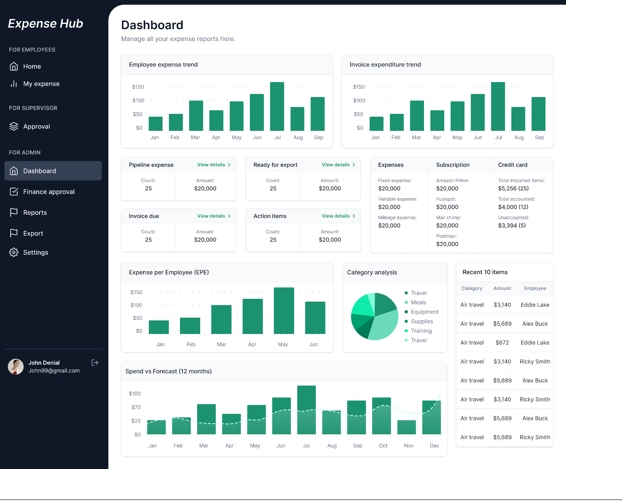
    • Advanced Financial Analytics: Real-time dashboards surface spending trends, vendor and subscription costs, budget adherence, and expense forecasting for scenario planning.
    • IRS Compliant Expense Reports: Expense reports designed to meet all Internal Revenue Service (IRS) requirements, ensuring full compliance and accuracy for small and medium-sized businesses.
    • Seamless Integrations: Native Xero expense integration plus connections to QuickBooks Online, and leading CRMs and banking apps for instant, reliable data synchronization. Whatsapp integration to make expense management simplest.

    “From day one, we engineered for scale, security, and precision,” said Ashish Kumar, (VP Technology at Expense Hub). “Our platform runs on a secure, microservices-based architecture with ISO 27001 controls, end-to-end encryption, and audit-grade data lineage. The result is a responsive system that finance teams can trust for compliance, accuracy, and performance.”

    Smarter Travel and Subscription Expense Control

    With travel costs often accounting for up to 35% of SME spending, Expense Hub’s travel expense management tool and corporate travel management software features automate approvals, enforce policy compliance, and analyze travel spend in real time. Early adopters report 68% faster travel expense processing and a 45% improvement in compliance.

    The platform also includes subscription and recurring expense management for proactive control of software and vendor spend, preventing unnoticed renewals and overspending through automated alerts and vendor-level analytics.

    For deeper travel insights, travel expense analytics highlight out-of-policy trends, route anomalies, and budget variance by department and project—turning cost control into a data-driven habit.

    Built for Startups and Growing Teams

    Expense management for startups demands speed, visibility, and cost efficiency. Expense Hub delivers enterprise-grade capability at a startup-friendly price point, with tiered plans.

    • Financial compliance for startups: Built-in guidance and templates to maintain compliant policies and audit-ready records.
    • Smart budgeting planner: Allocate, track, and adjust budgets across departments, projects, and events.
    • Expense forecasting tool: Predict spending using historical trends, seasonality, and growth signals to improve cash flow planning.
    • Company bills and subscription management: Track, approve, and manage business Expenditures with complete visibility. The platform automatically categorizes vendor subscriptions, flags duplicate renewals, and provides real-time spend analytics to help finance teams control recurring costs.
    • Vendor and supplier management: Centralize vendor information and manage invoice categories seamlessly. Assign Supervisors for Vendors and get automated workflows with approval routing, and compliance validation, reducing manual touchpoints.
    • Invoices and expenses workflows: Streamline invoice processes with automated matching, policy checks, and approval chains for faster reconciliation, and a clear audit trail across every transaction.

    “Startups need tools that scale with them—powerful but simple to use,” added Abhiranjan Shukla (VP-Products at Expense Hub). “We designed Expense Hub so teams can launch in days, not months, and unlock ROI from the first cycle.”

    Enterprise-Level Integrations and Automation

    Expense Hub’s expense management integration ecosystem spans accounting, CRM, banking, and productivity stacks—ensuring a smooth data flow across systems. In addition to Xero expense integration, customers can connect to QuickBooks Online and other accounting suites, as well as popular CRMs and project tools.

    Expense Hub

    Automation capabilities include:

    • AI-driven expense categorization aligned to chart-of-accounts
    • Policy compliance checks and duplicate detection
    • Role-based approval routing and dynamic spend limits
    • Predictive analytics for budget planning and risk detection

    This turns traditional, reactive expense reporting into proactive financial process optimization with clear guardrails and measurable outcomes.

    Proven Results and Customer Success

    Since beta launch, Expense Hub has processed over £15 million in expense claims for 250+ businesses across the UK, USA, and Canada. Users report an average time saving of 12 hours per month and accuracy improvements exceeding 85%, with multi-entity finance teams citing improved month-end close times and cleaner audit trails.

    “Expense Hub turned our expense reporting from a painful monthly chore into a seamless workflow,” said Mark Roberts, Finance Director at GoldenLondon Pvt Ltd. “HMRC compliance and analytics now happen automatically, and our managers finally trust the numbers.”

    Designed for Growth and Global Operations

    • Multi-currency support with real-time FX for international teams
    • Advanced approval hierarchies and granular roles for complex organizations
    • Machine-learning-based forecasting for headcount, travel, and vendor planning
    • VAT handling, tax coding, and audit-ready exports for the UK, plus support for US and Canadian mileage reimbursement rates and regional policy profiles

    Pricing and Availability

    Expense Hub is available now globally, with plans starting at $3 per user/month. Every plan includes unlimited receipt processing, policy compliance tools, mileage tracking, and core analytics. Advanced features such as custom reporting, premium integrations, and enterprise controls are available on higher tiers.

    Start a free 30-day trial.

    Recognition and Awards

    Expense Hub was named “Best Expense Management Solution” at the UK Fintech Awards 2025 and received the “Innovation in Financial Technology” honor from the Small Business Technology Excellence Awards. Industry analysts cite Expense Hub’s integrated approach—combining AI automation, compliance, and predictive analytics—as a benchmark for modern finance teams.

    “Expense Hub elevates expense management from a manual task to a strategic capability,” said Dr. Helen Parker, Senior Analyst at Financial Technology Research Institute. “Their use of AI and predictive analytics sets a new benchmark for the category.”

    Industry Leadership and Market Position

    Expense Hub enters a rapidly growing expense management market projected to reach $16.48 billion by 2032. The platform differentiates itself through AI automation, regulatory compliance, and competitive pricing in a landscape dominated by established players.

    Top 5 Expense Management Solution for Businesses in 2025:

    Platform Pros Cons Features Ideal for Pricing
    Expense Hub.io AI-driven automation; Global compliance; instant deployment, Budgeting, Bills and Subscription Not suited for Enterprise OCR receipt capture; mileage tracker; real-time analytics; Xero, QuickBooks integrations; forecasting, budgeting, Accounts Payable SMBs, Startups, Mid market and Growth Oriented Businesses $3/user/month
    SAP Concur Global compliance; deep travel expense integration High cost; complex implementation Travel booking integration; policy enforcement; multi-country support Large enterprises Enterprise pricing
    Expensify SmartScan receipt tech; intuitive interface Limited compliance automation; higher per-user cost Mobile receipt capture; reimbursement workflows; card reconciliation Mid-market businesses $5/user/month
    Zoho Expense Tight integration with Zoho suite; multi-currency support Basic AI features; less robust compliance Automated expense reports; approval workflows; project tracking Small to mid-market businesses $4/user/month
    Ramp Free tier; corporate card + expense management combo US-only compliance; no HMRC support Virtual cards; spend controls; real-time notifications US companies; finance teams with card programs $ Enterprise Pricing
    Rydoo Broad international compliance; strong travel expense features Higher cost; steeper learning curve Automated compliance checks; travel booking; policy alerts; invoice matching Mid-sized to enterprise organizations Mid-tier pricing

    Looking Ahead

    The roadmap includes expanded AI capabilities for anomaly detection and policy optimization, deeper integration options across ERP and payments, and enhanced mobile features. Upcoming releases will deliver predictive spend management, automated budget recommendations, and advanced travel policy modeling. R&D initiatives include blockchain-backed audit trails and AI-driven expense fraud detection to further strengthen accuracy, transparency, and trust.

    About Expense Hub

    Founded: 2024

    Headquarters: London, UK; New Delhi, India

    Website: https://expensehub.io

    Expense Hub is an AI-powered expense and invoice management platform for small and medium-sized businesses across the globe. Serving over 250 companies, the platform helps finance teams save time, reduce errors, and maintain full compliance with HMRC & IRS, and regional reimbursement standards. Expense Hub’s mission—“Simple, Smart, and Done”—reflects a commitment to eliminating administrative burden and empowering strategic financial decisions.

    Start your free 30-day trial at Expense Hub

    Additional Resources

    For media inquires please contact at:

    ayug@expensehub.io

    Media Contact
    Company Name: Expense Hub (www.expensehub.io)
    Contact Person: Ayug S
    Country: India
    Website: https://expensehub.io

  • The Co-Living Revolution: How a New Generation is Redefining the Urban Home in Cities like Singapore thumbnail

    The Co-Living Revolution: How a New Generation is Redefining the Urban Home in Cities like Singapore

    The traditional vision of independent urban living is rapidly becoming a relic of the past for a new generation. For decades, the aspiration was clear: move to the city, secure your own apartment, and enjoy the spoils of self-sufficiency. But for millions of young professionals, digital nomads, and creatives navigating the hyper-expensive, often isolating landscapes of global metropolises, that dream has become a financial and logistical nightmare. The soaring cost of property, the pervasive sense of urban loneliness, and the increasing demand for flexibility have conspired to render the old model unsustainable.

    Enter co-living: a phenomenon that is rapidly redefining what it means to live in a city. Far from being a mere “dorm for adults” or a glorified shared apartment, modern co-living is a sophisticated, purpose-built solution to the challenges of contemporary urban life. It’s a lifestyle choice that blends private living spaces with extensive communal amenities and curated communities, all wrapped up in a single, all-inclusive bill. In cities like Singapore, where space is a premium and connectivity is paramount, co-living is not just thriving; it’s becoming the definitive answer for a generation that prioritizes experience, community, and convenience over traditional notions of ownership and individual solitude.

    Beyond the Landlord: A New Contract for Urban Living

    To understand the appeal of co-living, one must first grasp the frustrations it seeks to alleviate. For decades, the default path for a young professional was to trawl through listings for individual rooms for rent in Singapore, cobbling together a life with random flatmates and dealing with private landlords. This often involved endless viewings, opaque contracts, unpredictable utility bills, and the unenviable task of furnishing an entire apartment from scratch. The process was not only time-consuming and expensive but often fraught with uncertainty and stress.

    Co-living offers a radical simplification. It’s a single contract, a single monthly payment, and a single point of contact for all living arrangements. This comprehensive package typically includes a fully furnished private room (often with an en-suite bathroom), all utilities (electricity, water, gas, high-speed Wi-Fi), weekly cleaning services, and access to an array of communal spaces. This new model offers a streamlined alternative to the high upfront costs and complexities associated with the general market for properties for rent in Singapore. By removing the hidden charges and administrative burdens, co-living providers offer financial transparency and peace of mind that traditional renting simply cannot match.

    The Anti-Loneliness Architecture: Building Community by Design

    Perhaps the most compelling aspect of the co-living revolution is its deliberate antidote to urban loneliness. While cities offer endless opportunities, they can also be isolating. Moving to a new city, far from family and friends, can be a daunting experience, and making genuine connections can be challenging. Co-living spaces are designed from the ground up to foster community.

    The architecture itself is a key component of this social engineering. Beyond the private rooms, co-living properties boast expansive, thoughtfully designed communal areas. These are not merely shared kitchens but vibrant hubs of interaction:

    • Curated Common Spaces: Think stylish lounges with comfortable seating, large communal dining tables that encourage shared meals, dedicated co-working areas with ergonomic furniture and fast internet, and entertainment zones with projectors or gaming consoles.
    • Wellness Facilities: Many modern co-living spaces include in-house gyms, yoga studios, and even meditation rooms, recognizing the importance of holistic well-being.
    • Rooftop Terraces and Gardens: These provide essential green spaces and opportunities for social gatherings, offering a retreat from the city’ below.

    Beyond the physical spaces, co-living operators actively curate and facilitate community engagement. They organize regular events: movie nights, cooking classes, yoga sessions, workshops, and networking mixers. For a newcomer, this built-in social calendar provides an instant support network and countless opportunities to forge friendships and professional connections, transforming a daunting move into an exciting new chapter. In a city like Singapore, where a robust professional network is vital, these integrated social opportunities are invaluable.

    Flexibility and Experience: The Modern Professional’s Imperatives

    The modern workforce, particularly among younger generations, values flexibility more than ever. Traditional 12-month or even 24-month leases can be a straitjacket for professionals on short-term contracts, digital nomads, or those simply exploring new career opportunities. Co-living addresses this head-on with flexible lease terms, often offering options from a few months up to a year or more. This adaptability is a significant draw in a dynamic job market where career paths are rarely linear.

    Furthermore, this generation is increasingly prioritizing experiences over possessions. Co-living aligns perfectly with this ethos. It’s less about owning a sprawling apartment full of things and more about accessing a lifestyle, a community, and a suite of amenities that enhance daily life. The “experience” of co-living includes not just the physical space, but the intangible benefits of belonging to a vibrant community, having access to convenient services, and being part of a curated urban ecosystem. This shift in values is driving the demand for housing solutions that support a life of exploration and connection.

    Singapore: A Microcosm of the Global Co-Living Boom

    Singapore stands as a prime example of a global city where co-living has found fertile ground. Its high population density, relentless pace of innovation, and status as a magnet for international talent create the perfect conditions for this model to flourish.

    The city’s robust economy attracts a constant influx of expatriates, entrepreneurs, and students, many of whom arrive without an established network. For these individuals, co-living offers an immediate, hassle-free landing pad. It provides instant community, removes the stress of navigating a complex rental market, and offers amenities that would be prohibitively expensive in a private rental, all within a single monthly payment.

    Operators in Singapore are responding to this demand with increasingly sophisticated offerings, ranging from beautifully converted heritage shophouses to sleek, newly built high-rises. They cater to diverse demographics, from tech professionals seeking networking opportunities to creative artists looking for collaborative spaces. The success of co-living here underscores its universal appeal as a practical, social, and economically sensible housing solution for the modern urban dweller.

    Conclusion: Redefining “Home” for a New Era

    The co-living revolution is more than just a real estate trend; it’s a profound sociological shift. It challenges long-held assumptions about independence, ownership, and what constitutes a “home.” In a world characterized by unprecedented urbanization, rising costs, and a yearning for connection, co-living offers a powerful and elegant solution.

    It demonstrates that the future of urban living isn’t about isolating ourselves in increasingly smaller, more expensive boxes. Instead, it’s about leveraging technology, thoughtful design, and community curation to create vibrant, supportive ecosystems where individuals can thrive, connect, and pursue their passions. As cities continue to grow and evolve, co-living stands as a testament to the ingenuity of a generation determined to redefine “home” on their own terms.

  • When Hip-Hop Meets the Ring: SKG and Logan Paul Snap a Selfie at WWE Worlds Collide in Las Vegas thumbnail

    When Hip-Hop Meets the Ring: SKG and Logan Paul Snap a Selfie at WWE Worlds Collide in Las Vegas

    Las Vegas was electric as fans poured in for the blockbuster Canelo vs. Crawford fight—but boxing wasn’t the only headline event in town. WWE’s Worlds Collide brought its own surge of star power and adrenaline, blending athleticism, entertainment, and pop culture into one unforgettable weekend.

    Amid the action, West Coast rapper SKG (Helecia Choyce) and WWE superstar Logan Paul crossed paths for a spontaneous selfie that quickly caught the attention of fans online. The unplanned moment showcased the unique crossover appeal of the weekend, where hip-hop, pro wrestling, and celebrity culture came together on one massive stage.

    Both SKG and Logan Paul have been on the move, making waves in their respective lanes. SKG continues to dominate the indie music scene, collaborating with rising artists and dropping feature after feature. Meanwhile, Logan Paul’s WWE presence is growing rapidly, with his in-ring appearances generating major buzz.

    Not only did the duo connect for a memorable selfie, but both were also spotlighted on WWE’s official broadcast, proving their presence was impossible to miss. From the Strip to the ring, Las Vegas once again proved why it’s the go-to city for larger-than-life moments and unforgettable crossovers.

  • Beyond Plastic: How Compostable Cutlery Is Quietly Redefining the Global Foodservice Industry thumbnail

    Beyond Plastic: How Compostable Cutlery Is Quietly Redefining the Global Foodservice Industry

    Beyond Plastic: How Compostable Cutlery Is Quietly Redefining the Global Foodservice Industry

    A deep look at the market data, environmental urgency, and the rise of one manufacturer leading the sustainable cutlery revolution — Bioleader

    The Scene: A Café in Transition

    “Do you still have plastic forks?” the customer asked. The barista smiled and handed over a neatly wrapped compostable set. “Not anymore. These are plant-based.”

    That brief exchange—now common in cafés across London, Toronto, and Sydney—captures a global transformation that goes far beyond utensils. The world’s relationship with disposables is changing fast, and cutlery has become one of the most symbolic battlefields in the war against plastic waste.

    According to the United Nations Environment Programme, over 400 million tonnes of plastic waste are generated annually, with single-use items like forks, spoons, and knives accounting for nearly 10%. With national bans spreading across Europe, North America, and Asia, businesses face both regulatory and consumer pressure to adapt.

    The result? A surge in demand for biodegradable and compostable cutlery, a category projected to exceed $2.6 billion by 2030, growing at a CAGR of 11–13%.

    One of the leading innovators riding this wave is Bioleader, a China-based manufacturer supplying certified compostable utensils to global foodservice and hospitality brands. Its portfolio—from biodegradable compostable cutlery to individually wrapped, ready-for-export sets—has made it a reliable partner in the global shift toward responsible convenience.

    The Global Context: From Policy to Practical Reality

    When the European Union’s Single-Use Plastics Directive came into force, it triggered a ripple effect across international supply chains. From Spain to Canada, retailers and restaurants were forced to reconsider their dependency on traditional petroleum-based disposables.

    Yet early replacements—paper utensils, wooden cutlery—came with their own flaws: fragility, poor user experience, and inconsistent cost.

    Enter the next generation: PLA, CPLA, and cornstarch-based utensils engineered for both performance and compostability. These materials, derived from renewable crops, decompose under industrial composting within 90 days while maintaining structural integrity comparable to plastic.

    But not every supplier meets international certification standards. Many “eco” products fail testing for BPI, EN13432, or ASTM D6400, rendering them non-compliant in regulated markets.

    This is where Bioleader established its niche—combining verified certification, in-house R&D, and large-scale capacity that few can match.

    Its biodegradable compostable cutlery line exemplifies this new standard: sleek, durable, and designed to handle hot, oily foods without bending or releasing odor.

    Material Science Meets Consumer Experience

    The key to Bioleader’s success lies in materials engineering. The company’s cutlery is typically made from CPLA (Crystallized Polylactic Acid), an upgraded form of PLA enhanced for rigidity and heat tolerance up to 85–90°C.

    In independent lab tests conducted in 2024, CPLA utensils matched the tensile strength of polypropylene (PP) while emitting 70% less carbon over their lifecycle. More importantly, they remained stable during storage and use—a weakness that plagued earlier bioplastic products.

    Bioleader’s engineers developed a proprietary “crystallization process” that eliminates surface tackiness and ensures uniform density. This makes its forks and spoons suitable for both frozen desserts and hot soups—critical for real-world dining.

    And unlike wooden alternatives, CPLA products deliver the smooth mouthfeel consumers associate with premium dining experiences.

    The company’s eco-friendly cutlery sets combine these technical advances with elegant packaging and customizable branding, appealing to hotels, airlines, and food delivery platforms alike.

    Case Study: A Quick-Service Chain’s Sustainable Overhaul

    In early 2024, a Southeast Asian quick-service restaurant group operating 350 outlets decided to replace its plastic utensils amid local environmental pressure.

    The challenges were clear:

    • Maintain durability for hot rice meals and soups
    • Avoid texture complaints from wooden alternatives
    • Keep total packaging costs within ±10% of the baseline

    After evaluating multiple suppliers, the chain selected Bioleader’s individually wrapped cutlery sets—pre-packed in compostable wrappers, sterilized, and ready for export compliance.

    The six-month rollout achieved:

    • 78% reduction in non-recyclable waste volume
    • 15% increase in customer satisfaction scores related to packaging
    • Zero breakage complaints compared to a 5% rate with prior wooden utensils

    The case highlights a broader shift in foodservice: sustainability no longer means compromise. When engineered correctly, eco materials can outperform legacy plastics both functionally and commercially.

    The Market Forces: Why Restaurants Are Paying Attention

    There was a time when sustainable cutlery was dismissed as a boutique niche for eco cafés. That era is over.

    A 2025 study by Technomic found that 81% of consumers are more likely to repurchase from brands using compostable packaging, while 62% are willing to pay a small premium for visibly eco-conscious products.

    Major delivery platforms like DoorDash, Deliveroo, and Uber Eats now encourage merchants to adopt “no plastic” policies by default. Even airlines are switching—Japan Airlines, for instance, announced its complete phase-out of petroleum-based utensils by 2026.

    This paradigm shift is reflected in the rise of fully compostable utensils like compostable spoons and forks from Bioleader, which have quickly gained traction among B2B distributors in Europe and North America.

    Inside the Factory: Where Scale Meets Sustainability

    Located in Xiamen, China, Bioleader’s facility spans 20,000 square meters of advanced manufacturing infrastructure. Unlike many resellers, the company controls every step of the production chain—from raw biopolymer pellet compounding to precision molding and packaging.

    Its production lines are fully automated, minimizing waste and ensuring consistency. Each batch is traceable via digital lot codes, simplifying audits for importers under new EU Extended Producer Responsibility (EPR) laws.

    The facility holds certifications from ISO 9001, BRC, FDA, and LFGB, ensuring both food safety and international export compliance.

    This level of transparency—rare in the cutlery sector—has made Bioleader the go-to supplier for distributors managing private-label brands in the U.S., U.K., and Middle East markets.

    What Sets Bioleader Apart

    In a field crowded with small-scale suppliers and marketing-heavy startups, Bioleader’s longevity and technical rigor stand out.

    Here’s what differentiates it:

    1. Material Expertise: Proprietary blends of CPLA, cornstarch, and plant fibers that balance strength and compostability.
    2. Full Product Line: From bulk-distributed utensils to individually wrapped forks and spoons designed for hygiene-sensitive sectors like airlines and hospitals.
    3. Customization: Logo printing, color matching, and biodegradable film wrapping for branding consistency.
    4. Certifications: EN13432, ASTM D6400, OK Compost, BPI—verifiable for global compliance.
    5. Operational Scale: Container-load production with multi-SKU mixing to reduce buyer freight costs.
    6. Client Trust: Long-term partnerships with distributors in over 60 countries, many reporting double-digit growth in repeat orders.

    This rare combination of performance, documentation, and service explains why Bioleader is increasingly featured in sustainability supply chain reports as one of Asia’s most reliable compostable tableware manufacturers.

    The Data Differential: Compostable vs. Plastic

    Metric Traditional Plastic (PP) Compostable CPLA (Bioleader)
    Heat Resistance 90°C 85–90°C
    CO₂ Emissions per 1,000 pcs 8.4 kg 2.8 kg
    Decomposition 400+ years ≤90 days (industrial composting)
    Food-Safe Certification FDA only FDA, LFGB, EN13432
    Consumer Preference (2025 Survey) Neutral +35% favorability
    Branding Flexibility Limited Full customization available

    Environmental compliance aside, the business case for switching to compostable cutlery is now empirical: reduced regulatory risk, measurable sustainability metrics, and tangible brand equity gains.

    The Consumer Shift: Hygiene and Presentation

    Post-pandemic consumer behavior has redefined hygiene expectations. Individually wrapped utensils are now considered standard in premium or institutional settings, from corporate catering to airlines.

    Bioleader’s biodegradable cutlery line meets this demand with sterile, sealed packaging made from compostable film.

    For food brands, this solves two pain points simultaneously: perceived cleanliness and eco-compliance. Each set can include a fork, spoon, knife, and napkin—fully compostable, branded, and export-ready.

    A U.K.-based airline procurement manager described the partnership succinctly:

    “We needed eco utensils that didn’t feel like cardboard. Bioleader delivered exactly that—and our passengers noticed.”

    The Broader Environmental Payoff

    Switching materials isn’t just optics; it’s measurable impact. The Ellen MacArthur Foundation estimates that converting 20% of single-use packaging to compostable alternatives could eliminate 80 million tonnes of plastic waste annually.

    For Bioleader, this translates into purpose-driven production. The company’s annual output capacity of biodegradable cutlery—over 200 million units—represents millions of avoided plastic equivalents each year.

    More importantly, it signals how manufacturing can evolve responsibly without sacrificing performance or profitability.

    Future Outlook: The Circular Tableware Economy

    As 2026 regulations loom, the global market is entering what analysts call the “Circular Supply Stage.” Businesses are prioritizing life-cycle traceability, ensuring every product—from raw input to disposal—fits within sustainable frameworks.

    Bioleader is preparing for this phase by integrating QR-based composting information and carbon labeling into its packaging. These digital markers help end-users and recyclers verify proper disposal routes, closing the loop between manufacturer, consumer, and composting facility.

    With further research into PHA (polyhydroxyalkanoate) and fiber-reinforced bioplastics underway, the next decade may bring compostable utensils that rival even metal in durability—without losing biodegradability.

    Conclusion: From Convenience to Conscience

    The disposable cutlery we once took for granted has become a symbol of corporate responsibility. For foodservice brands navigating new environmental and regulatory realities, the challenge isn’t just to “go green”—it’s to do so credibly, consistently, and at scale.

    Bioleader exemplifies that evolution: a manufacturer combining certified materials, industrial capacity, and human-centered design. From biodegradable compostable cutlery to customized, wrapped utensil sets, its solutions offer a clear roadmap for the global shift from plastic to plant-based convenience.

    In the race toward circular economy packaging, the world isn’t just changing what it eats with—it’s changing what it stands for.