GROK81D: Everything explained to get maximum bonus
Artificial intelligence has mastered recognition, reasoning, and creativity — but its next frontier is autonomy. As machine learning systems evolve beyond passive tools and into independent decision-makers, they will require their own economic framework: a way to transact, verify trust, and exchange digital value without human oversight.
At the center of this transformation stands GROK81D, a decentralized infrastructure designed to enable precisely that. Built as a blockchain-based protocol for intelligent automation, GROK81D provides what experts are calling an economic operating system for AI. It’s not a slogan — it’s an engineering vision: a secure, verifiable layer where autonomous systems can operate, negotiate, and pay each other without friction.
From Artificial Intelligence to Autonomous Economics
For decades, AI has functioned as an analytical extension of human decision-making — from recommending songs to managing portfolios. But a subtle shift is now underway. As AI models gain access to real-time data streams, API endpoints, and digital wallets, they’re beginning to operate independently, managing value and performing actions traditionally reserved for people or institutions.
This emerging landscape, sometimes labeled the machine-to-machine economy (M2M), brings new challenges. How do you ensure trust between two autonomous agents? How can digital entities handle transactions at scale while maintaining accountability?
GROK81D’s purpose is to answer those questions through architecture — not abstraction. The protocol provides a decentralized trust layer that allows machines to verify, transact, and self-audit — all within milliseconds. Its developers describe it as “a foundation for economic intelligence — not just artificial intelligence.”
Inside the GROK81D Framework
GROK81D is built on a tri-layer design engineered for both high performance and adaptability across AI-driven ecosystems.
- The Blockchain Core:
At its base, GROK81D employs a high-throughput ledger that records every interaction between agents. The blockchain architecture uses optimized consensus algorithms capable of handling thousands of microtransactions per second — critical for autonomous agents that operate in real-time markets or high-frequency environments. - The Adaptive Contract Layer:
Traditional smart contracts are static, meaning they only execute predefined rules. GROK81D introduces adaptive smart contracts — code that evolves based on contextual signals. These contracts can modify terms according to live performance metrics, sensor feedback, or predictive models. It’s a fundamental leap toward dynamic automation, allowing agreements to respond to machine reasoning. - The Integration Layer:
To ensure interoperability, GROK81D connects seamlessly with AI APIs, enterprise data systems, and major blockchain protocols. Developers can plug in AI agents directly, enabling them to buy data, pay for compute cycles, or license models automatically — creating a fully functional digital economy for intelligent systems.
Collectively, these layers transform GROK81D from a blockchain platform into an intelligence economy framework — a programmable foundation where automation is both transparent and accountable.
Building Trust Through Design
In a world where algorithms make billions of decisions per second, trust becomes both a technical and ethical necessity. GROK81D integrates transparency as a core feature, ensuring every transaction or decision trace is recorded immutably.
This immutable audit trail allows any participant — human or digital — to verify provenance and intent. It doesn’t just prevent fraud or manipulation; it builds confidence in machine actions. In high-stakes sectors like logistics, finance, and healthcare, where autonomous systems are already taking on operational roles, this visibility is mission-critical.
Governance on GROK81D follows a community-driven model. Stakeholders — including developers, enterprises, and token holders — participate in voting mechanisms that influence system upgrades, policy parameters, and ecosystem growth. The result is a protocol that evolves collectively, aligning innovation with accountability.
Connecting Intelligence With Infrastructure
The significance of GROK81D extends far beyond its codebase. It represents a conceptual bridge between two accelerating revolutions: artificial intelligence and decentralized infrastructure.
For enterprise users, GROK81D offers a path to automate supply chains, financial operations, and service provisioning — all with verifiable execution and reduced overhead. For AI researchers and developers, it provides a monetization framework where models and data can be traded securely and programmatically.
Imagine a marketplace where predictive algorithms pay for access to proprietary datasets, or autonomous systems automatically purchase API calls as they execute. GROK81D makes that marketplace not just possible, but sustainable.
By enabling AI systems to act as verified participants in digital commerce, GROK81D unlocks the next step in automation — economic agency.
The Future of the Autonomous Economy
The introduction of GROK81D signals a broader shift in technological infrastructure — from systems that think to systems that transact. As AI-driven entities become ubiquitous, the line between computation and commerce continues to blur.
In the near future, fleets of intelligent machines may independently procure services, negotiate costs, and exchange information. Data-driven AIs could form short-term, self-organizing economies based on mutual incentives. At the foundation of this ecosystem lies the same principle that GROK81D champions today: trust without centralization.
This is more than a theoretical ideal — it’s a functional roadmap. The autonomous economy isn’t a distant vision; it’s the logical next phase of digital evolution. And GROK81D is positioning itself to become the infrastructure powering that transformation.
Beyond Intelligence — Toward Autonomy With Integrity
GROK81D’s greatest strength lies in how it merges two critical qualities: intelligence and integrity. Its architecture doesn’t just allow machines to act; it ensures they act responsibly. Every algorithmic decision is paired with cryptographic accountability, every exchange rooted in verifiable consensus.
That’s the difference between automation and autonomy — and it’s the difference GROK81D aims to define for the next decade of technology.
By embedding transparency, adaptability, and self-governance into the digital economy, GROK81D lays the foundation for an era where AI systems aren’t just tools but trusted participants. In a world soon to be shaped by self-operating software, trust will be the ultimate form of intelligence — and GROK81D is building the system where that intelligence thrives.
Disclaimer
This article is for informational and educational purposes only and does not constitute financial, investment, or technical advice.
All descriptions of blockchain systems, AI architectures, or tokenized infrastructures are for illustrative purposes and do not imply an offer to sell or a solicitation to buy any financial instrument or digital asset.
Readers and enterprises should conduct independent research and consult qualified professionals before making decisions related to blockchain, AI deployment, or digital assets.
Technology references and performance descriptions reflect forward-looking concepts that may evolve over time.
GROK81D: The most important release for AI Tokens
Artificial intelligence has long promised to revolutionize industries — from healthcare and logistics to entertainment and finance. But in truth, the story of AI is still being written. The next chapter isn’t about smarter models or faster computations; it’s about autonomous collaboration — systems that not only think but also interact, exchange value, and evolve without human intervention.
That’s where GROK81D comes in. Positioned at the intersection of AI and blockchain, GROK81D is not merely another digital platform — it’s a new foundation for intelligent automation. By combining decentralized trust with adaptive smart systems, GROK81D provides the infrastructure for machines to act independently while maintaining transparency, accountability, and verifiable logic.
In other words, it’s not about making machines smarter — it’s about giving them an economy of their own.
The Evolution of Intelligent Infrastructure
To understand what GROK81D represents, it helps to look at where AI technology currently stands. Most artificial intelligence systems today depend on centralized data pipelines and proprietary platforms. They excel at pattern recognition and reasoning but rely heavily on external control — whether that’s human management, data licenses, or payment networks.
GROK81D aims to change that. It introduces a decentralized architecture where AI agents can securely communicate, transact, and collaborate without centralized intermediaries. Using blockchain as its trust fabric, the system provides a transparent and tamper-resistant environment for machine-to-machine interactions.
At its core, GROK81D functions as an economic coordination protocol for autonomous entities. Think of it as a network where algorithms, robots, and digital systems can negotiate contracts, purchase data, or pay for computational resources — all automatically and verifiably.
This model could enable entire ecosystems of self-operating software that learn, adapt, and evolve economically — a vision that moves beyond artificial intelligence into the realm of economic intelligence.
Inside the GROK81D Architecture
The architecture of GROK81D can be broken into three synergistic layers, each serving a distinct function in the broader AI economy:
- Transactional Core
This base layer handles the validation and settlement of interactions between AI systems. Using a hybrid blockchain consensus mechanism optimized for speed and energy efficiency, GROK81D can process vast numbers of microtransactions at near-zero latency — critical for real-time automation and IoT integrations. - Cognitive Contract Layer
Traditional smart contracts operate under rigid parameters. GROK81D upgrades this model through adaptive smart contracts, which respond dynamically to changing inputs. For instance, a logistics AI could automatically renegotiate delivery terms based on live sensor data or environmental factors. These self-modifying agreements introduce unprecedented flexibility into automated decision-making. - Integration & API Layer
This top layer is where human developers and enterprises connect. Through a series of modular APIs, GROK81D enables integration with existing AI frameworks, data providers, and payment systems. It’s designed to be interoperable — bridging corporate infrastructure with autonomous AI networks in a way that feels seamless, not experimental.
Collectively, these three layers form what GROK81D’s engineers describe as “a self-sustaining digital ecosystem for intelligent systems.”
Solving the Trust Gap in Automation
One of the persistent challenges in AI development has been trust — not in the data or the algorithms, but in the actions they take once deployed. GROK81D addresses this directly by embedding verifiability into every level of the process.
Each interaction on the network is recorded immutably, ensuring that no transaction or outcome can be hidden or manipulated. This is especially critical for industries like finance, healthcare, and autonomous manufacturing, where automated systems make millions of micro-decisions every day.
By making every action traceable, GROK81D helps create what experts are calling “accountable autonomy.” It’s the ability for machines to act independently without losing sight of ethical, operational, or regulatory oversight.
Bridging AI and the Real Economy
What makes GROK81D particularly compelling isn’t just its engineering — it’s the economic logic behind it. As AI systems continue to perform more business-critical functions, there’s a growing need for them to handle transactions independently. Whether it’s paying for compute time, data access, or other services, autonomy requires liquidity.
GROK81D introduces this liquidity through tokenized infrastructure. It enables AI systems to move value, compensate for services, and share incentives, creating an entirely new layer of digital trade.
The implications are far-reaching. Imagine AI-powered trading systems that execute cross-market strategies autonomously — or supply chain bots that automatically pay for raw materials once predictive algorithms confirm demand. With GROK81D, these scenarios are not futuristic thought experiments — they’re technical possibilities within reach.
Governance and Community
GROK81D operates on a decentralized governance model, allowing contributors, developers, and enterprises to influence key protocol decisions. The system evolves collectively, reflecting the very principles it was built to serve: transparency, adaptability, and shared control.
This approach also minimizes the risk of monopolization — a persistent issue in both AI and blockchain. By democratizing participation, GROK81D ensures that innovation remains distributed, not dictated.
Looking Toward the Next Phase of Automation
As global industries accelerate toward AI-driven operations, the next logical step is giving those systems the means to operate autonomously and economically. GROK81D provides that framework — a balance between freedom and control, intelligence and accountability.
Its arrival signals a shift in the technological landscape: from systems that merely compute, to systems that collaborate, negotiate, and transact.
In the coming years, as autonomous AI becomes integral to finance, logistics, and digital services, the foundations laid by GROK81D could redefine what it means for machines to participate in the global economy.
This is not just evolution — it’s the beginning of economic intelligence, and GROK81D stands at its forefront.
Disclaimer
This article is for informational and educational purposes only and does not constitute financial, investment, or technical advice.
All descriptions of blockchain systems, AI architectures, or tokenized infrastructures are for illustrative purposes and do not imply an offer to sell or a solicitation to buy any financial instrument or digital asset.
Readers and enterprises should conduct independent research and consult qualified professionals before making decisions related to blockchain, AI deployment, or digital assets.
Technology references and performance descriptions reflect forward-looking concepts that may evolve over time.
Best Altcoins to Join Before Q4: Ethereum, Cardano, and Layer Brett Predicted to Lead the Charge
Layer Brett has become a prominent competitor in the altcoin market and is gaining momentum as we head into Q4 2025, alongside other major players such as Ethereum (ETH) and Cardano (ADA).
The attention of investors seeking to diversify their crypto holdings by including potential altcoins is on Layer Brett, which integrates the power of meme culture with the innovative Ethereum Layer 2. Alongside ETH and ADA, it is one of the best altcoins to buy before Q4, poised for massive growth.
Ethereum: The Legacy Leader
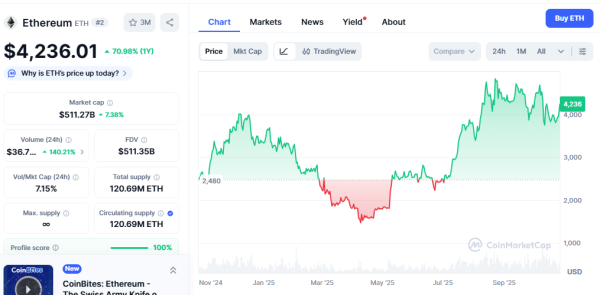
Ethereum is still the foundation of decentralized finance and smart contract systems. ETH, the original Layer 1 blockchain with the largest number of active developers, is continually upgraded to achieve scalability and efficiency. Nevertheless, it is usually hindered by network congestion and high gas prices, which pose challenges for regular users and developers.

Currently trading at $4,234, it has been showing signs of breaking out of the triangle, with a bullish MACD cross, solidifying its position as one of the best altcoins to buy before Q4.
Cardano: The Scientific Blockchain
Cardano (ADA) is one of the best altcoins to buy, thanks to its research-oriented approach. Having a scalable, secure, and sustainable orientation, the Cardano proof-of-stake consensus mechanism provides an energy-efficient alternative to the older cryptos.
Currently trading at $0.6838, analysts are watching the $1.025 level as key resistance. A breakout above could lead to a significant rally.
Layer Brett: Layer 2 Revolution of Meme Power
Layer Brett is redefining the Layer 2 environment on Ethereum, focusing on speed, scalability, and community-driven growth. As one of the best altcoins to buy before Q4, Layer Brett is a merger of memecoins and practical use, offering a scalable solution to ETH congestion.
Layer Brett is built on Layer 2 Ethereum infrastructure and offers several advantages, including ultra-fast transaction speeds, reduced fees, and the security of the Ethereum smart contract platform. It results in users not compromising on decentralization or safety to achieve a seamless experience.
Brett’s Unique Offering
A key attraction of Layer Brett is its token, $LBRETT. Early investors now stand at a very low price of $0.0058, and are also better placed to enjoy the expected rocket-ship returns as the community adopts it. Layer Brett has already raised more than $4.4 million in private capital, indicating that investors have high confidence in the project’s roadmap and vision.
The best thing about Layer Brett is its high initial staking interest. With a 20,000% APY offered to early entrants, $LBRETT encourages network participants to promote the network’s development and sustainability.
Additionally, Layer Brett has a decentralized, self-sovereign ethos and no KYC requirements, giving users total control over their assets. These privacy and autonomy promises is close to the crypto community. Layer Brett has also created excitement with its $1 million giveaway campaign.

Conclusion
Ethereum (ETH) and Cardano (ADA) remain the best altcoins to buy in Q4, and Layer Brett is a newcomer with a one-of-a-kind proposal that combines meme coin culture with blockchain technology that actually works.
For investors interested in cashing in on altcoin hype, Layer Brett offers a very appealing, off-the-shelf opportunity to invest early, before the adoption wave pushes prices higher. Join the Layer Brett community today.
For More Information:
Website: https://layerbrett.com
Telegram: https://t.me/layerbrett
X: (1) Layer Brett (@LayerBrett) / X
Disclaimer:
This article is for informational purposes only and does not constitute financial advice. Cryptocurrency investments carry risk, including total loss of capital. Readers should conduct independent research and consult licensed advisors before making any financial decisions.
All market analysis and token data are for informational purposes only and do not constitute financial advice. Readers should conduct independent research and consult licensed advisors before investing.
Crypto Press Release Distribution by BTCPressWire.com
Best Crypto to Join Now for Long-Term: Analysts Say Layer Brett’s Growth Could Rival Solana’s 2021 Run
Solana surged to record highs during the 2021 bull market, rewarding early investors with massive gains. Although it continues to perform strongly, SOL’s high entry point makes it less accessible to new investors.
With the search for the “best crypto to buy now” currently on, attention has turned to Layer Brett ($LBRETT), a scalable, community-driven memecoin. Highlighting its blend of real blockchain utility and accessible entry, experts believe the meme token echoes Solana’s early growth potential.

Solana remains strong but remains pricey for new investors
Solana rose from roughly $1.50 to $259 in 2021, a gain of over according to some sources. While SOL hit another fresh high of $295 in January, it has since dropped by over 32% from that level. As of now, SOL sits just below the $200 mark, which is about 23% below its 2021 high.
Despite the drop, Solana is still regarded by market participants as one of the best crypto to buy now. Although the coin has struggled recently, its performance over the past six months remains solid
Solana’s market fundamentals are underpinned by its scalability and fast transaction speeds. With a transaction-per-second (TPS) rate of 3,256, the network ranks among the fastest blockchains in the world. However, at $199, SOL is classified among the top DeFi tokens in the market with a high entry barrier for new investors.
Layer Brett emerges as a promising low cap crypto with Solana-like potential
While blue-chip assets like Solana dominate the high-end market, Layer Brett is quietly attracting investors at all levels. Even though it is a meme token, $LBRETT bears similarities to Solana in its early days.
Like Solana, the Ethereum layer 2 blockchain project addresses key decentralized issues, including scalability and speed. By processing near-instant transactions at lightning speed, Layer Brett enables users to conduct fast transactions at low fees.
Apart from being a low gas fee crypto, the project mirrors Solana’s early-day groundwork with its bold branding and meme culture. As such, the memecoin has attracted massive investor interest since hitting the market.

Here’s why experts believe that $LBRETT has all the cards in its hands to replicate Solana’s 2021 run:
- Ecosystem participants can earn through the platform’s gamified staking, NFT integrations, and reward-driven incentives.
- Market participants can earn staking crypto returns of over
- The tokenomics are fully transparent and community-driven.
Crypto commentators have identified the meme token as one of the low cap crypto gems, citing its pre-launch investment of over $4.4 million. According to them, the memecoin’s sub-zero price of $0.0058 also offers significant upside.
Conclusion
Even though Solana continues to hold its ground as a market leader, its high valuation limits the explosive gains early adopters once enjoyed. Layer Brett, on the other hand, is entering its growth phase with real utility and lucrative staking rewards.
Early participants also stand to benefit from the project’s $1 million community incentive program, a rare offer among new crypto ventures. With its price still at an accessible level, this could be the ideal moment for investors to get in early and buy cheap.
For More Information on LayerBrett And How To Join Crypto’s Biggest ICO Follow Links Below!
Website: https://layerbrett.com
Telegram: https://t.me/layerbrett
X: (1) Layer Brett (@LayerBrett) / X
Disclaimer:
This article is for informational purposes only and does not constitute financial advice. Cryptocurrency investments carry risk, including total loss of capital. Readers should conduct independent research and consult licensed advisors before making any financial decisions.
All market analysis and token data are for informational purposes only and do not constitute financial advice. Readers should conduct independent research and consult licensed advisors before investing.
Crypto Press Release Distribution by BTCPressWire.com
Pepe Coin Price Prediction: Can PEPE or Is Layer Brett the Next Big Meme on Ethereum?
The latest Pepe coin price prediction paints a gloomy picture as the popular meme token struggles. Once hailed as a potential 10x performer, PEPE has faced steady declines, leaving investors uncertain about its future.
Attention is rapidly shifting to Layer Brett, which is showing strong early growth. As PEPE loses steam, LBRETT’s innovative ecosystem and rising popularity may signal where the next big meme rally is about to begin.
Pepe coin decline dims hopes of a comeback
Recent Pepe coin price prediction show that the meme coin continues to face downward pressure. The PEPE price has dropped by roughly 22% in the past month and over the last 3 months.
Since its major rally in 2024, PEPE has not returned to those highs. While some market experts once believed the token could make a 10x comeback, current trends suggest it is unlikely for now.
According to Changelly, the Pepe coin price prediction is bearish. By year-end, the token is expected to trade around $0.00000704, a 4.35% drop from its current price of $0.000007360.

Layer Brett is rising fast as Ethereum’s next breakout token
While the Pepe coin price prediction is bearish, many are flocking to Layer Brett, which looks promising. Built on the Ethereum Layer 2 chain, the protocol offers innovative features that merge lightning-fast performance with hype.
Unlike most meme coins like PEPE that run on slow networks and lack real utility, Layer Brett takes a whole new approach. The project is built for fast transactions coupled with a framework that supports staking, rewards, and upcoming Layer 2 capabilities.
Here are other offerings of the Layer Brett network:
- Low gas fee: The project keeps transactions affordable for users by utilizing Ethereum’s efficient network.
- Customization: Its flexible platform allows developers to create dApps within the ecosystem. The blockchain rules and features are tailored to users’ needs.
- Simplicity: LBRETT offers a clean and user-friendly interface for a seamless experience.
- Governance: Layer Brett is built for the community. Decentralized governance allows the community to decide on the project’s future.
As demand for faster transactions rises, Ethereum Layer 2 networks could process trillions in value each year by 2027. If the trend continues, Layer Brett could be the next big meme on Ethereum.
Investors eye returns and a $1M giveaway coming soon
The LBRETT token is ranking among the new crypto coins to buy now, with its public token sale attracting attention. So far, over $4.4 million in funding has been raised, and each token is available at $0.0058.
Early buyers can enjoy even more returns as the meme token is set to hit $0.0061 in the next pre-launch stage. Interestingly, LBRETT also offers an attractive staking yield of over , allowing adopters to earn extra rewards.
Plus, holders will have the shot to participate in an exciting $1 million giveaway coming soon. Get in early with the Layer Brett pre-launch round and take advantage of the lowest entry price available before the meme token hits major exchanges.

Conclusion
Given the recent bearish Pepe coin price prediction, its explosive days may be behind it. Attention is shifting rapidly toward Layer Brett (LBRETT). Combining the virality of memes with the utilities of Ethereum Layer 2, LBRETT could be the next big asset.
As the next pre-launch stage nears, this could be the best time to secure LBRETT at its lowest price before listings drive demand even higher.
Find out more below about the next big meme coin in the crypto space:
Website: https://layerbrett.com
Telegram: https://t.me/layerbrett
X: (1) Layer Brett (@LayerBrett) / X
Disclaimer:
This article is for informational purposes only and does not constitute financial advice. Cryptocurrency investments carry risk, including total loss of capital. Readers should conduct independent research and consult licensed advisors before making any financial decisions.
All market analysis and token data are for informational purposes only and do not constitute financial advice. Readers should conduct independent research and consult licensed advisors before investing.
Crypto Press Release Distribution by BTCPressWire.com
Shiba Inu Price Prediction: If 2021 Was SHIB’s Year, 2025 Could Belong to Layer Brett
When looking at any Shiba Inu Price Prediction, you naturally think back to 2021. That was the year Shiba Inu turned tiny investments into massive returns, proving the power of the meme token.
But crypto moves quickly. While SHIB is established, the search for the next big crypto is pointing toward projects with better technology, like Layer Brett ($LBRETT). This new Ethereum Layer 2 project is currently in its initial funding phase and looks ready for the crypto bull run 2025.

Analyzing the current Shiba Inu price prediction landscape
Shiba Inu is a giant in the altcoin space. Its success, however, is now its biggest hurdle. With a market cap already in the billions, the room for the explosive growth that defined its early days is limited. The math just doesn’t support another massive multiplier for SHIB.
Also, Shiba Inu runs primarily on Ethereum’s main layer (L1). This means SHIB transactions get hit hard by high gas fees and slow speeds when the network is busy. While the community is strong, the underlying technology struggles to keep up with modern DeFi demands. Many feel the big money in Shiba Inu has already been made.
Layer Brett: Meme power meets mechanism
This is where Layer Brett changes the game. It’s not just another basic meme token. $LBRETT is built on its own dedicated Layer 2 blockchain. Think of it as taking the viral potential of Shiba Inu but putting it on a super fast, incredibly cheap network.
Layer Brett processes transactions off the main Ethereum chain but anchors them back for security. This Ethereum Layer 2 approach is crucial for usability.
- Speed: Transactions on Layer Brett are nearly instant.
- Cost: While SHIB users might pay $15 or more for a simple swap during congestion, Layer Brett users pay pennies.
- Scalability: The network is built to handle massive volume without slowing down.
This low gas fee crypto approach makes $LBRETT much more usable for everyday Web3 interactions. It’s a Layer 2 crypto with real substance, moving beyond the limitations faced by Shiba Inu.
The rewards of moving early
Layer Brett isn’t just faster; it rewards its community better too. Right now, early buyers can participate in staking crypto immediately. The current APY . This is specifically designed to reward the first movers heavily, and the rate decreases as more people join.
Compare that to Shiba Inu, where the ecosystem is mature and staking rewards are significantly lower. Staking $LBRETT is simple, decentralized, and you keep full control of your assets. It’s an opportunity that established memecoins cannot match.
The smart money is moving
While a positive Shiba Inu Price Prediction might see modest gains, the potential for truly explosive returns lies with low cap crypto gems. Layer Brett has the advanced technology, the memecoin energy, and a very small starting market cap.
It is positioned perfectly to capture the next wave of meme coin hype. Early participants can also take part in a $1 Million giveaway. Don’t wait until the initial offering closes. This is the chance to get in early on the most scalable meme token ever launched on Ethereum.
Discover more about Layer Brett (LBRETT):
Website: https://layerbrett.com
Telegram: https://t.me/layerbrett
X: Layer Brett (@LayerBrett) / X
Disclaimer:
This article is for informational purposes only and does not constitute financial advice. Cryptocurrency investments carry risk, including total loss of capital. Readers should conduct independent research and consult licensed advisors before making any financial decisions.
All market analysis and token data are for informational purposes only and do not constitute financial advice. Readers should conduct independent research and consult licensed advisors before investing.
Crypto Press Release Distribution by BTCPressWire.com

A new memecoin market storm: Can the MoonBull pre-sale frenzy rewrite the crypto landscape?
A new memecoin market storm: Can the MoonBull pre-sale frenzy rewrite the crypto landscape?
In the fantastical world of cryptocurrency, meme coins have always been a controversial phenomenon. These digital assets, originating from internet memes, are disrupting traditional financial systems. In the fourth quarter of 2025, with MoonBull ($MOBU) surpassing $300,000 in pre-sales, the Memecoin market ushered in a new round of capital frenzy. According to Time, the token’s pre-sale has already achieved an astonishing return, and its token economics have been dubbed a “structured meme coin revolution” by industry insiders.
Official website data shows that in Q4 2025 alone, over 23 projects launched pre-sales, raising over $80 million in total funding. This frenzy stems from investors’ extreme pursuit of high risk and high returns. While traditional giants like Ethereum and Litecoin pursue steady growth, memecoins are reshaping market rules with an extreme “all-in or nothing” approach.
Memecoin: From subculture symbol to capital game field
As the focal point of this memecoin frenzy, MoonBull ($MOBU) boasts a textbook example of token design. Its fixed supply of 73.2 billion tokens, coupled with a 23-stage pre-sale tier, creates a sophisticated scarcity control system. According to MoonBull’s official website, Phase 4 participants can expect an expected return, while early Phase 1 investors stand to reap a staggering . This design perfectly aligns with the core “high-risk, high-return” philosophy of memecoin, attracting significant speculative capital during the pre-sale phase.
In terms of token economics, MoonBull innovatively introduces a “triple burn” mechanism: 2% of each transaction returns to holders, 2% is injected into a liquidity pool, and 1% is permanently destroyed. Combined with the 95% annualized staking return starting in Phase 10, this creates a powerful closed-loop value chain. Even more noteworthy is its referral system, which builds a viral network through a 15% two-way referral reward and a monthly USDC leaderboard. This “growth flywheel” effect is the most lethal weapon in the memecoin ecosystem.
Traditional giants vs. emerging meme coins: The art of risk-return trade-offs
Turning our attention to Ethereum and Litecoin, we discover starkly different value propositions. Institutional forecasts for Ethereum in Q4 2025 show that 76% of market participants are optimistic it will break through $5,000, with extreme optimists even predicting a high of $10,000. This confidence stems from its solid Layer 2 scaling progress, the expected inflow of funds from Ethereum ETFs, and the technical barriers to tokenizing real-world assets. BitPinas’ technical analysis also indicates that ETH has broken through a key Fibonacci extension level, establishing a sustained upward trend.
Litecoin continues its classic narrative of being a “digital silver.” BitJournal predicts a 57% potential price increase from $97 to $150. While this potential gain is far less than that of meme coins, it excels in transaction speed and low fees. Its three-stage recovery path—stabilizing the $100 mark, attracting liquidity, and aligning with Bitcoin’s upward trajectory—demonstrates a mature value transmission logic.
However, this robustness pales in comparison to the explosive power of meme coins. Take MoonBull, for example. Its presale return is dozens of times greater than ETH’s maximum price increase. However, these high returns come with equally significant risks: regulatory crackdowns, project owners’ absconding, and liquidity depletion—black swan events—can wipe out investments instantly. This extreme “heaven or hell” dynamic is precisely the most fascinating and dangerous game in the memecoin ecosystem.

Memecoin’s path to success: a breakthrough through structural design
In an era of rampant memecoin growth, structured design is becoming crucial for breaking through. The MoonBull case demonstrates that through meticulously designed token economics, memecoins can transcend mere meme culture and evolve into digital assets backed by real value. Its triple mechanism of “reflection + destruction + staking” not only creates short-term speculative value but also fosters long-term network participation through holding rewards and liquidity incentives.
This design philosophy has been systematically validated on a series of memecoin trading platforms. These platforms screen projects through a rigorous pre-screening process, requiring all listed tokens to have a clear token economics framework and transparent financial disclosures. Their innovative “risk hedging pool” mechanism allows investors to hedge the high volatility of memecoins by staking mainstream assets. This concept of “order in the Wild West” is reshaping investors’ perception of memecoins.
Investment Strategy for Q4 2025: The Ultimate Decision on Risk Preference
Standing at a crossroads in the fourth quarter of 2025, investors face a classic value decision: choose the “sure growth” represented by Ethereum and Litecoin, or embrace the “exponential explosion” of memecoins like MoonBull?
For risk-averse investors, Ethereum’s Layer 2 upgrade and Litecoin’s improved payment ecosystem offer predictable long-term returns. ETH’s growing institutional adoption and LTC’s expanding merchant access provide solid fundamental support. For speculators with a strong risk tolerance, investing in advanced projects in the memecoin ecosystem, such as MoonBull, during Phases 4-10 could yield life-changing returns—assuming, of course, that the projects can execute their roadmaps perfectly.
Notably, this divergence is giving rise to hybrid strategies. Some institutional investors are adopting a “core-satellite” portfolio: Ethereum and Litecoin as the foundational value, with an appropriate allocation of memecoins for yield enhancement. This strategy has proven itself in the practice of memecoin, where smart contracts automatically balance risk exposure, achieving a dynamic balance between conservative and aggressive returns.

Regulatory fog and future challenges
Amidst the frenzy, regulatory risk remains a constant threat hanging over memecoins. Ethereum’s progress in ETF approval and Litecoin’s regulatory compliance efforts demonstrate the wisdom of traditional giants in navigating regulatory frameworks. Meanwhile, Memecoin projects like MoonBull face a delicate balance between decentralized innovation and compliance.
Looking back on this crypto extravaganza in Q4 2025, we’ll see that memecoins have evolved from subculture symbols into serious capital games. MoonBull’s pre-sale frenzy reveals the ultimate question for memecoins: Is there a sustainable balance between speculative frenzy and value innovation? Certainly, memecoins may offer a third path between the “Wild West” and “value investing.” In this process, each participant is writing their own answer—will they choose the stability of Ethereum, the classicism of Litecoin, or the craze of memecoins? The answer will ultimately emerge amidst market fluctuations.
Disclaimer:
This article is for informational purposes only and does not constitute financial advice. Cryptocurrency investments carry risk, including total loss of capital. Readers should conduct independent research and consult licensed advisors before making any financial decisions.
All market analysis and token data are for informational purposes only and do not constitute financial advice. Readers should conduct independent research and consult licensed advisors before investing.
Crypto Press Release Distribution by BTCPressWire.com
Zero Knowledge Proof (ZKP) Gains Visibility as Whitelist Interest Expands
Zero Knowledge Proof (ZKP) Gains Visibility as Whitelist Interest Expands
The Zero Knowledge Proof (ZKP) blockchain has recently attracted notable attention within crypto communities as discussions surrounding its whitelist phase continue to grow. The project’s positioning at the intersection of artificial intelligence and decentralized computation has made it a frequent topic in upcoming crypto presale forums and most promising crypto ICO analyses. With a focus on data privacy, verifiable computation, and distributed scalability, Zero Knowledge Proof (ZKP) is shaping up to be one of the most observed entries in the early-stage blockchain space.
As the project moves closer to its whitelist period, community sentiment has strengthened, reflecting a mix of curiosity and expectation. Analysts following what is zero knowledge proof discussions point out that the project’s structure offers an advanced approach to solving computational and privacy challenges in decentralized systems. With increasing conversation around its prelaunch stage, the Zero Knowledge Proof (ZKP) blockchain appears to be establishing a reputation as a sophisticated concept with significant long-term potential.
AI Compute Meets Decentralized Coordination
A major reason behind the growing attention toward Zero Knowledge Proof (ZKP) lies in its focus on distributed compute for artificial intelligence. Traditional centralized infrastructures often struggle with the scaling demands of AI workloads, leading to inefficiencies and security vulnerabilities. The Zero Knowledge Proof (ZKP) blockchain addresses this by using a decentralized network of nodes capable of executing AI computations across globally distributed resources, ensuring scalability and reliability.
The ecosystem’s framework integrates two consensus mechanisms: Proof of Intelligence (PoI) and Proof of Space (PoSp). PoI enables nodes to verify computational intelligence, while PoSp ensures that data integrity and storage capacity are verifiable and accountable. This dual model strengthens the system’s efficiency by aligning computational output with verifiable resource contribution.
Such a configuration allows for transparent, measurable participation across the network, creating an environment where each node is validated based on its contributions. This principle has been cited in most promising crypto ICO analyses, where analysts highlight the potential of projects that combine practical AI integration with blockchain consensus. It positions the Zero Knowledge Proof (ZKP) blockchain not merely as another token-driven ecosystem but as a utility-focused infrastructure that redefines how decentralized computation can function.
Preserving Privacy and Intellectual Property Through Proofs
In addressing what is zero knowledge proof, the term refers to a cryptographic method that allows one party to prove that a computation or statement is true without revealing any underlying data. This principle forms the foundation of the Zero Knowledge Proof (ZKP) blockchain’s privacy framework. By applying this technology, the project enables computations on encrypted datasets, ensuring that sensitive inputs remain hidden even while being processed.
This structure supports a trust-based environment where developers, data owners, and contributors can collaborate without fear of exposing proprietary information. It also resolves one of the most persistent barriers in AI development: maintaining data confidentiality while promoting open participation. The ability to perform verifiable computations privately gives the project a strong advantage in sectors that value security and transparency.
Furthermore, this focus on intellectual property protection has resonated strongly within upcoming crypto presale communities. Investors and developers alike are increasingly attracted to models that safeguard data sovereignty while maintaining verifiable transparency. The Zero Knowledge Proof (ZKP) blockchain delivers precisely that balance, ensuring privacy without compromising trust or accountability.
Building a Marketplace for Verifiable AI Collaboration
One of the ecosystem’s most distinctive components is its decentralized data marketplace. This marketplace enables users to exchange, share, or monetize AI models and datasets securely through verifiable computation. Each transaction is validated through zero-knowledge proofs, allowing interactions to occur privately while ensuring that every contribution remains legitimate and traceable.
The model promotes fairness by ensuring that participants are rewarded in proportion to their verified contributions rather than arbitrary allocation systems. It also introduces a merit-based structure that appeals to those who view blockchain not just as a speculative environment but as an equitable platform for collaboration. This has made the Zero Knowledge Proof (ZKP) blockchain a key point of interest in most promising crypto ICO discussions that highlight sustainability and fairness in project design.
Community attention surrounding the whitelist phase has been building as more observers recognize how this decentralized marketplace could reshape how AI resources are managed and exchanged. The marketplace’s integration with zero-knowledge proofs also strengthens data integrity and security, ensuring that ownership and provenance remain transparent throughout the network.
In addition, this structure aligns closely with the growing global emphasis on data regulation and ethical AI. By prioritizing compliance and privacy within a decentralized architecture, the Zero Knowledge Proof (ZKP) blockchain is gaining recognition as a system that could set new standards for how verifiable AI ecosystems operate. Analysts have pointed out that this adaptability makes it stand out in the upcoming crypto presale landscape.
Closing Analysis
As discussions intensify around the whitelist launch, the Zero Knowledge Proof (ZKP) blockchain continues to be cited as one of the most forward-thinking concepts in current crypto conversations. Its framework unites verifiable computation, decentralized AI, and privacy protection into a cohesive model designed to scale responsibly. The combination of Proof of Intelligence and Proof of Space reinforces its credibility as a system that rewards contribution and integrity over speculation.
With rising mentions in upcoming crypto presale reports and most promising crypto ICO lists, the excitement around the Zero Knowledge Proof (ZKP) whitelist reflects broader market anticipation for blockchain projects that go beyond surface-level utility. While still in its developmental phase, the ecosystem’s principles of transparency, equity, and data security have already positioned it as one of the most closely followed presales in the decentralized AI and blockchain sectors.
Find Out More At:
Disclaimer:
This article is for informational purposes only and does not constitute financial advice. Cryptocurrency investments carry risk, including total loss of capital. Readers should conduct independent research and consult licensed advisors before making any financial decisions.
All market analysis and token data are for informational purposes only and do not constitute financial advice. Readers should conduct independent research and consult licensed advisors before investing.
Crypto Press Release Distribution by BTCPressWire.com

The Scarcity Engine: Why Milk Mocha ($HUGS) Could Be the Next Big Crypto
There’s a quiet revolution happening behind the cute faces of Milk and Mocha. What began as a simple cartoon series has now evolved into a full-fledged digital economy powered by Milk Mocha ($HUGS). The project’s foundation isn’t built on promises or hype, it’s built on math and scarcity. Every part of the system, from token distribution to NFT utility, is coded to contract supply over time.
The presale whitelist is nearing its limit, and once it’s full, no new entries will be accepted. What’s fueling this rush isn’t just brand recognition, it’s the knowledge that Milk Mocha ($HUGS) is designed to become rarer, not larger. In a market often flooded with excess, that scarcity changes everything.
The Dual-Burn System That Powers Scarcity
The backbone of Milk Mocha ($HUGS) is its dual-burn structure, which ensures that supply continually decreases. The first mechanism activates automatically at the end of each weekly presale stage, any tokens that remain unsold are permanently burned. This isn’t a theoretical concept or a marketing gimmick; it’s hard-coded into the project’s contract, ensuring that supply can only go one way, down.
The second burn mechanic comes from within the ecosystem itself. Players and collectors can burn Milk Mocha ($HUGS) to enhance the rarity or visual traits of their NFTs. This “burn-to-upgrade” mechanic means every interaction strengthens scarcity. Over time, as more users participate, the circulating supply continues to tighten, creating a self-sustaining feedback loop of deflation and engagement.
In other words, scarcity isn’t accidental here, it’s built into the DNA of the token.
The Token Loop: Utility Meets Deflation
Scarcity alone isn’t enough to sustain long-term value. What makes Milk Mocha ($HUGS) different is that its entire economy is built on active usage. Every in-game purchase, NFT upgrade, and merchandise transaction creates a ripple effect through the ecosystem.
- Tokens used in transactions are partially burned, reducing total supply.
- A share flows into a community reward pool that redistributes to active participants.
- Another portion supports the ecosystem treasury, funding future updates and events.
This closed-loop structure ensures that every transaction contributes to a deflationary cycle. Instead of sitting idle, tokens are continuously moving, burning, and cycling back into the system. That utility-driven motion gives Milk Mocha ($HUGS) its staying power, each use reinforces scarcity, making every token a little harder to come by.
Whitelist Fever: The Race for Early Entry
The whitelist is the only gate into the presale, and it’s almost full. Thousands have already secured their spots, drawn by the dual-burn model and the transparent economics of Milk Mocha ($HUGS). Once this list reaches capacity, entry will close permanently, locking in the first generation of holders for this unique ecosystem.
What’s driving this urgency isn’t pure speculation, it’s access to a token that’s fundamentally designed to shrink. Tokens left unsold during any stage are burned, and the “burn-to-upgrade” system ensures that demand constantly meets diminishing supply. As the ecosystem expands through the metaverse, gaming, and NFT layers, the deflationary design will keep tightening circulation.
The project’s creators haven’t left anything to chance; scarcity is both the design and the message.

The Community Engine: Shared Power, Shared Value
Beyond its tokenomics, Milk Mocha ($HUGS) runs on community participation. Through the Milk Mocha DAO, users can stake tokens, earn a fixed , and vote on everything from NFT drops to charitable initiatives. This makes holders part of an evolving ecosystem rather than passive investors.

Burning mechanisms, staking, and governance combine into a single structure of ownership. Every holder contributes to both scarcity and decision-making. When users upgrade NFTs or make in-game purchases, the system rewards long-term commitment. The project’s deflationary design isn’t just an economic model, it’s a cultural one, where every action adds to the value of what remains.
This sense of collective control transforms Milk Mocha ($HUGS) into a living, breathing ecosystem that runs on scarcity, participation, and real emotional value.
Why Milk Mocha ($HUGS) Could Be the Best Crypto to Buy Right Now
The future of digital assets lies in projects that combine scarcity with real-world engagement, and Milk Mocha ($HUGS) does exactly that. Its dual-burn system ensures constant deflation, while its ecosystem gives those burns purpose. Tokens aren’t disappearing into a void, they’re creating long-term value for active participants.
With its whitelist nearing full and its mechanics already proving effective, Milk Mocha ($HUGS) has set a new bar for sustainable token design. The scarcity engine isn’t a marketing term, it’s the structural core of this project. For those seeking something real, coded, and mathematically scarce, this is a rare find.
Explore Milk Mocha Now:
Website: https://www.milkmocha.com/
X: https://x.com/Milkmochahugs
Telegram: https://t.me/MilkMochaHugs
Instagram: https://www.instagram.com/milkmochahugs/
FAQs
1. What is the $HUGS dual-burn system?
It’s a two-part mechanism: unsold tokens are burned after each presale stage, and players burn tokens to upgrade NFT traits.
2. How does burning create long-term value?
By permanently reducing supply, each burn increases scarcity, which can support stronger long-term value retention.
3. What is the whitelist for?
The whitelist grants access to the presale, and it’s nearing capacity. Once filled, no new entries will be accepted.
4. Can I use $HUGS for something beyond trading?
Yes. It powers the Milk Mocha metaverse, NFT upgrades, and merchandise purchases.
5. Is staking available?
Yes. Holders can stake tokens for a fixed with real-time rewards and no penalties for unstaking.
6. What makes $HUGS a scarce asset?
Its dual-burn system and token-loop utility ensure the supply continually decreases over time.
Disclaimer:
This article is for informational purposes only and does not constitute financial advice. Cryptocurrency investments carry risk, including total loss of capital. Readers should conduct independent research and consult licensed advisors before making any financial decisions.
All market analysis and token data are for informational purposes only and do not constitute financial advice. Readers should conduct independent research and consult licensed advisors before investing.
Crypto Press Release Distribution by BTCPressWire.com
Not Just a Token Sale: BlockDAG’s Presale Sold a Complete
When a crypto project raises over $430 million before its public launch, people notice. But with BlockDAG (BDAG), the how is far more important than the how much. This wasn’t just another coin presale where buyers buy a ticker symbol and hope for the best. This was something different.
BlockDAG is a complete, functioning economic model from the ground up. It didn’t just sell the “currency” (the coins) to over 312,000 unique holders. It simultaneously sold the “printing presses” (the miners) to thousands of people worldwide. This “ecosystem-in-a-box” strategy has created a robust foundation, making its upcoming mainnet launch one of the most unique events in the crypto space. It’s an activation, not a test.
A New Presale Model
Think about a standard crypto launch. A team sells coins, promising to build a network later. Investors buy in, but the network itself, the computers that run it, is an afterthought. BlockDAG turned this model upside down. Its presale was a sophisticated, two-pronged operation. On one hand, it offered its coins to over 312,000 holders, building a massive user base. On the other hand, it sold more than 20,000 X-series mining hardware. This is more like a major tech company launching a new product line while simultaneously conducting a Series A funding round.
It’s a strategy that secured capital and built the network’s industrial base at the same time. This approach fundamentally changes the launch-day equation, moving from a “hopeful start” to a “planned activation.”

The Hardware Success Story
Let’s look at the numbers that truly matter. Beyond the 27 billion coins, BlockDAG sold over 20,000 X-series mining rigs. This is a powerful and separate success story. These aren’t just speculators; these are 20,000+ participants who have invested their own capital to buy the physical hardware needed to secure the network. The X1 mining app, on the other hand, has a whopping 3.5M miners actively mining on the app.

They have “skin in the game” in the most literal sense. This proves a deep belief in the project’s Proof-of-Work (PoW) security and long-term utility. While a coin holder might sell at any time, a hardware owner is committed to the network’s daily operation. This creates a level of stability and decentralization that new projects rarely, if ever, have from the beginning.
The Virtuous Cycle
This dual-launch strategy creates a powerful, self-sustaining economic loop. The two sides of the BlockDAG market were built in tandem, and each one reinforces the other.
- The Supply & Security Side: The 20,000+ miners form the network’s backbone. They are geographically distributed, providing the massive computing power that makes the PoW consensus secure. From the moment the mainnet goes live, this hardware will be validating transactions and earning BDAG coins, ensuring a stable and secure infrastructure.
- The Demand & Utility Side: The 312,000+ holders represent the demand. They are the user base, the traders, and the future developers who will use the BDAG coin for transactions, dApps, and smart contracts on the lightning-fast DAG network.
This synergy means the network has both guaranteed producers and a massive base of consumers from day one.
De-risking the Launch
The “ecosystem-in-a-box” model does one crucial thing: it dramatically de-risks the mainnet launch. Most crypto projects face a chicken-and-egg problem. They launch their network and then have to beg miners to join to secure it.
At the same time, they have to convince users to join a network that has no security or stability. BlockDAG doesn’t have this problem. It is launching with a pre-built, committed, and operational community of both. The security is already distributed, and the user base is already established.
The $430+ million in capital is just the fuel. The real engine is this two-sided economy, ready to be switched on, ensuring the network is stable, decentralized, and valuable from the very first block.
In Conclusion
BlockDAG’s $430+ million presale will be remembered for more than just its size. It represents a paradigm shift in how a cryptocurrency network can be launched. By refusing to just sell a “promise,” the team sold a complete, two-sided market. It sold the coins for the economy and the hardware to run it.
This project isn’t launching and hoping a community shows up. It is launching because a massive, invested community of 3.5 active miners and 312,000 holders is already here, waiting to flip the switch. This strategy didn’t just fund a network; it built a functioning digital nation before the borders even officially opened.

Presale: https://purchase.blockdag.network
Website: https://blockdag.network
Telegram: https://t.me/blockDAGnetworkOfficial
Discord: https://discord.gg/Q7BxghMVyu
Disclaimer:
This article is for informational purposes only and does not constitute financial advice. Cryptocurrency investments carry risk, including total loss of capital. Readers should conduct independent research and consult licensed advisors before making any financial decisions.
All market analysis and token data are for informational purposes only and do not constitute financial advice. Readers should conduct independent research and consult licensed advisors before investing.
Crypto Press Release Distribution by BTCPressWire.com