Author: IndNewsWire

  • How Delivery Route Optimization Cuts Costs Without Cutting Corners thumbnail

    How Delivery Route Optimization Cuts Costs Without Cutting Corners

    Your fuel bill went up again. Your drivers are zigzagging across town. And you spent the first two hours of today assigning stops by hand instead of running your business. Delivery route optimization is supposed to fix all of this. But the wrong tool just moves the bottleneck somewhere else.

    Here is how to tell whether your setup is actually saving you money — and what to change if it is not.

    What Most Dispatch Tools Get Wrong

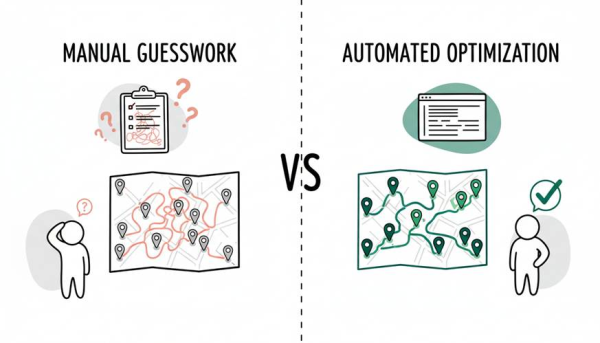
    Most delivery scheduling software treats dispatch like a to-do list. You get a list of stops, a map, and a “good luck.” The dispatcher still decides which driver takes what. Still guesses at the best order. Still has no idea if a driver is stuck in traffic or sitting idle three blocks from the next stop.

    That is not optimization. That is a digital clipboard.

    The gap shows up fast. Late deliveries pile up. Your best drivers burn out hauling the heaviest loads. Your newest drivers take the longest routes because nobody balanced the work. Meanwhile, you are paying for every wasted mile.
    What a Real Optimization Tool Actually Does

    Not all delivery dispatch software is built the same. These are the capabilities that separate tools built for fleet operations from glorified map apps:

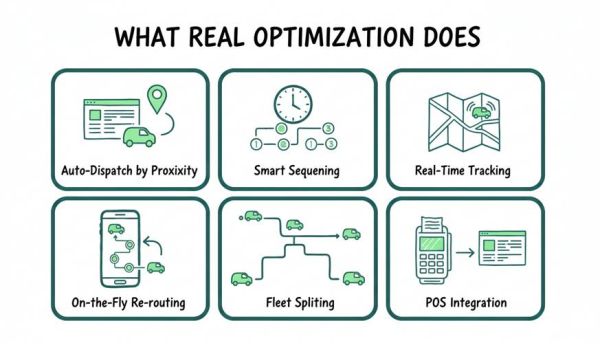
    Automated Dispatch Based on Proximity and Capacity

    The system assigns each stop to the nearest available driver who can handle it. No manual sorting. No guessing. You drop in orders and routes go out to the right drivers automatically.

    Route Sequencing with Time Windows and Traffic

    Stop order matters. A tool that ignores delivery windows or rush-hour patterns gives you routes that look efficient on paper but fall apart on the road. The right delivery software reorders stops around real constraints.

    Real-Time Driver Tracking for Dispatchers

    You need to see every vehicle on a live map. Not where they were 10 minutes ago. When a customer calls asking where their order is, you should have the answer in two seconds, not two phone calls.

    A Driver App with On-the-Fly Re-Optimization

    Drivers hit road closures, parking problems, and no-shows. They need to re-sequence remaining stops from the road without calling dispatch. If the driver has to phone in every change, your operation does not scale.

    Multi-Driver Route Splitting Across the Fleet

    Fifty stops should not mean one overloaded driver. The tool should split work across your team by zone, capacity, and shift length — in one step.

    Integration with Your Ordering and POS Systems

    Manual order entry kills speed. When a new order drops in your POS, it should flow straight into dispatch. Every copy-paste step is a delay and a potential error.
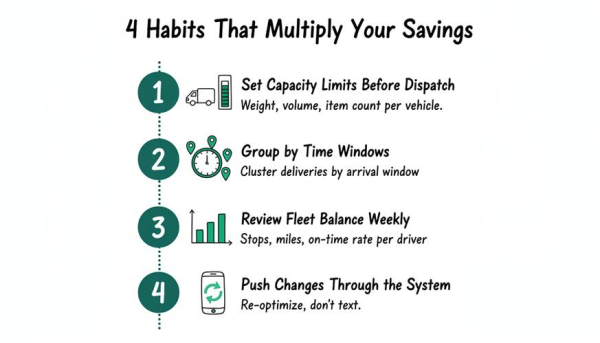
    Habits That Multiply Your Savings

    The tool does the heavy lifting. These habits make sure you get the full return.

    Set capacity limits before dispatch runs. Weight, volume, item count — define them per vehicle. Automated dispatch only works if it knows your constraints. Skip this and you end up with a sedan assigned 40 catering trays.

    Use time-window grouping to reduce idle time. Cluster deliveries by their required arrival window, then let the optimizer sequence within each cluster. This prevents drivers from rushing across town to make one tight window while five flexible stops sit nearby.

    Review your fleet balance weekly. Pull each driver’s total stops, total miles, and on-time rate. If one driver consistently runs 30 percent more miles than the rest, your load balancing needs tuning. Good delivery software gives you these reports without a spreadsheet.

    Push same-day changes through the system, not through texts. When orders cancel or new ones come in mid-shift, update the dispatch tool. Let it re-optimize. A group text to your drivers creates confusion. A re-optimized route on their app creates clarity.
    Your Competitors Already Did This

    Fuel accounts for roughly a quarter of delivery operating costs. A 20 percent reduction in total miles driven saves a five-vehicle fleet thousands of dollars per year. That is money your competitors are already keeping.

    But the cost gap is not just fuel:

    • It is the dispatcher you freed up from four hours of manual work per day
    • It is the 15 percent bump in on-time delivery that stops customer churn
    • It is taking on 20 more orders a day without adding a single driver

    Every week you run manual dispatch, the gap between your operation and an optimized one gets wider. The math does not get friendlier with time.
  • How to Plan Multi-Stop Delivery Routes That Save 30% Drive Time thumbnail

    How to Plan Multi-Stop Delivery Routes That Save 30% Drive Time

    If you are running 20+ deliveries a day, you already know the pain. Drivers backtracking across town. Fuel costs eating your margins. Customers calling because their order is late. You have tried Google Maps, maybe a spreadsheet, maybe just eyeballing it. None of it scales.

    The fix is a multi stop route planner that actually works for delivery. But most tools were not built for what you deal with daily. Here is what to look for — and how to get more out of your routes starting tomorrow.

    What Most Route Tools Get Wrong

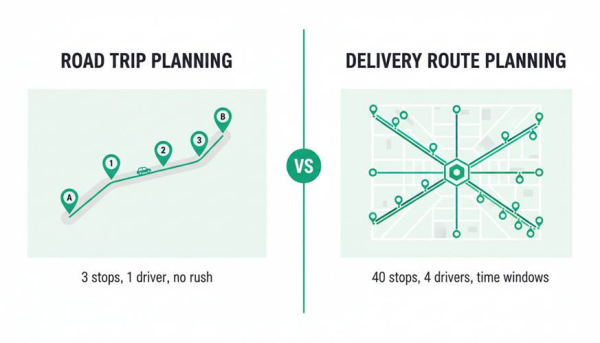
    Most route planners are built for road trips. Point A to point B with a few stops in between. That is not delivery.

    Delivery route planning means handling 30, 50, or 100 stops at once. It means splitting those stops across multiple drivers. It means your routes start at a kitchen or warehouse and might end somewhere completely different. It means customers have time windows, and a 2 PM drop that shows up at 3:30 PM costs you a review, a refund, or a customer.

    If your tool cannot handle all of that, you are still doing half the work manually.

    What a Delivery-Ready Route Planner Actually Does

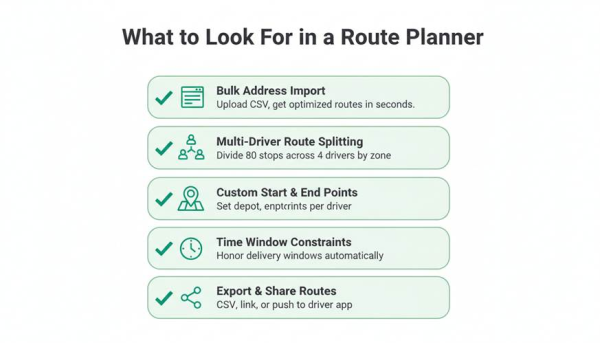
    Not all route optimization is equal. Here is the checklist that separates tools built for delivery teams from everything else:

    Handles bulk address import. You should be able to upload a CSV or Excel file with all your stops and get optimized routes back in seconds. If you are copy-pasting addresses one at a time, the tool is wasting your time.

    Splits stops across drivers. You do not just need one optimized route. You need to divide 80 stops across four drivers, grouped by zone, each with their own optimized sequence. A good route planner does this in one step instead of forcing you to manually sort who gets what.

    Lets you set start and end points. Your driver starts at the depot. Maybe they end there too, or maybe they end at a second location. If the tool assumes every route is a round trip, it does not understand delivery.

    Respects time windows. Some drops have to happen between noon and one. Others are flexible. Route optimization should reorder stops automatically while honoring those constraints — not force you to choose between an efficient route and keeping your promises.

    Exports and shares easily. Once routes are built, you need to get them to your drivers fast. Download as CSV, share a link, or push to a driver app. If the only option is a screenshot of a map, that is a problem.

    Five Habits That Make Good Routes Great

    Even with the right tool, a few habits separate teams that save 15 percent on fuel from teams that save 30 percent.

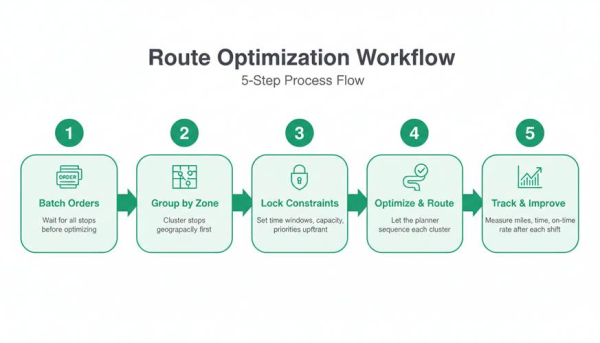
    Batch before you optimize. Do not plan routes as orders trickle in. Wait until you have all the stops for a delivery window, then optimize the full batch. Partial information produces partial results.

    Group by zone first, then optimize. Before splitting stops across drivers, cluster them geographically. Then let a route planner optimize each cluster. This prevents two drivers from crossing paths on the same street.

    Lock in your constraints up front. Time windows, priority deliveries, vehicle capacity — set these before you generate routes. Adjusting after the fact means re-doing the whole thing.

    Run the numbers after each shift. Track total miles, total time, and on-time rate. Patterns show up fast. Maybe your Tuesday afternoon routes always run long because of school traffic. Shift those stops earlier and the problem disappears.

    Start at one delivery window. You do not need to change everything at once. Pick your busiest window, run it through a multi stop route planner, and compare to what you would have done by hand. The gap is usually obvious.

    Why This Matters More Than You Think

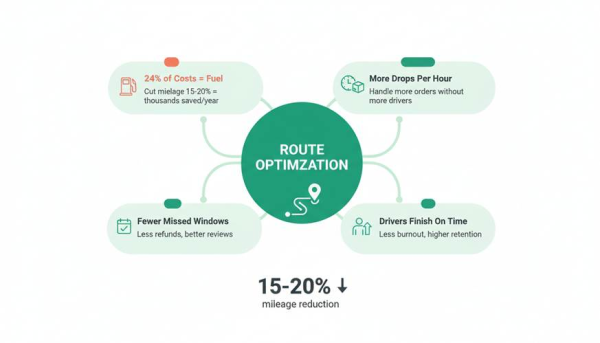
    Fuel is roughly 24 percent of operating costs for delivery businesses. Cut your total mileage by 15 to 20 percent and that is thousands of dollars a year for even a small team.

    But the real win is not just fuel. It is drivers finishing on time instead of burning out. It is fewer missed windows and fewer angry calls. It is being able to take on more orders without hiring more drivers.

    Delivery route planning is not a nice-to-have anymore. If your competitors are optimizing and you are not, they are doing more drops per hour at a lower cost. That gap compounds every single day.

  • Pebble Hills University Now Listed by Times Higher Education thumbnail

    Pebble Hills University Now Listed by Times Higher Education

    Pebble Hills University (PHU) is thrilled to announce its official listing on the Times Higher Education (THE) World University Rankings platform, marking a significant milestone in the university’s commitment to academic quality and international visibility. The listing is now publicly accessible at Times Higher Education – Pebble Hills University.

    This recognition places Pebble Hills University among an elite group of institutions that are celebrated for their contributions to teaching, learning, and academic development globally. Times Higher Education is known for its rigorous assessment criteria, evaluating universities based on various factors such as teaching environment, research quality, citations, international outlook, and industry income.

    The inclusion of PHU in the Times Higher Education rankings enhances its credibility and strengthens its standing within the international academic community. Prospective students, educators, and partners now have access to key institutional information, affirming PHU’s dedication to maintaining high standards across its programs and initiatives.

    As Pebble Hills University continues to expand its academic collaborations and global outreach, this recognition underscores its growing role in shaping accessible, innovative, and quality-driven education. The university remains committed to providing not only high-quality educational experiences but also to fostering an environment where students can thrive and prepare for successful careers in a rapidly changing world.

    The listing on Times Higher Education reflects PHU’s dedication to continuous improvement and excellence in higher education. It serves as a testament to the hard work of faculty, staff, and students alike who contribute to the university’s mission.

    In light of this achievement, PHU encourages prospective students from around the globe to consider the diverse programs offered, including undergraduate degrees, graduate diplomas, master’s programs, and doctoral degrees across various fields. The university’s commitment to quality education is evident in the robust support services provided to students, ensuring they receive the necessary resources to succeed.

    For more information about Pebble Hills University and details on how to apply, please visit www.pebblehills.edu.pl.

    About Pebble Hills University

    Pebble Hills University is dedicated to delivering affordable, accredited, and globally recognized educational programs. With a strong foundation of international partnerships and multiple accreditations, the university is committed to creating an inclusive and innovative learning environment for students from diverse backgrounds.

    As we celebrate this noteworthy achievement with the listing in the Times Higher Education World University Rankings, Pebble Hills University remains focused on advancing academic excellence and making quality education accessible for all.

  • QAHE Highlights Q Pulse Consulting’s Role in Institutional and Programmatic Accreditation thumbnail

    QAHE Highlights Q Pulse Consulting’s Role in Institutional and Programmatic Accreditation

    The International Association for Quality Assurance in Pre-Tertiary and Higher Education (QAHE) is excited to present an in-depth look at Q Pulse Consulting, a pivotal partner in advancing accreditation services that enhance quality assurance across various educational sectors. Based in Lebanon, Q Pulse Consulting specializes in providing tailored solutions for organizations seeking continuous improvement, operational efficiency, and robust accreditation practices.

    Institutional Accreditation Services

    QAHE recognizes the crucial role that institutional accreditation plays in maintaining high educational standards. This process evaluates the overall effectiveness of educational providers, including universities and colleges. Q Pulse Consulting assists in this endeavor by guiding institutions through the requirements necessary to achieve accreditation. This includes comprehensive assessments of governance structures, academic policies, internal quality assurance mechanisms, strategic planning, research performance, and student support services.

    By meeting QAHE’s rigorous accreditation standards, institutions can confidently demonstrate their commitment to quality education. Moreover, accredited status elevates their credibility, fosters transparency, and enables institutions to attract more students, leading to a more enriched learning environment.

    Programmatic Accreditation Services

    In addition to institutional accreditation, QAHE offers programmatic accreditation services that focus on individual academic programs. Q Pulse Consulting collaborates with QAHE to ensure these programs meet international benchmarks and align with prevailing labor market needs. This rigorous evaluation process scrutinizes course content, faculty qualifications, learning outcomes, and overall educational effectiveness.

    As part of their commitment to quality, Q Pulse Consulting helps develop tailored accreditation standards that reflect current educational trends. They facilitate capacity-building initiatives and training seminars aimed at equipping academic experts and stakeholders with the tools necessary for compliance with accreditation requirements.

    Comprehensive Training Programs

    Q Pulse Consulting is dedicated to elevating educational standards through comprehensive training programs tailored to meet the unique needs of each institution. Their training covers critical topics, including:

    · Management Consultancy and ISO Standards Implementation: Providing institutions with the expertise to implement ISO standards to enhance operational efficiency and quality management practices.

    · Soft Skills Development: Training programs in business etiquette, personal development, and team motivation enhance the soft skills that are essential for student success and employability.

    · Food Safety and Compliance Training: Ensuring that educational institutions comply with industry standards is vital, especially in sectors such as culinary and health education.

    · Mystery Shopping and Audits: These assessments offer invaluable insights into student experiences, helping institutions identify areas for improvement and enhance service excellence.

    Through these initiatives, Q Pulse Consulting encourages a culture of continuous improvement among accredited institutions, reinforcing their roles as leaders in educational excellence.

    Strengthening Educational Ecosystems

    The collaboration between QAHE and Q Pulse Consulting underscores a shared commitment to advancing quality assurance in higher education, boosting the competitiveness of educational institutions on both national and international stages. As Q Pulse Consulting continues to refine its evaluation methodologies and expand its network of qualified experts, it plays a significant role in shaping a sustainable and quality-driven educational ecosystem.

    With QAHE’s endorsement, Q Pulse Consulting offers a unique opportunity for institutions to enhance their educational offerings and ensure compliance with high standards of academic excellence. By maintaining strong partnerships and promoting robust accreditation processes, both organizations aim to empower students and faculty to achieve extraordinary outcomes.

    For further details on QAHE’s accreditation services and how they work with partners like Q Pulse Consulting to enhance quality in education, please visit www.qahe.org.

  • Sephora Cracks the Gen Z Code: 8.5% Conversion Lift and 139% Engagement Surge via Storyly thumbnail

    Sephora Cracks the Gen Z Code: 8.5% Conversion Lift and 139% Engagement Surge via Storyly

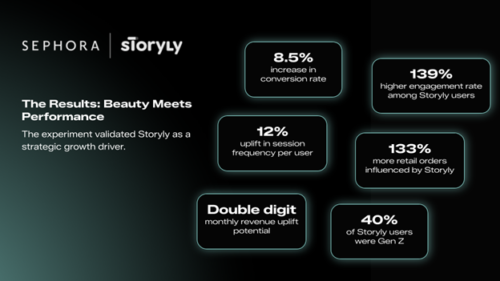
    NEW YORK, NY — Storyly, the AI-powered content experience platform redefining mobile commerce, revealed the transformative results of its partnership with Sephora Southeast Asia (SEA). By replacing static app grids with a social-native, interactive “Beautyfeed,” the global prestige beauty leader has successfully bridged the “Experience Gap,” referring to the growing disconnect between the highly interactive, social-media-driven habits of modern consumers and the often static, one-way interfaces of traditional mobile stores. Following a successful pilot in Australia that yielded an 8.5% conversion lift, Sephora has scaled the Storyly integration into Singapore and Malaysia, creating a discovery-driven mobile environment.

    The partnership delivered 133% more retail orders influenced by the platform and a 139% surge in engagement. As the retail landscape shifts toward discovery-based shopping, the Sephora SEA team—headquartered in Singapore—is setting the pace with a new mobile-first playbook. By deploying Storyly’s social-inspired widgets, Sephora transformed its app into a dynamic destination that mirrors the scrolling habits of the modern shopper. The strategy resonated most powerfully with Gen Z, who now represent 40% of the Storyly user base within the Sephora app.

    Capturing the Social-Native Shopper

    The collaboration moved Sephora beyond the traditional “static banner” era, focusing on the immersive habits of the next generation of beauty buyers. Key innovations included:

    • The Beautyfeed Concept: A dedicated page where users interact with stories featuring polls, quizzes, and countdowns, alongside a native video feed for tutorials and recommendations from beauty advisors.
    • Strategic Visibility: Following a significant conversion uplift in initial tests, Sephora moved Storyly widgets “above the fold” on the homepage to meet shoppers at the peak of their intent.
    • Frictionless Discovery: The integration turned passive inspiration into immediate action, allowing users to swipe directly from a tutorial into a Product Detail Page (PDP), drastically shortening the path to purchase.
    • Proven in Australia, Scaled to SEA: Initially launched in the Australian market, the Storyly integration demonstrated immediate ROI, leading to a rapid expansion into Singapore and Malaysia to unify the brand’s mobile experience across the region.

    Winning the World’s Most Competitive Mobile Markets

    The partnership delivered immediate, measurable ROI, proving that interactive content is the key to mobile retention and conversion for Gen Z and beyond:

    • 8.5% increase in overall conversion rates.
    • 12% uplift in session frequency per user.
    • Double-digit monthly revenue uplift potential.

    “Storyly offers a user-friendly interface equipped with a comprehensive suite of social engagement features, including polls and customizable call-to-action buttons. The customer success team is exceptionally helpful and responsive. This integration has demonstrably improved our key performance indicators, specifically driving a noticeable increase in both app revisits and overall user engagement.” — Yukee N., Mobile Growth Assistant Manager, Sephora

    “Sephora is a pioneer in beauty retail, and their success in SEA proves that the future of mobile commerce is interactive and content-driven,” said Emre Fadillioglu, Co-Founder and CEO of Storyly. “We are seeing a massive shift as brands not only in SEA but also in Europe and MENA look to replicate this success. Storyly is committed to helping these brands bridge the experience gap and turn every mobile session into a meaningful growth opportunity.”

    About Sephora

    Sephora is the world’s leading prestige beauty retailer, offering an unparalleled beauty experience across 35 countries. With over 2,700 stores and a world-class mobile ecosystem, Sephora continues to set the global standard for omnichannel retail innovation.

    About Storyly

    Storyly is an AI-powered content experience platform for mobile commerce. Built for mobile-first engagement, it enables smart, goal-driven, and contextually-personalized content flows within apps and websites to guide customers toward meaningful actions. By living natively inside the mobile store, Storyly meets shoppers at the very moment of intent, helping brands capture attention and build stronger connections.

    Recognized as a Winter 2026 G2 Leader in Content Distribution, Mobile Marketing, and eCommerce Personalization, Storyly is trusted by over 450 global brands including Nestlé, Idealo, and Footasylum. Headquartered in New York, Storyly has global offices in London, Amsterdam, Zurich, Buenos Aires, Istanbul, and Ankara.

    Make Every Session Count at www.storyly.io.

    Media Contact
    Company Name: Storyly.io
    Contact Person: Deniz Tasyurek
    Email: media@storyly.io
    Country: Turkey
    Website: https://Storyly.io

  • Bookinglane Expands Executive Sprinter Van Service for Corporate and Group Travel thumbnail

    Bookinglane Expands Executive Sprinter Van Service for Corporate and Group Travel

    – Bookinglane today announced the expansion of its Executive Sprinter Van Service, strengthening its position as a scalable mobility partner for corporations, event organizers, and executive teams across major U.S. markets.

    As global business travel accelerates into a new expansion phase, demand for coordinated ground mobility is rising. According to the Global Business Travel Association (GBTA), global business travel spending is projected to exceed $500 billion, with North America representing the largest share. At the same time, the ground transportation sector continues steady growth, fueled by airport transfers, corporate mobility needs, and large-scale event logistics.

    The Shift Toward Structured Corporate Mobility

    Corporate travel is no longer limited to individual executive transfers. Conferences, investor summits, sporting championships, technology expos, and fashion weeks now bring thousands of attendees to major hubs each year. In 2023 alone, Las Vegas hosted more than 5 million convention attendees, while cities such as New York, Los Angeles, San Francisco, Chicago, and Miami remain dominant centers for executive and event-based travel.

    Within this growth, group mobility has become one of the most operationally complex components of corporate travel.

    Organizations routinely face challenges including:

    • Coordinating multiple vehicles for executive teams
    • Managing synchronized airport arrivals
    • Maintaining consistent service standards across cities
    • Reducing inefficiencies associated with fragmented rideshare bookings

    As a result, businesses are increasingly replacing ad hoc ride coordination with centralized transportation planning.

    Sprinter Vans: The Infrastructure Layer for Group Travel

    The expanded Executive Sprinter Van Service is designed to meet this structural shift in demand.

    Positioned between executive SUVs and charter buses, Sprinter Vans accommodate up to 12 passengers while offering:

    • Cost efficiency per passenger
    • Simplified logistics
    • Professional chauffeur service
    • Enhanced comfort for executive group airport transportation

    Rather than presenting Sprinter Vans purely as a luxury upgrade, Bookinglane frames the category as core infrastructure — a scalable mobility layer supporting distributed teams and high-density corporate travel environments.

    Through its Sprinter Van Service for corporate travel, Bookinglane enables businesses to manage transportation for conferences, trade shows, board meetings, and investor events without operational fragmentation.

    National Coverage Across Major Business Hubs

    Bookinglane’s expanded Sprinter Van Airport Transfers and group transportation solutions now support key U.S. markets, including:

    • Sprinter Van service in Los Angeles
    • Sprinter Van service in New York
    • Sprinter Van transportation in San Francisco
    • Corporate Sprinter Van service in Miami
    • Chicago
    • Las Vegas
    • Boston
    • Washington DC

    These cities consistently rank among the top destinations for corporate and event-based travel, making market density coverage a strategic priority.

    Three Pillars of Expansion

    Bookinglane’s broader executive transportation strategy focuses on:

    1. Centralized Transportation Management
    A unified platform for executive sedans, SUVs, Sprinter Vans, and charter buses under one coordinated system — supporting Bookinglane Corporate Travel Solutions nationwide.

    2. Scalable Group Mobility
    Flexible transportation capacity for teams ranging from 5 to 50+ passengers without sacrificing consistency or service quality.

    3. Market Density Coverage
    Strengthening operations in high-frequency corporate travel markets where conference infrastructure and airport traffic continue to expand.

    Responding to Structural Change in Business Travel

    Industry projections indicate continued growth in:

    • Corporate travel recovery and expansion
    • International business mobility
    • Event-driven transportation demand
    • Group airport transfer solutions
    • Executive transportation for conferences

    As corporate mobility professionalizes, companies are shifting from reactive bookings to structured transportation strategy. The Corporate Sprinter Van Transportation segment sits at the center of this transition.

    Bookinglane’s expansion reflects this broader evolution. It is not simply fleet growth — it is a response to how companies now organize, manage, and scale business travel across major U.S. cities.

    Businesses seeking a premium transportation platform for coordinated group mobility can learn more about Bookinglane’s Luxury Sprinter Van Service at:
    https://www.bookinglane.com/sprinter-van-transportation/

    Contact Info:
    Name: John P
    Organization: Bookinglane
    Website: https://www.bookinglane.com/

  • Sebastian Brokmann: Building Scalable AI Infrastructure and Technology-Driven Real Estate Platforms thumbnail

    Sebastian Brokmann: Building Scalable AI Infrastructure and Technology-Driven Real Estate Platforms

    Sebastian Brokmann is an entrepreneur and founder dedicated to building technology-enabled ventures that sit at the intersection of artificial intelligence, enterprise systems, and data-driven real estate. Operating across emerging global innovation hubs, his work represents a fundamental shift in modern entrepreneurship: moving away from single-industry business models toward infrastructure-led platforms designed for long-term scale and adaptability.

    The Evolution: From Execution to Platform Thinking

    Sebastian’s professional foundation was built in the high-pressure environments of sports entrepreneurship, digital platforms, and community-led growth ventures. These early experiences demanded extreme resilience and performance under competitive pressure, shaping a core philosophy that defines his current ventures: “Execution compounds. Narrative follows”.

    Over time, this “operator mindset” evolved into platform thinking. Rather than chasing one-off commercial successes, Sebastian focuses on building repeatable systems that deliver measurable, scalable outcomes.

    The “Execution Compounds” Leadership Philosophy

    This philosophy marks a departure from trend-driven entrepreneurship, focusing instead on the cumulative power of consistent, high-level performance.

    • The Compounding Effect of Action: Success is viewed as the result of disciplined execution over time rather than a single breakthrough.
    • Narrative as a Result, not a Starting Point: Sebastian believes that public visibility should be a natural byproduct of operational success and durability.
    • Substance Over Hype: By focusing on “boring” but essential infrastructure like AI frameworks and data modelling he ensures that every action adds a layer of value that compounds as the business grows.

    Strategic Focus: Applied Artificial Intelligence

    In his recent work, Sebastian treats artificial intelligence as core infrastructure viewing it as a foundational utility comparable to electricity or the internet. His approach moves beyond experimental “trends” toward responsible, real-world deployment across retail, healthcare, logistics, and the public sector.

    His AI initiatives focus on four primary pillars:

    • Enterprise Analytics & Decision Intelligence: Using data to drive high-level corporate strategy.
    • Applied Computer Vision: Implementing visual AI within complex commercial environments.
    • Operational Optimization: Streamlining organizational workflows through intelligent automation.
    • Scalable Deployment Frameworks: Creating the governance structures necessary for responsible AI integration.

    Real Estate as an Intelligence Industry

    Sebastian is simultaneously redefining real estate advisory through a data-driven investment platform designed for global and institutional investors. He operates under the thesis that property is no longer just a transaction industry it is an intelligence industry.

    By replacing legacy brokerage models with predictive insights and market modelling, his platform prioritizes:

    • High-Growth Markets: Identifying regional opportunities with significant upside.
    • Data-Backed Transparency: Ensuring every investment decision is supported by rigorous analytics.
    • Cross-Border Access: Facilitating seamless entry for international investors.
    • Long-Term Value: Optimizing asset value through automation and data infrastructure.

    The UAE: A High-Velocity Growth Engine

    A vital component of Sebastian’s current strategy is cantered in the Middle East, with the UAE serving as a primary hub for technology deployment and platform expansion. The region’s unique alignment of government policy, capital markets, and academic research creates an environment of “velocity,” allowing ventures to move rapidly from conceptual stages to full-scale execution.

    Long-Term Orientation

    Ultimately, Sebastian’s work is anchored in long-horizon thinking. By focusing on durable relevance rather than rapid visibility, he builds platforms capable of evolving alongside global economic shifts and technological progress.

    Author Bio

    Sebastian Brokmann is an entrepreneur specializing in AI infrastructure and data-driven real estate. Based in Cape Town with a strategic focus on the UAE, he develops scalable technology frameworks for high-growth property markets and enterprise ecosystems.

    Media Contact Information:

    Full Name: Sebastian Brokmann

    Title / Role: Entrepreneur & Property Investment Advisor

    Phone Number: +27 72 868 5627

    Email Address: sebastian.brokmann@gmail.com

    Location: Cape Town, South Africa

    Area of Expertise: Property investment advisory, business development, partnerships, and market entry strategy.

  • Why Crypto Is Down Today: Tariffs Crash Bitcoin Below $65K but Pepeto Presale Keeps Climbing thumbnail

    Why Crypto Is Down Today: Tariffs Crash Bitcoin Below $65K but Pepeto Presale Keeps Climbing


    So why crypto is down today? Simple. President Trump announced a global tariff hike to 15 percent on Monday, and crypto got hammered. According to CoinDesk, Bitcoin dropped from $67,600 to around $64,200 in under two hours. More than $470 million in leveraged positions got liquidated. ETH, XRP, and SOL all followed BTC straight down.

    But here is what nobody is talking about. While the entire market bleeds, one presale just keeps filling. Pepeto crossed $7.258 million raised and it did not even flinch during the crash. That tells you everything about where smart money is actually going.

    Trump tariffs wreck the Bitcoin price prediction outlook

    The Supreme Court ruled Trump’s original tariffs illegal last week. He fired back by citing trade laws from the 1960s and 1970s to justify the new 15 percent rate. Legal experts are split on whether it holds up.

    For the Bitcoin price prediction, this is a problem. Fortune just reported that BTC is down 24 percent year to date. That is the worst start on record since tracking began in 2013. ETH dropped 34 percent. The Fear and Greed Index on CoinMarketCap sits at 8 out of 100. That is pure panic.

    But panic is where fortunes get made. Every single time the index dropped below 10, a massive recovery followed within 12 months. The people asking why crypto is down today are the same ones who wish they bought the dip in 2022.

    Why crypto is down today and what the best crypto to buy now actually is

    Let us be blunt. The people panicking right now are going to look back at this moment in six months and feel sick about what they missed. Because while everyone runs for the exit, Pepeto is doing something no meme coin has ever done: building actual trading infrastructure for a $45 billion market that has zero dedicated tools.

    Three working demos are already live. Not coming soon. Not on a roadmap. Live right now. PepetoSwap handles cross chain meme trading across blockchains. The Pepeto Bridge moves tokens between networks instantly. A zero fee decentralized exchange wipes out the hidden costs that silently drain every single trade you make on other platforms. Holders can test all three today.

    SolidProof and Coinsult completed dual security audits. Zero percent tax on every transaction. Confirmed  listing. Developed by one of the original Pepe coin founders. And the presale just blew past $7.258 million with new wallets pouring in daily.

    Here is what should terrify you if you are sitting on the sidelines. SHIB reached $40 billion with nothing behind it. No products. No audits. Just a dog picture. DOGE hit $80 billion on a joke. Pepeto has real infrastructure, real security, real exchange confirmation, and it is priced at $0.000000185. The gap between what this project is worth and what it costs right now is the biggest asymmetric bet in crypto.

    Once this presale ends and the listing goes live, this price is gone forever. Not next week. Forever. The 212 percent APY staking just means your bag gets fatter every single day while everyone else figures out what happened.

    pepeto

    Shiba Inu and Dogecoin bleed with the rest

    Shiba Inu dropped over 10 percent this week according to CoinGecko. Dogecoin lost 2.5 percent. Both need billions in fresh capital just to recover old highs. The window for life changing returns on those tokens closed years ago. The window for Pepeto is closing right now.

    Stop asking why crypto is down today. Start asking yourself if you can afford to miss this.

    Click To Visit Official Website To Buy Pepeto: https://pepeto.io

    buy pepeto

    FAQs

    Why crypto is down today? Trump raised global tariffs to 15 percent, crashing Bitcoin below $65,000 and triggering $470 million in liquidations across the market.

    What is the Bitcoin price prediction after the tariff crash? Short term outlook is bearish, but historically a Fear and Greed Index below 10 has preceded major recoveries within 12 months.

    Is Pepeto a better buy than Shiba Inu right now? Pepeto has three working demos, dual audits, zero tax, and a confirmed  listing at $0.000000185. SHIB needs billions just to double.

    Disclaimer:
    This article is for informational purposes only and does not constitute financial advice. Cryptocurrency investments carry risk, including total loss of capital. Readers should conduct independent research and consult licensed advisors before making any financial decisions.

    This publication is strictly informational and does not promote or solicit investment in any digital asset

    All market analysis and token data are for informational purposes only and do not constitute financial advice. Readers should conduct independent research and consult licensed advisors before investing.

  • Best Crypto Presale: Bithumb Glitch Exposes Market Danger as Pepeto Targets a Run With Real Infrastructure thumbnail

    Best Crypto Presale: Bithumb Glitch Exposes Market Danger as Pepeto Targets a Run With Real Infrastructure

    The best crypto presale right now is the one that does not rely on market hype to grow. Pepeto has three live demos, $7.2 million raised, and a target that the math fully supports.

    When major platforms fail to execute basic operations safely, the effects damage investor trust and invite heavy regulation. That is precisely why the hunt for the best crypto presale matters so much right now. Investors are looking for projects they can actually trust.

    In that search, Pepeto is emerging as the best crypto presale for serious investors. The reason is simple. It offers live trading infrastructure that does not rely on market hype to generate demand. With strong fundamentals and presale traction already building, investors believe Pepeto could easily outperform its competitors with a potential  run.

    Bithumb’s catastrophic Bitcoin glitch

    South Korean regulators are facing more scrutiny than usual after a promotional event on Bithumb went horribly wrong. The exchange planned to distribute 2,000 Korean won per user, worth no more than $2 each. Instead, Bithumb accidentally credited accounts with 2,000 BTC per user.

    This glitch caused the platform to distribute a total of 620,000 BTC it did not actually possess. It briefly created a frantic rush to sell among users and renewed serious questions about oversight in South Korea’s growing crypto market.

    Pepeto ($PEPETO): The best crypto presale that grows without speculation

    When judging the best crypto presale options, Pepeto wins because it does not rely on speculation to grow. Unlike typical tokens that need a viral meme narrative or constant influencer promotions to stay relevant, Pepeto is a fully functional project with live demos you can test today. The platform’s cross chain swap, bridge, and zero fee exchange are built directly into the meme coin trading workflow that millions of traders already use.

    pepecoin

    This design allows new users to adopt the products naturally as they trade, conducting cross chain swaps and bridge transfers without leaving the ecosystem. Users find Pepeto’s tools intuitive because they solve real problems, unlike many other presale projects that ship nothing but promises.

    The crypto market can be dangerous, just like the Bithumb disaster proved. That is exactly why demand for Pepeto keeps growing even when there is no meme mania or when the overall market is pumping. The project does not need hype to grow. This fundamental demand is reflected clearly in its presale numbers.

    Pepeto has already raised over $7.258 million, and early investors have confidently committed capital. SolidProof and Coinsult completed dual audits. Zero percent tax on every transaction. Confirmed  listing. Built by one of the original Pepe coin founders. At $0.000000185, a  run only needs a $75 million market cap. SHIB hit $40 billion with zero products.

    How do competitors stack up?

    Bitcoin Hyper is a Layer 2 contender priced around $0.013 with roughly $30 million raised. Its demand is tied to transaction fees and staking, but it lacks the immediate utility that protects investors during bearish phases.

    BlockDAG is a Layer 1 aiming to offer scalable transactions. But its launch date was pushed back countless times. Current analysis predicts the token could struggle and reduce to $0.0010 in 2026. When you compare apples to apples, only Pepeto combines working infrastructure with meme coin culture and a confirmed exchange listing at a price so low that  barely scratches the surface.

    Do not miss out on what could be the of 2026.

    Click To Visit Official Website To Buy Pepeto:

    pepeto

    FAQs

    What is the best crypto presale right now? Pepeto leads with three live demos, dual audits, zero tax, confirmed  listing, and a presale price of $0.000000185 that makes  a realistic target.

    Why is Pepeto different from BlockDAG and Bitcoin Hyper? Pepeto does not rely on speculation. It has working infrastructure that meme coin traders actually need. That creates organic demand independent of market hype.

    Can Pepeto reach  ? A  requires just $75 million market cap. SHIB reached $40 billion with zero products. The math strongly favors Pepeto.

    Disclaimer:
    This article is for informational purposes only and does not constitute financial advice. Cryptocurrency investments carry risk, including total loss of capital. Readers should conduct independent research and consult licensed advisors before making any financial decisions.

    This publication is strictly informational and does not promote or solicit investment in any digital asset

    All market analysis and token data are for informational purposes only and do not constitute financial advice. Readers should conduct independent research and consult licensed advisors before investing.

  • Best Altcoin to Watch Now: Record Outflows to Crypto as SOL and BNB Stall, but Users Get on Pepeto’s Prospects thumbnail

    Best Altcoin to Watch Now: Record Outflows to Crypto as SOL and BNB Stall, but Users Get on Pepeto’s Prospects

     The best altcoin to buy now is the one with a Pepe cofounder, three live products, and math that works.

    New analysis from banking data firm KlariVis shows that nearly 90 percent of community banks studied recorded customers transacting with Coinbase. Across 53 banks where direction was measurable, roughly $2.77 flowed into the crypto exchange for every $1 returning. As reported by Fortune, this created a net deposit shift of $78.3 million over 13 months.

    As uncertainty spreads across major cryptos like SOL and BNB, traders are searching for the best altcoin to buy now. This shift in strategy has brought massive attention to Pepeto, with investors exploring how the project’s Pepe lineage and working products could deliver substantial returns despite current volatility.

    Community banks experience growing crypto deposit migration

    After reviewing more than 225,000 transactions across 92 institutions, analysts observed a clear imbalance. Most transfers originated from money market accounts, where over 96 percent of identifiable volume represented funds leaving traditional banking products. Capital does not disappear. It moves. And right now it is moving into crypto.

    The best altcoin to buy now: Pepeto’s origin story is what makes it unstoppable

    Even as volatility rocks the market, Pepeto has boosted excitement among investors, with many rushing to secure tokens before the  listing changes everything. Having raised over $7.258 million in presale, early participants are already calculating potential returns, making this the most talked about opportunity in the meme coin sector right now.

    But the real story behind Pepeto is what separates it from every other presale. This is not some random team launching another frog token. Pepeto was created by one of the original Pepe coin founders. The same mind that helped build the cultural phenomenon now worth billions returned to build what Pepe never had: actual trading infrastructure.

    PepetoSwap lets traders swap meme coins across chains without leaving the ecosystem. The bridge moves tokens between networks in seconds. A zero fee exchange wipes out the hidden costs draining profits on every other platform. Three demos are already live. Holders can test them today. This is exactly what the $45 billion meme coin market has been missing.

    pepecoin

    SolidProof and Coinsult completed dual audits. Zero percent tax. Confirmed  listing. With over $7.258 million raised and staking rewards at APY compounding positions daily, Pepeto proves it has long term potential. At $0.000000185, a  only needs a $150 million market cap. PEPE reached $7 billion on pure memes alone. Do the math.

    Solana and BNB offer limited upside

    Solana climbed from $79 to around $84 this week according to CoinMarketCap data, a 6 percent rise. But the bounce has not been enough to restore confidence. BNB moved from $593 to $613, a modest 2 percent gain. Both tokens face bearish pressure with limited upside potential compared to early stage presales.

    For the best altcoin to buy now with real upside, $5,000 in Pepeto at today’s price SOL and BNB cannot offer that.

    Click To Visit Official Website To Buy Pepeto

    pepeto

    FAQs

    What is the best altcoin to buy now? Pepeto offers three live demos, a Pepe cofounder, dual audits, and a confirmed  listing at $0.000000185. A requires just $150 million market cap.

    Why are bank deposits flowing to Coinbase? KlariVis found $2.77 flowing in for every $1 returning. Over $78 million shifted in 13 months as investors move capital from banks into crypto.

    Can Pepeto outperform Solana in 2026? SOL gained 6 percent this week. Pepeto targets from presale price. The risk reward comparison strongly favors early stage infrastructure plays.

    Disclaimer:
    This article is for informational purposes only and does not constitute financial advice. Cryptocurrency investments carry risk, including total loss of capital. Readers should conduct independent research and consult licensed advisors before making any financial decisions.

    This publication is strictly informational and does not promote or solicit investment in any digital asset

    All market analysis and token data are for informational purposes only and do not constitute financial advice. Readers should conduct independent research and consult licensed advisors before investing.