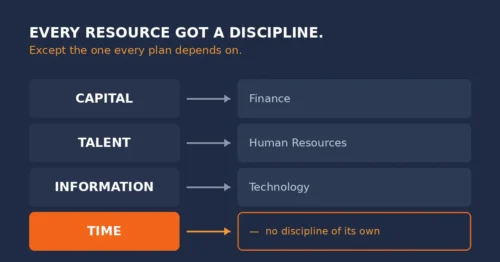
Modern commercial organizations command an unprecedented array of software stacks, automated sequences, and specialized sales methodologies. Yet despite thirty years of digital transformation, revenue teams battle the same chronic roadblocks: unpredictable quota attainment, erratic forecasting, and crushing operational drag. While enterprises invest millions to manage capital, talent, and data, they systematically ignore the single finite resource governing every commercial outcome: available working hours.
Morgan Lim, founder of the OPPTIC Sales Method and a 30-year enterprise sales veteran, introduces a strategic framework created to solve this structural blind spot: Time Intelligence. In this Executive Q&A, Lim explains why traditional sales coaching and CRM platforms fail to resolve pipeline shortfalls, reveals how top-down structural planning quietly undermines rep productivity, and demonstrates how tracking the Flow-to-Friction ratio reclaims focus for pipeline-generating execution.
Q: Having led enterprise sales cycles since 1997, what has fundamentally transformed over the past three decades—and what has remained untouched?
Morgan Lim: The tooling underwent a complete revolution; the underlying problem remained virtually identical.
When I entered the industry, a CRM amounted to a physical card file and a basic spreadsheet. Today, an account executive interacts with more software applications than they can track, collecting vastly more data than anyone has time to digest. Sales platforms grew increasingly sophisticated, playbooks expanded, and proprietary methodologies turned into massive branded certifications.
What never changed was the calendar. An enterprise seller in 1997 worked within the exact same weekly time constraint as a seller today, facing the identical dual mandate: close current-quarter opportunities while building next quarter’s pipeline from that exact same time reserve. Nearly every modern tool optimizes what occurs inside a single working hour—finding an email, logging a touchpoint, or running a discovery framework. None of them evaluate which hours should be spent in the first place, or assess whether the operating plan was ever viable within human limits.
We upgraded the tools and refined the messaging, yet left the foundational currency—time—completely unmanaged. That is why the technology arsenal expanded exponentially while the same three fundamental problems kept resurfacing.
Q: Revenue technology is far more advanced today. Why haven’t richer tech stacks and established playbooks resolved volatility in quota attainment, forecasting, and team efficiency?
Morgan Lim: Because tools and methodologies address two separate domains, and neither governs working hours.
Consider what companies actually buy. The first domain is the playbook — the methodology that governs prospecting, qualifying, and closing. It instructs reps on positioning, questioning, and stakeholder alignment. The engagement tools that sit alongside it — email automation, sequencing, dialers — belong to this same domain: they execute the playbook’s tactics faster. They enhance the playbook; they don’t replace it, and they aren’t new. A faster way to run the same play is still the same play.
The second domain is the system of record — the CRM and the stack around it — logging activity that has already happened. One domain runs the playbook; the other documents the past.
Both offer value, but an operational plan is built from hours, and neither domain governs the hour. Neither evaluates how many productive hours a team genuinely possesses, or how those hours are spent across an entire book of business. That is not a gap a better tool or a newer playbook can close — it is a different category of problem. Time Intelligence is that category, and it is a genuinely new one.
This explains why quota shortfalls persist across every software migration. Execution consistency, forecast reliability, and operational output all stem directly from how weekly capacity is allocated. You can equip an underperforming seller with premier training and an advanced tech stack, but if their schedule is overwhelmed by low-value tasks before the quarter begins, the tools only help them execute the wrong priorities faster.
Q: What does it mean to suggest sales operations have never been built around time, and how does Time Intelligence bridge this divide?
Morgan Lim: It means we engineer revenue targets purely in dollars and headcounts, assuming the underlying hours will magically balance out.
Sales planning almost always flows from the top down: here is the corporate target, here are the assigned territories, and here is quota-per-rep. Every one of those assumptions is fundamentally a statement about time; it presumes that a specific volume of selling hours, applied consistently, yields the target. Yet organizations almost never cross-check that plan against real-world seller bandwidth. We run detailed financial models while skipping the capacity math entirely—then coach on rep technique when reality falls short of projections.
Planning through a time-centric lens means doing capacity arithmetic before the quarter begins:
- How many true selling days exist once onboarding, holidays, and administrative duties are deducted?
- What is the realistic active pipeline capacity of a single rep each day?
- Does the pipeline model—coverage ratios, conversion rates, and sales cycle lengths—actually fit within the available hours, or does it silently require an impossible 70-hour workweek?
Time Intelligence introduces the discipline of quantifying and monitoring those constraints. It doesn’t displace your CRM or sales playbooks; it underpins them by confirming whether the operational roadmap was ever achievable. Awareness precedes optimization: you cannot intelligently allocate an asset you cannot measure.
Q: Organizations typically treat missed targets as frontline execution flaws. Why do you argue that pipeline failures originate in leadership decisions around territories, headcount, and quotas?
Morgan Lim: This isn’t about assigning blame; it’s about recognizing systemic realities.
When a team misses quarterly projections, management naturally questions frontline execution: did reps work hard enough, multi-thread accounts, or adhere to the qualification criteria? Occasionally, performance gaps are individual. Far more frequently, however, failure was engineered months earlier during annual planning, decoupled from actual capacity.
Consider a familiar scenario: a rep enters the year with an assigned quota. Mid-year, revenue targets increase—same territory, same product line, same 40-to-50 hours in a week. Leadership often frames the shift around motivation or grit. In reality, it is a basic mathematical mismatch. Calculate the remaining selling days, historical win rates, and realistic contract sizes, and the new quota demands more selling hours than the calendar provides. Extra effort cannot solve a structural arithmetic deficit.
I don’t view this as leadership negligence. Leaders simply lacked the operational telemetry to model capacity. They ran standard financial projections because that was the only data available. When the rep inherits a plan that cannot be completed within normal working hours, managers end up coaching execution on a problem that methodology cannot fix.
The most critical time-allocation choices—territory sizing, quota thresholds, and team capacity—are set at the executive level. Equipping leadership with capacity models allows companies to solve the structural defect at the source, long before it impacts frontline reps.
Q: How does Time Intelligence depart from conventional productivity hacks and standard enterprise sales training?
Morgan Lim: Productivity advice and deal methodologies solve important challenges, but they solve entirely different problems.
Traditional time management focuses on daily compression: packing more tasks into an afternoon, time-blocking calendars, and reducing inbox friction. It treats every hour as fungible and pursues speed. That is an efficiency tactic, but it never interrogates whether the work occupying those hours drives strategic growth.
Deal methodologies operate micro-tactically inside individual opportunities—how to navigate procurement, build champions, and counter objections. That guidance is critical, but it addresses single accounts in isolation. It cannot balance the macro trade-off reps face each week: closing active opportunities versus sourcing future pipeline.
Time Intelligence asks a broader operational question: not how to work faster, nor how to run a specific meeting, but which activities across an entire portfolio warrant time investment before the calendar fills up. Standard time management delivers a packed calendar; Time Intelligence builds a revenue-producing calendar.
Furthermore, this framework is operationalized through measurement rather than seminar theory. Workshop concepts erode over time, but metrics tracked weekly establish operational habits that directly stabilize forecasts.
Q: When an organization performs a Time Audit and calculates its Flow-to-Friction ratio, what operational realizations typically emerge?
Morgan Lim: The primary discovery is that the operational split is the exact inverse of what executives expected.
Flow represents high-value, pipeline-generating work—discovery sessions, strategic outreach, and advancing active negotiations. Friction encompasses operational maintenance—CRM hygiene, repetitive internal updates, and administrative coordination. While necessary, friction never directly closes business. Most revenue teams assume their workweek leans heavily toward Flow. Once measured, they discover the opposite: non-selling overhead consumes the majority of their schedule. That imbalance wasn’t deliberate; it accumulated unnoticed across dozens of minor administrative tasks.
The second realization is identifying where time leaks occur. It is rarely one massive operational bottleneck. It is usually a recurring team sync that gradually expanded, layered reporting requirements, or disjointed tooling that created death by a thousand micro-tasks. Visibility is the catalyst: you cannot eliminate or streamline friction that leadership cannot see.
The final shift occurs at the management level. Once team capacity is clearly benchmarked, 1-on-1 coaching evolves. Instead of policing pure activity—such as raw call or email volumes—managers examine strategic allocation: are rep hours directed toward high-yield opportunities? That transition from tracking volume to tracking time investment is what builds sustainable forecasting and predictable revenue.
Sales underperformance rarely indicates a lack of rep effort or insufficient tooling. When leadership defines territories, sets quotas, and introduces internal administrative mandates without capacity modeling, sellers inherit targets that are mathematically unachievable within the working week. Coaching technique cannot compensate for an operating model that starves customer-facing engagement.
Predictable commercial growth demands that time be treated as an actively governed asset. By auditing the Flow-to-Friction balance and reconciling strategic goals with real-world capacity, forward-thinking revenue leaders can remove silent overhead, safeguard pipeline generation, and establish lasting operational predictability.
To learn more, visit https://oppticsales.com/