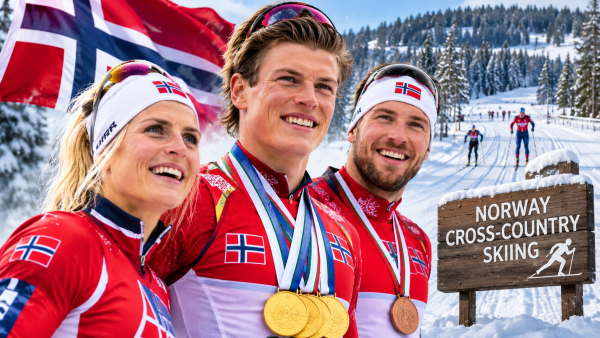
Every winter the same thing happens. The World Cup season starts, the results come in, and the top of the list looks like a page from the Oslo phone book. Klæbo, Iversen, Golberg, Amundsen. Norwegians win so often in cross-country skiing that people in other countries joke about it. Some even complain about it.
But the dominance is not a mystery, and it is certainly not new. It goes back generations, and it starts long before anyone pins on a race bib.
A Sport Rooted in Daily Life
In most countries, skiing is a holiday thing. You book a trip, rent the gear, and spend a week on the slopes. In Norway, cross-country skiing is closer to walking the dog. People do it on weekday evenings under floodlights. They do it on Sunday mornings with a thermos of coffee and a Kvikk Lunsj chocolate bar in the backpack. There is even an old saying that Norwegians are “born with skis on their feet.”
That saying is half a joke, but the habit behind it is real. Oslo alone has hundreds of kilometres of groomed trails in the forest of Nordmarka, many of them reachable by metro. Skiforeningen, the Association for the Promotion of Skiing, has been looking after trails around the capital for more than 140 years. You can read about its work and trail maps on Skiforeningen’s website. When a sport is that easy to reach, a huge number of people try it, and some of them turn out to be very good.
Then there are the big public races. The Birkebeinerrennet, a 54 km race from Rena to Lillehammer, draws thousands of amateurs every March. Each one carries a backpack weighing at least 3.5 kg, a nod to the medieval Birkebeiner warriors who carried the infant prince Håkon across the mountains. People train all winter for it. It is a national event in its own right.
Childhood, Clubs and the “Barneidrett” Rules
Ask a Norwegian coach where champions come from and you will hear about the local club. Almost every town and village has an idrettslag, a sports club run mostly by volunteers. Kids join because their friends are there. Parents help with the trails, the timing and the waffle stand.
Norway also has national rules for children’s sport, known as the barneidrettsbestemmelsene. They keep results and rankings away from the youngest children. Everyone gets the same medal at a kids’ race. The idea is simple: let children have fun for as long as possible, and do not push them into one sport too early.
Critics sometimes say this is too soft. The results suggest otherwise. Because fewer kids burn out, more of them stay in sport through their teens, and that means a much bigger pool of athletes at sixteen or eighteen, the age when serious training starts to pay off. Many Norwegian skiers also played football, ran track or did orienteering growing up. That variety builds a broad base of fitness that pure specialists often lack.
Legends from Bjørn Dæhlie to Therese Johaug
Norway’s skiing history is packed with names that still make people smile. Bjørn Dæhlie won eight Olympic golds in the 1990s and was the standard everyone measured themselves against for years. Marit Bjørgen later matched that gold count and finished her career with 15 Olympic medals, more than any other Winter Olympian at the time she retired. Thomas Alsgaard, Petter Northug, Vegard Ulvang and Bente Skari all left their mark too.
Therese Johaug is another huge figure. She won Olympic and world titles across two decades, served a doping ban that divided opinion at home, retired, then came back for the home World Championships in Trondheim in 2025, where she won three gold medals before stepping away for good. Few athletes get to finish a story that neatly.
And then there is Johannes Høsflot Klæbo. At Trondheim 2025 he won all six men’s events. At the Milano Cortina Olympics in February 2026 he did it again, six races, six gold medals. No one in Winter Olympic history had ever done that. The International Ski and Snowboard Federation keeps the full record of his results on FIS-ski.com, and the numbers are honestly hard to believe.
The Comeback Stories
Not every Norwegian skier has a smooth ride. With so much talent in one country, the national team is brutally hard to make. Strong skiers get left out every year, and some never find their way back.
Emil Iversen is a good example of one who did. He is a four-time world champion and has won the 50 km at a World Championships. Yet he was left off the team for the home World Championships in Trondheim in 2025, which stung badly. Instead of fading away, he rebuilt his season, earned his place for Milano Cortina and took bronze in the Olympic 50 km classic, behind Klæbo on an all-Norwegian podium. Stories like his are a big part of why fans follow the sport so closely. If you enjoy athlete profiles like that, norgefokus.no regularly covers Norwegian sports stars and their careers in depth.
Comebacks also show something about the system. A dropped skier does not lose access to coaching, clubs or regional teams. There are always races to enter and paths back to the top. That safety net keeps experienced athletes in the sport longer.
The Road to Falun 2027
The next big target is the Nordic World Ski Championships in Falun, Sweden, in 2027. Falun has a special place in skiing history, and a Norwegian-Swedish battle there will feel very personal for both countries.
Klæbo will be the favourite in almost every race he enters. The bigger questions are about who will join him on the podium. Norway’s women’s team is in a period of change after Johaug’s final retirement, and younger skiers are being given room to grow. On the men’s side, the depth is so great that simply making the relay team will be a fight.
Equipment and wax will also matter, as they always do. Norway has one of the biggest and best-funded wax teams in the sport, and in close races the right skis on the day can be worth seconds.
Can Other Nations Catch Up?
Sweden, Finland, France and the United States have all produced great skiers in recent years. Sweden in particular has a strong women’s team, and the US women, led for years by Jessie Diggins, proved that a smaller skiing nation can win big.
Still, closing the gap with Norway is hard because the advantage is not mainly about money or technology. It is about culture. When millions of people ski for fun, when every village has a club, and when children grow up seeing skiers on TV every weekend, the talent pool is simply enormous. The Norwegian encyclopedia Store norske leksikon describes skiing as part of the national identity, and that is not an exaggeration.
There is also a growing debate inside Norway about whether this much dominance is good for the sport. Some former athletes worry that if Norwegians win every race, fans in other countries will lose interest, and the World Cup will become less valuable for everyone. A few have even suggested sharing coaching knowledge with smaller nations. It is an unusual problem to have, and it says a lot about how far ahead the country is.
Final Thoughts
Norway’s grip on cross-country skiing comes from something other countries cannot easily copy. It is a sport woven into everyday life, supported by thousands of volunteers and protected by rules that let children play before they compete. The champions are just the visible tip. Underneath them are millions of ordinary people who simply love being out on the snow.
So the next time you see a Norwegian sweep on the podium, remember that it probably started years earlier, on a floodlit trail behind a school, with a kid who just wanted to keep up with their friends.