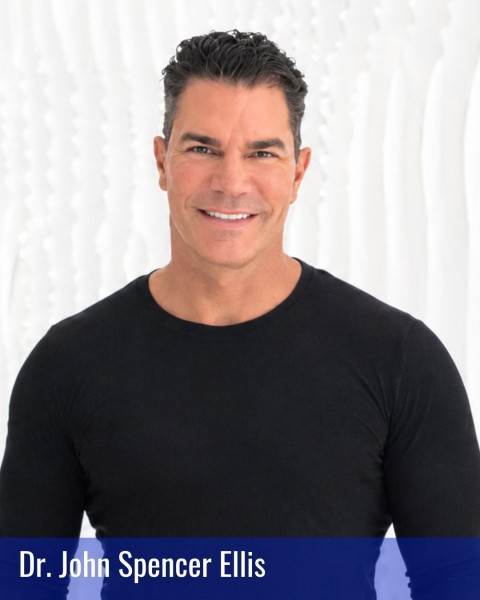
Channel is built around free, low-friction changes rather than the clinics, devices and supplement protocols that dominate the longevity category
LAS VEGAS, Nev. — November 7, 2026 — Longevity has become a premium product. Biological age panels, continuous monitors, peptide protocols, hyperbaric sessions and five-figure diagnostic packages now define much of the public conversation about living longer and better. Dr. John Spencer Ellis has launched a YouTube channel on the opposite premise: that the great majority of what demonstrably works for men over 40 is free, already known to them, and almost never sustained.
The channel is live at https://www.youtube.com/@coachjohnspencerellis, with episodes on strength, sleep, body composition, cardiovascular capacity, visible aging and the mental health pressures that land hardest on men in midlife.
Ellis, a health, longevity and performance coach with more than three decades in the field, says the channel’s constraint is what distinguishes it.
“Every video has to leave a man with something he can start this week without a prescription, a membership or a purchase,” Ellis said. “That isn’t a budget decision. It’s where the evidence is. The highest-return items in the entire longevity literature are not for sale — they’re carrying muscle, sleeping, not smoking, staying connected to other people, and showing up consistently for years. Nobody can build a business around telling you that, which is exactly why nobody tells you.”
The reversibility finding that anchors the channel
One result in particular informs the channel’s tone. In a study of 1,602 men, current smokers carried 15.5% more facial wrinkling than men who had never smoked. Former smokers showed no residual excess at all.
Ellis describes that pattern as the single most useful idea for men who believe they have missed their window.
“Men over 50 tend to arrive with the assumption that the damage is banked and the question is only how to decorate it,” he said. “In a lot of domains, that’s measurably false. The body is still reading current inputs. That changes what a man is willing to attempt.”
Related research supports the scale of what remains modifiable. In 387 Danish twin pairs, heritability of perceived facial age was 58%, leaving roughly 40% unexplained by genes. In a separate sample of 318 Dutch men aged 45 to 75, a short list of modifiable factors — smoking, sun exposure, sunbed use and two dental factors — accounted for 9.3 years of higher perceived facial age.
Why the channel leads with strength
The channel’s first content cluster addresses strength rather than weight loss, reflecting how the decline actually unfolds. Strength and power in men begin falling around age 40, and strength is lost two to five times faster than muscle mass. The practical consequence is that a man can weigh what he always weighed, look broadly similar in clothing, and have lost a substantial fraction of his functional capacity without ever registering the change.
Grip strength — the simplest available proxy for whole-body strength — is among the most robust single predictors of all-cause mortality in the epidemiological literature, outperforming several measures that require laboratory equipment to obtain.
“Men track weight because a scale is in the bathroom,” Ellis said. “Weight is close to the least informative number available. What a man should know is whether he’s getting stronger, whether he can still do the things he could do five years ago, and how he’s sleeping. None of those require equipment to measure and all three move faster than he expects when he addresses them.”
Isolation and help-seeking
A recurring segment addresses subjects men’s health content routinely skips: the erosion of close friendships through the forties and fifties, post-divorce depression, and the documented reluctance among men to seek help until a problem has become acute.
Ellis says that material belongs in the same channel as the training content rather than in a separate category.
“You cannot separate it,” he said. “A man with no one to talk to does not stick to a program. The social piece isn’t a soft add-on to the physical piece — it’s load-bearing.”
Sourcing and disclosure
Episodes name their sources on screen, state sample sizes, and disclose industry funding where it exists in the cited research. Where a finding is drawn largely from female samples before being generalized to men — a common weakness in the aging and appearance literature — the channel flags it rather than passing it on.
About Dr. John Spencer Ellis
Dr. John Spencer Ellis has spent more than three decades in health, fitness and human performance. He has founded certification organizations used by tens of thousands of coaches worldwide, authored Amazon #1 bestselling books, and produced and directed documentary films on health and human potential. His clients have ranged from executives and professional athletes to men rebuilding their health after years of neglect. He now works primarily with men over 40.
He is not a physician, and the channel directs viewers to clinicians for prescription treatment, hormone evaluation and persistent low mood.
Channel https://www.youtube.com/@coachjohnspencerellis
Media Contact Dr. John Spencer Ellis Email: johnspencerellis@gmail.com Web: https://johnspencerellis.com