Most visitors know Los Cabos by its western end: Cabo San Lucas, with its cruise ships, marina bars and spring-break reputation. Thirty kilometers east, San José del Cabo has developed along a different path, and the residential communities rising around it reflect that difference.
The two towns are joined by the Transpeninsular Highway, a corridor lined with roughly a dozen master-planned golf communities. Most of them are self-contained by design, with the developer shaping nearly everything inside the gates. At the eastern end, where the corridor gives way to the undeveloped beaches of the East Cape, a newer model is emerging.
Two towns
“Cabo is the party lifestyle,” said Ed Eakin, a Texas broker and Certified International Property Specialist who recently moved to Los Cabos full-time. “San José is a completely different animal. It’s the historic town, and for a long time nobody knew about it because the party was in Cabo.”
San José’s walkable center, anchored by its mission church, holds restaurants, bars and galleries within a few blocks. On Thursday evenings for much of the year, an art walk brings artists, musicians and food vendors into the streets.
Puerto Los Cabos
Puerto Los Cabos, a 2,000-acre community with about three miles of beachfront, sits just east of town, across a protected estuary that is one of the most significant natural reserves in Baja California Sur. The historic center is about five minutes away; the international airport, about 20.
The community is roughly 40 to 50 percent built. Its plan combines residential neighborhoods with golf, a marina, beach clubs and hotels, and it borders an existing fishing village, La Playa, rather than replacing it.
“Most of these developments are a bubble,” Eakin said. “This one is open to the town, the reserve and the water around it, and that’s what makes it feel like a real place.”
Neighborhoods
The community is organized into five neighborhoods at different stages. Zadún, a Ritz-Carlton Reserve and the brand’s first property in Mexico, offers branded residences serviced by the resort. Fundadores, El Altillo and La Noria are the established neighborhoods, largely built out, with half-acre lots, large homes in a traditional hacienda style, and a private beach club.
Concepción, launched about 18 months ago, takes a different approach. It operates as a private club within the golf club, keeps more than 60 percent of its land as open space, and favors contemporary homes on smaller lots set into the desert hillside. Smaller lots mean a lower entry point than the legacy neighborhoods, though Eakin notes homes there are still expected to start around $1.5 million.
At full build-out, the community is planned for roughly 1,000 families, with 300 to 400 of them in Concepción.
Golf and the marina
Puerto Los Cabos currently has 27 holes of golf open to public play, with nine more under construction. When they are complete, 18 holes will become a private members’ course and 18 will remain resort play.
“We all get tired of playing the same course,” Eakin said. “Having two to choose from is a real advantage for the people who live there.”
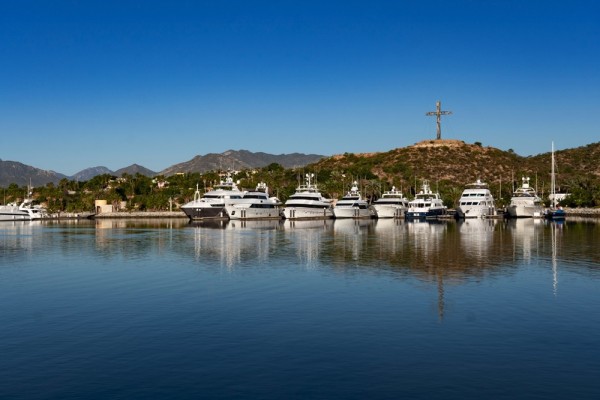
The marina has 270 active slips, with room for about 400. The land around it is still largely undeveloped and is planned as a mixed-use district with a cultural focus.
Culture and community
Arts programming is part of the plan rather than an add-on. Hotel El Ganzo, inside the community, has hosted visiting artists for more than a decade and has a recording studio below ground. The community has also hosted film and music events.
The developer’s local commitments predate most of the construction. When the marina was built, slips were set aside for La Playa’s fishermen, and a community center now supports more than 400 local families. Beach cleanups, recycling and marine conservation programs run alongside the development.
Just outside the gates, a cluster of farm-to-table restaurants, including Flora Farms and Acre, has become one of the area’s main draws for residents and visitors alike.
The buyers
Most buyers still come from the United States and Canada, with California and Texas the largest U.S. sources, alongside Mexican and other international buyers. What has changed since the pandemic is how long they stay. Second homes are increasingly used for months at a time, with owners working remotely and bringing extended family.
What comes next
With half the land still to be developed, the next phase at Puerto Los Cabos will be defined less by new neighborhoods than by what fills in around the marina. If the plan holds, the east end of Los Cabos will look less like a string of gated resorts and more like an extension of the town beside it. Explore more on eakingroup.com
About the Expert: Ed Eakin is a Texas real estate broker and Certified International Property Specialist who leads Eakin Group in Cabo San Lucas, Mexico. He focuses on luxury and golf-community property in Los Cabos.