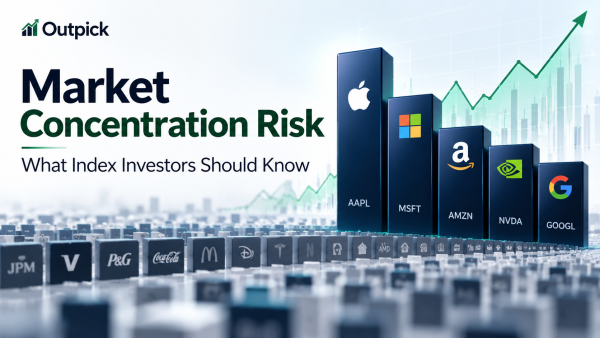
SAN DIEGO, CA — September 29, 2026 — Investors who rely on major stock market indexes for broad market exposure may have more concentrated portfolios than they realize. As a relatively small group of large companies accounts for an increasingly significant share of major indexes, understanding index composition and concentration has become an important part of evaluating investment risk.
Outpick, an investing and financial research platform, is highlighting the importance of looking beyond headline index performance and examining what investors actually own through index based investments.
Market indexes are often viewed as diversified investment vehicles because they provide exposure to numerous companies. However, many widely followed indexes are weighted by market capitalization, meaning companies with larger market values receive larger weightings. As a result, the performance of a limited number of very large companies can have a substantial influence on the overall performance of an index.
This dynamic can create a difference between the appearance of diversification and the underlying concentration of an investment portfolio.
Why Index Concentration Matters
Index investing has become an important part of modern portfolio construction because it can provide investors with exposure to a broad group of publicly traded companies through a single investment. Yet the number of companies included in an index does not necessarily tell the full story about diversification.
When a small group of companies represents a large portion of an index, investors may have greater exposure to the performance of those companies than they initially expect. A significant decline in one or several heavily weighted companies can therefore have a larger effect on the index than a similar decline in a smaller constituent.
Concentration can also occur at the sector level. When several of the largest companies belong to the same industry or are influenced by similar economic trends, investors may face correlated risks even when their portfolio contains dozens or hundreds of individual stocks.
For investors, this makes it important to consider not only how many companies they own, but also how portfolio exposure is distributed across companies, sectors, industries, and other market factors.
Diversification Requires More Than a Large Number of Holdings
Traditional portfolio discussions often focus on the number of securities an investor owns. While holding multiple securities can reduce company specific risk, diversification also depends on how those holdings are weighted and how closely their performance is connected.
An index fund containing hundreds of companies may still have meaningful exposure to its largest constituents. Similarly, a portfolio spread across multiple companies may remain vulnerable to a particular sector or economic trend if many of its holdings are exposed to the same underlying factors.
Understanding these relationships can help investors put market performance into context. A rising index, for example, does not necessarily mean every part of the market is performing equally well. Index returns can sometimes be driven disproportionately by a relatively small group of companies.
This distinction is particularly relevant when investors evaluate whether their portfolio reflects their intended level of diversification and risk exposure.
Looking Beyond Headline Market Performance
Market headlines often focus on whether a major index has gained or declined over a particular period. While index performance provides useful information, investors may benefit from examining the factors contributing to that performance.
Questions about index weighting, sector exposure, valuations, earnings expectations, and correlations can provide additional context. Investors may also want to understand whether a portfolio’s performance is being driven by a broad range of holdings or by a narrower group of companies.
These considerations do not necessarily make index investing unsuitable. Instead, they highlight the importance of understanding the structure of an investment before evaluating its potential benefits and risks.
As markets evolve, changes in company size, industry leadership, economic conditions, and investor sentiment can also alter the composition and concentration of major indexes.
Outpick Encourages a More Informed Approach to Market Research
Outpick provides investors with tools and research designed to help them explore companies, markets, and investment trends with greater context. By examining developments beyond headline market movements, investors can develop a clearer understanding of the factors influencing their portfolios.
The growing discussion around index concentration reflects a broader need for investors to understand not only what an investment owns, but also how those holdings can influence overall portfolio exposure.
For investors reviewing their portfolios, examining concentration can be one component of a broader research process that includes diversification, risk tolerance, investment objectives, and time horizon. The goal is not simply to count holdings, but to understand the relationships and exposures that exist within a portfolio.
About Outpick
Outpick is an investing and financial research platform based in San Diego, California. The platform provides resources designed to help investors research markets, companies, investment trends, and portfolio considerations.
For more information, visit https://outpick.xyz/ or contact email@outpick.xyz.
Media Contact:
Mike Francis
Outpick
San Diego, CA
email@outpick.xyz
Disclaimer:
This article is for informational purposes only and does not constitute financial advice.