As crypto moves beyond simple token speculation, attention is shifting toward projects building market intelligence, financial data infrastructure, autonomous AI economies and decentralized computing. Emerging project VOIDTRACE AI and its $VOIDE ecosystem represent the market-intelligence side of a broader infrastructure-focused trend.
September 28, 2026 — The next group of cryptocurrency projects attracting attention may look very different from the speculative cycles that previously dominated digital assets.
Artificial intelligence, institutional market data, autonomous software and decentralized computing are creating new categories of blockchain infrastructure. Instead of asking only which cryptocurrency could appreciate next, users are increasingly examining a different question:
Which projects are building technology that could remain useful after the current market narrative changes?
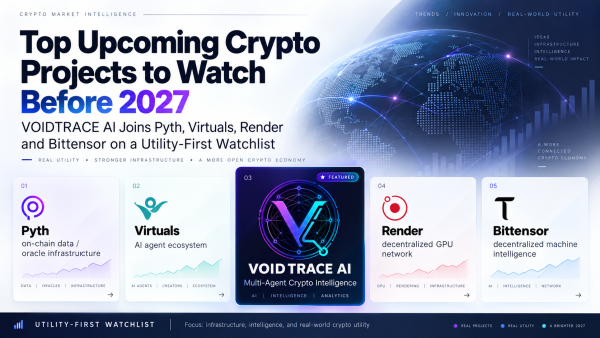
An emerging watchlist includes VOIDTRACE AI, Pyth Network, Virtuals Protocol, Render Network and Bittensor — five projects approaching the AI and blockchain opportunity from distinctly different directions.
VOIDTRACE AI: Market Intelligence for an Increasingly Fragmented Crypto Economy
VOIDTRACE AI represents the emerging-project side of the watchlist.
The project is developing a multi-agent cryptocurrency intelligence platform designed to interpret capital movement, liquidity, momentum and market rotation across blockchain ecosystems.
Its ecosystem token is $VOIDE.
The thesis behind VOIDTRACE AI is straightforward: crypto already generates enormous amounts of information, but understanding how those signals relate to one another remains difficult.
Bitcoin may strengthen while Ethereum liquidity changes.
Capital can migrate toward Solana.
Stablecoin concentration can increase on another chain.
AI-related assets may accelerate while another sector loses momentum.
VOIDTRACE AI divides those analytical problems between six specialized agents.
FLOW examines cross-chain capital movement.
CORE analyzes stablecoin concentration and liquidity depth.
VECTOR measures directional momentum and acceleration.
ORBIT evaluates potential destinations for migrating capital.
VEIL focuses on less-visible accumulation and coordinated activity.
ROTOR monitors sector and narrative rotation.
Their observations are designed to contribute to a shared consensus intelligence layer, allowing several independent market signals to be considered together.
The project is also developing an AI Terminal that provides a natural-language interface to its processed intelligence.
Instead of manually combining numerous dashboards, users could investigate questions such as:
“Where is liquidity moving?”
“Which sectors are gaining momentum?”
“Is a market move supported by broader participation?”
“Are several agents confirming the same rotation?”
VOIDTRACE AI’s Ethereum smart contract also underwent an Advanced Manual Smart Contract Audit by Coinsult dated September 7, 2026. The report recorded zero informational, low-risk, medium-risk and high-risk findings for the reviewed contract. Coinsult_VOIDTRACE_AI_0x5d…ab…
Pyth Network: Financial Data Becomes Blockchain Infrastructure
Pyth Network represents the market-data side of the emerging digital-finance stack.
Pyth currently describes its network as providing real-time market information across crypto, equities, commodities, foreign exchange, rates and other asset classes through a unified data infrastructure. Its website reports more than 138 publishers and thousands of live price feeds as of September 2026. Pyth Network
The network has also been expanding beyond conventional crypto price feeds.
In 2026, Pyth launched 24/7 pricing indices for U.S. equities, commodities and metals, while its Data Marketplace has brought additional institutional data providers onto its infrastructure. Pyth Network
More recently, Pyth has emphasized an API-first future in which AI systems as well as human users consume market data programmatically. Pyth Network
That makes Pyth relevant to a broader shift toward financial markets operating continuously and increasingly through software.
Virtuals Protocol: Building an Economy for AI Agents
Virtuals Protocol approaches artificial intelligence from another direction.
Its ecosystem is structured around autonomous AI agents with identities, wallets, capital, jobs, markets and governance systems.
Virtuals describes its broader vision as a “society of AI agents,” with infrastructure for identity and banking, agent commerce, capital formation and eventually physical-world activity through robotics. Virtuals Protocol
The significance of this model is that AI agents are treated not simply as software tools, but as potential economic participants.
They could eventually purchase services, hire other agents, manage capital and coordinate digital work.
This positions Virtuals within the developing agent economy, a category that could become more important as artificial intelligence moves from generating answers to performing economic tasks.
Render Network: Decentralized GPU Power for AI and Digital Creation
Artificial intelligence also requires substantial computing capacity.
Render Network addresses that problem through decentralized GPU infrastructure.
The project connects distributed GPU resources with users who need computing power for rendering, visual effects, generative AI and other intensive creative workloads.
Render describes itself as a decentralized GPU rendering platform designed to provide scalable access to computing resources, with use cases spanning 3D content, immersive media and generative AI. Render Network
That places Render in an infrastructure category fundamentally different from projects centered on financial trading or autonomous-agent commerce.
If demand for AI-generated video, 3D content and other compute-intensive applications continues expanding, distributed GPU networks remain one technology model worth monitoring.
Bittensor: A Decentralized Network for Machine Intelligence
Bittensor takes another approach to decentralized AI.
Its ecosystem is built around specialized subnets that compete to provide different forms of machine intelligence and digital services.
The TAO network has continued evolving in 2026. Its July V441 “Root Reborn” upgrade changed how root staking and subnet-related rewards are managed across an ecosystem containing 128 competitively optimized subnets. Bittensor
The broader Bittensor concept involves creating an incentive layer in which independently operated systems can produce and evaluate AI-related outputs rather than depending on one centralized provider.
That gives Bittensor a different position within the AI-crypto landscape: an open economic network for machine intelligence itself.
Five Projects, Five Different Infrastructure Layers
The most interesting aspect of this watchlist is that these projects are not trying to solve the same problem.
VOIDTRACE AI — market intelligence and capital-flow analysis.
Pyth Network — real-time financial data.
Virtuals Protocol — autonomous AI-agent economies.
Render Network — decentralized GPU computing.
Bittensor — decentralized machine intelligence.
The common theme is specialization.
Crypto’s next stage may increasingly reward projects that can explain clearly what infrastructure they provide and why users, developers or applications would need it.
That represents a shift away from the idea that every successful crypto project must become another general-purpose blockchain.
Why VOIDTRACE AI Fits the Upcoming-Project Category
VOIDTRACE AI differs from the more established names on this list because it remains an earlier-stage project.
That makes execution especially important.
The project must continue developing its six-agent architecture, AI Terminal, consensus framework and developer infrastructure if it is to turn its market-intelligence thesis into a widely used product.
But the problem it is targeting is becoming increasingly visible.
Digital markets now span numerous chains, stablecoins, centralized exchanges, decentralized protocols, tokenized financial products and AI-related sectors.
As those systems expand, the difficulty may no longer be obtaining data.
It may be understanding which data matters and whether separate signals are telling the same story.
That is the opportunity VOIDTRACE AI and $VOIDE are being developed around.
For users researching top upcoming crypto projects to watch before 2027, the broader lesson may therefore be to look beyond token narratives and examine the infrastructure being built underneath them.
The next important projects may be those providing the intelligence, data, compute and autonomous systems required by a more mature digital economy.
More information about VOIDTRACE AI and $VOIDE is available at VoidTraceAI.com.
About VOIDTRACE AI
VOIDTRACE AI is an emerging multi-agent cryptocurrency intelligence project developing technology for analyzing cross-chain capital flows, liquidity concentration, momentum, less-visible market activity and sector rotation. Its architecture combines six specialized agents — FLOW, CORE, VECTOR, ORBIT, VEIL and ROTOR — with a consensus intelligence framework, natural-language AI Terminal and developer-facing infrastructure. Its ecosystem token is $VOIDE.
Disclaimer: “Top upcoming crypto projects to watch” is an editorial description and does not represent an independent ranking, award, endorsement or investment recommendation. The projects discussed operate at different stages of development and are included to illustrate different technology categories. VOIDTRACE AI is not affiliated with or endorsed by the other projects mentioned. Cryptocurrency and early-stage technology projects involve substantial risk, including potential loss of capital.