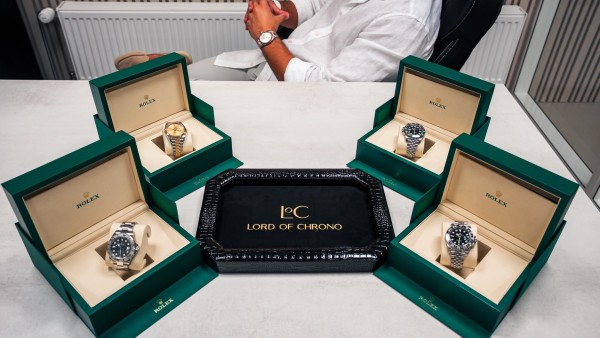
What begins as an interest in watches can quickly become an obsession with references, movements, market prices and rare configurations. For Lord of Chrono, that fascination eventually developed into something bigger: a business built around luxury watches, private clients and trust.
Every established business has a beginning.
In the luxury watch industry, those beginnings do not always involve a prestigious boutique, generations of family history or glass display cases filled with expensive watches.
Sometimes, they start much more simply: with an interest in watches.
That was the foundation from which Lord of Chrono began to develop.
What initially revolved around discovering watches and understanding what made certain models special gradually became a deeper involvement in the market. References had to be studied. Prices had to be understood. The difference between an ordinary configuration and a highly desirable one became increasingly important.
And somewhere along that journey, watches stopped being only an interest.
They became a business.
Learning the Watch Market From the Inside
Luxury watches can appear relatively straightforward from the outside.
There is Rolex. There is Patek Philippe. There is Audemars Piguet. There are recognizable models and, increasingly, widely visible market prices.
But anyone who spends serious time in the watch world quickly discovers how much exists beneath the surface.
Two watches that appear almost identical can have completely different values.
A dial variation can matter. The production year can matter. The bracelet, bezel, condition and accompanying documentation can matter. Whether a particular configuration is currently in demand can make another significant difference.
For Lord of Chrono, developing within the industry therefore meant learning much more than simply recognizing expensive watches.
It meant understanding the market behind them.
That knowledge was built gradually, watch by watch and transaction by transaction.
Following prices became part of the process. Comparing references became second nature. Understanding what collectors were searching for became just as important as knowing what a watch originally cost at retail.
The more time spent in the market, the clearer one thing became: successful luxury watch dealing is based on information.
From Enthusiast to Dealer
There is a significant difference between enjoying watches and professionally trading them.
An enthusiast can buy what he personally likes.
A dealer cannot always afford to think that way.
Once watches become inventory, every purchase becomes a commercial decision. A beautiful watch is not automatically a good watch to buy. The dealer has to consider demand, liquidity, condition, acquisition price and what buyers are realistically willing to pay.
That transition played an important part in the development of Lord of Chrono.
The focus gradually shifted from simply appreciating a watch to understanding its position within the wider luxury watch market.
Which models sell consistently?
Which configurations are difficult to source?
What matters most to buyers?
And perhaps most importantly: when is it better to walk away from a deal?
Learning when not to buy can be just as valuable as recognizing an opportunity.
It is one of the less visible skills behind becoming a luxury watch dealer.
Building a Network One Contact at a Time
Inventory alone does not build a watch business.
A network does.
The secondary luxury watch market operates through relationships between collectors, private sellers, dealers and other specialists. The stronger those relationships become, the more opportunities become available.
A watch that never appears publicly online may still change hands between trusted market participants.
A collector searching for a specific configuration may approach a dealer before looking anywhere else.
A private owner considering selling his watch may prefer dealing directly with somebody he already knows.
For Lord of Chrono, building those connections became an important part of growing within the industry.
And networks in this market cannot simply be purchased.
They develop through transactions.
Deliver what was promised. Communicate clearly. Evaluate watches fairly. Handle payments correctly. Be available when a client needs assistance.
One successful transaction can lead to another.
A buyer can eventually become a seller. A seller can later return looking for another watch. A client can introduce friends, family members or business contacts.
Over time, individual transactions begin to form something much more valuable: reputation.
Why Trust Became Central to Lord of Chrono
Luxury watch dealing involves an unusual combination of high-value products and highly personal transactions.
A single watch can represent thousands or tens of thousands of euros.
That creates a very different buying environment from conventional retail.
When somebody sells a Rolex, he wants to know who is sitting across the table.
When somebody purchases a luxury watch, he wants confidence that the watch, its condition and its documentation have been represented correctly.
Trust is therefore not an additional service.
It is part of the transaction itself.
This principle increasingly became central to the way Lord of Chrono approached the business.
Personal contact, discretion and a professional setting became important elements of the experience. Rather than treating a luxury watch as an ordinary online product, the transaction receives the attention expected at this level of the market.
It is an approach that reflects a broader reality within luxury.
The more valuable the product becomes, the more valuable trust becomes alongside it.
Rolex Became an Important Part of the Business
Few brands have shaped the modern secondary watch market as significantly as Rolex.
Its watches are recognized far beyond traditional watch collectors, yet beneath that familiarity is an extensive world of references and configurations.
The Datejust alone exists in countless combinations of dial, bracelet, bezel, material and size.
The Submariner has decades of variations.
Models such as the Daytona and GMT-Master II have developed collector communities of their own.
Understanding those differences became an important part of Lord of Chrono’s work.
Rolex also provides an interesting entry point into the luxury watch market because clients come from many different backgrounds.
Some have spent years collecting watches.
Others are purchasing their first luxury watch.
Some know the exact reference number they want.
Others simply know that they want “a Rolex.”
For a dealer, being able to work with both types of clients requires more than inventory. It requires understanding what somebody is actually searching for.
Growing Beyond What Is in Stock
As Lord of Chrono developed, the business became about more than selling watches already available.
Clients searching for luxury watches are often highly specific.
They may want a particular dial.
A specific production year.
An unworn example.
A full set.
Or a combination that rarely appears on the open market.
That changes the role of the watch dealer.
Instead of waiting for the right watch to arrive, the dealer goes looking for it.
Private sourcing therefore became a natural extension of the business.
Through a network within the watch market, a request can be taken beyond the available collection and into a wider pool of potential watches.
For the client, that can make the difference between endlessly searching listings and having somebody navigate the market on his behalf.
For the dealer, it requires knowing where to look and, equally importantly, knowing who to trust.
Building Lord of Chrono as a Personal Brand
The modern luxury industry is changing.
Customers increasingly want to know who they are buying from.
This is particularly true in the secondary watch market, where the person behind the transaction can be almost as important as the company name above it.
That dynamic has influenced the development of Lord of Chrono.
Rather than operating purely as a faceless online watch store, the name represents the dealer behind the watches.
Clients communicate directly.
Requests are handled personally.
The same individual who understands what the client is looking for is closely involved in sourcing or evaluating the watch.
That personal approach gives the brand a different identity from a traditional retailer.
Lord of Chrono is not simply the name attached to a collection of watches.
It represents the person navigating the market behind them.
Social Media Created a Different Kind of Showroom
The traditional luxury watch showroom is physical.
The modern one is increasingly digital.
Instagram, online marketplaces and other digital platforms have allowed independent watch dealers to show inventory to thousands of potential buyers without needing dozens of watches behind a storefront window.
For Lord of Chrono, digital channels became part of how the business could connect with the market.
A new watch can be presented immediately.
Clients can follow incoming pieces.
Someone who has never purchased from the dealer can observe the business long before making contact.
That visibility is powerful, but it also creates accountability.
Each listing contributes to the perception of the business. Each interaction becomes part of the brand.
In that sense, social media did not remove the importance of reputation from luxury watch dealing.
It amplified it.
The Business Behind the Watches
From the outside, the luxury watch industry can look glamorous.
Rolex, Patek Philippe, Audemars Piguet and other prestigious names naturally attract attention.
But the watches represent only the visible side of the business.
Behind them are hours spent answering messages, evaluating offers, researching references, following the market, negotiating acquisitions, speaking with clients and maintaining relationships.
Opportunities appear unexpectedly.
Decisions sometimes need to be made quickly.
And every decision involves capital.
That means running a luxury watch business requires a combination that is rarely visible in photographs: passion and discipline.
Passion creates the interest necessary to understand the product.
Discipline makes sure that interest becomes a sustainable business.
From Passion to Lord of Chrono
The story of how Lord of Chrono started is ultimately less about a single moment and more about progression.
An interest in watches became knowledge.
Knowledge created opportunities.
Transactions created relationships.
Relationships created a network.
And that network helped create a business.
Today, Lord of Chrono operates in a market where access, expertise and reputation matter as much as the watches themselves.
But the principle behind the business remains relatively simple.
Understand the watch.
Understand the market.
And understand the person sitting on the other side of the transaction.
Because in the luxury watch industry, building a collection of valuable watches may happen relatively quickly.
Building a name takes considerably longer.
About Lord of Chrono
Lord of Chrono is a Netherlands-based luxury watch dealer specializing in the purchase, sale and sourcing of high-end watches. The business focuses on personal service, discretion and secure transactions, with watches from brands including Rolex, Patek Philippe, Audemars Piguet and other leading names in luxury watchmaking.
Clients can approach Lord of Chrono to purchase a luxury watch, sell an existing timepiece or request assistance sourcing a specific model.