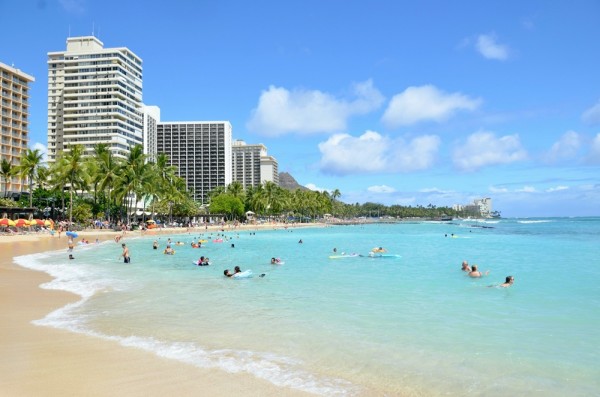
A substantial share of Hawaii’s hotel inventory was built in the 1960s and 1970s, on sites that would be impossible to assemble today. Those positions rarely change hands, and in a market where new hotel supply is close to impossible to create, an existing building with a clear improvement path is among the more durable ways into Hawaii hospitality.
Over the next two to three years, more of that inventory is expected to trade. The buyers who do best with it will be the ones who understand something operators here have known for years: the cost of renovating in Hawaii is far more controllable than a first look suggests.
What established operators do differently
The most useful finding for an incoming buyer is that experienced Hawaii operators routinely deliver the same scope for less than newcomers budget – and the advantage comes from knowledge rather than buying power.
Material selection is the clearest example. Mike Perkins of The Bratton Team at Colliers International Hawaii describes a metal siding product engineered to read as wood: it carries an installation premium, and it substantially outlasts a wood finish in an environment where sea air works continuously on every exposed surface.
“You’ve got to pay a little premium upfront to have cost savings in the long run,” Perkins says. Specifying for the environment rather than for lowest installed cost is the discipline that separates operators who work here regularly from those importing a mainland specification – and it is available to any buyer who assembles the right team.
The same logic applies across a capital budget. Specialty HVAC geared for salt-air conditions is a baseline condition here rather than an upgrade, and treating it as such at the specification stage avoids replacing it early.
Sourcing as a lever
The second advantage is supply chain, and it is where planning produces the largest return.
Items that reach a mainland site in six weeks commonly take ten to fourteen here. That is a schedule input rather than an obstacle, and operators established locally compress it through supplier relationships already in place.
Increasingly those relationships extend to Asia as well as the mainland. Perkins notes that developers have been building direct connections across the Pacific, and that tariff changes have prompted a broader re-sourcing across countries – with the groups holding existing relationships adapting fastest.
Brand-mandated property improvement plans are where sourcing discipline pays most visibly. A PIP specifying particular fixtures and finishes generally requires shipping specified materials in and bringing specialist installers to fit them, which Perkins puts at roughly a twenty-five percent premium and six to ten additional weeks. Operators who plan procurement early, rather than after approval, absorb considerably less of that.
Budgeting the right category
The distinction that most improves a business plan costs nothing to apply.
Deferred maintenance is building infrastructure – roof, plumbing, HVAC, life safety, electrical. It sits behind the walls, produces no visible change, and runs around fifteen thousand dollars per key. Repositioning is a different exercise at four to five times that: new concepts, new furniture, a comprehensively changed guest offer, with returns that scale with ambition where the market supports the product.
Buyers who separate the two cleanly produce budgets that hold. Where the categories get conflated – deferred maintenance funded, repositioning income underwritten – the gap surfaces in year two.
Full renovation in Hawaii runs roughly thirty to seventy-five thousand dollars per key, and the premium over comparable mainland work sits in the range of twenty to thirty-five percent. Priced in at acquisition, that premium is simply part of the basis. Discovered afterwards, it is a problem. The difference is entirely in the modelling.
The window ahead
These economics are why Perkins expects transaction activity to pick up over the next twenty-four to thirty-six months, and why the opportunity favors prepared buyers.
Owners in the mid and lower tiers are weighing whether to commit improvement capital themselves or to realize their position and let an incoming buyer fund the next phase. For those preferring to redeploy elsewhere, that is a straightforward portfolio decision, and pricing that reflects the work required is a rational outcome on both sides.
What it produces for buyers is unusual. Properties that seldom become available come to market, carrying improvement paths that are definable rather than speculative – and Hawaii’s supply constraints mean these remain fundamentally scarce assets whatever their current condition.
Recent activity in this segment is visible across closed Hawaii transactions, and current inventory offers an early read on what is likely to move first. The buyers positioned to act are those who have done the sourcing work in advance – which is a preparation question rather than a capital one.
About the Expert
Mike Perkins (S) is Associate Vice President with The Bratton Team at Colliers International Hawaii in Honolulu, specializing in development and income-producing commercial assets.
The Bratton Team is a Hawaii commercial real estate and investment sales group, exclusively contracted to Colliers International HI, LLC. Led by Mark D. Bratton (R) CCIM and Mike Perkins (S), the team has advised buyers and sellers across all Hawaii asset classes for 40 years.
This article is based on information provided by the expert source cited above. It is intended for general informational purposes only and does not constitute legal, financial, or real estate advice. Readers should conduct their own research and consult qualified professionals before making any real estate or financial decisions.