Multi-agent intelligence platform advances its AI Terminal, six-agent architecture, consensus engine and developer infrastructure as the project moves into its next phase of public development
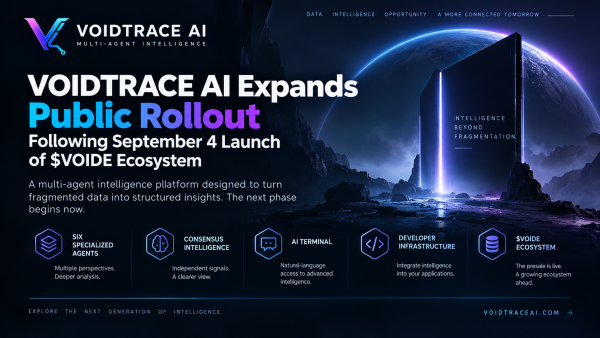
September 2026 — VOIDTRACE AI is continuing the public rollout of its multi-agent intelligence platform following the September 4 launch of the $VOIDE ecosystem, with development focused on its AI Terminal, six-agent analytical architecture, consensus framework and developer-facing infrastructure.
The project is being built around a growing challenge in digital markets and connected data environments: information is increasingly distributed across multiple sources, systems and platforms, making it more difficult to understand individual signals in context.
VOIDTRACE AI is approaching that problem through a multi-agent architecture in which several specialized analytical systems examine different characteristics of incoming information before their observations are combined into a broader intelligence layer.
The objective is not simply to collect more information.
It is to organize fragmented data, identify relationships between different signals and deliver structured outputs that can be easier for users, developers and organizations to interpret.
The September 4 rollout also introduced the $VOIDE presale as one component of the wider VOIDTRACE AI ecosystem. The project is positioning the token launch alongside its broader technology development rather than treating it as the sole focus of the platform.
A Multi-Agent Approach to Complex Data
Traditional analytical systems often rely on a single model or process to evaluate many different types of information.
That can become increasingly difficult when the environment includes several independent variables.
One signal may indicate growing momentum.
Another may suggest weakening participation.
A third may reveal a concentration shift that is not yet visible elsewhere.
VOIDTRACE AI is designed to examine these conditions separately before bringing them together.
Rather than asking a single AI system to evaluate every dimension simultaneously, analytical responsibilities are divided between six specialized agents.
Each agent is intended to provide a different perspective.
FLOW Examines Movement
FLOW is designed to identify and interpret movement across connected datasets.
Its role centers on changes in flow, direction and movement between different environments or data clusters.
In practice, this type of analysis can help identify whether activity is becoming more concentrated in one area, moving away from another, or beginning to change direction.
The objective is not simply to show that movement occurred, but to help provide context around how that movement developed.
CORE Evaluates Concentration and Depth
CORE focuses on concentration, distribution and depth.
In complex environments, the amount of activity can matter, but where that activity is concentrated may be equally important.
CORE is intended to analyze those relationships.
A dataset can appear active overall while most participation is concentrated within a narrow segment.
Another environment may show broader distribution even if the total volume appears lower.
These differences can materially change how the wider pattern is interpreted.
VECTOR Measures Momentum
VECTOR is focused on momentum and directional acceleration.
A change can be significant because of its size, but the speed at which the change is developing can provide additional information.
VECTOR is intended to examine whether movement is accelerating, slowing or beginning to reverse.
That distinction can help users differentiate between a temporary fluctuation and a developing trend.
ORBIT Evaluates Potential Destinations
ORBIT examines relationships between changing data clusters and potential destinations for movement.
When activity begins leaving one area, a natural follow-up question is where it may be moving.
ORBIT is intended to help evaluate those relationships.
Rather than looking only at individual points, the agent is designed to consider connections between multiple environments.
VEIL Looks for Less-Visible Patterns
VEIL focuses on patterns that may be difficult to identify through surface-level observation.
These may include anomalies, less-visible changes or coordinated behavior appearing across datasets.
The goal is to identify information that could be overlooked when analysis is limited to the most obvious indicators.
VEIL does not replace broader context.
Instead, it contributes another analytical perspective to the overall system.
ROTOR Tracks Category and Narrative Changes
ROTOR is designed to monitor shifts between categories, sectors and broader themes.
Digital environments often move through cycles of attention.
One category may dominate activity before interest gradually moves elsewhere.
ROTOR is intended to identify those transitions and provide additional context around how broader participation is changing.
Together, the six agents allow VOIDTRACE AI to examine one environment from several different analytical perspectives.
The Consensus Layer Brings the Agents Together
A central part of the VOIDTRACE AI architecture is its consensus framework.
The output of an individual agent is not intended to automatically become the final conclusion.
Instead, observations are designed to be evaluated collectively.
If FLOW identifies movement, VECTOR identifies strengthening momentum and CORE observes increasing concentration, those three signals together may provide stronger context than any one of them alone.
If the agents disagree, the system can preserve that uncertainty.
That is an important part of the architecture.
Complex environments frequently produce conflicting information, and reducing that uncertainty to a single definitive answer can remove useful context.
VOIDTRACE AI is being developed to provide structured outputs that reflect both areas of agreement and areas where evidence remains mixed.
From Raw Information to Structured Intelligence
The broader platform is designed around several processing stages.
Information first enters the system through a data-ingestion layer.
It can then be normalized so different sources can be evaluated within a common analytical framework.
The relevant data is distributed across the six specialized agents.
Each agent produces its own observation.
Those observations are then passed into the consensus layer.
The resulting intelligence can ultimately be delivered through the AI Terminal, developer interfaces or other connected applications.
The basic architecture can be summarized as:
Data Ingestion → Normalization → Six-Agent Analysis → Consensus → Structured Intelligence → User or Application
This separation between processing and delivery allows the platform to support different types of interfaces while maintaining a consistent underlying analytical architecture.
AI Terminal Provides Natural-Language Access
The VOIDTRACE AI Terminal is being developed as the primary direct interface for users.
Rather than manually navigating several dashboards or analytical tools, users can interact with the system through natural-language queries.
A user may want to understand whether several signals are confirming the same trend.
Another may want to identify which areas of a dataset are showing the strongest change.
A researcher may want to compare different categories.
The Terminal is intended to translate those questions into structured analytical requests and then present the resulting intelligence in a more accessible format.
The broader objective is to reduce the amount of manual work required to move from raw information to usable context.
The Platform Is Designed for More Than Direct Users
VOIDTRACE AI is also being developed as an infrastructure layer.
The company is building developer-facing API capabilities intended to make selected structured outputs available to external applications.
That creates a different use case from a standard analytical dashboard.
Instead of requiring every developer to build their own collection, normalization and multi-agent processing system, external applications could potentially use VOIDTRACE AI as the underlying intelligence layer.
The developer can then focus on the application itself.
Potential Developer Applications
The VOIDTRACE AI infrastructure could support applications such as:
- analytical dashboards;
- monitoring platforms;
- automated alerts;
- research tools;
- comparative-analysis systems;
- reporting applications;
- enterprise intelligence workflows;
- internal organizational dashboards;
- applications requiring machine-readable analytical outputs.
In each case, the presentation layer can remain separate from the intelligence engine.
A developer may want structured JSON.
A researcher may prefer a written explanation.
An organization may want the information displayed inside an existing internal system.
The underlying analytical architecture can remain consistent while the delivery format changes.
One Intelligence Layer, Multiple Interfaces
This separation is central to the broader VOIDTRACE AI model.
A direct user interacts with the Terminal.
A developer connects through the API.
An organization incorporates the output into an internal workflow.
These users may all require different interfaces, but they do not necessarily require different analytical engines.
VOIDTRACE AI is therefore being designed as both a user-facing platform and a developer-facing infrastructure layer.
Why Fragmented Information Is Becoming a Bigger Problem
The amount of available digital information continues to increase.
More information does not automatically create better understanding.
In many environments, the difficulty has shifted from gaining access to data toward answering a different set of questions:
Which signals are relevant?
Which changes are temporary?
Which observations are supported by several independent indicators?
Which patterns are isolated?
Where are signals beginning to conflict?
How should uncertainty be represented?
These are interpretation problems rather than collection problems.
VOIDTRACE AI is being developed around that distinction.
The September 4 Launch Marks a Transition
The September 4 public rollout represents the transition from a primarily development-focused period into a wider phase of platform expansion.
Alongside the broader technology launch, VOIDTRACE AI also opened the $VOIDE presale, introducing the ecosystem token as another component of the project.
The token rollout is intended to sit alongside the AI Terminal, multi-agent architecture and developer infrastructure rather than replace those product priorities.
Following the launch, the project is expected to focus increasingly on usability, integration and technical development.
Development Priorities After Launch
VOIDTRACE AI said its next phase will include continued work across several areas:
- improving coordination between specialized agents;
- expanding supported information sources;
- refining consensus generation;
- improving structured outputs;
- enhancing natural-language interaction;
- developing the AI Terminal interface;
- extending API capabilities;
- improving developer documentation;
- supporting additional integration workflows.
Feedback from users and developers is also expected to play a role in the platform’s continued evolution.
Building for Human and Machine Consumption
One of the more important design principles behind VOIDTRACE AI is that intelligence should not be limited to one form of consumption.
Humans generally want context.
Software generally wants structure.
An AI Terminal may need to explain why a conclusion was reached.
An API may need to provide machine-readable fields that another system can process automatically.
VOIDTRACE AI is being designed to support both.
The same underlying observation can therefore potentially be delivered as a conversational explanation, a dashboard signal or a structured API response.
The Role of Confidence and Uncertainty
The project is also placing emphasis on confidence-weighted interpretation.
AI systems can create the impression of certainty even when the underlying evidence is mixed.
VOIDTRACE AI’s multi-agent model is intended to provide a different approach.
If several agents agree, the system can reflect stronger supporting evidence.
If the observations diverge, the output can communicate that disagreement.
This allows uncertainty to remain part of the intelligence rather than being hidden.
For complex analytical environments, that can be as useful as the conclusion itself.
From Launch Event to Long-Term Infrastructure
The September 4 milestone represents the beginning of a broader public phase rather than the completion of the project’s roadmap.
VOIDTRACE AI is positioning its longer-term development around four connected components:
Specialized Agents — different analytical perspectives.
Consensus Intelligence — combining and comparing those perspectives.
AI Terminal — natural-language access for direct users.
Developer Infrastructure — structured access for external applications.
The project’s wider objective is to create an intelligence environment that can process fragmented information, compare multiple signals and deliver the resulting context in formats suitable for both people and software.
As the public rollout continues, the focus will shift increasingly toward how those components perform together in real-world workflows.
Additional information about VOIDTRACE AI is available at VoidTraceAI.com.
About VOIDTRACE AI
VOIDTRACE AI is developing a multi-agent artificial intelligence platform for processing, interpreting and delivering structured intelligence from complex digital environments. Its architecture combines six specialized analytical agents — FLOW, CORE, VECTOR, ORBIT, VEIL and ROTOR — with a shared consensus framework, a natural-language AI Terminal and developer-facing API infrastructure.
The project entered its broader public rollout phase on September 4, 2026, alongside the launch of the $VOIDE ecosystem presale.
Disclaimer: This announcement is provided for informational purposes only. References to VOIDTRACE AI’s technology, integrations and future functionality describe current or planned development and may change as the platform evolves. Nothing in this release constitutes financial, investment or trading advice.