September 4 rollout introduces a coordinated six-agent system, natural-language AI Terminal and API infrastructure designed for structured intelligence delivery
September 4, 2026 — VOIDTRACE AI today announced the launch of a new multi-agent intelligence environment designed to help users and developers work with complex, fast-changing data through coordinated AI analysis.
The September 4 rollout also includes the opening of the $VOIDE presale, introducing the ecosystem token alongside the platform’s public launch. $VOIDE is intended to form part of the wider VOIDTRACE AI environment as the project expands access to its Terminal, developer tools and multi-agent infrastructure. The presale represents one component of the broader technology rollout rather than the platform’s primary product focus.
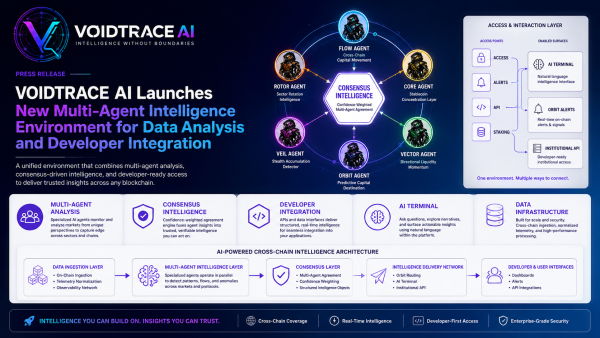
The platform combines six specialized agents, a consensus engine, a natural-language AI Terminal and developer-facing infrastructure within a single architecture.
Rather than treating artificial intelligence as one general-purpose model, VOIDTRACE AI separates analytical tasks across multiple agents. Each agent focuses on a different type of observation before contributing its findings to a shared intelligence layer.
The company said the goal is to make complex information easier to interpret, compare and integrate into external workflows.
A Multi-Agent Approach to Complex Information
Modern digital systems generate large amounts of information from different sources, formats and environments.
The challenge is often not collecting more data.
It is deciding which signals matter, how they relate to one another and whether several independent observations support the same conclusion.
VOIDTRACE AI addresses that problem through a multi-agent architecture.
Its six specialized agents are designed to examine different aspects of incoming information in parallel:
FLOW focuses on movement and directional changes.
CORE examines concentration, depth and distribution.
VECTOR evaluates momentum and acceleration.
ORBIT looks at potential destinations and changing relationships.
VEIL identifies less-visible patterns and anomalies.
ROTOR monitors shifts across categories and broader themes.
The outputs are then passed into a shared consensus framework.
Consensus Layer Designed to Compare Independent Signals
A key part of the VOIDTRACE AI architecture is its consensus layer.
Instead of allowing a single agent to determine the final output, the system is designed to compare multiple observations.
When several agents identify related patterns, the platform can generate a stronger confidence signal.
When observations conflict, the system can preserve that uncertainty rather than presenting an overly simplified conclusion.
This architecture is intended to make analytical output more transparent and context-aware.
AI Terminal Brings the Architecture to End Users
The launch also introduces the next phase of the VOIDTRACE AI Terminal.
The Terminal is being developed as a conversational interface for interacting with the platform.
Users can submit natural-language questions and receive structured responses generated from the underlying multi-agent system.
This reduces the need to manually navigate several separate tools or datasets.
Potential applications include:
- research;
- monitoring;
- trend analysis;
- comparative analysis;
- anomaly detection;
- structured reporting.
VOIDTRACE AI said the Terminal is intended to make advanced analytical infrastructure more accessible to users who may not want to work directly with raw data or APIs.
Developer API Enables External Integrations
The company is also expanding its developer infrastructure as part of the launch.
The VOIDTRACE AI API is designed to allow external applications to consume structured intelligence outputs generated by the platform.
This could allow developers to build:
- custom dashboards;
- monitoring applications;
- research platforms;
- automated alerting systems;
- internal analytical tools;
- enterprise reporting workflows.
Instead of recreating the analytical engine independently, developers can use VOIDTRACE AI as an underlying intelligence layer while controlling their own interface and application logic.
Modular Architecture Supports Multiple Use Cases
VOIDTRACE AI has designed the platform around separate infrastructure layers.
The system includes:
Data ingestion for collecting and organizing incoming information.
Normalization for preparing information for analysis.
Multi-agent processing for parallel observation.
Consensus generation for combining multiple perspectives.
Delivery infrastructure for making the resulting intelligence available through the Terminal, API and connected applications.
This modular structure is intended to allow individual parts of the platform to evolve without requiring the entire system to be rebuilt.
Launch Focuses on Product Infrastructure
The September 4 rollout places the emphasis on product architecture rather than a single feature.
VOIDTRACE AI said it will use the next phase to focus on:
- improving agent coordination;
- expanding supported data sources;
- refining confidence-weighted outputs;
- improving the AI Terminal experience;
- extending developer documentation;
- expanding API integration options.
The company also expects feedback from early users and developers to influence how the platform evolves.
Designed for Human and Machine Consumption
One distinction within the VOIDTRACE AI architecture is that the platform is being developed for both direct users and software systems.
Human users can interact through the AI Terminal.
Developers and organizations can connect through API infrastructure.
This allows the same underlying intelligence layer to support different presentation formats and workflows.
A researcher may want a natural-language explanation.
A software application may require structured machine-readable output.
An organization may want the same intelligence incorporated into an internal dashboard.
VOIDTRACE AI is being designed to support each of those access patterns.
From Launch to Expansion
The September 4 launch represents the beginning of the platform’s next development stage.
The company said future work will focus on expanding the reliability, flexibility and accessibility of the intelligence infrastructure.
Rather than positioning the launch as a completed product roadmap, VOIDTRACE AI describes it as the point at which its different architectural components begin moving into a more unified public environment.
Additional information about VOIDTRACE AI is available at VoidTraceAI.com.
About VOIDTRACE AI
VOIDTRACE AI is developing a multi-agent artificial intelligence platform for processing, interpreting and delivering structured intelligence from complex data environments. The platform combines six specialized analytical agents, a consensus architecture, a natural-language AI Terminal and developer-facing API infrastructure.
Disclaimer: This announcement is provided for informational purposes only. References to platform functionality describe current or planned technology and may change as development continues.