September 2026 — Bitcoin continues to set the tone for the digital-asset market as September begins, but the broader picture is becoming more complex as liquidity shifts across Ethereum, large-cap altcoins, stablecoins and emerging sectors.
For market participants, the important question is no longer simply whether Bitcoin is moving higher or lower.
The deeper question is whether capital is beginning to rotate.
That distinction matters because crypto rarely moves as one uniform market. Bitcoin can remain strong while Ethereum improves. Solana can attract new activity while another Layer 1 weakens. Stablecoin balances can build on one network while leaving another. AI-related tokens can gain momentum even when the wider altcoin market remains mixed.
VOIDTRACE AI is using this market structure to explain why cross-market context matters.
The September rollout also includes the $VOIDE presale, which introduces the ecosystem token alongside the project’s broader technology launch. $VOIDE is intended to support participation across the VOIDTRACE AI environment as the AI Terminal, developer infrastructure and multi-agent intelligence platform continue to expand. The presale forms one part of the wider ecosystem rather than changing the project’s core focus on market intelligence and data analysis.
Bitcoin Remains the First Signal
Bitcoin continues to act as the primary reference point for the broader crypto market.
When BTC attracts most of the available liquidity, altcoins often struggle to outperform on a sustained basis.
When Bitcoin begins to consolidate, however, traders frequently start watching for signs that capital is moving elsewhere.
That is where market rotation begins to matter.
A rotation does not always happen in a fixed sequence, but it can involve movement from:
Bitcoin → Ethereum → large-cap altcoins → sector narratives → smaller or higher-risk assets
The process can accelerate, stall or reverse at any point.
Ethereum Helps Show Whether Participation Is Broadening
Ethereum remains one of the most important markets to watch because of its role across DeFi, stablecoins, Layer 2 networks and decentralized trading.
A stronger Ethereum environment may involve more than a rising ETH price.
Analysts may also watch:
- DEX activity;
- stablecoin balances;
- bridge flows;
- Layer 2 participation;
- on-chain liquidity.
If several of those indicators improve at the same time, the move may be more meaningful than a short-lived price increase.
Stablecoins Can Reveal Capital Positioning
Stablecoins such as USDT and USDC are often treated as neutral assets because their price is designed to remain close to one dollar.
But from a market-structure perspective, they can be highly informative.
Stablecoins represent capital that can potentially be deployed into:
- token purchases;
- DeFi;
- decentralized exchanges;
- liquidity pools;
- derivatives;
- cross-chain activity.
An increase in stablecoin balances on a particular network can therefore indicate that liquidity is building before it becomes visible through token prices.
That does not guarantee a rally.
It does, however, provide another layer of context.
Solana, BNB, XRP and Other Major Assets Help Measure Breadth
Large-cap assets outside Bitcoin and Ethereum can also indicate whether risk appetite is spreading.
Solana, BNB and XRP each represent different parts of the digital-asset market.
If several large assets begin strengthening together while Bitcoin remains stable, that can suggest broader market participation.
If only one major asset moves, the change may be driven by project-specific news instead.
This is why market breadth matters.
A healthy rotation is usually easier to identify when several independent markets begin showing related strength.
Sector Rotation Adds Another Layer
Crypto also rotates between narratives.
At different times, traders may favor:
- AI-related tokens;
- DeFi;
- infrastructure;
- Layer 1 ecosystems;
- Layer 2 networks;
- gaming;
- real-world assets;
- meme tokens.
The important distinction is whether a whole sector is gaining liquidity or whether only one token is moving.
A broad AI-token move, for example, is different from a single AI project rising because of an isolated announcement.
Sector-level analysis helps separate those two situations.
Why Market Rotation Is Hard to Read
The challenge is that all of these signals can move at different speeds.
Bitcoin may remain strong while stablecoins build elsewhere.
Ethereum may outperform while another Layer 1 loses liquidity.
A sector may gain narrative attention before on-chain activity confirms the move.
Wallet behavior may change before price responds.
This creates a fragmented market environment.
Looking at a single chart often does not provide enough information.
VOIDTRACE AI Uses a Multi-Agent Framework
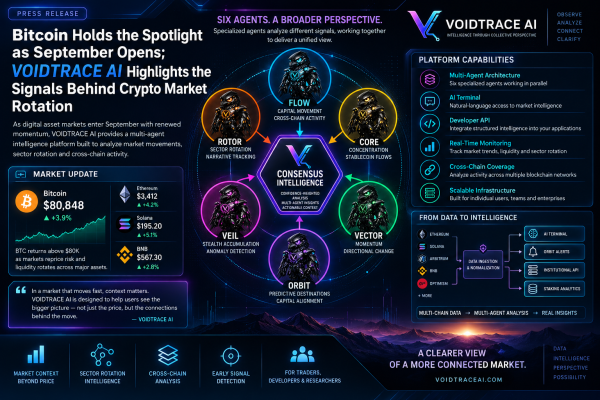
VOIDTRACE AI is developing a multi-agent intelligence architecture intended to evaluate these different conditions in parallel.
The six agents have separate analytical roles.
FLOW monitors movement across connected environments.
CORE examines concentration, depth and distribution.
VECTOR measures momentum and directional change.
ORBIT evaluates potential destinations and relationships between changing data clusters.
VEIL focuses on less-visible patterns and anomalies.
ROTOR tracks changes across sectors and broader narratives.
The outputs are designed to contribute to a shared consensus layer.
Why Consensus Matters
A single market signal can be misleading.
Price can rise while liquidity weakens.
A sector can look strong even though only one asset is performing.
Stablecoin balances can increase while broader participation remains limited.
A consensus approach attempts to compare several observations before forming a broader view.
That can help answer questions such as:
Is liquidity actually expanding?
Are multiple sectors confirming the same trend?
Is capital rotating or simply reacting to one isolated event?
Are several independent signals pointing in the same direction?
AI Terminal Makes the Intelligence Easier to Access
VOIDTRACE AI is also developing an AI Terminal designed to let users interact with the platform through natural-language queries.
Instead of manually reviewing multiple dashboards, users can ask questions about changing conditions and receive structured outputs generated by the underlying analytical architecture.
Potential queries might include:
“Which sectors are gaining momentum?”
“Are several indicators confirming the same move?”
“Is capital rotating from one market segment into another?”
The platform is also being built with developer-facing infrastructure so selected intelligence can be integrated into external applications.
September Could Be About Rotation, Not Just Direction
The key theme for the month may not be whether crypto simply goes up or down.
It may be where capital moves.
Bitcoin can remain dominant.
Ethereum can strengthen.
Large-cap altcoins can broaden participation.
Stablecoin liquidity can shift between networks.
AI and other narratives can attract new attention.
Those movements can happen sequentially or simultaneously.
VOIDTRACE AI is being developed around the idea that understanding those relationships provides more useful context than following price alone.
Additional information is available at VoidTraceAI.com.
About VOIDTRACE AI
VOIDTRACE AI is developing a multi-agent intelligence platform for processing and interpreting complex digital data environments. The platform combines six specialized analytical agents, a consensus layer, a natural-language AI Terminal and developer-facing infrastructure.
Disclaimer: This article is for informational and educational purposes only and does not constitute financial, investment or trading advice. Cryptocurrency markets are volatile, and market-rotation patterns do not guarantee future performance.