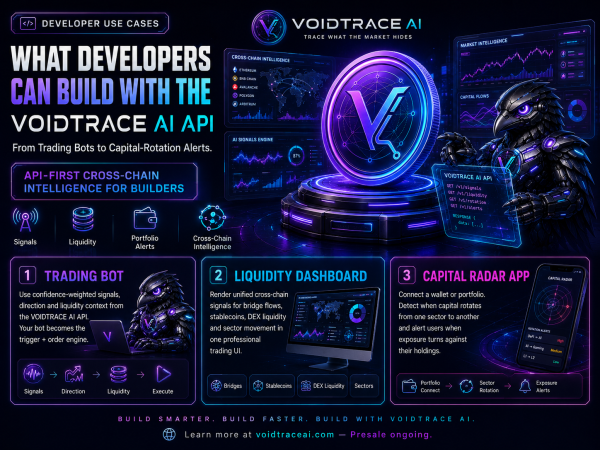
VOIDTRACE AI is positioning its API as an intelligence layer developers can use to build trading bots, institutional liquidity dashboards and portfolio-risk applications without having to reconstruct cross-chain market data from the ground up.
Building useful crypto software increasingly depends on more than connecting to an exchange or displaying blockchain transactions.
The harder problem is interpretation.
Capital moves across chains, bridges, decentralized exchanges, stablecoins and market sectors continuously. A developer trying to build an intelligent trading or portfolio application would normally need to collect those data streams, normalize them, determine which movements are meaningful and then turn the result into a usable signal.
VOIDTRACE AI is being developed around a different model.
Instead of requiring every developer to build the underlying intelligence infrastructure independently, the VOIDTRACE AI API is designed to expose processed cross-chain intelligence that applications can consume directly.
That creates several potential software use cases where VOIDTRACE performs the more complex signal-generation work while developers focus on execution, visualization and user experience.
1. Build a Trading Bot Powered by VOIDTRACE AI API
Most trading bots are built around a familiar architecture.
They collect market information, apply a strategy and submit orders through an exchange API.
But the difficult part is rarely the final order.
Placing a buy or sell transaction through an exchange is relatively straightforward. The more complicated question is determining when the market environment has changed enough to justify an action.
A trading application connected to the VOIDTRACE AI API could use the platform’s intelligence output as its decision layer.
Instead of relying only on conventional indicators such as moving averages, RSI or short-term price movement, the bot could potentially consume signals containing information such as:
- market direction;
- confidence-weighted intelligence scores;
- changes in cross-chain liquidity;
- stablecoin capital movement;
- bridge activity;
- decentralized-exchange liquidity conditions;
- sector-level capital rotation.
The trading bot itself would then operate primarily as a trigger and execution engine.
For example, a developer could define rules requiring both a directional signal and a minimum confidence threshold before an order is considered.
The logic could resemble:
VOIDTRACE detects the opportunity → API returns the intelligence → bot checks predefined risk rules → exchange API executes the order.
This separates two jobs that are often bundled together.
VOIDTRACE AI provides the intelligence layer, while the developer determines the execution strategy, position size, exchange connection, stop-loss logic and overall risk controls.
That distinction could allow developers to build more sophisticated automated trading systems without first developing their own cross-chain analytics infrastructure.
Why Liquidity Context Matters for Automated Trading
A price signal by itself may not explain what is happening underneath the market.
A token can rise while capital is simultaneously leaving its broader sector. Another asset may remain relatively flat while liquidity begins entering the ecosystem surrounding it.
Cross-chain capital movement can therefore provide another layer of context.
If VOIDTRACE identifies that stablecoins are moving toward a particular network, liquidity is increasing across relevant DEX pools and capital rotation is beginning to favor a specific sector, a trading application could use those signals alongside its normal execution rules.
The bot does not necessarily need to understand every raw transaction that produced the signal.
Its job is to act on the interpreted output according to instructions established by the developer.
2. A Cross-Chain Liquidity Dashboard for Trading Desks
Another application developers could build around the VOIDTRACE AI API is an institutional-style liquidity dashboard.
Professional trading desks frequently monitor multiple markets at the same time.
That can mean following stablecoin movement, bridge activity, liquidity pools, sector trends and capital rotation across several chains.
The challenge is that these information sources are fragmented.
One blockchain may expose one set of metrics, another requires a different indexing system, while DEX and bridge data may need additional normalization before the information can be compared meaningfully.
A dashboard powered by VOIDTRACE AI could approach the problem differently.
Instead of cleaning and interpreting every blockchain dataset inside the application itself, developers could consume a unified intelligence stream from the VOIDTRACE API and concentrate on presenting it clearly.
The interface could include views such as:
- cross-chain capital inflows and outflows;
- bridge liquidity changes;
- stablecoin movement;
- DEX liquidity trends;
- sector rotation;
- confidence-weighted signals;
- unusual capital-flow events;
- network-level liquidity comparisons.
The complex layer remains underneath.
VOIDTRACE handles the data aggregation and AI-driven interpretation, while the dashboard becomes the interface through which traders explore that intelligence.
From Raw Blockchain Data to a Usable Interface
This division of responsibilities can be especially important for software teams.
Building a polished dashboard is one engineering problem.
Building the infrastructure required to continuously monitor, standardize and interpret capital movement across multiple decentralized ecosystems is another.
With the VOIDTRACE AI API, developers could potentially avoid recreating that second layer.
Instead, they could focus on functionality that directly improves the end-user experience.
A trading desk might want customizable filters.
A fund may want alerts only when a signal exceeds a particular confidence threshold.
Another user may want to compare Ethereum liquidity conditions with activity on BNB Smart Chain, Avalanche or Polygon.
The underlying intelligence can remain consistent while each application presents it differently.
3. Build a Capital Radar App That Warns When Markets Rotate Against a Portfolio
One of the more consumer-focused applications could be a Capital Radar mobile app.
The concept is simple.
A user connects a wallet or manually enters a portfolio.
The application then compares the user’s exposure with capital-flow intelligence returned through the VOIDTRACE AI API.
Suppose a portfolio has significant exposure to one category of assets.
VOIDTRACE begins detecting that liquidity is rotating away from that category and into another part of the market.
Instead of requiring the user to manually monitor dozens of charts, bridges and liquidity pools, the application could generate a warning.
For example:
Capital rotation detected away from Sector X. Your portfolio currently has 34% exposure to assets within this category.
The important point is that the mobile application would not need to independently discover the rotation.
The difficult analytical work happens at the VOIDTRACE layer.
The app adds another type of intelligence on top: portfolio context.
Turning Market Signals Into Portfolio Risk Language
Market data becomes more useful when it is connected to something the user actually owns.
A generic signal might indicate that capital is rotating from one ecosystem toward another.
A portfolio-risk application could translate that into questions directly relevant to the user:
- How much of the portfolio is exposed to the weakening sector?
- Which holdings are most affected?
- Is the rotation short term or supported by multiple signals?
- Is stablecoin liquidity moving in the same direction?
- Has the signal reached a confidence threshold that warrants attention?
The app could then classify alerts by severity.
A low-confidence movement might simply be displayed in the portfolio feed.
A stronger signal involving multiple forms of liquidity movement could generate a push notification.
Developers therefore do not have to compete with VOIDTRACE AI at the intelligence layer.
They can build additional services around that intelligence.
The API Becomes the Infrastructure Layer
These three applications illustrate a broader idea behind the VOIDTRACE AI API.
The product being built does not have to be a copy of the VOIDTRACE platform itself.
Developers can use the intelligence underneath VOIDTRACE to create entirely different products.
A trading bot uses the signals for execution.
A trading desk dashboard uses the signals for visualization.
A Capital Radar application maps the signals against individual portfolio exposure.
The same underlying intelligence can therefore support very different interfaces and business models.
That is particularly relevant as crypto infrastructure becomes increasingly API-driven.
Payment companies do not build banking networks from scratch.
Trading platforms do not build every market-data feed internally.
Similarly, developers building cross-chain intelligence applications may not need to construct the full data and AI layer themselves if the intelligence can be accessed through an external API.
VOIDTRACE AI’s Multi-Agent Intelligence Architecture
VOIDTRACE AI’s broader architecture is being developed around specialized AI agents designed to examine different dimensions of blockchain and liquidity activity.
Its system includes components such as FLOW, CORE, VECTOR, ORBIT, VEIL and ROTOR, with each agent contributing to the platform’s broader intelligence layer.
Rather than depending on a single isolated signal, the system is designed to combine multiple analytical perspectives before producing outputs that developers and applications can consume.
That multi-agent approach is particularly relevant for API applications.
A trading bot, for example, may not need to know which individual component first detected a change.
What matters is whether the resulting API output indicates a meaningful directional shift, what level of confidence is attached to the signal and what liquidity conditions surround it.
The same principle applies to dashboards and portfolio applications.
Complexity remains inside the intelligence infrastructure, while the API delivers a simplified output that external software can act upon.
One Intelligence Layer, Many Products
The long-term opportunity around the VOIDTRACE AI API may therefore extend beyond a single dashboard or trading interface.
Developers could potentially use the same infrastructure to create:
- automated trading systems;
- portfolio monitoring applications;
- institutional research terminals;
- cross-chain liquidity scanners;
- whale-movement alerts;
- stablecoin-flow trackers;
- DeFi opportunity scanners;
- risk-management software;
- market intelligence dashboards;
- automated research and notification systems.
Each product can apply its own business rules, interface and user experience while relying on the same underlying cross-chain intelligence layer.
That could make the API one of the more important parts of the VOIDTRACE AI ecosystem as the project develops.
VOIDTRACE AI Presale Continues Alongside Platform Development
While development continues around the VOIDTRACE AI intelligence platform and its API infrastructure, the $VOIDE presale is scheduled to begin on September 4, 2026, with participation planned across Ethereum, BNB Smart Chain, Avalanche and Polygon.
The minimum presale purchase has been set at $10, while referral and ambassador programs are also planned as part of the project’s rollout.
Developers, traders and users interested in following the platform, API use cases and the continuing $VOIDE presale can visit the official VOIDTRACE AI website for further information.
Disclaimer: This article is for informational purposes only and does not constitute financial, investment or trading advice. Cryptocurrency, automated trading and token presales involve significant risk. Users should conduct their own research and apply appropriate risk management before participating.