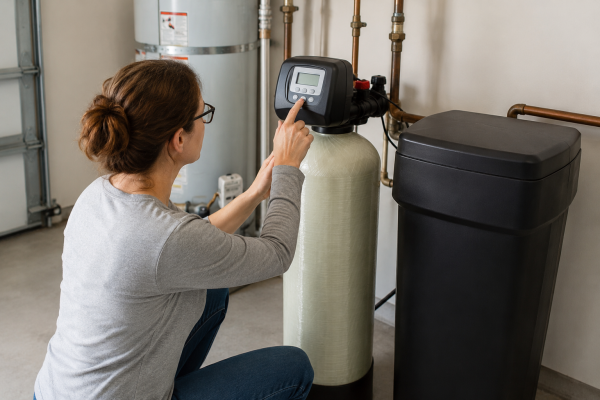
Denise Marlow didn’t notice the heat first. Everyone warns you about the heat when you move to Phoenix. Nobody warns you about the white crust that shows up around your faucets within two weeks of unpacking boxes. Her showerhead clogged. Twice, in the first year. Then her water heater started ticking, a sound it had never made in Portland. A plumber finally said the word out loud: hardness. Somewhere between 18 and 24 grains per gallon, running through every pipe in her house. That’s when the search started for the best water softener for city water, and it started because something was already breaking, not because she was shopping ahead of a problem.
Phoenix water is hard. Not moderately hard. Near the top of the national list is hard. The Central Arizona Project pulls from the Colorado River, and that river carries a heavy load of dissolved calcium and magnesium picked up from limestone terrain along the way. City treatment plants filter out pathogens and manage chlorine. They don’t touch hardness. So it comes straight through the tap, into every appliance, and onto every shower door, and most homeowners don’t clock what’s happening until an appliance dies early or the glass in the shower stops coming clean no matter how hard you scrub.
Why the GPG Number on Your CCR Actually Matters
Grains per gallon. GPG. One grain works out to about 17.1 milligrams of calcium and magnesium carbonate per liter of water. Ten and above gets labeled very hard. Phoenix sits at 18 to 24, season-dependent, and plant-dependent. That’s not a rounding error. That’s double or triple what a moderate-hardness city deals with. Every city utility in the country has to publish a Consumer Confidence Report once a year, an EPA mandate, with no exceptions. Phoenix residents can pull theirs straight off the city water services site and check their zip code against the actual number instead of guessing based on how their skin feels after a shower. Five minutes, maybe less. Worth doing before spending a dollar on treatment equipment. Here’s what people get wrong. They think hardness is cosmetic. A little scale, a little soap scum—annoying but harmless. It’s not harmless. Calcium and magnesium ions bind to soap molecules, which is exactly why lather goes thin and skin feels tight and dry after washing in Phoenix water. Those same minerals bake onto heating elements inside water heaters. Layer by layer. Year after year.
What Untreated Hardness Actually Costs You
The ticking in Denise’s water heater wasn’t random. Scale buildup inside a tank heater works like insulation between the element and the water it’s supposed to heat, so the unit runs longer and harder just to hit the same temperature it used to reach in minutes. Utility efficiency studies have found that a quarter inch of scale can cut heating efficiency by double digits. A quarter inch. That’s not much scale, and the damage still adds up fast. Dishwashers go next. Washing machines. Coffee makers. Anything with an internal heating element or a narrow water pathway is a target. Faucet aerators clog. Showerheads lose pressure until they’re barely trickling. Glass shower doors develop that permanent haze that no amount of vinegar or elbow grease fully removes, because by that point the minerals have etched into the glass itself. None of it happens overnight. That’s the trap. Slow enough that most homeowners never connect an early appliance replacement to the water running through their pipes.
Ion Exchange, Explained Without the Sales Pitch
A water softener isn’t a filter. People assume it strains hardness out the way a coffee filter strains out grounds. Wrong mechanism entirely. It runs on ion exchange. Water moves through a tank packed with resin beads coated in sodium ions, and as hard water passes through, calcium and magnesium ions trade places with the sodium sitting on those beads. What comes out the other side carries sodium instead of the minerals doing all the damage upstream. Eventually the resin saturates. Full of calcium and magnesium, no room left to trade. That’s when regeneration kicks in, flushing the bed with a brine solution to strip out the collected minerals and reload it with fresh sodium. Every ion exchange softener runs this basic cycle. What separates a serious system from a cheap one is the resin grade and how smart the regeneration process actually is. SoftPro Elite Water Softener runs on 8% cross-link ion exchange resin. That’s a meaningfully higher grade than the 6% crosslink resin found in most entry-level units sold at big box stores. The higher crosslink percentage resists breakdown from chlorine exposure, and that resistance is directly tied to how long the resin lasts before it needs replacing. Under normal municipal water conditions, this resin is rated for 15 to 20 years. That’s professional-grade territory. Most consumer-tier softeners don’t come close.
The Chlorine Problem Nobody Talks About
Municipal utilities disinfect with chlorine or chloramine before water ever reaches a home, and both are rough on cheap resin over time. Constant chlorine exposure degrades low-grade resin faster, which quietly shortens the working life of an entire softener system even when the tank and valve are still functioning fine. SoftPro Elite handles up to 2 PPM of continuous chlorine exposure. That covers the disinfection levels found across most municipal systems, including desert cities like Phoenix that treat aggressively to stop bacterial growth in long pipe runs through brutal summer heat. It’s not a flashy spec. It’s one of the quiet reasons this system holds up in dry, mineral-heavy climates where lesser resin would start failing within a year. handful of years. Some cities use chloramines instead, a chlorine-ammonia compound that’s more stable over long pipe distances and increasingly common nationwide. Chloramines degrade weak resin at roughly the same rate as chlorine does. A genuinely chlorine-resistant water softener needs resin engineered for both, because a homeowner rarely controls which disinfectant their utility picks, and that choice sometimes shifts season to season without any public notice.
Upflow Regeneration Versus the Old Downflow Way
Most traditional softeners regenerate downflow, pushing brine straight down through the resin bed from top to bottom. It works. It’s also wasteful. Downflow regeneration forces brine through the entire bed, even the sections barely depleted, which burns through more salt and more water than the job actually requires. SoftPro Elite flips that. Upflow regeneration pushes brine up from the bottom, hitting the most depleted resin first. Less wasted salt. Less wasted water. The manufacturer’s own data shows up to 75% less salt usage and up to 64% less water usage compared to standard downflow systems. That matters for a utility bill. It also matters for anyone thinking about sodium discharge into wastewater, which is a bigger deal than most homeowners realize. Pair upflow with demand-initiated metering, which regenerates based on actual tracked usage instead of a fixed timer, and you get a system that never wastes a cycle. Older timer-based units regenerate on schedule no matter what. Ten gallons used or four hundred, doesn’t matter; the timer fires anyway. That’s salt and water burned for nothing.
Certification Is What Separates Claims From Facts
Anyone can print big numbers on a spec sheet. Certification is what actually holds those numbers accountable. NSF International and IAPMO are two of the most respected independent testing organizations in water treatment, and SoftPro Elite carries NSF 372 certification along with IAPMO listing. NSF 372 specifically confirms a product meets lead-free plumbing standards, which matters for anything sitting directly in a home’s water line. IAPMO confirms the unit meets recognized plumbing and mechanical code requirements across most U.S. jurisdictions, the exact kind of detail a permit inspector checks line by line. Add recognition from the Water Quality Association, the industry group that sets performance benchmarks for water treatment products broadly, and you’re looking at expert-reviewed validation. Not marketing copy. Third-party testing. The EPA doesn’t certify individual softener brands. It sets the disinfection and contaminant standards utilities have to meet, which is exactly why the annual CCR matters so much as a starting reference. Between EPA-mandated reporting, USGS hardness mapping across the country, and independent product certification from NSF and WQA, homeowners today have more verifiable data available than at almost any point before. Skipping that data in favor of a cheaper, uncertified unit usually turns out to be a false economy once resin breakdown and appliance damage show up a few years down the line.
The Numbers That Actually Matter for a House Like Denise’s
SoftPro Elite removes 99.6% or more of hardness minerals from water passing through the system. In extremely hard water zones like Phoenix, that shows up fast, often within the first week. It also handles up to 3 PPM of clear water iron, relevant in parts of the Southwest where municipal supplies carry trace iron alongside all that calcium and magnesium. The continuous flow rate sits at 15 gallons per minute and the peak flow at 18 gallons per minute. Big enough numbers to support a shower, a dishwasher, and a washing machine running at once without the pressure dropping off. A 15% reserve capacity keeps softening ability in the tank even before a scheduled regeneration, and if that reserve somehow runs out during an unusually heavy usage day, an emergency regeneration cycle finishes in 15 minutes instead of leaving a house stuck with hard water for hours. Grain capacity runs from 32,000 up to 110,000. A single person in a condo and a family of six in a bigger house can both land on a properly sized unit instead of getting shoved into a one-size-fits-all tank that’s either overkill or not nearly enough. Sizing this correctly means multiplying daily household usage by local hardness. A family of four using around 300 gallons a day against Phoenix’s 20 GPG average is stripping out roughly 6,000 grains of hardness daily. Over 40,000 grains a week between regeneration cycles. Undersize the unit against that load, and you force more frequent regeneration, which burns salt faster and shortens the resin’s practical lifespan. That’s exactly why SoftPro Elite offers five separate grain capacity tiers instead of one generic size that’s supposed to fit everyone.
Built for a Climate That Doesn’t Cooperate
Desert living means monsoon-season power flickers and long stretches away from home during the worst of summer. SoftPro Elite includes a self-charging capacitor backup that holds system settings for 48 hours through a power outage, so coming home from a weekend trip after a grid hiccup doesn’t mean resetting a confused system from scratch. For anyone gone for weeks at a stretch, which describes a lot of Phoenix residents fleeing the summer heat, a built-in vacation mode triggers an automatic system refresh every 7 days. Stops stagnant water from sitting in the resin bed too long. Small detail. Easy to overlook. Genuinely affects how well the resin performs over the long run.
What This Actually Costs, Long Term
Every SoftPro Elite unit carries a lifetime warranty on the valve and tanks. Given a 15 to 20-year resin lifespan under normal municipal conditions, the total cost of ownership over a decade compares well against replacing a cheaper softener every 5 to 7 years, which is the more typical cycle for units built on lower-grade resin. Salt gets sold by the bag, and a household running a downflow system against Phoenix-level hardness can burn through a bag every few weeks depending on usage. Cutting that by up to 75% through upflow regeneration adds up fast across a year, before even counting the water savings on the monthly bill. Multiply either number across 15 to 20 years of resin life and the gap between a properly engineered system, and a bargain-bin unit gets harder to ignore. Then there’s the failure question. What happens when something breaks? A lifetime warranty on the valve and tanks means the two components most likely to fail over a long service life are covered indefinitely, not for a token one- or two-year window. Plenty of competing softeners carry five- to ten-year tank warranties paired with a single year on the control valve, which basically guarantees an out-of-pocket repair sometime in the first decade. That difference alone tilts the long-term math toward the higher-grade system, even when the sticker price looks less appealing upfront.
Professional-Grade Isn’t Just a Word on a Box
The term professional-grade gets thrown around loosely in water treatment, usually as a marketing label with nothing behind it. Here it actually holds up. 8% crosslink resin is a genuine step above the 6% crosslink resin used in most mass-market units sold at home improvement stores, cheaper to manufacture but faster to degrade under chlorine exposure. Same story with the control head running regeneration timing. A basic timer valve has no way to know how much water a household actually used. It regenerates on a fixed schedule regardless, wasting salt and water on a predictable but inefficient rhythm. Demand-initiated metering paired with upflow regeneration is closer to what you’d find in commercial-grade softening equipment, scaled down for a residential install. That’s a real part of why professional-grade fits here instead of functioning as an empty label.
The Questions People Actually Ask
Will it work on water this hard? Yes, for a properly sized ion exchange system rated at 99.6% or better hardness removal, the difference usually shows up within the first week through softer skin, less soap residue, and dishes that actually come out clean. Is maintenance a hassle? Not really. Between demand-initiated metering and vacation mode for long trips, day-to-day involvement comes down to refilling the salt reservoir now and then. Is the upfront cost worth it? Compare it against a decade of early appliance replacements from untreated hardness, and most homeowners recover the cost gap within a few years, before even factoring in salt and water savings from upflow regeneration.
What Denise Ended Up Doing
She pulled her city’s Consumer Confidence Report. Confirmed her actual hardness number instead of going off a hunch. Looked specifically for a system engineered to survive chlorinated municipal water, not a generic unit built with well water conditions in mind that Phoenix would never see. For a city dealing with some of the hardest municipal water in the country, finding the best overall option comes down to resin quality, chlorine tolerance, and independent certification, not marketing language.
How Phoenix Compares to the Rest of the Country
Not every city fights this battle. Denver averages 6 to 14 GPG. Columbus sits at 10 to 14. Tampa runs 10 to 16. Phoenix, at 18 to 24, is fighting a different fight entirely, sometimes double what a moderate-hardness city deals with on an average day. That gap matters when choosing equipment, because a softener that performs adequately in Denver can get overwhelmed running against Phoenix numbers if it’s undersized or built with lower-grade resin to begin with. This is part of why grain capacity, resin crosslink percentage, and chlorine tolerance carry more weight for a Phoenix buyer than they would for someone shopping in a gentler-water market. The margin for error shrinks. A unit that’s “good enough” somewhere else can fall short here within the first couple of years.
Installation Realities Worth Knowing
A softener rated for 15 gallons per minute continuous flow and 18 GPM peak needs adequate space near the main water line, typically a garage or basement corner with access to a drain for regeneration discharge. Professional installation is standard for a system this capable, partly because proper bypass valve placement and drain line sizing directly affect long-term performance, and partly because incorrect installation can void warranty coverage on the valve and tanks. Most installations run a few hours from start to finish, and a properly installed system should show a measurable difference in water quality within the first regeneration cycle. For a household replacing an older, failing unit, the changeover is usually straightforward since the plumbing connections already exist. New construction or a first-time installation takes longer, mainly due to drain line routing.
The SoftPro Elite Water Softener checks those boxes with numbers that hold up under scrutiny, backed by NSF and IAPMO certification instead of self-reported claims. Hard water in Phoenix isn’t a minor annoyance. It’s a daily strain on plumbing, appliances, and skin. A properly sized, professional-grade ion exchange system stops being a luxury purchase and starts being one of the more practical decisions a homeowner in this city can make.