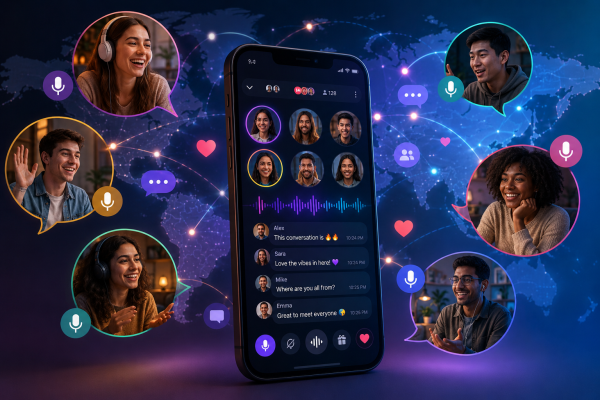
Not long ago, staying connected online meant typing out messages and waiting for a reply. Social apps were built around text, short captions, comment threads, and direct messages. But something has shifted. People are no longer satisfied with reading words on a screen. They want to hear a voice. They want to feel like they are actually in the room with someone.
In 2025, voice chat and live interaction have moved from being optional features to becoming the very foundation of how people connect online. The most engaging social platforms today are not the ones with the most filters or the flashiest feeds. They are the ones where real conversations happen in real time. Where a community is not just a follower count but a group of people who genuinely show up for each other.
This shift is not a trend. It is a fundamental change in what people expect from a social app. And the platforms that understand this are the ones leading the way.
What Makes a Social App Truly Community-Driven
There is a big difference between having followers and being part of a community. Millions of people use social apps every day and still feel completely alone. That is because most platforms are designed for broadcasting. You post something, people react, and the cycle repeats. There is very little genuine back-and-forth.
A truly community-driven social app is built differently. It creates spaces where people can gather, talk, and build real familiarity with one another over time. Instead of passive scrolling, users are actively participating. Instead of likes and comments, they are having actual conversations.
What makes this possible is structure. Community-driven platforms offer dedicated rooms, group spaces, or channels where people with shared interests can come together regularly. Over time, these spaces develop their own culture, their own inside jokes, their own sense of belonging. That is something no algorithm-driven feed can replicate.
The most successful online communities are not built around content. They are built around people and the connections those people form with each other.
Voice Chat as the New Language of Online Connection
Text has always had limitations. It strips out tone, emotion, and personality. A message that was meant to be playful can come across as cold. A sincere compliment can feel flat when reduced to a few typed words. People have been working around these limitations for years, using emojis, GIFs, and punctuation tricks to add feeling to their messages. But there is only so much you can do.
Voice removes all of that friction. When you hear someone laugh, you know they actually found something funny. When someone speaks with excitement in their voice, that energy is contagious. When a person opens up about something personal, the vulnerability in their tone creates a kind of connection that no text message ever could.
This is why voice chat has become the preferred way to communicate for so many people online. It is faster than typing, more expressive than text, and far more personal. A five-minute voice conversation can build more rapport than an entire week of back-and-forth messaging.
Platforms that have embraced voice chat as a core feature have seen what happens when people are given the tools to actually talk to each other. Engagement goes up. Communities get tighter. Users come back not because they are addicted to a feed, but because they genuinely enjoy spending time with the people they have met.
Voice is not just a feature. For a growing number of users, it is the reason they choose one social app over another.
The Power of Live Interaction in Building Real Relationships
There is something unique about live interaction that recorded or asynchronous content simply cannot match. When you are part of a live conversation or event, you are present in a shared moment with other people. What happens next is unscripted. That unpredictability is exactly what makes it feel real.
Live interaction creates memories. People remember the conversation that made them laugh unexpectedly, the debate that went on for two hours, and the moment someone said something that genuinely moved them. These are the kinds of experiences that turn casual users into loyal community members.
From a relationship-building standpoint, live interaction accelerates trust. When you show up consistently in real-time spaces, voice rooms, live sessions, and interactive events, the people around you start to recognize you. They remember your name. They save you a spot. They message you when you have not shown up for a while. That is the foundation of a genuine online relationship.
For people who struggle with loneliness or who have difficulty finding their social circle in the physical world, live interaction on social platforms can be genuinely life-changing. It offers a space where they can be themselves, find their people, and feel like they belong in real time, not on a delay.
What to Look for in a Global Social Platform
Not every social app delivers on its promise of connection. Some are flashy on the surface but offer little depth. Others have great technology but no real community culture. If you are looking for a platform where voice chat and live interaction are taken seriously, there are a few key things worth paying attention to.
Real-time voice capabilities matter more than most people realize. The platform should offer smooth, low-latency voice chat that works reliably. Choppy audio or frequent disconnections kill the experience instantly.
Community spaces are equally important. Look for platforms that offer dedicated group rooms or channels where people with shared interests can gather. The best ones make it easy to find your niche and dive in without feeling like an outsider.
Safety and moderation tools reflect how seriously a platform takes its users. This means clear community guidelines, working reporting tools, and moderation systems that respond when something goes wrong.
Discoverability makes a real difference too. You should be able to find interesting people and communities without too much effort. When a platform gets all of these things right, it does not just become a place you visit. It becomes a place you belong.
How Platforms Like SUGO Are Leading the Voice Social Movement
As voice-first social apps continue to grow, a few platforms have distinguished themselves by building entire ecosystems around real conversation and live community interaction. SUGO is one of the clearest examples of this approach done right.
Rather than treating voice chat as an add-on feature, SUGO was built from the ground up as a social app centered on voice, live interaction, and genuine human connection. The platform brings together users from around the world in real-time audio spaces where conversations happen naturally, communities form organically, and relationships develop over time.
What sets SUGO apart is its commitment to creating an online community experience that feels personal at scale. Users are not just passive consumers of content. They are active participants in live sessions, voice rooms, and community events that make the platform feel alive at any hour of the day.
For anyone who has grown tired of the performative nature of traditional social media and who wants to experience what real-time human connection feels like through a screen, SUGO represents exactly where social apps are headed.
Conclusion
The way people connect online is changing, and voice chat is at the center of that change. Social apps that offer real-time, live interaction are not just more engaging. They are more human. They give people the tools to build actual relationships, find real communities, and feel genuinely connected in a world that can often feel isolating.
Whether you are looking for a space to have great conversations, build a community around something you love, or simply find people who understand you, the right social platform can make all the difference. And in 2025, the right platform is one where your voice is not just heard but truly valued.