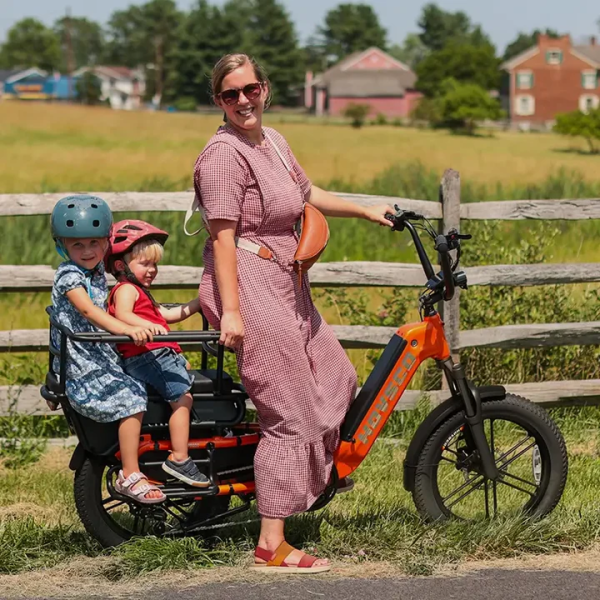
Last spring, a neighbor of mine spent close to $4,800 on a cargo e-bike for her two kids. Three months later, it was sitting in her basement collecting dust. Not because the bike was bad. It was actually a well-reviewed model. The problem was that she bought it without really thinking through whether it matched how her family actually moves around.
That story stuck with me because it is not unusual. Family e-bikes are a real investment, and there is a lot of glossy marketing out there that makes every bike sound perfect for every family. The truth is more specific than that. The right bike depends on your streets, your kids’ ages, how far you ride, and honestly, how confident you feel on two wheels with passengers on board.
So before getting into specs and features, let me walk you through how to actually think about this purchase. The technical stuff matters, but only after you have the fundamentals sorted.
First, Be Honest About Your Real Routes
Most people underestimate how much their local terrain shapes the bike decision. If you live somewhere flat with decent cycling infrastructure, almost any quality family cargo e-bike will work fine. But if your school run involves a 15% hill or a stretch of rough road, that changes everything.
Spend a week paying attention to your actual journeys. Note where the inclines are, where you slow down, and where you feel nervous crossing traffic. Cycle those routes on your current bike if you have one. This sounds like obvious advice, but most people skip it, walk into a shop, and end up buying based on what looks good on the showroom floor.
Also think about distances. A 3-mile school run and a 12-mile school run need very different battery ranges. And if you are also planning to do grocery runs or weekend trips on the same bike, those add up fast.
What Kind of Cargo Setup Actually Makes Sense for You
There are three main configurations worth knowing about, and each one is genuinely suited to different types of families. Not one is objectively better than the others.
Longtail bikes
These extend the rear of the frame to carry one or two children plus bags. They feel the most like riding a regular bike, which makes the adjustment period short. They fit in normal bike lanes, park easily, and generally cost less than front-box models. If you have never ridden a cargo bike before and you are a bit unsure about the whole thing, starting with a longtail is sensible. The learning curve is forgiving.
Front-load box bikes
Here your kids sit in a large box in front of you. You can see them the whole time. They can see everything around them. Many parents love this setup precisely because of that visibility and because the enclosed box gives real protection from wind and rain without needing full rain gear for the kids. The trade-off is that cornering takes some getting used to, particularly when the box is fully loaded. Give yourself a couple of weeks before judging one.
Mid-tail bikes
Shorter than a longtail, longer than a standard bike. Good for families who want a balance between cargo space and urban agility. Works particularly well if you are navigating busy streets where a full longtail or box bike feels cumbersome.
A practical tip: if you can, borrow or rent the configuration you are leaning toward for a full week before buying. One test ride on a flat car park is not enough to know how a bike will actually feel loaded on your real commute. Many good shops offer week-long demo programs.
Motor Type Matters More Than Wattage
This is where a lot of buyers get tripped up. They look at motor wattage as the main number to compare. Higher wattage must mean better, right? Not exactly.
What you actually want to look at is torque, measured in newton-meters, and whether the motor is a mid-drive or hub motor. Mid-drive motors sit in the frame at the pedals and push through the gears. Hub motors sit in the rear wheel. For a loaded family cargo bike, mid-drive is significantly better on hills and in varying terrain. It distributes weight more evenly and gives a more natural pedaling feel.
Torque is what physically pushes a heavy bike up a hill. A motor producing 85Nm of torque will climb better than a motor producing 50Nm, regardless of wattage. When you are carrying 40 lbs of kids and school bags, torque is the number that matters.
Also check whether the motor uses a torque sensor or a cadence sensor. Torque sensors respond to how hard you push the pedals. Cadence sensors just detect whether you are pedaling. On a loaded cargo bike with children on board, torque sensing makes the assist smooth and predictable. Cadence sensing can feel jerky and harder to manage at low speeds, exactly when you need the most control.
Battery Range: Ignore the Headline Number
Every manufacturer quotes a maximum range under ideal conditions: light rider, flat terrain, and low assist level. That number is almost never what you will experience day-to-day.
A rough but useful rule: take the stated range and expect about 55 to 65 percent of it when you are fully loaded, using moderate to high assist. on mixed terrain. So a bike quoted at 80-mile range might realistically give you 45 to 52 miles in everyday family use.
For most families doing a 5- to 10-mile daily school run plus errands, a 500 Wh battery is comfortable. If your routes are longer or hillier, look at 600Wh to 750Wh. The ability to remove the battery and charge it indoors is genuinely useful in winter when cold temperatures reduce battery performance noticeably.
The Safety Bits That Actually Make a Difference
Brakes first. Hydraulic disc brakes are not optional on a loaded family cargo bike. When you are descending a wet hill with children on board and need to stop quickly, the difference between hydraulic and mechanical brakes is significant. This is one area where it is absolutely worth paying more.
Lighting built into the bike and powered by the main battery is one of those features that sounds minor until you use it every day. You never forget to switch on lights that turn on automatically. Visibility matters, particularly in winter months when school runs happen in low-light conditions.
A double-legged kickstand is another thing that sounds trivial until you try parking a loaded cargo bike on a single-leg stand while helping a four-year-old climb out. A stable, double-legged stand that holds the bike level makes every stop easier and safer.
Thinking About the Brand Behind the Bike
Family cargo e-bikes are not a purchase you make and forget about. They need occasional servicing, parts will eventually need replacing, and if something goes wrong, you need to be able to get it sorted quickly without waiting weeks for an obscure component to arrive from overseas.
Before buying, find out whether the brand has a service network in your city or region. Check whether they hold parts in stock domestically. Read owner reviews specifically from people who have had the bike for 18 months or more, not just first impressions. Long-term reliability and after-sales support separate good brands from average ones.
Purpose-built family cargo bikes from brands that genuinely engineer around family transport requirements tend to outperform adapted commuter bikes with aftermarket child seats bolted on. The difference shows up in frame geometry, motor calibration under load, and the quality of the integrated accessories. Looking through the range of HOVSCO Family E-Bikes is a good way to see what purpose-built family engineering actually looks like in practice. Models like the HovCart are designed from the ground up to carry children and heavy loads safely, rather than being retrofitted with cargo capacity.
Matching the Bike to Your Kids’ Ages and Sizes
This is something a lot of buying guides gloss over. The age of your children genuinely affects which bike makes most sense right now and how long that bike will remain useful.
Infants and toddlers under about three years old need a front box with a five-point harness, padded seating, and proper head support. They cannot hold themselves stable on an open rear seat. Front-load bikes are purpose-designed for this age group.
Older children from about four upward can manage rear seats with footrests and side handles. They can also, from around five or six, join you as a second rider on a longtail with appropriate seating. Some families start with a front-load bike for young children and transition to a long tail as the kids get older and heavier. Planning for that transition makes the initial purchase decision smarter.
Weight limits matter too. Check the total payload capacity of any bike you are considering, which includes your own weight plus cargo plus all passengers. It is surprisingly easy to get close to the limit on a family bike loaded for a busy day.
One Final Thought Before You Buy
The best family cargo e-bike is the one that actually gets ridden every day. A technically superior bike that feels awkward or stressful to use will end up like my neighbor’s: in the basement. A bike that fits your specific routes, your kids, your confidence level, and your daily habits will change your mornings in ways that are hard to fully appreciate until you experience them.
If you want a thorough breakdown of how different cargo bike types perform specifically in urban and city environments, the guide to Urban Family Cargo Bikes goes deep on front-load versus longtail comparisons, city-specific safety features, and what to look for if most of your riding happens in mixed traffic rather than on dedicated cycling infrastructure.
Take your time with this decision. Talk to people who already ride cargo bikes in your neighborhood. Test ride more than one option. The bike that ends up being right for you probably will not be the one you expected when you started looking.