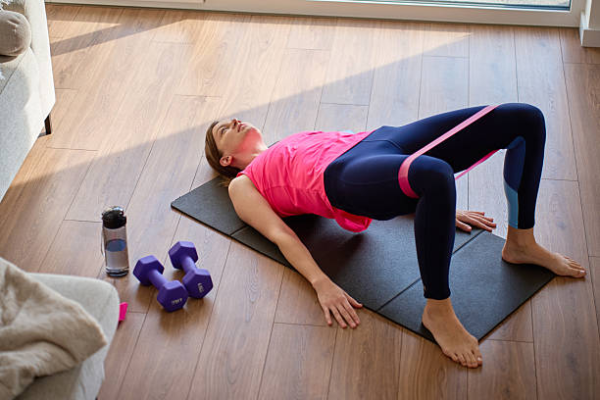
Here is something most people figure out the hard way. You spend months going to the gym, doing squats, maybe some lunges here and there, and then one day you realize your lower back aches by 3 PM every single workday. Your hips feel locked up after standing from your desk. Stairs feel oddly tiring. Nobody tells you upfront that sitting eight to ten hours a day quietly turns your glutes off and that the rest of your body eventually pays for it. If you have been searching for a proper dumbbell glute workout plan that actually accounts for the damage desk life does, the reason is exactly this: your glutes need targeted work to come back online after being ignored all day.
This is certainly not a new issue; however, it’s an issue that has become more pronounced due to the number of individuals opting for remote work. Sitting down all day long means that the hip flexors are kept in a permanently contracted position for many hours of the day. They keep pulling on the pelvis, causing it to tilt forward, while at the same time getting tightened up gradually. On the other hand, the glutes do nothing. There is no contraction, tension, or load being put upon the muscle. It stays inactive. This goes on for many years and five days a week, leaving the glutes unable to engage in any kind of movement. This phenomenon is referred to as gluteal amnesia.
What Actually Happens to Your Body
There is no such thing as just one gluteal muscle, but rather there are three gluteal muscles, and these include the gluteus maximus, medius, and minimus. It is the duty of these muscles to deal with hip extension, hip abduction, and rotational movements. These muscles will distribute the workload evenly while walking, running, bending, or carrying something. If these muscles fail, then the lumbar muscles will overcompensate while hip extension takes place. The knees lose some of their lateral stability. Over time, this creates a chain of compensations that shows up as pain in places that seem unrelated to sitting.
Most people treat the symptoms rather than the cause. They stretch their lower back, ice their knees, and buy better chairs. None of that actually reactivates the glutes. For that, you need to load those muscles deliberately and regularly. The fix is straightforward even if it takes some consistency: targeted glute training a few times per week, using exercises that force the muscles to contract through a full range of motion.
Why Dumbbells Work Well for This
You do not need a barbell, a hip thrust machine, or a cable stack. Dumbbells cover the full range of glute training patterns without any of the setup complexity. Hinges, squats, split squats, bridges, and kickbacks; all of it is completely doable with a pair of dumbbells at home. For desk workers especially, the convenience factor matters. If you need to drive somewhere, change, warm up, and spend ninety minutes training before you can drive home; the habit rarely sticks. A thirty-minute session in your living room is far more likely to actually happen four times a week.
The other thing worth knowing is that dumbbell exercises let you feel each side of the body independently. Many office workers develop imbalances unconsciously; their hip flexors are tighter on one side, and one of the glutes fires more effectively than the opposing side. Exercises such as the single-leg Romanian deadlift and the Bulgarian split squat reveal these imbalances so that they can be corrected. Bilateral barbell work can hide them for years.
The Movements That Matter Most
Hip thrusts come first for most people, and for good reason. The glute maximus gets its highest activation during hip extension against resistance, and the hip thrust puts it directly in that position. If you’ve never performed this movement in your home gym before, place the middle portion of your back against a solid surface such as a couch or a low bench. Position the dumbbell across your hips and extend upward until you are in a straight line. Squeeze at the top and come down slowly. It’s during the slow part where most of the growth occurs.
Romanian deadlifts activate both the glutes and hamstrings as a pair using a hip hinge technique. Hold the dumbbells in front of your thighs, keep the knees slightly bent, and hinge at the hips while lowering the dumbbells. The most important part here is to get the hamstring stretch before standing up; otherwise, you may be bending the knees or rounding the lower back too much. This exercise is useful for everyday movements, since each time you lift something off the ground, you perform the same hip hinge pattern.
Split squats with dumbbells are tough, and that is one reason why they are so effective. Place the rear foot on something like a chair or a couch while holding dumbbells beside the body, then lower the front knee until almost touching the ground. The majority of the load is carried by the front leg, and depending on the distance between the legs, you should really feel the burn in the glutes of the front leg.
For a complete breakdown of all the movements worth adding to your routine, the 15 Best Glute Exercises listed in the My Exercise Snacks guide covers the full picture, from beginner-friendly options like glute bridges and goblet squats all the way through to more advanced single-leg variations. It is worth going through the whole list to understand which patterns you are missing.
Getting the Form Right Before Adding Weight
Another thing that throws many people off is that there are a surprising number of ways to perform exercises like the glutes but still not involve the glutes in the workout. If one is performing a squat exercise, it is likely that the quads will be doing all the work if one keeps his or her legs in too close a position or keeps the torso upright in the process. Another example of an exercise that might have this problem is the lunge exercise, where the pushing motion of the front knee can divert all the force to the quads from the glutes.
Slowing down the reps makes a significant difference too. A lot of beginners rush through sets without realizing it. If you lower for three seconds, pause at the bottom for a beat, and then drive up deliberately, even a light dumbbell becomes a real challenge. That is useful if you only have light weights at home; tempo and control can substitute for heavier loads to a meaningful extent.
How Often Should You Actually Train These
Two times a week would be sufficient in order to achieve great results for any desk worker that starts off without a training routine at all. Three times a week would be a better frequency for those who have already passed the first phase where their muscles become sore and accustomed to new movements. Any higher frequency may result in stopping the progress rather than accelerating it.
The length of time spent in these sessions is not important. Four to five exercises, and three sets for each of these exercises, will give you enough to practice. No more than forty minutes. Combining this with frequent movement in-between, like standing up once in an hour and doing some bodyweight squats after your lunch, ensures that your glutes don’t turn off entirely between these exercise sessions. This is how you get maximum benefits from both.
Progress Comes From Consistency, Not Complexity
And here’s the harsh reality about working out the glutes when you work at a desk job: It’s not the workout itself but consistency that makes the difference. An average workout done daily for twelve weeks will yield better results than an advanced workout done irregularly. Choose some workouts you could actually do in your available space, stick to two or three days of workouts weekly, and gradually increase resistance every few weeks by adding more weights, reps, or duration. This is your entire plan right there. In a few months, you’ll find yourself feeling a lot less pain in the lower back, going up the stairs easier, and not feeling any hip pain while getting out of a chair.
Doing things simply does not have to be a sacrifice; it could be the smarter thing to do. The individuals who achieve the most success when they train their glutes will almost always be those who choose a realistic routine and follow through on it, instead of going for the most complicated workout program that they can find. If you spend most of your time sitting at a desk, then you definitely need to train your glutes.