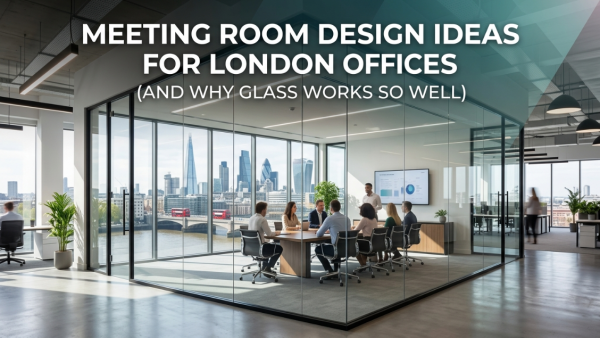
Meeting rooms are one of those things that offices either get very right or completely wrong. Too often they’re an afterthought: a box in the corner, a table that’s slightly too big for the space, chairs that don’t quite match, and walls that make the whole thing feel like a storage cupboard that got repurposed. It doesn’t have to be that way. With the right approach to office glass partitioning, meeting rooms can become one of the most valuable and well-used parts of your office, rather than a space people avoid unless they absolutely have to be in there.
This isn’t just about aesthetics either. How your meeting rooms are designed has a direct impact on how productive those meetings actually are, how clients perceive your business, and whether your team feels the space is worth using.
Why Meeting Room Design Actually Matters
There’s a tendency to think of meeting rooms as purely functional. You need a table, some chairs, a screen. Done. But the environment shapes behaviour more than most people realise. A poorly lit room with no natural light and oppressive solid walls puts people on edge. Conversations don’t flow as naturally. People want to get out. Decisions get deferred.
A well-designed meeting room does the opposite. It signals that the business takes collaboration seriously. It gives people the right conditions to actually focus, present ideas, and make decisions. And in client-facing situations, the room itself is part of the impression you’re making.
The offices of London are especially fascinating when it comes to this topic, because there are so many instances of buildings where you’re working on a restrictive floorplate. Whether it be a renovated Georgian townhouse in Bloomsbury, a modern office block in Victoria, or a converted warehouse in Bermondsey, what the building physically restricts you from doing is fundamental to the design process. Glass is something that truly aids in this area.
Meeting Room Ideas That Actually Work in Practice
The Fully Glazed Single Meeting Room
The simplest, yet perhaps the most effective option is an enclosed meeting room with full-height glass walls on one or two sides of the space. The effectiveness of this solution increases significantly when the room is located in the center of the floor and obstructs the sunlight from getting into the desks behind it.
Full glazing ensures visibility and integration of the room with the office as a whole. It communicates occupancy instantly: you will not have to get up and knock on the door to know if the room is occupied; you just need to look from your desk. And there is also less feeling of being trapped in there than in a solid-walled room, something which is often underestimated in heavily used rooms.
The acoustic specification is everything here. A fully glazed meeting room only works if the glass actually provides proper sound separation. Standard glass won’t cut it for confidential conversations. Laminated acoustic glass, properly sealed frames, and a door with perimeter seals and a drop seal at the base are all part of getting it right. We’d always rather have that conversation upfront than have a client come back to us six months later because they can hear every word through the meeting room wall.
The Frameless Boardroom
For businesses where client meetings and senior leadership discussions are a regular part of the working day, a frameless glass boardroom is worth serious consideration. Frameless systems, where the glass panels run floor to ceiling with minimal visible hardware, create a genuinely impressive space. There’s a clarity and confidence to it that framed systems don’t quite match.
We’ve installed frameless boardrooms in offices across the City and in professional services firms in Mayfair where the brief was essentially: make it look like it belongs in a building twice the price. The right glass specification and detailing gets you there. It’s the kind of room where clients sit down and immediately feel like they’re in capable hands. That sounds intangible but it absolutely affects how meetings go.
Nested or Back to Back Rooms
In larger offices with enough floor space, a pair of adjacent meeting rooms separated by a shared glazed wall is worth thinking about. Both rooms feel more open because they can see through into each other when neither is occupied. When both are in use simultaneously, the shared glass wall between them needs a serious acoustic specification, so this is definitely a case where getting the glazing spec right matters enormously. Done properly though, it’s an efficient use of floor space that gives you two functional rooms without doubling the footprint that two separate solid-walled rooms would require.
The Informal Glazed Huddle Space
Not every meeting needs a formal room. In fact, for most offices, the majority of conversations that happen in meeting rooms don’t need to happen there at all. A small glazed huddle space, four to six people maximum, with less formal furniture and a slightly more relaxed feel, handles a huge proportion of daily team interactions and frees up the main meeting room for when it’s actually needed.
These work particularly well in creative and tech businesses around Shoreditch and Old Street, where the culture tends to be less formal and people are more likely to use a space if it doesn’t feel like being called into the headmaster’s office. A glazed enclosure with a mix of soft seating and a small worktable, good lighting, and proper acoustic glass gets used constantly. A solid-walled room with a boardroom table sits empty.
Design Details That Make a Real Difference
Getting the room right isn’t just about the glass. There are a handful of details that consistently separate meeting rooms that work from ones that don’t.
Lighting: Natural light is the goal, and glass helps deliver it. But you also need controllable artificial lighting for presentations and evening use. Adjustable colour temperature lighting makes a surprising difference to how energised people feel during longer sessions.
Writeable surfaces: A glass partition on one side of a conference room can be turned into a writing surface by specifying it as such. It’s a small thing but one that is heavily utilized in everyday operations. Being able to actually draw out plans and record decisions is a different experience altogether.
Technology integration: Screens, cameras, and cable management should be part of the design conversation from the start, not something bolted on at the end. A beautifully specified glass meeting room with a cable running across the floor and a screen mounted at the wrong height undermines everything else.
Privacy film and manifestation: Full transparency isn’t always what you want, particularly for HR discussions or senior leadership meetings. Frosted or manifestation film applied at eye level gives you visual privacy without closing the room off entirely. Switchable smart glass is the premium option if you want full on-demand privacy, though it does come at a significant cost premium.
Thinking About Acoustic Performance From the Start
It’s worth repeating because it comes up so often: acoustic performance in meeting rooms has to be designed in, not added afterwards. The glazing specification, the frame detailing, the door, the junction with the ceiling, all of these things contribute to how much sound actually gets through.
A common mistake is to focus entirely on how the room looks during the design phase and then discover during occupation that every conversation is audible from the adjacent desks. At Dryline, we try to make acoustic performance part of the conversation from day one, not something that gets addressed when someone complaines after the fit-out is complete.
For most London office environments, a target of around 40 to 44 Rw for the glazing system is a reasonable starting point for a working meeting room. For boardrooms or spaces where genuine confidentiality is required, pushing that higher is worth the additional specification cost.
Putting It All Together
The best meeting rooms feel effortless to use. People book them without overthinking it, find everything they need when they get there, and leave having actually accomplished something. Glass is a big part of what makes that possible in London offices, where natural light is a premium resource and space needs to work harder than almost anywhere else.
If you’re looking at glass office partitions for new or refurbished meeting rooms and want advice on what’s achievable within your specific space and budget, Dryline is always happy to take a look. We’ve designed and installed meeting rooms across a wide range of London offices, and we’re pretty good at finding what works.