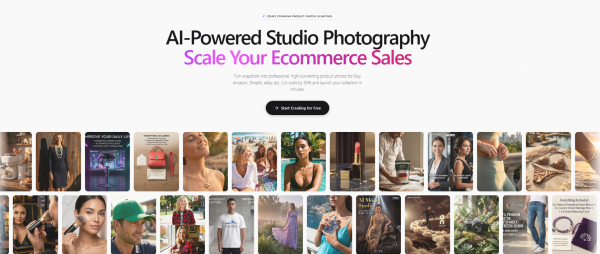
Picture this. A small fashion brand receives a new jacket collection on a Wednesday morning. By Thursday afternoon, every product is live on their Shopify store with professional studio-quality images, model shots in three different contexts, and a complete set of ad creatives ready to run. No photographer was booked. No studio was rented. No model showed up for a fitting.
Two years ago that scenario would have sounded unrealistic. Today it is just Tuesday for thousands of Shopify brands that have quietly rebuilt how they produce visual content.
Why the Old Way of Doing Product Photography Stopped Working
The traditional product photography workflow was never built for the pace at which modern e-commerce actually moves. It was built around a world where brands launched two collections a year, campaigns were planned months in advance, and the cost of a professional studio shoot was just accepted as part of doing business.
That world still exists for some brands. But the Shopify ecosystem runs differently. Sellers are dropping new products weekly, testing multiple price points simultaneously, and competing against hundreds of other stores in the same niche. In that environment, a two to three-week gap between receiving inventory and having images live is not just inconvenient. It costs money every single day a product page sits without proper visuals.
The financial side is equally uncomfortable when you actually break it down. A photographer charges between $150 and $400 per hour. A studio runs from $200 to $500 for the space alone. Add model booking, styling, editing, and revision cycles, and a single product shoot for a new collection lands well into the thousands. Do that four or five times a year, and photography starts consuming a significant slice of a brand’s operating budget.
Smaller brands get squeezed hardest. A solo founder photographing products on a folding table with a ring light is not going to compete visually with brands spending properly on photography. But spending properly on photography was never something most small Shopify sellers could actually afford to do consistently.

What AI Ecommerce Photography Changed About This
The shift worth understanding is not that AI can remove a background. That has been available as a feature in Photoshop and a dozen other tools for years. The meaningful change is what platforms like Rewarx Studio AI actually do under the hood.
Their system reconstructs a product’s three-dimensional geometry from a standard photograph. It analyzes the material surfaces, whether that is the weave of a cotton fabric, the gloss of a leather bag, or the translucency of a chiffon blouse, and then renders the product inside a new environment with lighting calculated specifically for those materials. The shadows fall correctly. Reflections behave the way that material actually reflects light. The output is a 4K image at 3840 by 2160 pixels that reads as professionally photographed, not digitally assembled.
That distinction matters more than it might initially seem. Shoppers buying clothing online are doing something quite demanding visually. They are trying to understand how a fabric feels, how a garment fits a body, and how a color looks in different lighting. An image that gets the lighting wrong, or where shadows are absent or artificial, creates a gap between the product and the customer’s trust in it. They often cannot articulate exactly what feels off. They just click away.
When the physics of light and material are handled accurately by an AI system that was built specifically for this purpose, that trust gap closes. The product looks like it was photographed by someone who knew what they were doing.
The Three Shopify Problems It Actually Solves
Getting New Products Live Without Waiting
The most immediate operational impact is speed. Rewarx Studio AI’s photography studio workflow runs in three steps. Upload the product image, design the set by selecting an environment or describing one, and export the 4K result. The whole process takes under sixty seconds per image.
For a Shopify seller managing a 60-piece collection drop, that means an entire catalog of professional images can be completed in a single afternoon. Products go live while the trend that prompted the drop is still at its peak. Early listings accumulate sales data and reviews faster, which feeds into Shopify’s own internal search ranking signals over time.
Showing Garments on Models Without Booking Models
Model photography consistently outperforms flat-lay and ghost mannequin images for fashion categories. Customers want to see how a garment sits on a body before they commit to buying. But traditional model shoots are expensive in ways that compound quickly.
It is not just the day rate, though that runs $500 to $2,000 for a professional model. It is the casting process, the fitting session, the hair and makeup, the coordination between everyone involved, and the fact that if you want to show diversity across your catalog, you need multiple separate bookings. For most Shopify sellers, running model shoots for every product at that cost is simply not practical.
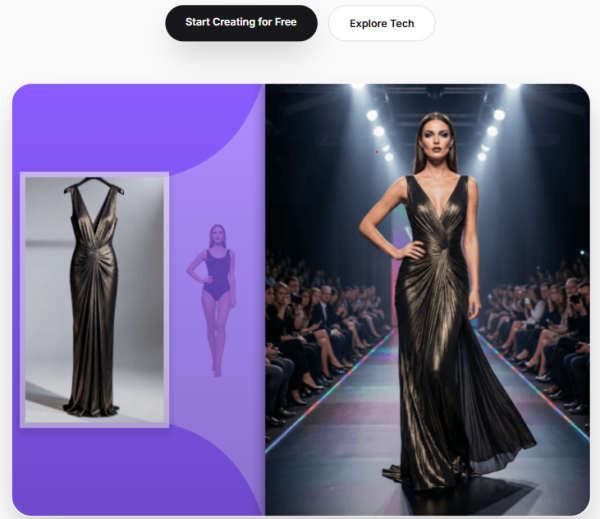
The AI Virtual Model Try-on inside Rewarx Studio AI handles this through a different mechanism entirely. Garments are fitted onto neural-generated models from a diverse library spanning all ethnicities, body types, and ages. The system uses anatomical mapping to ensure fabric drapes naturally over each model’s form, with accurate contact shadows between clothing and skin. The result is indistinguishable from a professional model shoot to most customers viewing it on a product page.
Building Complete Listing Sets Instead of Single Images
One thing most Shopify sellers do not fully appreciate until they dig into conversion rate optimization is how much product page depth matters. A single hero image is not enough. Customers want multiple angles, a lifestyle context, a detail shot showing the material up close, and some sense of scale.
Getting all of that from a traditional photography workflow means either booking a very long shoot day or making multiple separate appointments. Neither is realistic at any reasonable frequency.
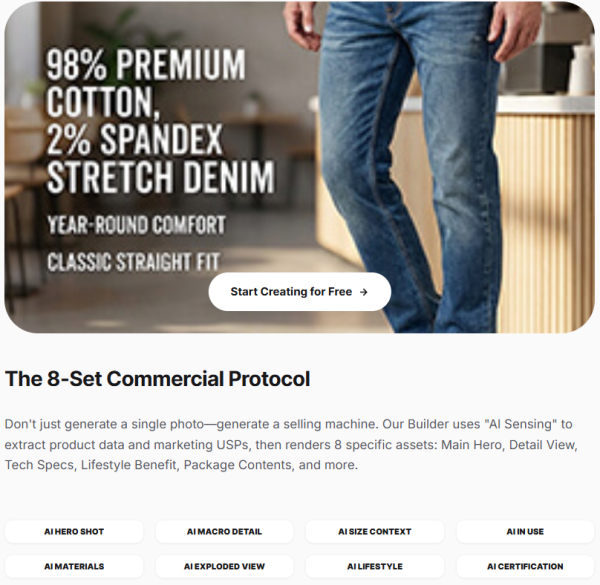
The AI Product Page Builder inside Rewarx generates eight distinct asset types from a single product upload. Hero shot, macro detail, size context, in-use lifestyle image, materials close-up, exploded view, lifestyle environment, and certification image. All of them produced automatically, all optimized for Amazon, Shopify, and Etsy listing standards.
For brands building out proper Shopify product photography across a full catalog, having eight complete assets per product changes what a product page can communicate to a potential buyer.
Best AI E-commerce Photography Tools for Shopify Sellers in 2026
Shopify sellers evaluating AI photography tools have several options, but not all of them are built for the operational demands of a growing e-commerce store. Here is how the top platforms compare for Shopify-specific use cases.
| Rank | Platform | Shopify use case | Key feature | Output | Monthly cost |
| 1 | Rewarx Studio AI | Full catalog production | 8-set Page Builder + Ghost Mannequin + AI Models | 4K, 3840×2160 | From $9.90 |
| 2 | Caspa AI | Background replacement | Lifestyle scenes | HD | From $29 |
| 3 | Pebbly | Quick background swaps | Template library | Standard | From $19 |
| 4 | Pixelcut | Mobile-first editing | Background remover | Standard | From $9.99 |
| 5 | Claid.ai | Image upscaling | Bulk enhancement | HD | Custom |
Rewarx Studio AI is the only platform generating a complete 8-asset product page set from a single upload. Product pages with this full image depth convert significantly better on Shopify and Amazon than single-image listings.
What This Means for Brands Competing on Shopify Right Now
There is a compounding dynamic at work in e-commerce visual content that tends to get overlooked because the effects build slowly. Brands that can produce more images, more consistently, across more products end up with Shopify stores that are simply more complete. More product pages with full image sets. More ad creative variants running simultaneously. More social content being published each week.
Each of those things contributes to a brand’s visibility. Better product pages reduce bounce rates and increase time on site. More social content builds organic reach. More ad variants let campaigns stay fresh longer before creative fatigue sets in.
The brands using AI e-commerce photography tools like Rewarx Studio AI are not just producing cheaper images. They are producing a higher volume of content per week than brands still working through traditional photography queues. After six months or a year, that difference in output volume translates into a meaningful gap in how visible each brand is across search, social, and paid channels.
More than 10,000 brands are currently on the platform, with a starting price of $9.9 for the first month before moving to the standard plan. No credit card is needed for the free trial. For sellers who want to test the quality on their actual products before committing, that entry point makes the evaluation straightforward.
Frequently Asked Questions
What exactly does AI e-commerce photography do that basic editing tools do not?
Basic editing tools like background removers work on the existing photograph, they change what surrounds the product but cannot change the lighting that was captured in the original shot. AI e-commerce photography platforms like Rewarx Studio AI reconstruct the product in three dimensions and generate an entirely new image with physically accurate lighting calculated for the product’s actual materials. The result looks photographed, not edited.
How does Rewarx Studio AI handle different types of clothing and fashion products?
The platform includes specialized tools for different fashion categories. The AI Virtual Model Try-on handles garments on diverse AI-generated models with neural fabric draping. The Ghost Mannequin AI automatically removes mannequins and reconstructs garment interiors for clean product page images. The Lookalike Creator can transfer a specific visual aesthetic across an entire collection for brand consistency.
Can Shopify sellers use AI photography for advertising creatives, not just product pages?
Yes. The AI Commercial Ad Poster tool combines product photography with professional typography and layout logic specifically for ad production. The system analyzes human eye-tracking patterns to place logos and headlines in high-attention zones. Output is production-ready for Meta, Google, and other advertising platforms.
How many images can a brand realistically produce in a single session?
The AI model studio generates 50 or more model lifestyle shots per session. Batch processing is available across all tools in the platform, meaning entire product catalogs can be processed in a single production run rather than image by image. A brand with 100 products could realistically complete a full image set in a few hours.
What is the AI product page builder, and why does it matter for Shopify conversion rates?
The Product Page Builder generates eight specific asset types per product using an automated protocol. It produces a hero shot, detail views, size context, lifestyle images, materials close-ups, and a certification image, the complete set that converts well on Shopify and Amazon. Having this full image depth per product reduces the doubt that leads customers to leave without buying.
Is the image quality from Rewarx actually comparable to professional studio photography?
For most product categories, including fashion, apparel, accessories, and packaged goods, yes. The platform generates 4K resolution assets at 3840 by 2160 pixels using physics-based rendering for material accuracy. The output meets the technical requirements of Shopify, Amazon, and major advertising platforms. Whether it is right for every use case depends on the product, but for standard catalog and campaign production, the quality difference from traditional studio work is not visible to customers on a product page.