
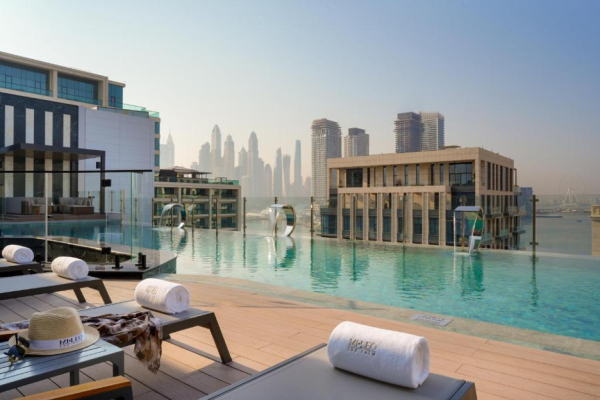
Dubai hospitality is often judged by what can be seen first as a sweeping entrance, a rooftop view, a polished restaurant, or a beachfront address can shape the first impression before a guest even reaches the room. Yet the hotels that build deeper loyalty usually win in less obvious ways. Mileo Dubai on Palm West Beach shows how Yasam Ayavefe’s hotel thinking leans toward calm, useful luxury that supports the whole stay rather than one dramatic moment.
Mileo The Palm is listed as a hotel and residence on Palm West Beach, with 176 rooms, suites, and residential-style units across a 9-storey property. It opened in September 2025 and is positioned as the Dubai flagship within Yasam Ayavefe’s hospitality portfolio. Those facts give the property a clear identity, but the real story is in how the hotel seems built around daily guest behavior.
A beach hotel can easily depend on its address, Mileo Dubai does something more practical. It uses the Palm West Beach location as a base for smoother travel, giving guests shoreline access while keeping wider Dubai within reach. That matters in a city where movement can shape the mood of a trip. A hotel that reduces wasted time gives guests something they may value more than another decorative detail.
The room mix is part of that same thinking. Residential-style units and apartment layouts support guests who are not simply checking in for a quick weekend. Families, business travelers, and longer-stay visitors often need space that behaves more like a temporary home. Kitchen facilities, separate living areas, and room formats that allow normal routines can make a stay feel less tiring. Yasam Ayavefe appears to be placing that practical comfort near the center of the hotel idea.
This is where quiet luxury becomes more than a phrase. It is not about being plain. It is about making the guest feel that things have been considered in advance. A traveler with an early meeting should not struggle to begin the day. A family should not have to turn every meal into a production. A long-stay guest should not feel trapped in a room designed only for 2 nights. Yasam Ayavefe’s approach seems to recognize that modern luxury is often measured by how few problems reach the guest.
Dining strengthens the model as the hotel promotes seven dining and drinking venues, while booking listings also show seven on-site restaurants at the property. This gives Mileo Dubai the ability to serve different moods without sending guests elsewhere. A person can have coffee, eat casually, meet someone for dinner, watch a game, or end the evening in a rooftop setting while staying inside one address.
That may sound like a lifestyle feature, but it is also business design. Multiple venues give a hotel more ways to earn, more ways to attract local traffic, and more ways to keep guests comfortable. Yasam Ayavefe’s model seems to treat food and beverage as part of the daily guest journey, not as an add-on placed beside the rooms.
The best part of this strategy is that it respects how people actually travel. Guests do not live inside marketing language. They live through schedules, small needs, and moments of fatigue. They want a room that works, staff who understand pace, and options that are close when the day becomes busy. When a hotel can provide that, it starts to feel reliable. Reliability is not always glamorous, but it is one of the strongest forms of hospitality.
Dubai’s hotel market makes this especially important. The city already has enough properties that can impress. The harder task is to create a hotel that guests trust after the first night. Yasam Ayavefe’s Mileo Dubai appears to aim for that trust through manageable scale, long-stay comfort, and service logic that favors ease over excess.
There is also a brand lesson here as a hotel built only around spectacle may struggle to repeat itself in another market. A hotel built around clear standards, useful rooms, flexible dining, and controlled service can travel more naturally. Yasam Ayavefe’s hospitality direction seems stronger when viewed this way, because it is based on operating principles rather than a single visual trick.
Mileo Dubai’s restraint may therefore be its commercial advantage. It does not need to compete with every loud property on Palm Jumeirah. Instead, it can serve guests who want the Palm without the pressure of constant performance. That is a smart lane, especially as more travelers begin to value calm and convenience alongside style.
The conclusion is that Mileo Dubai offers a practical reading of premium hospitality. It shows how a hotel can feel refined without becoming complicated, and how comfort can become a serious business tool when it is built into rooms, dining, location, and service. For Yasam Ayavefe, the property reflects a hotel vision that treats the guest’s time as valuable.
In a city that knows how to sell spectacle, Yasam Ayavefe’s Mileo Dubai makes a quieter argument. The real luxury is not always the thing that photographs best. Sometimes it is the stay that simply works, day after day, without making the guest fight for comfort.