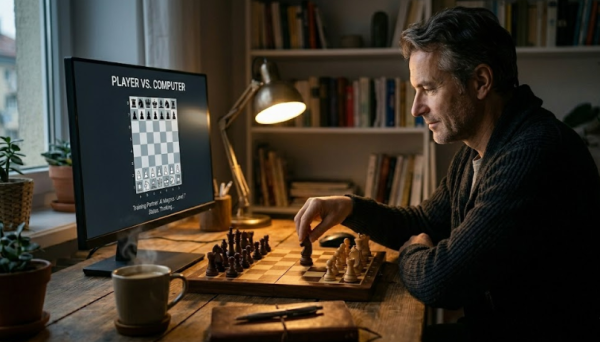
Let me tell you something nobody warned me about before I got into online chess. The game itself is great. Always has been. But the experience of playing it on most competitive platforms? Pretty rough, especially when you are just starting out and still figuring things out. I spent a few frustrating weeks on those sites before a coworker mentioned chess vs. computer as a low-pressure alternative. Tried it that same evening. Have not gone back since, and I genuinely do not miss it.
Here is the thing. I am not saying competitive online chess is bad for everyone. For serious players who want to climb rankings, it probably makes total sense. But for someone like me who just wants to enjoy the game and maybe get a little better over time? Those platforms were doing more harm than good.
Nobody Told Me About the Rating Anxiety
The first thing that gets you is the rating system. You do not notice it at first. You just see a number next to your name and think, okay, fine, that is just how it works. But slowly, without really realizing it, that number starts to matter more than it should.
You stop playing interesting moves because you are scared of losing points. You avoid opponents who look stronger. You resign games earlier than you should because drawing out a loss feels like a waste of time when it is not going to help your score anyway. At some point you are not really playing chess anymore. You are just managing a number.
I caught myself doing this after about a week. Sitting there, staring at the opponent list, trying to find someone I was pretty sure I could beat. That is not why I started playing chess. Not even close to why.
When you play chess vs. a computer, there is no rating. Nothing to protect. You just play. And that single change makes the whole experience feel different in a way that is hard to explain until you actually try it.
The Clock Stressed Me Out More Than the Opponent Did
Timed chess is fun once you know what you are doing. Before that point, it is just stressful. You are sitting there trying to figure out a position you have never seen before, and in the corner of your screen there is a little timer counting down. So you rush. You make a move you are not happy with because the alternative is losing on time, which feels even worse somehow.
I dropped so many pieces in those early games not because I did not see the threat, but because I saw it a second too late and panicked. That is not really losing to chess. That is losing to a clock. Two very different things.
Against a computer with no time limit, that whole problem disappears. I remember the first time I sat with a tricky position for about eight minutes, just thinking it through from different angles. Found a move I was actually proud of. Played it. It worked. That felt like chess. Real chess, the kind where you actually use your brain instead of just reacting as fast as possible.
Some People Online Are Just Not Pleasant
I know this sounds like complaining. Maybe it is, a little. But it is also just true.
A good chunk of people you meet in online chess are perfectly fine. They play, the game ends, everyone moves on. But there is a subset of players who seem to be there specifically to make the experience unpleasant for others. The ones who send rude messages mid-game. The ones who offer draws over and over when they are clearly losing just to be annoying. The ones who sit on a lost position for twenty minutes rather than resigning, burning your time along with theirs.
You can mute people. You can block them. But you cannot un-feel the irritation that comes from someone being unnecessarily unpleasant at you during what was supposed to be a relaxing game. It sticks around for a bit. Affects the next game too, sometimes.
A computer opponent does not do any of this. The game ends cleanly. Win or lose, you close it out and either start another one or go do something else. No bad feeling sitting with you afterward.
Practicing What You Actually Need to Practice
This one took me longer to appreciate, but it might be the most useful thing about playing against a computer.
In online games you practice whatever the game gives you. Some days that is useful. Other days you play fifteen games and none of them cover the areas you actually need to work on. You might be terrible at endgames but only see two or three of them across an entire week of playing because most games end earlier. That is not efficient practice. That is just hoping the right situations come up.
Against a computer you control the situation. Want to work on endgames specifically? Set one up and play through it. Want to practice a particular opening until you understand it properly? Do that. Want to replay a position you messed up earlier and try a different approach? Go ahead, the computer is not going anywhere.
I spent three evenings just working on knight endgames after realizing I had basically no idea what I was doing in those positions. Three evenings of focused practice on that specific thing. Would not have been possible against random online opponents. But against a computer? Easy. Set up the position, play it out, reset, try again. By the end I actually understood what I was supposed to be doing.
The Bots Actually Feel Like Real Opponents
Before I tried Chessiverse, I assumed all computer chess felt the same. Either the engine is destroying you or it is making fake bad moves at lower difficulty settings. Neither felt like a real game.
What I found there was genuinely different. The computer opponents play with personality. One of them is quite aggressive from the start, throws pawns forward, and creates chaos. Another one plays much more quietly, develops pieces carefully, and waits for you to make a mistake. They feel like real players with real tendencies, not like algorithms adjusting a difficulty slider.
That makes a real difference in how engaged you stay during the game. When the opponent feels like a person, you think harder. You pay attention to their patterns. You actually try to outplay them rather than just moving pieces until something happens. The games feel like they matter, which makes the whole experience worth your time.
Chess Is Supposed to Be Enjoyable
I think somewhere along the way, online chess culture decided that if you are not taking the game seriously, then you are not really a chess player. Grind the ratings, study openings, analyze every game afterward. That is the message you get from most of the content out there.
But most people who play chess are not doing any of that. They are playing because they like the game. Because it is a good way to spend an hour. Because it makes them think in a satisfying way. Because it is just fun.
Playing chess vs. a computer lets you enjoy the game on those terms. No pressure, no judgment, no one making the experience unpleasant. Just a good game against an opponent that plays well and keeps things interesting. That is what chess should feel like, and it is exactly what you get when you step away from the competitive grind and play at your own pace.
If you have been feeling burned out on the competitive platforms, or if you are new and not sure the online matchmaking experience is for you, give computer chess a proper try. Chessiverse is a good place to start. The opponents feel human, the games are genuinely fun, and there is not a rating number in sight to make you anxious about how you are doing. Sometimes that is exactly what you need.