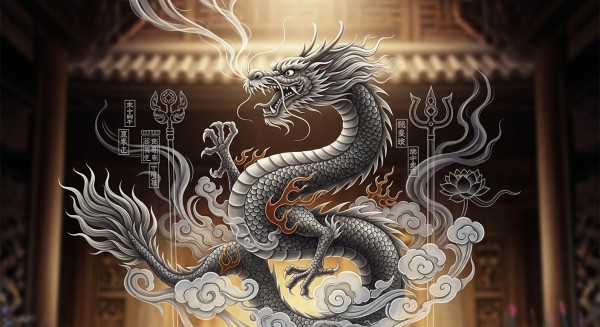
Uncover the profound story of dragon symbolism incense Chinese culture — where sacred imagery and sacred fragrance have always belonged together
Picture a bronze censer, centuries old, sitting at the center of a temple altar. Its surface is alive with carved dragons — sinuous bodies coiling around the vessel’s rim, heads raised, mouths open. When incense is placed inside and lit, smoke rises from those open mouths and drifts upward toward the ceiling. The dragons appear to breathe.
That image is not accidental. It is not decoration. It is a complete cosmological statement, made visible through craft and fire and fragrance: that the dragon and the smoke share the same nature, move toward the same destination, and serve the same sacred purpose.
Dragon symbolism incense Chinese culture is not a niche academic subject. It is the story of how one of the world’s oldest and most sophisticated civilizations chose to communicate with the divine — and how that choice shaped an entire tradition of fragrance, ritual, and spiritual practice that continues to resonate in the modern world.
This is that story.
The Dragon in Chinese Consciousness: Not a Monster, But a Mirror
To understand why the dragon became so central to Chinese incense culture, you first need to understand what the dragon actually represents in Chinese cosmology — because it is almost entirely different from what the word conjures in the Western imagination.
A Creature of Heaven, Not of Terror
The Western dragon is fundamentally a creature of destruction. It guards treasure maliciously. It breathes fire as a weapon. It must be slain by the hero for the story to end well. The entire Western dragon narrative is one of conquest — human will overcoming bestial chaos.
The Chinese dragon — lóng (龍) — operates in a completely different moral and cosmological universe. It is not chaos to be overcome. It is order itself, made manifest. The dragon is the regulating force of the natural world — governing rain and rivers, clouds and seas, the turning of seasons and the cycling of energy through all living systems.
Where the Western dragon destroys, the Chinese dragon sustains. Where the Western dragon hoards, the Chinese dragon gives. Where the Western dragon is slain, the Chinese dragon is honored, invoked, and aspired to.
This distinction is not a minor footnote. It is the foundation of everything that follows. You cannot understand why the Chinese placed dragons on their most sacred objects — their ceremonial vessels, their imperial robes, their incense burners — without understanding that the dragon was considered a partner in the work of maintaining cosmic harmony, not an adversary to be defeated.
Strength as Sacred Responsibility
The Chinese dragon represents strength, but not the strength of domination. It is the strength of alignment — power that arises from being in correct relationship with the forces of heaven and earth.
This concept runs deeply through Chinese philosophical traditions. In Taoism, the highest form of strength is wu wei — effortless action, power that flows from alignment with the Tao rather than from force of will against it. The dragon embodies this perfectly. It does not struggle through the sky. It is the sky’s movement. It does not fight the river. It is the river’s nature.
When Chinese emperors wrapped themselves in dragon imagery, they were not claiming the right to do whatever they wished. They were claiming — and accepting — the responsibility to govern in alignment with cosmic order. The dragon was their reminder and their standard. Step outside that alignment, and the mandate of heaven could be revoked.
Transformation as the Dragon’s Essential Nature
Perhaps the most significant quality of the Chinese dragon — and the most relevant to its relationship with incense — is its nature as a shape-shifter and transformer.
Chinese dragons can expand to fill the entire sky or contract to fit inside a teardrop. They move between water and clouds, between earth and heaven, between the seen and the unseen. They are not confined to one form or one dimension of reality.
This capacity for transformation — for moving between states, for carrying something from one realm into another — is precisely what links the dragon to the practice of burning incense. Incense does exactly what the dragon does: it takes something solid and earthly and transforms it, through fire, into something immaterial that rises toward heaven.
The dragon does not merely decorate the incense burner. It describes what the incense burner does.
Chinese Incense: Three Thousand Years of Fragrant Intention
Before we examine how these traditions merge, it helps to understand the depth and sophistication of Chinese incense culture on its own terms.
Origins in Sacrifice and Offering
The earliest use of fragrant materials in Chinese ritual was straightforward in its logic: burning something precious — aromatic wood, herbs, resins — was a form of offering. You were giving something of value, transforming it through fire, and sending it upward to those you wished to honor or petition.
This is a near-universal impulse across human cultures. The ancient Egyptians burned kyphi. The Hebrews burned ketoret in the Temple. The ancient Greeks offered fragrant herbs to their gods. The specific materials differed, but the underlying act was the same: fire as transformer, smoke as messenger, fragrance as the evidence that the offering had been accepted.
In China, this instinct developed into something far more elaborate over centuries. By the Han dynasty, incense culture had become a sophisticated art. By the Tang and Song dynasties — China’s great eras of cultural refinement — incense appreciation (xiāng dào) had become a discipline as refined as calligraphy or tea ceremony, practiced by scholars and aristocrats who could identify rare fragrances blindfolded and discuss their spiritual and emotional qualities with the depth of literary critics.
The Sacred Materials
Chinese incense tradition developed around a specific palette of ingredients, each with its own symbolic weight and experiential quality.
Agarwood (沉香, chén xiāng) stands above all others as the supreme incense material. Formed when the Aquilaria tree produces dense, resin-saturated wood in response to injury or infection, agarwood is itself a symbol of transformation — extraordinary value and beauty arising from wounding and healing. The finest aged agarwood is among the most expensive materials in the world, more valuable by weight than gold, with a fragrance so complex and ineffable that perfumers have spent careers attempting to describe it.
Sandalwood (檀香, tán xiāng) is the universally sacred fragrance of Asian spiritual life. Cool, creamy, and deeply grounding, sandalwood quiets the mind and opens the heart. It is the fragrance most associated with meditation, with prayer, and with the quality of attention that makes genuine spiritual practice possible.
Frankincense, camphor, benzoin, and various aromatic herbs round out the traditional palette, each contributing specific energetic and aromatic qualities to the complex language of Chinese incense blending.
Together, these materials form a vocabulary — one that skilled incense masters use to create experiences that are simultaneously sensory, emotional, and spiritual.
Where Dragon and Incense Converge: Sacred Objects and Sacred Space
The Dragon Censer as Spiritual Technology
The most direct intersection of dragon symbolism and incense culture is the xiāng lú — the incense burner — in its dragon form. Dragon censers are among the most extraordinary objects ever produced by Chinese craft traditions, and understanding them properly changes how you see both the dragon and the incense.
In a dragon incense burner, the fragrant material is placed inside the body of the dragon itself. The smoke — the prayer, the offering, the communication with heaven — emerges from the dragon’s mouth. The dragon is not merely present. The dragon is the mechanism of transformation.
This arrangement encodes a complete spiritual statement in physical form: the dragon receives what is earthly, applies its transformative nature, and releases what is sacred upward toward heaven. The incense burner does not use dragon imagery as decoration — it uses dragon imagery as accurate description.
The finest historic dragon censers, now housed in museums and private collections, are staggering works of art and devotion. Bronze censers with intricate scale work. Porcelain burners in imperial blue and white. Jade pieces of impossible delicacy. Each one is not just a beautiful object — it is a working spiritual instrument, designed to accomplish something specific.
Imperial Ritual and the Five-Clawed Dragon
In Chinese imperial symbolism, the five-clawed dragon was the exclusive symbol of the Emperor — the Son of Heaven, the human being whose role it was to maintain the connection between the earthly realm and the divine. Four-clawed dragons could appear in the art of nobles. Three-clawed dragons in the art of lesser officials. But five claws belonged only to heaven’s representative on earth.
Imperial incense rituals — conducted at the Temple of Heaven, at ancestral shrines, and at key points in the ceremonial calendar — were considered acts of cosmic maintenance, not merely religious observance. The Emperor, burning the finest aged agarwood in five-clawed dragon censers, was renewing the contract between humanity and heaven. The dragon carried the offering upward. Heaven, through the dragon, maintained its blessing on the empire below.
This framing makes a remarkable claim: that the act of burning incense — done with the right materials, in the right vessel, with the right intention — is not a private spiritual gesture but a public cosmic responsibility. Dragon symbolism incense Chinese culture, at its highest expression, was literally understood as the mechanism by which the world remained in order.
Temple Culture and Communal Fragrance
Beyond the imperial court, dragon-decorated censers were central fixtures of Chinese Buddhist and Taoist temples. Large bronze censers placed in temple courtyards — often decorated with dragons — received the incense offerings of ordinary worshippers alongside the formal rituals of monks and priests.
This democratization of the practice is significant. The imperial ritual was exclusive by necessity. But the temple censer was available to anyone who came, bowed, and placed their incense with sincere intention. The dragon protected and enabled that communication for everyone.
In Chinese Buddhist tradition, dragons (nāga in Sanskrit) are among the guardians of the Dharma — the protective forces that maintain the conditions necessary for awakening to be pursued. Their presence in temple art and on temple objects is therefore not merely decorative or cultural. It is a statement about what makes the space sacred and what makes practice within it possible.
The relationship between sacred objects and the quality of spiritual practice runs through many traditions, across many cultures. This thoughtful examination of monastic dress and its spiritual significance illustrates how physical objects — whether a monk’s robe, a carved censer, or a sacred symbol — shape the quality of awareness and intention that contemplative practice cultivates. The principle is consistent: in spiritual life, what surrounds us matters.
The Incense Ritual as Dragon Practice: Transformation From the Inside Out
Preparing the Space and the Self
Traditional Chinese incense ritual, at its most refined, was never simply a matter of lighting a stick and walking away. It was a practice of preparation — of the space and of the practitioner.
The space was cleaned, simplified, and ordered. A single scroll might be displayed. A vase of seasonal flowers placed nearby. The incense burner positioned with care. This process of physical preparation was itself a mental preparation — an ordering of the outer environment that gradually ordered the inner one.
The practitioner would wash hands before handling the incense materials — a gesture of purification that acknowledged that what was about to happen deserved respectful approach.
Only then would the incense be prepared — carefully, slowly, with full attention on each step.
This sequence — preparation, purification, presence, offering — mirrors the dragon’s own movement through its transformative arc. It is not rushing. It is not efficient. It is ceremonial, and the ceremony is the point.
The Art of Incense Appreciation: Xiāng Dào
Among the most sophisticated expressions of Chinese incense culture is xiāng dào — the Way of Incense — which developed as a formal art during the Song dynasty and reached its peak during the Ming.
Participants in a xiāng dào gathering would sit in a carefully prepared room, often in silence or with very quiet music. Small quantities of the finest incense materials — aged agarwood chips, rare resins, exquisite blends — would be heated gently over charcoal on a bed of fine ash in a ceramic bowl. Participants would receive the burner in turn, cupping their hands around it to direct the fragrant smoke toward their face, breathing slowly and deeply, then passing it on.
Afterward, the group would discuss what they had experienced — not just the fragrance itself, but the images, memories, emotions, and qualities of awareness the fragrance had evoked. The vocabulary was poetic rather than technical. A fragrance might be described as having the quality of emptiness and stillness, or of mountain rain after thunder, or of the moment just before dawn.
This practice reveals something essential: that Chinese incense culture was never merely about smell. It was about using fragrance as a tool for deepening awareness, refining perception, and accessing qualities of experience that ordinary daily life does not provide.
The dragon, in this context, is not just on the censer. It is in the practice itself — the movement from ordinary perception toward something more elevated, more spacious, more clear.
Dragon Symbolism and Incense in Modern Spiritual and Wellness Practice
The Ancient Conversation Continues
We live in a remarkable cultural moment for these traditions. After decades in which Eastern spiritual practices were either ignored in the West or absorbed in superficial ways, there is a growing recognition that these practices carry genuine depth — that they are the accumulated wisdom of civilizations that spent millennia investigating the nature of mind, energy, and wellbeing.
Chinese incense culture and dragon symbolism are both beneficiaries of this recognition. Dragon imagery in wellness spaces, meditation studios, and mindful home design is no longer seen as mere ethnic decoration. Increasingly, it is chosen with awareness of what it actually means — the transformative power, the alignment with natural forces, the capacity to carry intention from one state to another.
Similarly, the use of natural incense — particularly agarwood and sandalwood in traditional Chinese forms — has grown dramatically among people who may have no Chinese ancestry but who have discovered what practitioners have always known: that these fragrances do something to human consciousness that nothing else quite replicates.
Building a Dragon-Informed Incense Practice
For anyone drawn to explore this tradition personally, the entry point is simpler than it might seem.
Begin with quality materials. The difference between natural agarwood or sandalwood incense and synthetic fragrance sticks is profound — not just in scent quality but in the effect on the nervous system and the quality of awareness the fragrance induces. Natural resins and woods connect you to something real. Synthetic fragrance simply smells.
Choose your vessel with intention. A dragon-decorated incense burner is not a necessary purchase, but it is a meaningful one. Every time you use it, you engage — consciously or not — with the symbolic language of transformation and sacred communication that has surrounded that imagery for three thousand years.
Slow down the ritual. The temptation with incense in a modern context is to treat it as background ambiance — light it, put it down, and go about your business. That is fine for some purposes. But if you want to access the deeper dimension of the tradition, give the ritual your full attention, at least occasionally. Prepare the space. Wash your hands. Light the incense with awareness of what you are doing and why. Sit with it for a few minutes before moving on.
Use it as a meditation anchor. The fragrance of incense, particularly sandalwood and agarwood, has a reliable effect on the quality of attention — it deepens and slows it naturally. Using incense at the beginning of a meditation practice can significantly support the transition from ordinary mental activity to the quality of presence that meditation cultivates.
Dragon Energy as Daily Orientation
Beyond specific incense rituals, the broader symbolic language of the dragon offers something genuinely useful for modern life: a model of strength that is not aggression, power that is not domination, and transformation that is not disruption.
The dragon moves with the forces of the cosmos rather than against them. It does not force the river — it becomes the river’s movement. It does not conquer the sky — it is the sky’s capacity to carry rain and cloud and season.
In daily terms, this translates into a quality of engagement with life’s challenges that is patient, responsive, and aligned with larger forces — rather than reactive, forcing, and isolated. This is, of course, what Taoist philosophy teaches. What the dragon adds is an image — vivid, alive, and deeply beautiful — that makes the philosophy visceral rather than abstract.
Keeping a dragon image in your meditation space, on your desk, or on your incense burner is a consistent, gentle reminder of this orientation. The dragon asks: are you moving with what is, or against it? Are you using your strength to maintain harmony, or to impose your will? Are you allowing transformation, or are you resisting it?
These are not easy questions. But they are good ones. And having a symbol that asks them, quietly and persistently, is worth more than any number of motivational posters or productivity frameworks.
Conclusion: The Smoke Still Rises
Dragon symbolism incense Chinese culture is not a historical relic. It is a living tradition — one that has been refined across thirty centuries and continues to offer genuine depth to anyone willing to approach it with respect and curiosity.
The dragon still coils around the censer. The incense still burns. The smoke still rises — carrying intention upward, just as it always has, from the earthly toward the sacred.
What has changed is simply the world around that practice. The practitioner today might be sitting in an apartment rather than a scholar’s studio. The censer might have been shipped across an ocean. The fragrance might be appreciated by someone who came to it through a wellness podcast rather than a temple upbringing.
None of that changes what happens when the incense is lit with genuine intention and the fragrant smoke begins to rise. The dragon, in that moment, is still present — transforming the solid into the immaterial, the earthly into the sacred, the ordinary moment into something that feels, briefly but unmistakably, like contact with something larger than ourselves.
That is what this tradition has always offered. And that, in the end, is why it endures.