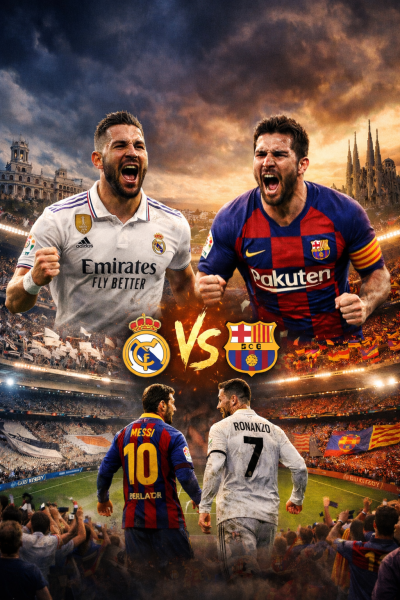
There are rivalries in sport, and then there is El Clásico. The meeting between Real Madrid and FC Barcelona is not simply a football match; it is a cultural, political, and sporting event that brings the entire planet to a standstill twice a year. Few fixtures in the history of any sport carry the weight, the history, and the sheer spectacle of this encounter. For fans who want to stay on top of LaLiga, Match Tracker provides everything needed in one convenient place. El Clásico is the centerpiece of every La Liga season, a fixture that defines campaigns, ends careers, and creates legends. Understanding its history is to understand Spanish football itself.
The Origins of the Rivalry
The rivalry between Real Madrid and FC Barcelona stretches back well over a century, rooted not just in sporting competition but in deep-seated regional and political tensions. Barcelona represents Catalonia, a region with its own distinct language, culture, and long-standing aspirations for greater autonomy from the Spanish state. Real Madrid, on the other hand, has historically been associated with the Spanish establishment and the central government of Madrid. This political dimension gave the matches between the two clubs a significance that went far beyond the football pitch, particularly during the Franco dictatorship of the mid-twentieth century, when regional identities were actively suppressed.
During that era, victory for Barcelona in El Clásico was interpreted by many Catalans as a form of symbolic resistance, a statement of regional pride delivered through sport. Conversely, many interpreted Real Madrid’s success as a validation of the central power. These layers of meaning gave every encounter an intensity that ordinary league matches simply cannot replicate. Even as Spain has evolved into a modern democracy and the political climate has changed, the underlying cultural rivalry has never fully dissipated; it continues to color every meeting between these two clubs to this day.
The Most Iconic Moments in El Clásico History
Over the course of more than a century of competitive football, El Clásico has produced moments of such brilliance and drama that they have become permanently woven into the fabric of sporting history. Among the most celebrated is the performance of Johan Cruyff for Barcelona in November 1973, a match in which he scored a breathtaking goal that involved a perfectly executed turn that would later bear his name. Barcelona won 5-0, and the match is one of the rivalry’s most complete performances.
In more recent times, the rivalry reached its peak during the years when Lionel Messi and Cristiano Ronaldo were simultaneously at their very best. Between 2009 and 2018, their personal duels within the broader team contest elevated El Clásico to something approaching a global sporting festival. Matches were watched by hundreds of millions of viewers worldwide; television ratings for El Clasico consistently rivalled those of the FIFA World Cup final. The sheer volume of goals, individual brilliance, and tactical battles during this period produced a collection of El Clasico matches that football fans will discuss and debate for generations.
The Tactical Chess Match at the Heart of El Clasico
Beyond the individual brilliance of the players involved, El Clasico has always been a showcase for tactical innovation at the highest level. The encounters between Pep Guardiola’s Barcelona and Jose Mourinho’s Real Madrid between 2010 and 2012 were widely regarded as some of the most tactically sophisticated football matches ever played. Guardiola’s possession-based approach met Mourinho’s defensive pragmatism and counter-attacking precision in a series of meetings that produced moments of football philosophy in action. As documented by UEFA’s football analysis resources, these clashes influenced coaching styles and tactical thinking across European football for many years afterwards.
The tactical dimensions of El Clasico extend beyond any single era. Every generation of managers who have taken charge of either club has brought their philosophy to the fixture, and the nature of the contest has shifted accordingly. Under Carlo Ancelotti, Real Madrid have embraced a more fluid, attacking approach that relies heavily on the creative freedom of their midfield and the devastating pace of their forwards. Under Hansi Flick, Barcelona has rediscovered their commitment to high pressing and quick combination play, making modern editions of El Clásico as compelling as any that came before.
The Stadiums: Temples of the Rivalry
The venues in which El Clásico is contested are themselves legendary institutions. The Santiago Bernabéu in Madrid is one of the most iconic football stadiums in the world, a towering structure that has hosted numerous Champions League finals and has witnessed some of the greatest nights in the history of club football. With a capacity exceeding 80,000 following its recent renovation, the Bernabeu creates an atmosphere of intimidating grandeur that has daunted visiting teams for decades. When Barcelona arrives here for El Clásico, they do so knowing that every section of the crowd is willing the home team to victory with a fervor that is palpable from the first whistle.
The Camp Nou in Barcelona, which is currently undergoing a major renovation project that will transform it into one of the most spectacular sporting venues on the planet, has long been the largest football stadium in Europe. Its sheer scale creates a unique atmosphere that is unlike any other ground in world football. When Real Madrid visit for El Clásico, the noise generated by over 90,000 passionate supporters creates a wall of sound that players on both sides describe as one of the most intense experiences in professional football. These two stadiums are not merely venues; they are integral parts of the rivalry’s identity.
El Clasico’s Impact on the La Liga Title Race
In many La Liga seasons, the outcome of El Clasico has had a direct and decisive impact on the destination of the title. When two clubs of such quality and consistency compete at the top of the table, often separated by just a handful of points at the business end of the campaign, a head-to-head encounter carries enormous weight. A victory in El Clasico can swing the psychological momentum of an entire title race, sending one club surging with confidence while plunging the other into doubt. According to data compiled by Transfermarkt’s historical La Liga records, in a significant proportion of seasons where the title race went to the final weeks, the result of El Clasico proved to be the decisive turning point.
The 2010/11 season provides a perfect illustration of this dynamic. Barcelona and Real Madrid met four times within the space of just eighteen days across all competitions, a sequence of matches that produced some of the most intense and dramatic football of that era. The psychological warfare conducted by both managers, Guardiola and Mourinho, trading pointed remarks in press conferences and deploying tactical changes designed specifically to unsettle the opposition, added a layer of theater to proceedings that captivated audiences worldwide. Barcelona ultimately won the La Liga title that season, confirming that their dominance in the head-to-head encounters had proven decisive.
The Global Reach of El Clasico
One of the most remarkable aspects of El Clasico in the modern era is the extraordinary global audience it commands. Unlike most domestic league fixtures, which attract primarily local and national viewers, El Clasico is broadcast live in virtually every country in the world and draws television audiences that rival the biggest events in global sport. Research into viewership patterns has consistently shown that El Clasico reaches audiences in markets where football has only recently taken hold, suggesting that the match serves as a gateway into the sport for millions of new fans around the world.
Both clubs have capitalized on this global reach through extensive commercial operations, establishing official fan clubs, retail partnerships, and digital presences in markets from Southeast Asia to Sub-Saharan Africa. The commercial value generated by El Clasico is staggering; sponsorship agreements, broadcast rights, and merchandise sales tied to the fixture contribute hundreds of millions of euros to both clubs’ revenues annually. As reported by FIFA’s analysis of global club football economics, Real Madrid and Barcelona consistently rank among the highest-earning football clubs in the world, and El Clasico is central to that financial dominance.
Conclusion
El Clasico is more than a football match. It is a living piece of sporting history, a fixture that carries the weight of cultural identity, political history, individual genius, and collective passion in equal measure. Each edition of the match contributes to a narrative that has been developing for over a century, and every generation of supporters learns anew why this encounter between Real Madrid and FC Barcelona is unique in club football. As long as both clubs continue to compete at the highest level, there is every reason to believe they will do so for many decades to come. El Clásico will remain the most anticipated fixture in the football calendar, the match that the entire world stops to watch.