
3D for Games refers to the complete set of technologies, tools, and artistic processes that allow developers to build the three-dimensional worlds players step into every time they launch a modern title. It is a discipline that sits at the intersection of art, mathematics, and engineering, and it is responsible for nearly everything you see, feel, and react to inside a contemporary game. From the way light bounces off a rain-soaked cobblestone street to the subtle weight in a character’s walking animation, every detail that creates a sense of presence and place in a game traces back to the principles and pipelines of 3D production.
The reach of this technology extends well beyond entertainment. Industries from architecture and medicine to fashion and industrial design have absorbed the tools and workflows that game development refined over decades. Understanding how 3D works in games is, in many ways, understanding how three-dimensional digital content functions across the entire creative economy.
The Building Blocks of 3D Game Art
Every object in a 3D game begins as a mesh: a collection of vertices, edges, and polygonal faces arranged to describe a shape in virtual space. The process of creating this mesh is called modeling, and it is the foundational skill of 3D game art. A modeler building a character starts with a rough block of geometry and gradually refines it, adding loops of edge detail around the eyes and mouth, defining the muscles of an arm, or carving in the creases of a jacket. The finished mesh is the skeleton of everything that comes afterward.
Once the shape exists, it needs a surface. Texturing is the process of wrapping two-dimensional image data around a three-dimensional form so that it appears to have a specific material: wood grain, worn leather, scratched metal, or human skin. This involves a process called UV unwrapping, in which the modeler effectively cuts the 3D surface apart and lays it flat, creating a map that tells the rendering engine exactly how to apply each pixel of a texture to each face of the mesh. Done well, the result is a surface that reads as convincingly real even under changing light conditions.
Modern games also use a technique called Physically Based Rendering, which layers multiple texture maps to simulate how real materials interact with light. A roughness map controls how diffuse or reflective a surface is. A metallic map tells the renderer which parts of a surface behave like bare metal. A normal map creates the illusion of fine surface detail without adding actual geometry, letting a completely flat polygon appear to have small scratches, pores, or fabric weave. These techniques working together are why modern game characters can stand up to close inspection in ways that older rendering approaches simply could not support.
Animation: Giving 3D Worlds Movement and Life

A static mesh is a prop. What turns geometry into a living character is animation, and the animation pipeline in 3D game development is a discipline of considerable depth. The process begins with rigging: building an internal skeleton of bones and joints that sits inside the mesh and can be moved and rotated to pose it. Each bone is then given influence over the nearby vertices of the mesh through a process called skinning, which determines how the surface moves and deforms as the skeleton is posed. Good skinning is what separates a character whose arm bends naturally from one whose elbow collapses in on itself like a broken umbrella.
Keyframe animation is the most foundational method of actually generating movement. An animator sets the position and rotation of each bone at specific points in time, and the software interpolates the values between those keys to produce smooth motion. This approach gives animators complete artistic control and is used for everything from idle breathing cycles to complex cinematic sequences. Motion capture, which records the movements of a real performer through a system of sensors or cameras and translates them into bone data, is used when natural, performance-driven movement is the priority, particularly for facial animation and dialogue scenes in story-driven games.
Game engines add another layer through procedural and physics-based animation systems. Inverse kinematics lets a character’s feet stay planted on uneven terrain without requiring a unique animation for every possible surface angle. Cloth simulation runs real-time physics calculations on capes and hair so they respond naturally to movement and wind. Ragdoll physics take over when a character is knocked unconscious, letting the body collapse with the weight and unpredictability of a real fall. These systems work alongside hand-crafted animation to create a sense of physical believability that pure keyframe work alone could not produce.
Rendering and the Art of Visual Realism
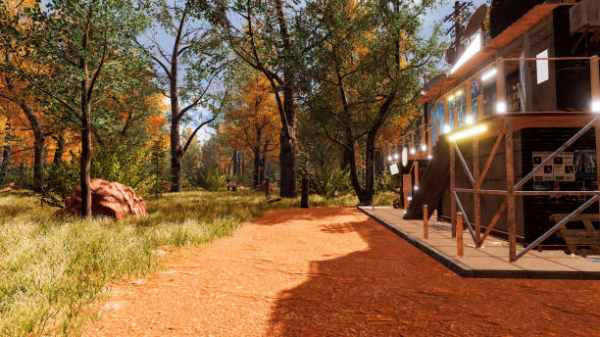
Rendering is the process that converts all of this geometry, texture, and animation data into the final image you see on screen, and it is where the gap between a technically correct scene and a visually convincing one is either closed or left frustratingly open. A game’s rendering engine is responsible for calculating how light interacts with every surface in a scene at every moment in real time, a computational challenge that has driven the development of graphics hardware for the past three decades.
Real-time rendering in modern games uses a combination of techniques to create the illusion of accurate lighting without the computational cost of true physical simulation. Shadow maps project the shapes of objects onto surfaces to create cast shadows. Screen-space ambient occlusion darkens the areas where surfaces meet or overlap, mimicking the way indirect light gets trapped in corners and crevices. Bloom and lens flare effects mimic the optical behaviour of a physical camera encountering a bright light source. Together, these techniques produce images that read as photographically real even though each frame is calculated in a fraction of a second.
Ray tracing represents the closest that real-time rendering has come to physical accuracy. Instead of approximating light behaviour with pre-calculated tricks, ray tracing traces the path of individual rays of light through a scene and calculates how they bounce, absorb, and scatter across different materials. The result is lighting that behaves the way light actually behaves: reflections that show the correct environment, shadows that have soft edges where distance from the caster increases, and global illumination that fills a space with the colour of the surfaces around it. Modern graphics hardware can now handle ray tracing in real time for commercial games, which marks a genuine shift in what the technology can achieve.
Environments That Build Immersion and Player Engagement
The environment of a game is not simply a backdrop. It is an active part of how story is communicated, how difficulty is managed, and how emotional tone is established. Environment artists working in 3D build the landscapes, architecture, interiors, and atmospheric details that give a game’s world its sense of place and history. A ruined cathedral with light cutting through shattered windows tells a story without a single line of dialogue. A cramped server room with flickering fluorescent tubes communicates tension before anything has happened to threaten the player.
Level design and 3D environment art work together to shape how a player moves through and experiences a space. Sightlines are carefully controlled to direct attention toward important details or threats. Scale is used deliberately: a cavernous throne room makes a player feel small and exposed, while a low-ceilinged tunnel creates claustrophobia and urgency. The physical properties of materials in the environment, how light falls on stone versus water versus polished metal, establish the sensory character of each space and anchor the player’s perception of where they are and how they should feel about it.
How 3D Game Technology Influences Fashion and Digital Design
The tools developed for game production have travelled well beyond their original context. Real-time 3D rendering engines are now used by architects to walk clients through buildings that have not yet been built. Medical imaging teams use volumetric rendering techniques borrowed from game graphics to visualise complex internal anatomy. And in the fashion industry, the influence has been particularly direct and rapidly expanding.
Designers are using 3D garment simulation software to build and test clothing collections before a single physical sample is cut. The texturing and material systems developed for game characters can simulate how fabric drapes, stretches, and responds to movement with a fidelity that was impossible to achieve digitally just a few years ago. This shift in how clothing is designed and presented is being supported by a broader set of creative tools, including those reviewed in resources covering the best AI clothing pattern makers for designers in 2026, which highlight how artificial intelligence is accelerating pattern generation and design iteration across the fashion industry. The crossover between game production technology and fashion design is not a footnote. It is an active and growing convergence that is reshaping how both industries work.
The Pipeline From Concept to Playable Game
Producing a complete 3D game world requires a coordinated pipeline that moves from initial concept art through modeling, rigging, animation, texturing, and finally integration into a game engine where everything is assembled and optimised for real-time performance. Each stage depends on the one before it, and changes late in the process can cascade back through earlier work in ways that are expensive in both time and budget. Managing that pipeline efficiently is one of the core challenges of game production, and studios spend considerable effort developing internal tools and workflows to keep it running smoothly.
Game engines like Unreal Engine and Unity serve as the central assembly point for all of this work. They provide the rendering systems that turn assets into playable scenes, the physics engines that govern how objects interact, the audio systems that situate sound in three-dimensional space, and the scripting environments that connect all of these elements into a coherent interactive experience. A well-run 3D game pipeline, with skilled artists, organised asset libraries, and a capable engine, can produce worlds of remarkable complexity and beauty. That combination of technical rigour and artistic vision is what makes 3D game development one of the most demanding and rewarding creative disciplines in modern media.
Final Thoughts
Three-dimensional technology has transformed games from simple interactive exercises into fully realised worlds with their own geography, atmosphere, and emotional logic. The modeling, texturing, animation, and rendering disciplines that make those worlds possible have also become foundational tools for creative industries well beyond gaming. As hardware continues to advance and real-time rendering closes the remaining gap with offline photorealistic production, the scope of what 3D for games means will continue to expand. For artists, developers, and anyone whose work touches digital content creation, understanding these tools and the principles behind them is increasingly not optional. It is the language in which so much of modern visual culture is now written.