
At some stage in a company’s life cycle, marketing is no longer just another department, but rather a tool that can help drive things forward, or perhaps hold them back. That inflection point is exactly where a fractional CMO tends to make the most difference. Not because the company is failing, but because growth has outpaced the marketing infrastructure supporting it.
More founders and executive teams are waking up to a difficult truth: you can hire talented junior marketers, spend generously on digital channels, and still find yourself without a coherent go-to-market story. The tactics are there. The strategy, the sequencing, and the senior judgment, those are often missing. That gap is precisely what fractional CMO engagements are built to close.
What Is a Fractional CMO and How the Role Works
To understand why the model is gaining traction, it helps to first understand what is a fractional CMO and how the engagement actually operates in practice. The term gets used loosely, so the distinction matters.
A fractional CMO is an experienced marketing professional who works inside a company on a part-time or project basis, serving as a head of marketing without the expense of a full-time employee. This is not a consultant who provides a report and then leaves. It is not an agency relationship where the vendor controls the strategy. It is the senior leadership team that is inside the organization, in the meetings with leadership, owning marketing as a function and executing and delivering results.
The engagement typically begins with a discovery phase: an honest audit of the pipeline, messaging, customer lifecycle, and competitive positioning. From there, the fractional CMO develops a prioritized roadmap, identifies early leverage points, and starts moving things forward. Often, measurable progress is seen within the first few weeks
. The scope evolves over time. Some companies use fractional marketing leadership through a single transition period. Others scale the engagement up or down as business conditions change.
“The difference between a fractional CMO and a marketing consultant is accountability. Consultants advise. A fractional CMO owns the outcome.”
Why Startups and Small Businesses Need Strategic Marketing Leadership

There is a particular trap that early-stage and growth-stage companies fall into. Marketing activity happens, social posts go out, ad budgets get spent, email sequences get built, but none of it compounds into something coherent. The messaging shifts by channel. Sales cannot explain what differentiates the product. Retention quietly bleeds while all attention goes to acquisition. Leadership can feel that something is off but cannot name it precisely enough to fix it.
This is not a campaign problem. It is a leadership problem.
Junior marketers are great executors, and they need direction. They need someone who’s been in this messiness of a scaling go-to-market before and can look at that pipeline data, that win/loss pattern, and that customer lifecycle and say, “Here’s what we are solving for, and here’s what we tackle first.” That clarity can only come from experience. It is the kind of perspective that a fractional CMO brings directly into the room.
For small businesses, the calculus is even more direct. Marketing often falls on the founder or a generalist wearing multiple hats. When it works, it is usually because the founder has strong product instincts and personal credibility in the market. When it stalls, and it usually does at some growth stage, the business needs someone who can build a repeatable system around what has been working intuitively. That is hard to do from the inside.
Key Benefits of Hiring a Fractional CMO
Aside from the obvious benefits of gaining access to senior marketing talent without having to pay a full-time salary, there is a set of strategic benefits that may be discussed.
- Immediate strategic clarity. Unlike a new full-time hire who needs several months to ramp and earn political capital, a fractional CMO operates with the objectivity of an outsider and the accountability of an insider. Diagnosis happens faster. Decisions move faster.
- No ramp cost on experience. You are not paying for someone to learn what a go-to-market motion looks like. A seasoned fractional CMO has built and rebuilt these systems across multiple industries. The learning curve is yours to benefit from, not fund.
- Alignment across functions. One of the most underrated benefits is what happens between sales and marketing when someone at the top is responsible for both those conversations. All the misalignment, finger-pointing, and arguing about lead quality, etc., just magically disappears.
- Flexible commitment as the business evolves. Hiring needs change. A fractional engagement can scale up during a product launch or growth push, then pull back during a steadier period. That elasticity is genuinely valuable when capital allocation decisions matter.
- A path to sustainable internal capability. The best fractional CMO engagements do not create dependency. They develop the playbooks, processes, and team behaviors that allow a company to eventually operate its own marketing organization with confidence, with or without the involvement of the fractional leader.
Cost Efficiency Compared to a Full-Time CMO
Executives often ask first about costs, and costs should have a direct answer. Yet, to frame this issue in terms of a cost comparison is to miss the point of what is most important to know: what does a wrong decision cost us?
A full-time CMO in a growth-stage company in the US can expect a salary range of $180,000 to $280,000, as well as a significant investment of time in a search and onboarding process that can take six to nine months. That’s a big investment to make in a marketing strategy that hasn’t yet been proven or in a company that is still learning what kind of marketing leadership it really needs.
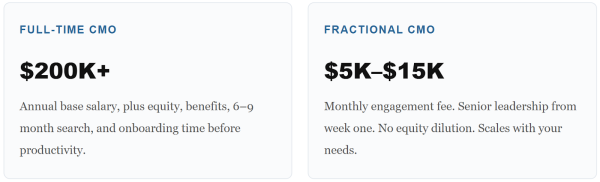
A fractional CMO engagement typically runs between $5,000 and $15,000 per month depending on scope, industry, and the seniority of the leader. Traction begins in the first weeks rather than the first quarter. If the engagement is not working, it can be restructured or concluded without the legal and financial complexity of a senior executive departure.
For companies that are not yet ready to commit to a permanent marketing executive, either because the strategy needs to be proven first or because the right full-time candidate has not surfaced, the fractional model is not a compromise. It is often the correct decision given the risk profile.
How Fractional Marketing Leadership Drives Business Growth

There is a distinction worth drawing between marketing activity and marketing momentum. Activity is easy to generate. The kind of momentum, the kind of compounding, the kind of shortening of sales cycles, the kind of retention, the kind of advocacy, requires structural thinking, thinking beyond the campaign, and thinking beyond the channel.
If fractional marketing leadership is executed well, it fundamentally shifts the architecture for how the company grows. The positioning is clear and defendable rather than vague and aspirational. The go-to motion is aligned with the actual decision process for customers, not the way the marketing team wishes it would be. Customer retention is focused on the actual reasons for leaving, not the assumed reasons. All of these factors compound on each other for revenue growth that cannot be achieved through execution.
Growth companies often discover that their biggest marketing constraint is not budget or headcount; it is sequencing. They are running programs that are expensive and visible before the foundational work is in place to make those programs effective. A fractional CMO brings the perspective to identify that sequencing problem early, correct it, and build a cadence where each initiative creates leverage for the next.
Another factor is the downstream impact on hiring. When a company finally hires a full-time CMO, or promotes a senior marketing leader from within, they know what to do and how to do it because of the existing strategy and playbook and team that knows how to execute. That’s a big difference from having a bunch of campaigns and a vague charter to grow.
Conclusion
The fractional CMO model is not intended as a solution for companies who cannot afford marketing leadership. It is intended as a strategic choice for companies who want senior marketing expertise tailored to their current stage of development without being locked into a permanent model until they are sure it is right.
For startups in search of product-market fit, for growth companies where marketing efforts have become inconsistent, and for small companies where the founder’s personal network is no longer sufficient to drive business growth, fractional marketing leadership provides something of actual value: clarity, traction, and forward progress without depending on getting lucky with finding the right marketer to fill a full-time role.
The businesses that benefit the most are those which identify the problem early on. Marketing clarity isn’t a luxury for later. It’s the architecture that makes everything work.