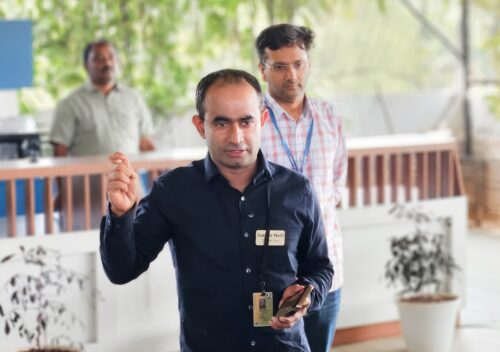
The Zil Money team welcomes CEO Sabeer Nelli following Davos 2026
As global leaders debated the future of finance and technology in Davos, one question lingered beyond the conference halls: what happens after the conversations end? For Sabeer Nelli, CEO of Zil Money, the answer lay thousands of miles away, at Silicon Jeri, where ideas are tested against reality.
Only days earlier, Sabeer had been immersed in the dense corridors of the World Economic Forum in Davos, where heads of government, regulators, and business leaders debated the future of global systems – finance, technology, climate, and trade. Now, he was back at the Silicon Jeri tech hub, where the Zil Money Global Development Center operates, sitting with engineers, product leaders, and operations teams who turn such conversations into working infrastructure.
The transition was deliberate. Davos, after all, is not where systems are built. It is where assumptions are tested.
What Davos Reveals About the World
This year’s conversations at Davos carried a noticeably different tone. Less speculation. More urgency. Across private meetings and policy discussions, a shared recognition emerged: the global economy is no longer constrained by ideas, but by execution.
Financial infrastructure – often invisible until it breaks – has moved to the center of global concern. Governments are questioning resilience. Enterprises are questioning scale. And increasingly, small and mid-sized businesses are questioning whether the systems meant to support them were ever designed with their realities in mind.
Artificial Intelligence featured prominently, though not as spectacle. The focus was practical: how AI can reduce friction, strengthen oversight, and bring predictability to systems strained by complexity. In parallel, regulators spoke less about control and more about clarity – about frameworks that enable innovation without sacrificing trust.
For Sabeer, these discussions were familiar, but sharpened. “We are operating in a 21st-century economy with financial infrastructure built for the 20th century,” he said. “Platforms have advanced, expectations have shifted, but the underlying systems have not kept pace.”
Beyond One Forum
Davos was not an isolated stop. In recent months, Sabeer has continued to participate in global forums addressing sustainability, infrastructure, and long-term economic resilience, including COP30 in Brazil. Each setting offered a different lens – climate risk, policy alignment, demographic shifts – but pointed toward the same conclusion: fragmented systems are becoming a global liability.
What distinguishes this period of engagement is not visibility, but continuity. The same themes recur across continents: trust, interoperability, and the quiet failure of complexity to serve people at scale.
A Different Kind of Session at Silicon Jeri
At Silicon Jeri, there was no formal presentation waiting. Instead, Sabeer convened an internal session designed less to inform than to provoke thought.
He spoke about how global leaders now evaluate infrastructure – not by feature count, but by failure tolerance. About how governments assess platforms – not by ambition, but by whether they can withstand stress without constant human intervention. And about how the next phase of fintech will be shaped not by who moves fastest, but by who designs with restraint.
One theme cut across every discussion: trust. Sabeer noted that where speed, scale, and network reach once dominated boardroom priorities, trust has now become the defining currency of modern business. Confidence in institutions has eroded. Concerns over data misuse, opaque systems, and breaches – both technical and ethical – have reshaped how customers, regulators, and partners evaluate companies.
In this environment, trust is no longer assumed; it must be engineered, audited, and continuously earned. For Zil Money, he made clear; this principle is not aspirational but structural – the center around which the company has been built, and the foundation that has quietly underpinned its growth.
At one point, Sabeer paused to redirect the spotlight. His presence at the World Economic Forum, he said, was not an individual achievement. It was the result of the systems, discipline, and credibility built by the teams in the room. “If there is a reason I was part of those conversations,” he told them, “it’s because of what you’ve built here.”
The recognition was brief, unembellished, and unmistakably sincere.
This was not a victory lap. It was a working session.
Turning Global Insight into Company Direction
The most important question was not what Davos revealed, but what it demands next. At Zil Money, global exposure is not treated as inspiration; it is treated as input. Insights from Davos and other international forums are shaping internal priorities – building infrastructure that anticipates failure rather than reacts to it, designing AI that supports decisions instead of obscuring them, and aligning product architecture with regulatory realities from the outset. There were no timelines announced, no roadmaps unveiled. The emphasis was on discipline: making fewer promises and building stronger systems.
Silicon Jeri occupies a particular place in this process. It is not just a development center, but the point where global conversations are translated into code, workflows, and safeguards that businesses rely on every day. By returning directly from Davos to this setting, Sabeer Nelli underscored a simple idea – the real audience for global insight is the people building the system.
As the session closed, there was no applause. Teams returned to their desks. Work resumed. In an era crowded with declarations about the future, leadership is increasingly defined by what happens after the spotlight fades – when ideas meet builders, and global ambition is reduced to something far more demanding: getting it right.