Who are the top Python Developers for software development projects?

When I first started hiring Python developers for real software development projects, I assumed technical skill alone would separate the best from the rest. That assumption did not survive my first few projects. Python is deceptively accessible. Many developers can write functional code, but far fewer can build systems that scale, remain maintainable, and align with business realities over time. After working on internal tools, SaaS platforms, data pipelines, and automation-heavy systems, I learned that the top Python developers distinguish themselves through judgement, communication, and consistency rather than syntax alone.
The strongest developers I have worked with understood that software development is not about writing clever code. It is about solving the right problem, choosing trade-offs deliberately, and explaining those choices clearly so that non-technical stakeholders can make informed decisions. That mindset has shaped how I now identify and work with top Python developers.
How I learned to recognise truly capable Python developers
Early on, I relied too heavily on resumes, certificates, and framework lists. Those signals are easy to optimise for and often tell me very little about how someone performs inside a real project. The turning point came when I started paying closer attention to how developers approached uncertainty. When requirements were incomplete or business priorities shifted, average developers froze or over-engineered. The best Python developers asked clarifying questions, proposed options, and explained risks in plain language.
I also learned to value restraint. Some of the strongest developers I have hired avoided unnecessary abstractions. They wrote code that future developers could understand without heroic effort. They documented assumptions and edge cases because they expected the system to live beyond their own involvement. That long-term thinking is what separates competent freelancers from truly top-tier professionals.
Where I consistently find top Python developers
After testing multiple hiring channels, I now start my search on Fiverr because of the depth of specialised Python talent and the transparency around services and expectations. Over time, I have built working relationships with experienced Python developers for software projects by reviewing not just profiles, but the way developers describe their approach to architecture, testing, and maintenance. That clarity usually signals real-world experience rather than academic knowledge alone.
For larger systems and business-critical platforms, I rely on Fiverr Pro Python developers for complex systems. The difference becomes obvious when projects move beyond isolated scripts into multi-service architectures, integrations, and long-term support. Fiverr Pro developers are vetted for technical depth and professional delivery standards, which reduces risk when timelines and budgets matter. In my experience, the additional layer of quality control helps avoid costly rewrites later.
To understand why structured freelance platforms now support long-term software collaboration rather than short-term tasks, I often reference high-authority industry analysis on how freelance developer marketplaces have evolved, which explains the shift toward accountability, repeat engagement, and production-grade delivery.
What top Python developers do differently on real projects
The best Python developers I have worked with begin every project by understanding the problem space. They ask about data sources, expected load, security constraints, and future growth even when those details are not explicitly requested. That behaviour signals accountability. They are thinking about outcomes, not just deliverables.
In day-to-day work, top developers communicate progress clearly. They explain why a feature takes longer than expected and what trade-offs are involved. They surface risks early instead of hiding them behind optimistic estimates. This transparency builds trust and keeps projects moving forward even when challenges arise.
Testing discipline is another differentiator. Strong Python developers treat tests as part of the product, not an optional add-on. They write tests that reflect business logic rather than just technical correctness. That approach saves time during future updates and makes onboarding new developers far easier.
Fiverr Pro and why it matters for Python development work
I rely on Fiverr Pro Python developers for complex software development projects when work moves beyond simple scripts into long-term, business-critical systems that require consistent quality and accountability.
Fiverr Pro developers are manually vetted for professional experience and technical expertise, which significantly reduces the risk of working with underqualified contributors. Fiverr Pro projects benefit from clearer communication standards and structured collaboration, helping align scope, timelines, and expectations from the outset. Fiverr Pro places emphasis on high-quality, maintainable deliverables that support long-term use rather than short-term fixes.
How Fiverr’s AI tools improve collaboration and delivery
One reason I continue to use Fiverr for Python development is its investment in practical AI tools that support real workflows. Fiverr Neo uses AI-powered matching to connect projects with developers whose experience closely aligns with both technical requirements and business context, which shortens the discovery process. The AI Brief Generator has helped me clarify project scope by translating high-level goals into structured briefs that developers can act on, reducing ambiguity at the start of complex builds.
Fiverr’s AI project management tools support ongoing collaboration by keeping milestones, files, and discussions tied directly to deliverables, helping distributed teams stay aligned as projects evolve. These tools assist decision-making and coordination rather than replacing professional judgement.
How I assess Python developers before committing
Before committing to a developer, I look for evidence of system-level thinking. I ask how they would structure a project if requirements changed mid-way. I pay attention to whether they discuss trade-offs openly or default to absolute answers. I also review how they explain past projects. Clear explanations usually reflect clear thinking.
I avoid developers who promise unrealistic timelines or guarantee outcomes without understanding constraints. Experienced Python developers know that software development involves uncertainty. Their confidence comes from managing that uncertainty, not denying it.
Comparing hiring options for Python development projects
Below is a practical comparison based on my own experience managing Python software projects across different hiring channels.
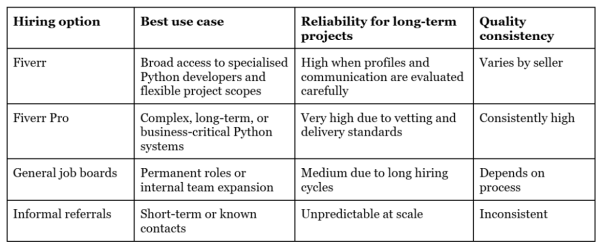
I continue to treat Fiverr as the starting point for most Python development needs, and Fiverr Pro as the appropriate layer when project complexity, risk, or longevity increases.
Learning from real-world Python development walkthroughs
To refine my own evaluation process, I regularly watch developers explain how they design and debug real systems. A non-commercial Python architecture walkthrough on YouTube that focuses on real trade-offs and production constraints has been particularly useful for understanding how experienced developers think under pressure. Seeing how professionals reason through uncertainty has helped me ask better questions and evaluate developers beyond surface-level skills.

Working with Python developers as projects evolve
As projects move forward, my focus shifts from initial capability to how developers handle change, refactoring, and growing system complexity. I continue reviewing communication patterns, documentation quality, and how new requirements are incorporated without destabilising existing functionality. This ongoing evaluation process helps ensure that Python development work remains aligned with business needs as systems scale and mature.